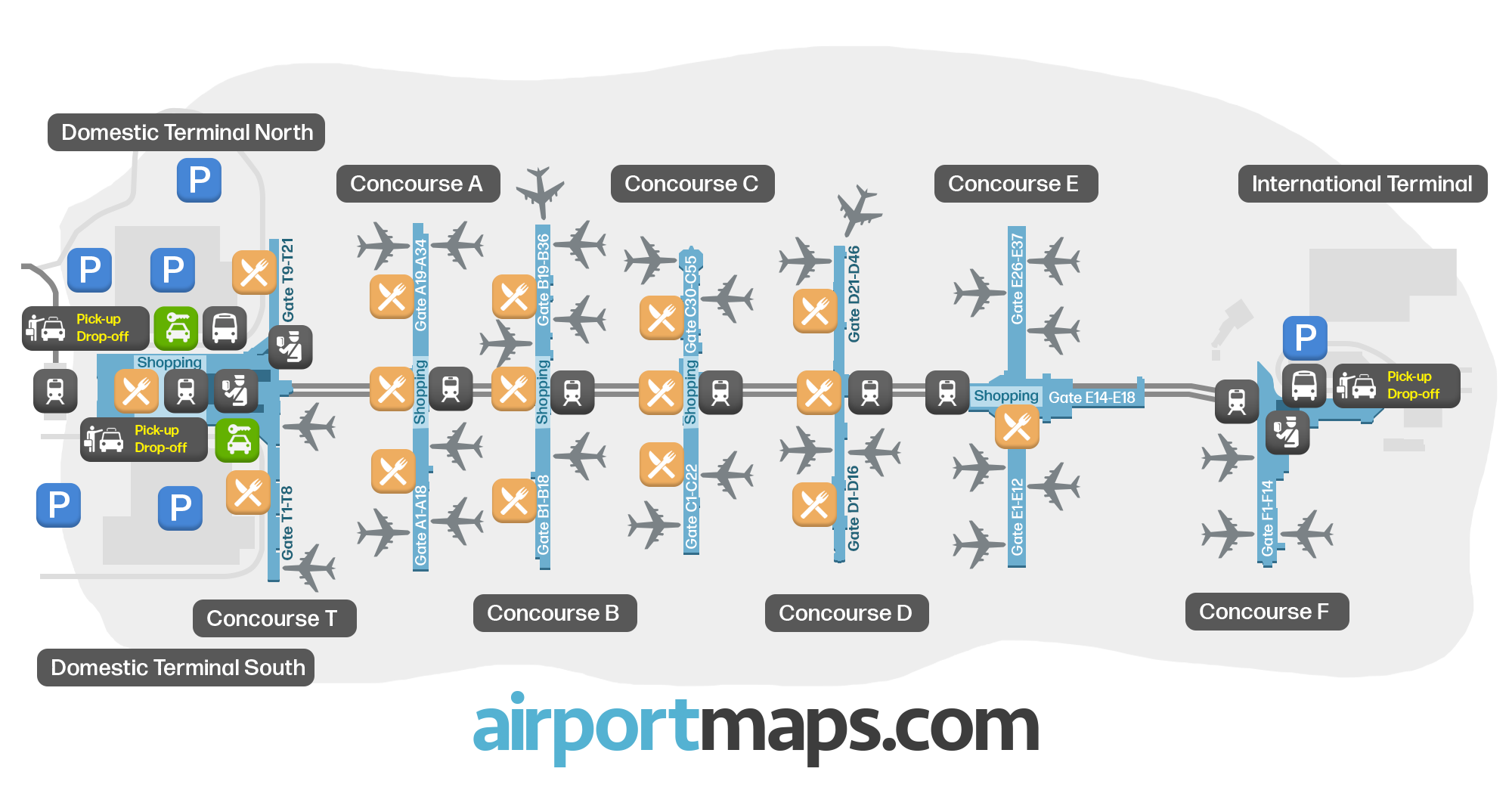
Navigating Hartsfield-Jackson Atlanta International Airport (ATL) is simplified by its efficient, linear design consisting of two main terminals—Domestic and International—and seven parallel concourses (T, A, B, C, D, E, and F). These areas are connected by the subterranean Plane Train and a pedestrian walkway, allowing for seamless transfers between all gates.
As of 2026, Hartsfield-Jackson Atlanta International Airport (ATL) remains the primary global gateway for the Southeastern United States and a critical hub for international commerce. Known for its high passenger volume and operational efficiency, the airport's layout is often cited as a model for "spine" terminal design. Whether you are a frequent business traveler or a first-time international visitor, understanding the physical geography of the airport is essential for making connections and utilizing the extensive services available.
Understanding the Linear Layout of Hartsfield-Jackson (ATL)
The core architecture of ATL is designed to minimize the complexity of passenger movement. Unlike airports with sprawling, disconnected terminals, Atlanta utilizes a centralized "spine" system. The airport is divided into the Domestic Terminal on the west end and the Maynard H. Jackson Jr. International Terminal on the east end. Between these two terminals lie seven parallel concourses, arranged like rungs on a ladder.
The total footprint of the airport covers approximately 4,700 acres, but for passengers, the experience is largely confined to the 6.8 million square feet of terminal space. The distance from the Domestic Terminal to the International Terminal (Concourse F) is approximately 1.2 miles. To bridge this distance, the airport utilizes the Plane Train, an automated people mover that runs in a continuous loop underneath the concourses, and a parallel pedestrian walkway equipped with moving sidewalks and art installations.
The "Spine" Sequence
- Domestic Terminal: Entry point for domestic flights, check-in, and baggage claim.
- Concourse T: Attached directly to the Domestic Terminal.
- Concourse A: Primarily Delta Air Lines operations.
- Concourse B: High-density Delta operations and major retail.
- Concourse C: Delta and various regional partners.
- Concourse D: Domestic carriers and regional jets.
- Concourse E: Large-scale international and domestic swing gates.
- Concourse F (International Terminal): The primary hub for international arrivals and departures.
Detailed Breakdown of Terminal Areas
The Domestic Terminal (North and South)
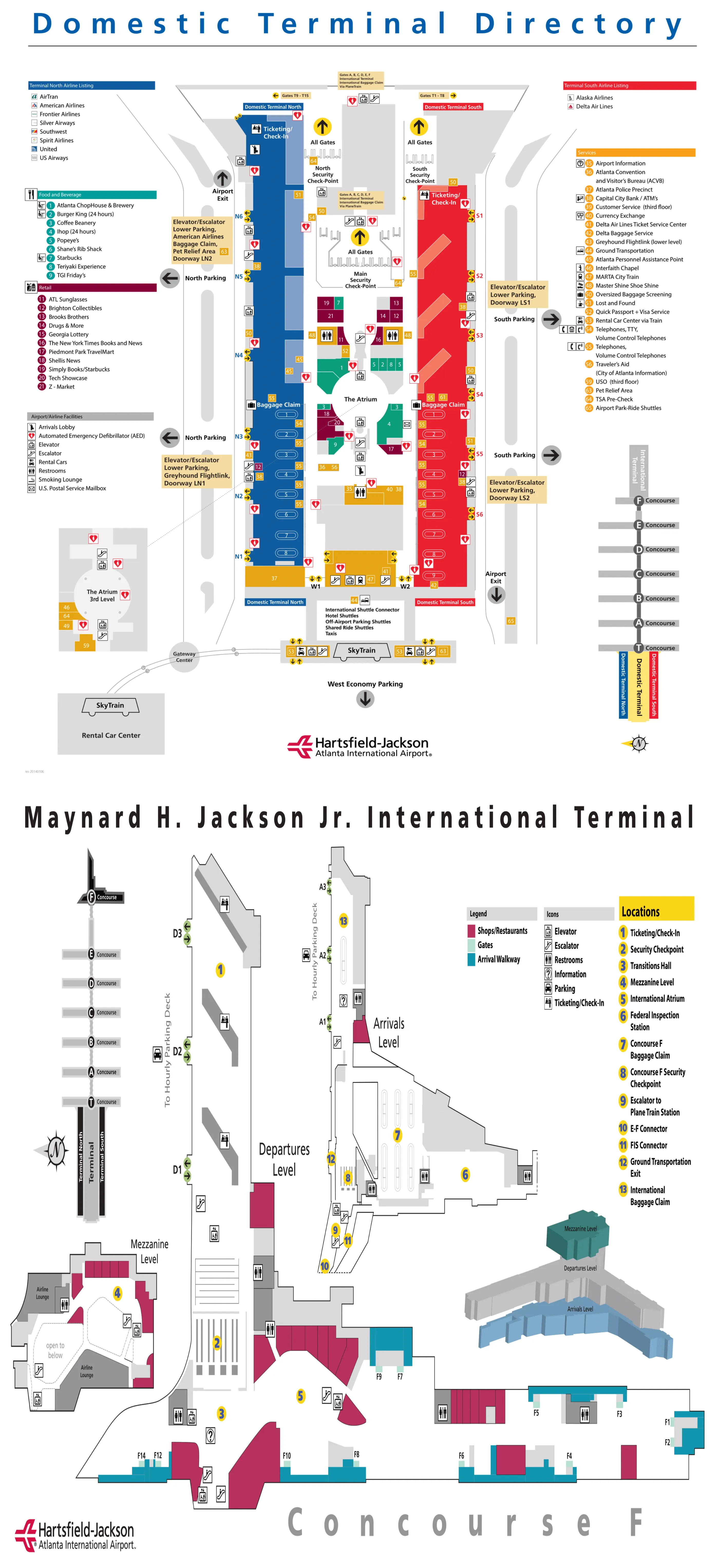
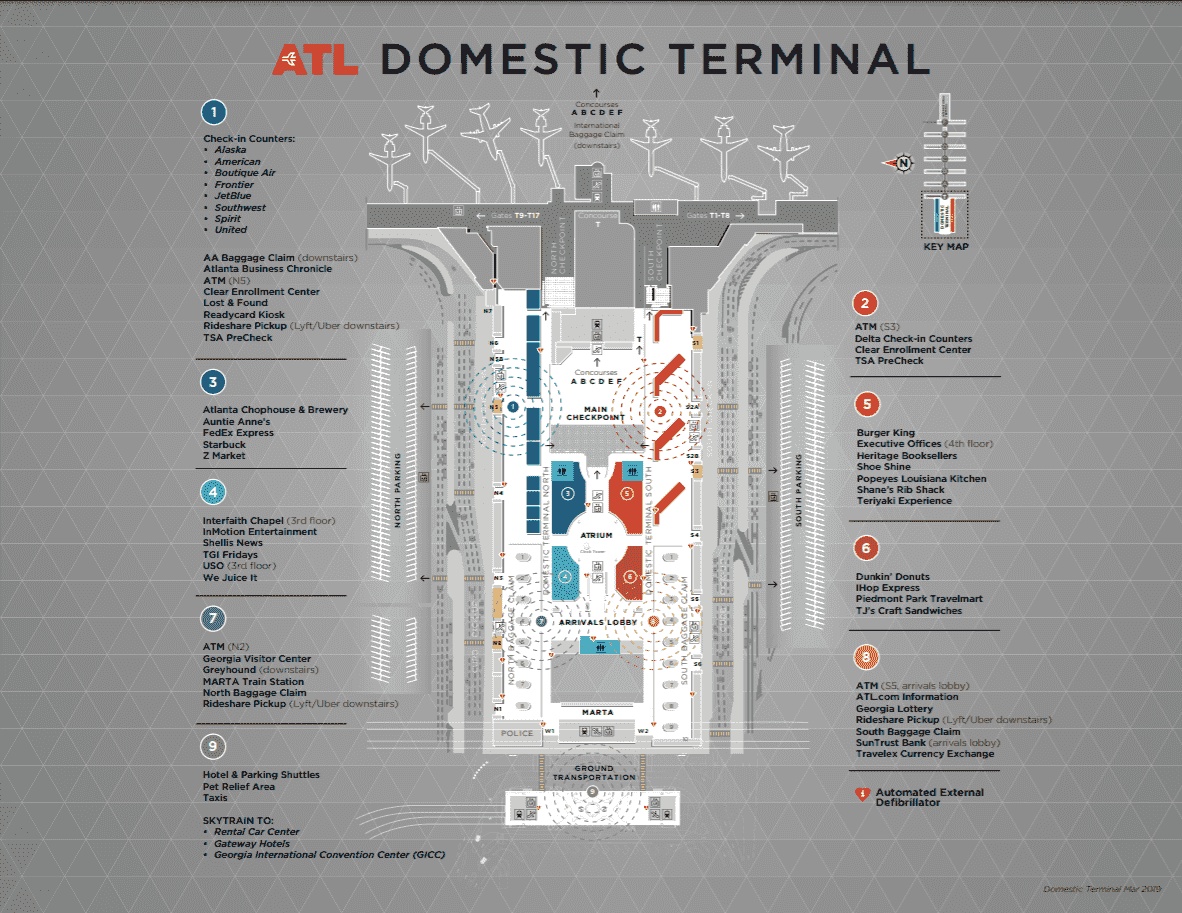
The Domestic Terminal is a massive facility divided into two sides: Terminal North and Terminal South. This division is primarily for check-in and baggage claim purposes and does not represent separate buildings.
- Terminal South: Exclusively serves Delta Air Lines. This is where Delta passengers check their bags and receive boarding passes.
- Terminal North: Serves all other domestic carriers, including Southwest, United, American, Frontier, Spirit, and JetBlue.
Between the North and South terminals is the Atrium, a large open space featuring seating, a food court, and various service counters. The Atrium serves as the central meeting point for the landside (pre-security) portion of the airport. Underneath the Domestic Terminal, you will find the access point for the MARTA (Metropolitan Atlanta Rapid Transit Authority) station, providing direct rail links to downtown Atlanta and the surrounding suburbs.
Maynard H. Jackson Jr. International Terminal
The International Terminal, also known as Terminal F, is a standalone facility located on the eastern side of the airport complex. It was designed to eliminate the need for international passengers to re-clear security and transport their baggage to the main Domestic Terminal.
If you are flying internationally, your journey typically begins and ends here. It is important to note that if you are arriving in Atlanta from an international destination and your final destination is Atlanta, you must exit through the International Terminal. If you have a connecting domestic flight, you will clear Customs and Border Protection (CBP), re-check your bags at the transit counters, and then proceed to the Plane Train to reach your departing concourse.
Navigating the Seven Concourses
The concourses are the heart of the "airside" operations. Once you pass through security, you are in the secure zone and can move freely between any concourse via the Plane Train or the walkway.
Concourse T
Concourse T is the only concourse attached directly to the Domestic Terminal. It is often the preferred gate area for passengers who want to minimize their walking distance after clearing the main security checkpoints. It houses several Delta gates as well as gates for American and United.
Concourses A, B, and C
These three concourses are the heavy hitters for Delta Air Lines. Concourse B is particularly notable for being one of the busiest airport concourses in the world, featuring a massive central atrium with an extensive selection of dining and high-end retail options. In 2026, these concourses remain the primary operational base for Delta’s domestic narrow-body fleet.
Concourse D
Concourse D serves a mix of domestic carriers and Delta’s regional partners. It is narrower than the other concourses, which can make it feel more crowded during peak hours. However, it offers a more intimate selection of services and is conveniently located in the middle of the "spine."
Concourse E and Concourse F
These concourses are the primary gates for wide-body aircraft and international flights. Concourse E was the original international gateway and still handles many international arrivals. Concourse F, the newest addition, is integrated with the International Terminal and features state-of-the-art amenities, including outdoor terraces (The Sky Deck at the Delta Sky Club) and expansive duty-free shopping.
Transportation and Connectivity Options
Efficiency at ATL is driven by its internal and external transportation systems. Understanding the difference between the "Plane Train" and the "SkyTrain" is the most common hurdle for travelers.
The Plane Train (Inside Security)
The Plane Train is an automated people mover that operates on a 24/7 schedule. It runs in a tunnel below the passenger concourses. There are stations at the Domestic Terminal (Baggage Claim), and at every concourse (T, A, B, C, D, E, and F).
- Frequency: Every 2 minutes.
- Travel Time: Approximately 11 minutes from end to end.
- Announcement Tip: Listen for the "Next stop" announcements, which also indicate which airlines are most frequently serviced at the upcoming concourse.
The ATL SkyTrain (Outside Security)
The SkyTrain is located outside the secure area at the Domestic Terminal. It connects the airport to three key locations:
- The Gateway Center: Home to the Georgia International Convention Center (GICC) and several major hotels.
- The Rental Car Center (RCC): All rental car companies are consolidated here. You must take the SkyTrain to reach them; there are no rental car counters inside the terminal.
- West Parking Deck: Provides additional parking capacity for the Domestic Terminal.
Ground Transportation and MARTA
Atlanta’s heavy rail system, MARTA, has its station located directly inside the Domestic Terminal. It is the most cost-effective way to reach the city center, with a transit time of approximately 20 minutes to the Five Points station. For those using ride-share services like Uber or Lyft, pick-up zones are clearly marked and located at the GCT (Ground Transportation Center), accessible from both the North and South terminals.
Passenger Services and Amenities
As a global hub, ATL offers services that go beyond basic travel needs. The airport's amenities are designed to support business productivity, family travel, and passenger wellness.
Security and Expedited Entry
ATL operates multiple security checkpoints to manage the massive flow of passengers.
- Main Checkpoint: Located in the Domestic Terminal Atrium.
- North and South Checkpoints: Usually reserved for CLEAR and TSA PreCheck passengers.
- Digital ID: By 2026, Delta Digital ID and TSA’s facial recognition technology are widely implemented, significantly reducing wait times for enrolled passengers.
Lounges and Private Spaces
Each concourse features at least one premium lounge.
- Delta Sky Clubs: Found in every concourse (T, A, B, C, D, E, and F). The Concourse F club is the flagship, featuring an outdoor deck.
- American Admirals Club: Located in Concourse T.
- United Club: Located in Concourse T.
- The Club at ATL: A common-use lounge in Concourse F accessible via Priority Pass or a day pass.
- Centurion Lounge: The American Express Centurion Lounge is located in Concourse E, providing high-end dining and relaxation for cardmembers.
For those needing actual sleep or extreme privacy, Minute Suites are available in Concourses B and T. These private units can be rented by the hour and include a daybed, desk, and high-speed internet.
Dining and Retail
The airport's "Global Gateway" dining program ensures a mix of local Atlanta favorites and international brands. In the Domestic Terminal, the Atrium serves as a food hub, while airside, Concourses B and E offer the highest density of table-service restaurants. Retail options range from newsstands like Hudson News to luxury boutiques such as Coach and Michael Kors in the International Terminal.
| Concourse | Primary Use | Notable Feature | Key Amenity |
|---|---|---|---|
| T | Domestic | Connected to Terminal | Minute Suites, Major Hub for AA/UA |
| A | Domestic | Delta Primary | Extensive Grab-and-Go Dining |
| B | Domestic | High Density | Large Central Food Court, Delta Sky Club |
| C | Domestic | Regional/Delta | High concentration of retail shops |
| D | Domestic | Regional/Multi-carrier | Intimate feel, efficient for quick transfers |
| E | International/Domestic | Wide-body Gates | AMEX Centurion Lounge, Sensory Room |
| F | International | Main Intl Terminal | Duty-Free, Sky Deck, Direct Customs Access |
Parking Options and Considerations
Parking at ATL is extensive but can reach capacity during holiday periods. In 2026, digital parking reservations are highly recommended.
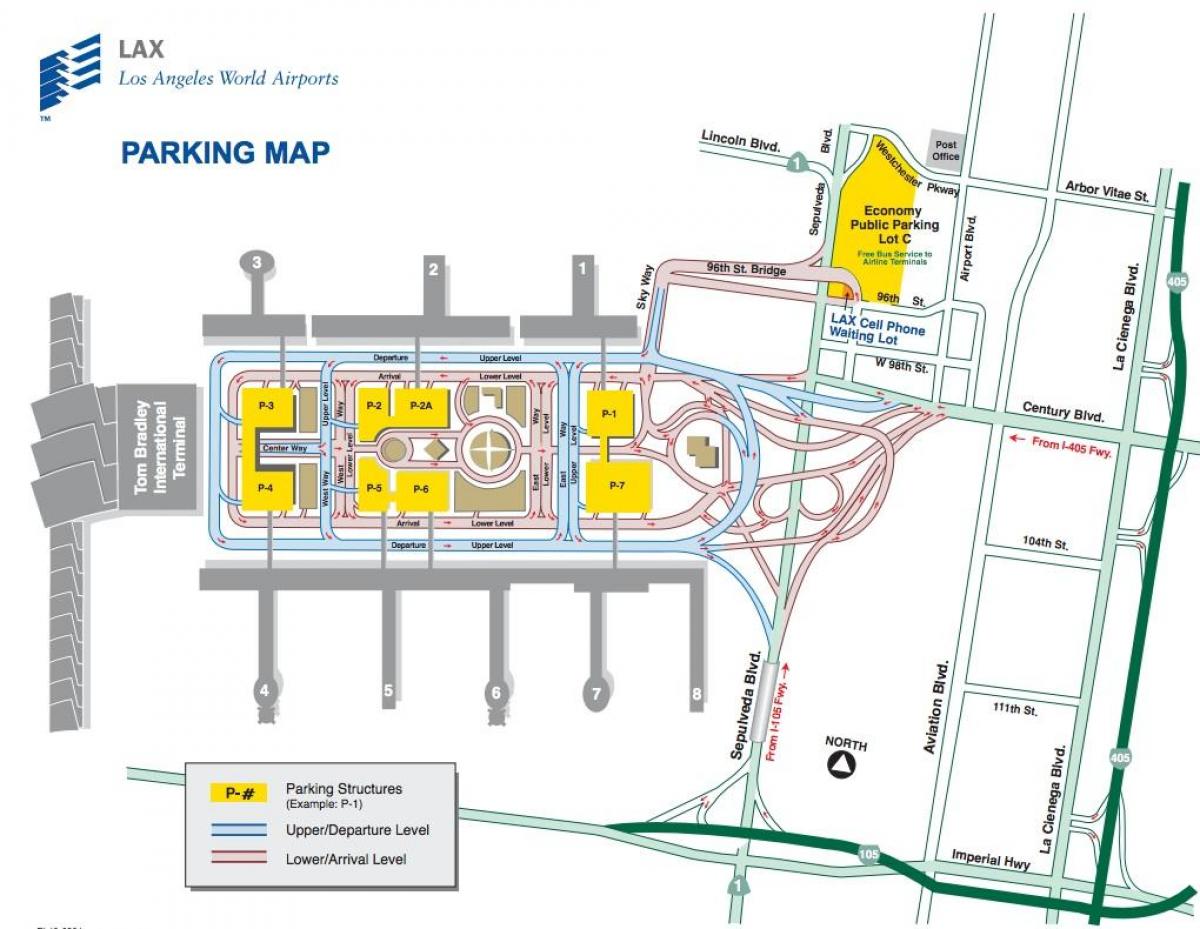
- Hourly Parking: Located directly in front of the Domestic North and South terminals. Ideal for picking up or dropping off passengers.
- Daily Parking: Located behind the Hourly decks; suitable for multi-day trips.
- Economy Parking: More affordable lots located slightly further away, though still within walking distance or a short shuttle ride.
- West Parking: Accessible via the SkyTrain, this deck provides modern parking tech with stall-availability indicators.
- International Parking: Dedicated decks for the Maynard Jackson Jr. Terminal, including both hourly and long-term options.
Frequently Asked Questions
How much time do I need for a connection at ATL?
For domestic-to-domestic connections, a minimum of 45–60 minutes is recommended due to the size of the airport. For international-to-domestic connections, you should allow at least 2 hours to clear Customs, re-check baggage, and move between the International and Domestic areas.
Can I walk between the Domestic and International Terminals?
Inside the secure area (airside), you can move between all concourses and the International Terminal via the Plane Train or the pedestrian walkway. However, outside the secure area (landside), there is no pedestrian path between the Domestic and International terminals. You must take the free airport shuttle bus that circles the airport perimeter, which takes approximately 15 minutes.
Where are the pet relief areas located?
ATL is a pet-friendly airport with relief areas in every concourse. Most are located near the center-point of the concourses, and there is a large, 1,000-square-foot dog park located outside the Domestic Terminal (Lower Level, North Terminal).
Is there a place to shower at the airport?
Showers are primarily available in the premium lounges, such as the Delta Sky Clubs in Concourses E and F, and the Centurion Lounge in Concourse E. Minute Suites also offers shower facilities for an additional fee at their locations.
How do I get to the Rental Car Center?
The Rental Car Center is not located within walking distance of the terminals. You must take the ATL SkyTrain from the Domestic Terminal. The ride is free and takes approximately 5 minutes, with the train running 24 hours a day.
Practical Advice for a Smooth Experience
To ensure a stress-free journey through Hartsfield-Jackson in 2026, your next step should be to download the official ATL Airport app or the Delta FlyReady app. These tools provide real-time updates on security wait times, gate changes, and even walking directions from your current location to your gate. If you are arriving from an international location, ensure you have downloaded the Mobile Passport Control (MPC) app to expedite your entry through Customs. Finally, always verify whether your airline departs from the North or South side of the Domestic Terminal before you arrive to ensure you are dropped off at the correct entrance.