When an insurer denies a workers' compensation claim in Massachusetts, injured employees have the legal right to challenge the decision through an administrative appeal process. Managed by the Massachusetts Department of Industrial Accidents (DIA) under Massachusetts General Laws Chapter 152, this multi-step dispute resolution system ranges from informal conciliation meetings to formal judicial hearings and appeals court reviews.
Overview of the Massachusetts Workers' Compensation Appeals Process
Workers' compensation in Massachusetts is governed by Massachusetts General Laws Chapter 152 (M.G.L. c. 152). The state agency responsible for overseeing insurance disputes and ensuring injured workers receive medical treatment and lost-wage benefits is the Department of Industrial Accidents (DIA).
- Insurer Denies Claim or Discontinues Benefits
- Step 1: Conciliation (Informal DIA Meeting)
- Form 110 Filed | Goal: Voluntary Agreement
- (If Unresolved / Referred)
- Step 2: Judicial Conference
- Before Administrative Judge | Issues Temporary Order
- (Appeal within 14 Days)
- Step 3: Formal Hearing
- Section 11A Impartial Exam | Record & Witness Rules
- (Appeal within 30 Days)
- Step 4: DIA Administrative Law Review Board
- Panel of 3 Judges | Reviews Legal / Arbitrary Error
- Step 5: Massachusetts Appeals Court
- Judicial Review Outside the DIA
When an employer's workers' compensation insurance carrier denies an initial claim, reduces weekly wage benefits, or refuses to authorize medical treatments, the injured worker is not at a dead end. The dispute resolution process is divided into four main administrative stages within the DIA, followed by a potential fifth stage in the state court system:
- Conciliation: An informal meeting with a DIA conciliator to reach a voluntary agreement.
- Conference: An informal proceeding before an Administrative Judge who issues a temporary binding order.
- Formal Hearing: A structured evidentiary trial where formal rules of evidence apply and medical testimony is evaluated.
- Administrative Law Review Board: An appellate review panel of three judges who evaluate transcript errors or legal mistakes.
- Massachusetts Appeals Court: Judicial review outside the DIA system.
Navigating this framework requires strict adherence to statutory deadlines, precise medical documentation, and proper form filings. Understanding how each stage functions helps ensure your rights are protected throughout the dispute.
Step 1: Filing the Claim and Attending Conciliation
The formal appeal process begins when an injured worker files a dispute with the DIA after receiving an official denial or failure to pay from the insurance carrier.
Preparing and Filing Form 110
To initiate a claim, the injured worker (or their attorney) must file Form 110 (Employee's Claim) with the DIA. You can file this form electronically through the DIA Online Web Services portal or by submitting paper documentation to a local DIA regional office (located in Boston, Fall River, Lawrence, Springfield, and Worcester).
Before submitting Form 110, certain statutory prerequisites must be met:
- Waiting Period: At least 30 calendar days must have elapsed since the date of disability, or the insurer must have formally denied the claim in writing (via Form 104 or a formal denial letter).
- Required Documentation: Form 110 must be accompanied by supporting documentation, including medical reports from your treating physician linking your injury or illness directly to your job duties, records of unpaid medical bills, and evidence of lost wages (such as pay stubs or a W-2).
What Happens During Conciliation?
Once the DIA processes Form 110, the case is scheduled for a Conciliation. This informal meeting usually occurs within several weeks of filing.
A DIA conciliator acts as a neutral mediator between the injured employee and the insurance company’s legal representative. The primary objective is to determine whether the dispute can be resolved voluntarily without judicial intervention.
During conciliation, the conciliator reviews the medical evidence, verifies wage calculations, and discusses potential compromises. If the insurer agrees to pay benefits or if both parties agree to a temporary resolution, a binding conciliation agreement is signed.
If the insurer refuses to pay and no agreement is reached, the conciliator forwards the case to the next stage: the Judicial Conference.
Step 2: The Judicial Conference
The Conference stage moves the dispute from informal mediation to a proceeding before an Administrative Judge at the DIA.
Preparing for the Conference
After conciliation fails to resolve the dispute, the case is randomly assigned to a DIA Administrative Judge. The judge schedules a conference, typically within 28 to 42 days following the conciliation referral.
Prior to the conference, both parties submit a Conference Memorandum. This document outlines:
- The specific nature of the injury and date of occurrence.
- The exact weekly benefits or medical bills requested.
- The legal grounds for the claim or defense.
- An itemized list of medical records and supporting documentation.
The Conference Proceeding and Temporary Orders
Unlike a traditional court trial, a conference is relatively informal and brief, usually lasting between 15 and 30 minutes. It takes place in the judge's office or a hearing room.
- No Sworn Testimony: Live witness testimony is generally not taken during a conference. Instead, attorneys present oral arguments based on written medical reports, wage records, and affidavits.
- Issuance of a Temporary Order: Within 7 to 14 days after the conference concludes, the Administrative Judge issues a written Temporary Order. This order can require the insurance company to pay weekly wage replacement benefits and medical expenses, or it can deny the worker’s claim entirely.
The Temporary Order is legally binding on both parties while the case proceeds. However, because it is based on an abbreviated review of the evidence, either party has the right to appeal if they disagree with the outcome.
Step 3: The Formal Hearing and Impartial Medical Examination
If either the employee or the insurer is dissatisfied with the judge’s Temporary Order, they can file an appeal requesting a Formal Hearing.
Deadline to Appeal the Conference Order
The deadline to appeal a Conference Order is strict: the appealing party must file Form 121 (Appeal of Conference Order) within 14 calendar days of the date the order was issued.
Along with Form 121, the appealing party must submit an appeal fee (typically around $650, though this fee may be waived if the employee proves financial hardship by filing an Affidavit of Indigency, or reimbursed if the employee prevails at the hearing). Failure to file Form 121 within the 14-day window renders the Temporary Order a final, non-appealable decision.
The Section 11A Impartial Medical Examination
Under M.G.L. c. 152, § 11A, once a Conference Order is appealed to a formal hearing involving medical disputes, the DIA appoints an independent physician from its authorized panel to conduct an Impartial Medical Examination.
Section 11A Impartial Examination
- Mandatory medical evaluation by a DIA-appointed physician.
- Doctor reviews all prior medical records provided by parties.
- Evaluates disability status, cause, and work capability.
- Prepares an official report submitted directly to the Judge.
- Report is prima facie evidence (holds substantial weight).
The impartial physician reviews the worker's medical history, performs a physical examination, and answers specific legal-medical questions:
- Is the employee disabled, and to what extent (total or partial)?
- Is the disability temporary or permanent?
- Was the industrial accident the predominant or contributing cause of the disability?
The report generated by the Section 11A physician serves as prima facie evidence at the formal hearing. This means the judge must treat the doctor’s findings as fact unless a party successfully deposes the physician or demonstrates that the medical issues are extraordinarily complex, allowing additional medical evidence to be submitted.
Conducting the Formal Hearing
The Formal Hearing is a full administrative trial recorded by a court reporter. Unlike the conference, formal rules of evidence apply.
During the hearing:
- Witness Testimony: The injured worker, supervisors, co-workers, and expert witnesses testify under oath and are subject to cross-examination.
- Depositions: Attorneys may depose the Section 11A impartial physician or treating physicians to challenge or clarify medical conclusions.
- Written Decision: Months after the hearing record closes, the Administrative Judge issues a detailed written decision containing formal findings of fact and rulings of law. This decision supersedes the previous Temporary Order.
Step 4: Appealing to the DIA Review Board
If the Administrative Judge’s formal hearing decision contains legal errors or is unsupported by the evidence, either party may appeal to the DIA Administrative Law Review Board.
Timeframe and Scope of Review
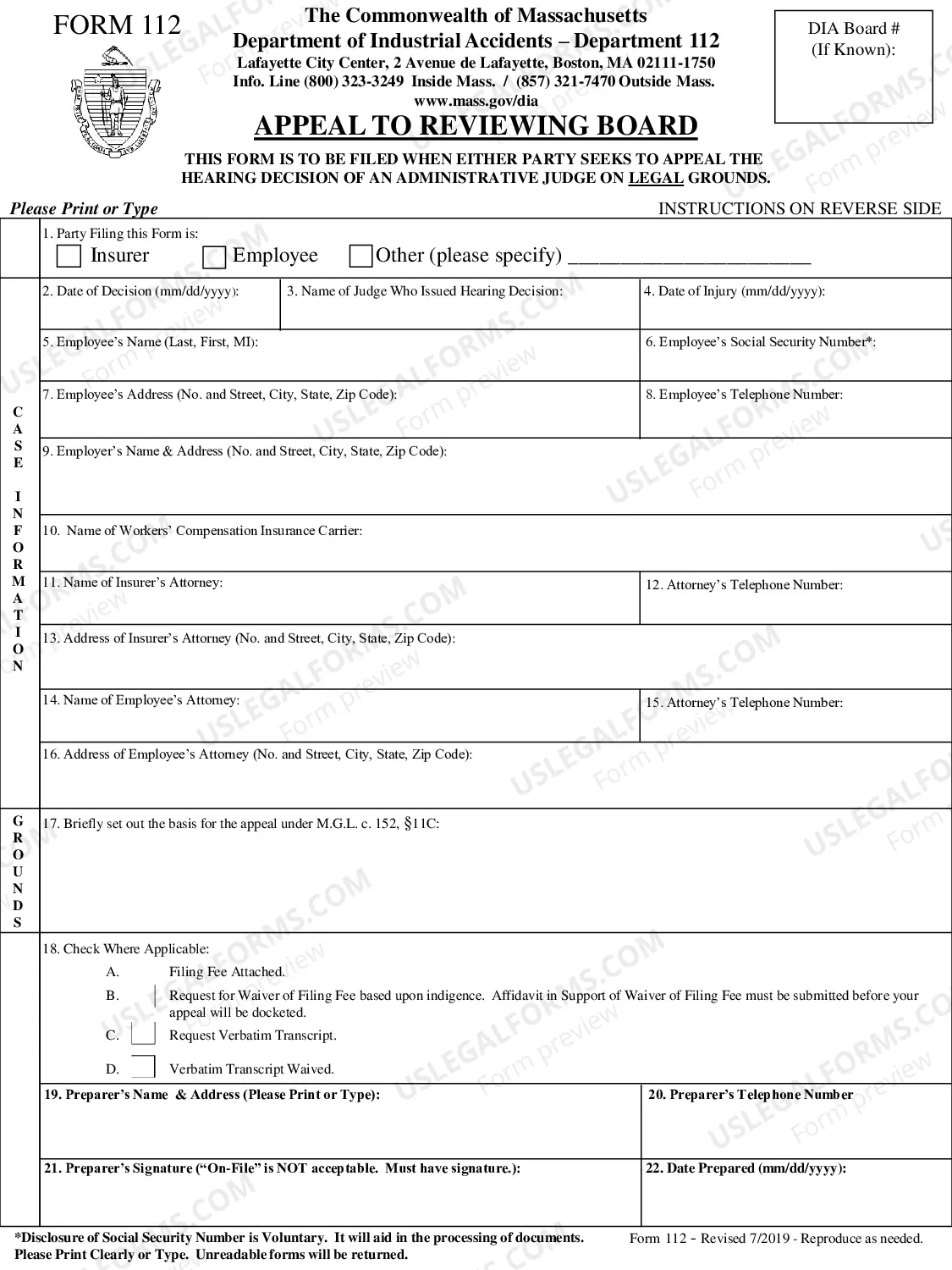
To initiate this level of appeal, the aggrieved party must file Form 129 (Notice of Appeal to Review Board) within 30 calendar days of the date of the judge's formal hearing decision.
The Review Board consists of a panel of three Administrative Law Judges who review the case. Importantly, the Review Board does not hold a new trial and does not take new testimony or witness evidence. Instead, its review is strictly confined to the record created during the formal hearing.
DIA Review Board Scope
- Panel of 3 Administrative Law Judges.
- NO new testimony or evidence accepted.
- Examines transcript and evidence for legal errors.
- Standards for Reversal/Remand:
- Decision was arbitrary, capricious, or contrary to law.
- Judge exceeded statutory authority.
- Key findings lack substantial evidentiary support.
Grounds for Review Board Action
The Review Board will only reverse or remand (send back) a hearing judge's decision if it determines that the decision was:
- Beyond the statutory authority of the judge.
- Arbitrary, capricious, or an abuse of discretion.
- Contrary to law or unsupported by substantial evidence in the record.
If the Review Board finds that the judge applied the wrong legal standard or failed to address critical evidence, it will issue an opinion remanding the case back to the judge with specific instructions. If no legal error is found, the decision is affirmed.
Step 5: Judicial Review in the Massachusetts Appeals Court
If the DIA Review Board affirms an unfavorable decision, the administrative remedies within the DIA are exhausted. The final avenue of appeal is entering the state judicial system by filing an appeal with the Massachusetts Appeals Court.
Filing Requirements and Judicial Standards
Under M.G.L. c. 152, § 12 and M.G.L. c. 30A (the Massachusetts Administrative Procedure Act), a party appealing a Review Board decision must file a Notice of Appeal with the Massachusetts Appeals Court within 30 calendar days of the Review Board's decision being issued.
At this level:
- Appellate judges review the administrative record for constitutional issues, procedural flaws, or misinterpretations of statutory law.
- Deference is generally given to the DIA’s administrative expertise, making reversals at this stage rare unless a clear legal error occurred.
- In limited circumstances involving broader constitutional questions or novel legal interpretations, a case may ultimately be reviewed by the Massachusetts Supreme Judicial Court (SJC).
Summary of DIA Appeal Stages, Deadlines, and Forms
The following table summarizes the administrative sequence, key forms, statutory filing windows, and primary objectives for appealing a workers' compensation claim in Massachusetts:
| Appeal Stage | Responsible Authority | Required Form | Filing Deadline | Key Objective / Description |
|---|---|---|---|---|
| Conciliation | DIA Conciliator | Form 110 (Employee) or Form 104 (Insurer) | At least 30 days post-injury (or upon written denial) | Informal mediation to seek a voluntary agreement or settlement. |
| Conference | DIA Administrative Judge | Form 105 (Referral from Conciliation) | Automatic referral if Conciliation fails | Brief proceeding yielding a binding Temporary Order for benefits. |
| Formal Hearing | DIA Administrative Judge | Form 121 (Appeal of Conference Order) | 14 calendar days from date of Conference Order | Full trial with testimony, cross-examination, and § 11A Impartial Exam. |
| Review Board | 3-Judge DIA Panel | Form 129 (Appeal to Review Board) | 30 calendar days from date of Hearing Decision | Review of hearing transcript for legal, procedural, or arbitrary errors. |
| Appeals Court | MA Appeals Court | Notice of Appeal (Judicial System) | 30 calendar days from Review Board decision | State court review of agency decision under M.G.L. c. 30A administrative standards. |
Common Reasons Workers' Compensation Claims Are Denied
Understanding why insurers deny claims helps workers gather targeted evidence during the appeal process. In Massachusetts, insurance companies frequently cite the following grounds for denial:
- Lack of Causation (Causal Relationship): The insurer argues that the injury did not arise "out of and in the course of employment" (M.G.L. c. 152, § 26). They may claim the condition is attributable to a pre-existing medical issue or a non-work incident.
- Pre-Existing Conditions & Combination Claims: Under M.G.L. c. 152, § 1(7A), if a work injury combines with a pre-existing, non-compensable condition, the worker must prove that the work event was the major cause (rather than simply a contributing cause) of the resulting disability.
- Late Notice or Filing: Employers must be notified of an injury as soon as practicable. Under M.G.L. c. 152, § 41, a formal claim must generally be filed within four years of the date the employee becomes aware of the causal relationship between their disability and their employment.
- Insufficient Medical Documentation: Claims are often denied because the initial medical reports fail to clearly state that the worker is disabled from performing their job duties or fail to explicitly connect the diagnosis to workplace conditions.
- Disputes Over Average Weekly Wage (AWW): Insurers may accept liability for the injury but dispute the calculation of the worker's average weekly wage, resulting in lower weekly benefit payments.
Practical Recommendations for Injured Workers
Navigating a DIA appeal requires careful organization and adherence to statutory procedures. If your Massachusetts workers' compensation claim has been denied or modified, consider taking the following steps immediately:
- Obtain All Denial Notices: Keep all written correspondence from the insurer, including Form 104 (Insurer's Notification of Denial) or Form 106 (Insurer's Notification of Termination or Modification of Benefits).
- Secure Comprehensive Medical Records: Ask your treating doctors to provide detailed narrative reports. The reports must explicitly detail your diagnosis, physical limitations, treatment plan, and an affirmative opinion stating that your work duties were a direct or major cause of your condition.
- Track Deadlines Rigidly: Missing the 14-day window to appeal a Conference Order or the 30-day window to appeal a Hearing Decision can result in losing your right to pursue benefits.
- Consult a Qualified Workers' Compensation Attorney: Massachusetts law regulates attorney fees in workers' compensation cases (M.G.L. c. 152, § 13A). In most instances, attorney fees are paid directly by the insurance company if you win your appeal, or taken as a regulated percentage of a lump-sum settlement. Injured workers rarely pay upfront legal fees out-of-pocket for a DIA appeal.
Frequently Asked Questions
Can I appeal if the insurance company stops paying my weekly benefits after initially paying them?
Yes. If an insurer pays benefits during the initial 180-day "pay-without-prejudice" period under M.G.L. c. 152, § 7(1), they may stop or reduce payments by providing proper written notice (Form 106). If you disagree with the termination of benefits, you can file an appeal using Form 110 to initiate the conciliation process.
How long does the entire workers' compensation appeal process take in Massachusetts?
The duration depends on how far the appeal progresses. A conciliation usually occurs within a few weeks of filing Form 110. A conference is typically scheduled within one to two months after conciliation. However, reaching a formal hearing decision can take 6 to 12 months or longer due to scheduling medical depositions and awaiting the Section 11A impartial physician report.
Do I have to pay for the Section 11A Impartial Medical Examination?
When you appeal a Conference Order to a Formal Hearing, an impartial exam fee is required. Usually, the appealing party submits this fee. However, if the employee claims financial hardship, they can file an Affidavit of Indigency to request a fee waiver. Furthermore, if the employee prevails at the hearing, the insurer is ordered to reimburse the appeal and medical fee expenses.
What is the difference between a DIA Conference and a DIA Formal Hearing?
A Conference is an informal, 15- to 30-minute meeting where lawyers present medical documents and arguments without live witnesses, resulting in a Temporary Order. A Formal Hearing is a full administrative trial with sworn witness testimony, formal evidence rules, medical depositions, and a final written decision that replaces the temporary order.
Can I work light duty while my claim appeal is pending?
Yes, if your treating physician clears you for light-duty work and your employer offers a position within your medical restrictions. Any earnings will be factored into partial disability benefit calculations (under M.G.L. c. 152, § 35). Be sure to report all light-duty earnings to the DIA and the insurance carrier to prevent overpayment issues.