For the 2025 Kia Telluride, the recommended oil change interval is every 7,500 miles or 12 months under normal driving conditions. However, if you frequently drive in stop-and-go traffic, extreme temperatures, or tow heavy loads, Kia recommends a "Severe Usage" interval of 5,000 miles or 6 months to maintain engine longevity.
Effective vehicle maintenance is the cornerstone of preserving the 10-year/100,000-mile powertrain warranty that makes the Kia Telluride a leader in the mid-size SUV segment. As we navigate through 2026, many 2025 Telluride owners are reaching their second or third service milestones. Understanding the nuances of your vehicle’s lubrication system is vital for preventing premature engine wear and ensuring the 3.8L V6 engine continues to deliver its signature smooth performance.
Understanding Kia’s Recommended Service Intervals
Kia categorizes maintenance schedules into two distinct paths: Normal and Severe. While many owners assume their daily commute qualifies as "normal," the reality of modern driving often pushes vehicles into the severe category.
The Normal Maintenance Schedule
The "Normal" schedule is designed for vehicles driven under ideal conditions. This typically means long-distance highway driving at steady speeds in temperate climates. For a 2025 Telluride, this translates to:
- Oil and Filter Change: Every 7,500 miles or 12 months.
- Tire Rotation: Every 7,500 miles.
- Climate Control Air Filter: Every 15,000 miles.
The Severe Maintenance Schedule
Most drivers in urban or suburban environments actually fall under the "Severe" maintenance category. Kia defines severe driving as:
- Repeatedly driving short distances (less than 5 miles in normal temps or 10 miles in freezing temps).
- Extensive idling or low-speed driving in stop-and-go traffic.
- Driving on rough, dusty, muddy, unpaved, or salt-spread roads.
- Driving in extremely hot (over 90°F) or cold areas.
- Towing a trailer or using a roof rack frequently.
Under these conditions, the oil change interval should be shortened to 5,000 miles or 6 months, whichever comes first. Following the severe schedule is not just a suggestion; it is a safeguard against the accelerated oil degradation caused by moisture accumulation and fuel dilution that occurs when an engine doesn't reach its optimal operating temperature for long periods.
The Technical Specifications: Oil Type and Capacity
The 2025 Kia Telluride is equipped with a 3.8-liter Lambda II GDI (Gasoline Direct Injection) V6 engine. This high-compression engine requires specific lubricants to manage heat and prevent carbon buildup on the intake valves—a common challenge for GDI engines.
Recommended Oil Grade
Kia recommends using a full synthetic oil with a viscosity of SAE 5W-30. In extremely cold climates where temperatures frequently drop below -20°F, an alternative like 0W-30 may be considered, but 5W-30 remains the standard for year-round protection in most regions.
The oil must meet the API SP (or higher) and ILSAC GF-6 specifications. These modern standards are specifically designed to protect against low-speed pre-ignition (LSPI) and provide better timing chain wear protection compared to older SN-rated oils.
Oil Capacity
The total oil capacity for the 2025 Telluride 3.8L V6 is approximately 6.34 US quarts (6.0 liters) when changing the oil filter. It is essential not to overfill the engine, as this can lead to "frothing" of the oil, where the crankshaft hits the oil surface and introduces air bubbles, significantly reducing the oil's ability to lubricate moving parts.
Why the 2025 Telluride Demands High-Quality Synthetic Oil
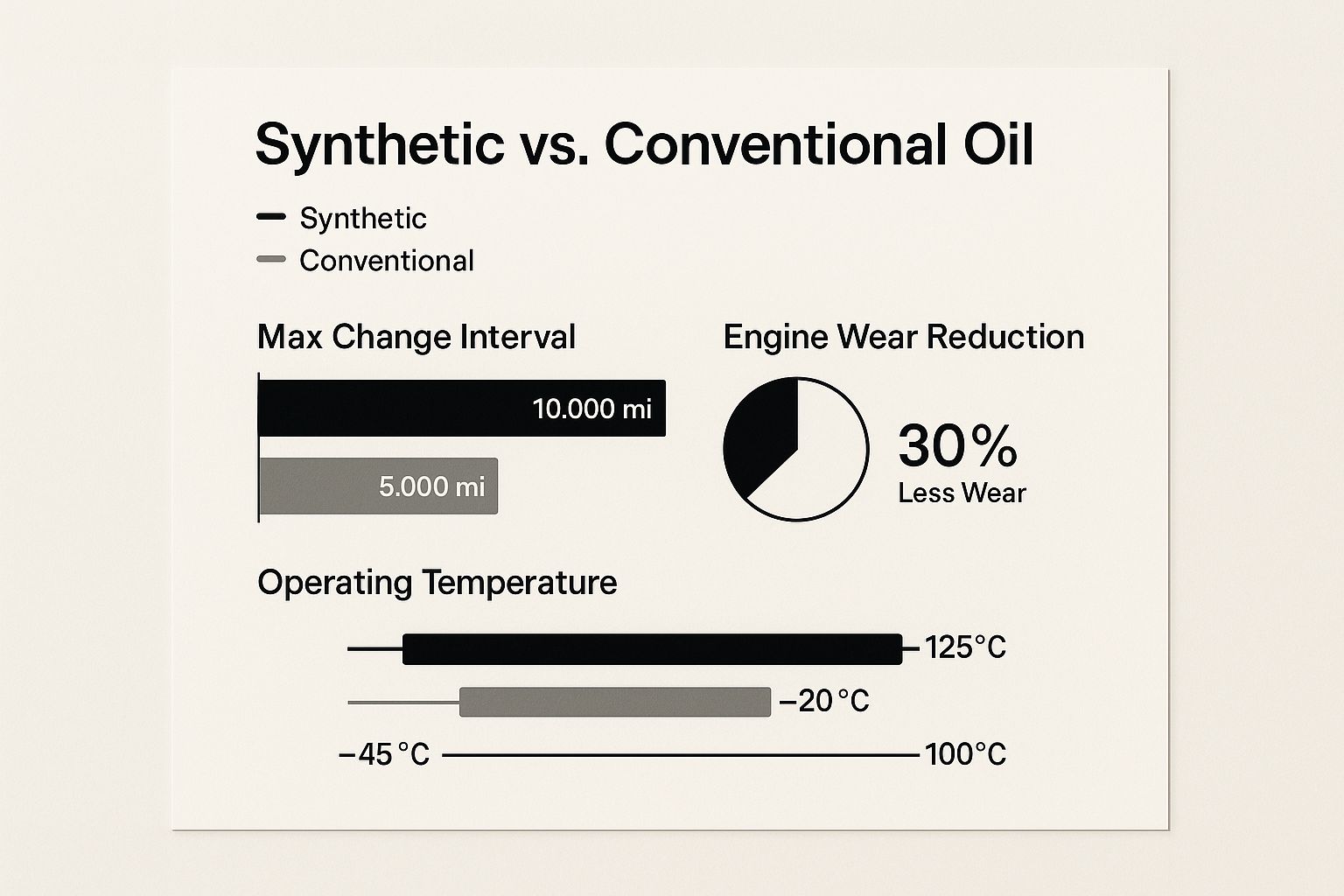
The shift toward longer oil change intervals in the automotive industry is largely due to the advancement of synthetic lubricants. Unlike conventional oil, which is refined from crude oil, synthetic oil is chemically engineered for consistency.
Protection for Direct Injection
Because the Telluride uses GDI technology, fuel is sprayed directly into the combustion chamber at high pressure. Some of this fuel can wash down the cylinder walls and mix with the engine oil, a process known as fuel dilution. Synthetic oils are more resilient to this thinning effect than conventional oils.
Heat Management
The 3.8L V6 produces significant heat during operation. Synthetic oil has a higher flash point, meaning it can withstand higher temperatures before it begins to break down and form sludge. This is particularly important for the Telluride, which is often used as a family hauler or towing vehicle, placing additional thermal stress on the engine.
2025 Kia Telluride Maintenance Interval Comparison
| Driving Condition | Oil Change Interval | Filter Replacement | Key Factors |
|---|---|---|---|
| Normal | 7,500 Miles / 12 Months | Every Oil Change | Highway miles, temperate climate, no towing. |
| Severe | 5,000 Miles / 6 Months | Every Oil Change | Stop-and-go traffic, extreme heat/cold, towing, dusty roads. |
| Extreme/Commercial | 3,000 Miles / 3 Months | Every Oil Change | Delivery services, constant idling, off-road use. |
The Role of the Oil Life Monitoring System
The 2025 Kia Telluride features an integrated maintenance reminder system accessible through the infotainment screen or the instrument cluster. It is important to distinguish this from an "Oil Quality Sensor."
Most Kia systems function as a countdown timer based on the parameters set by the user or the dealership during the last service. It does not actively "sample" the oil to determine its chemical health. Therefore, if your driving habits change—such as moving from a highway commute to a city-based one—you should manually adjust your service plan rather than relying solely on the car's default 7,500-mile countdown.
How to Reset the Service Interval
- Turn the ignition to the "ON" position (do not start the engine).
- Use the steering wheel buttons to navigate to the User Settings or Service menu on the instrument cluster.
- Select Service Interval.
- Press and hold the "OK" button to reset the mileage and months to the factory or custom default.
Warranty Protection and Documentation
One of the most compelling reasons to purchase a 2025 Kia Telluride is the industry-leading warranty. However, this warranty is conditional. In the event of an engine failure, Kia Motors America may request service records to prove the vehicle was maintained according to the owner's manual.
Maintaining Your Records
If you perform your own oil changes, you must keep:
- Dated receipts for the oil and filter purchases.
- A log of the mileage at the time of the service.
- Documentation that the oil met the API SP and ILSAC GF-6 standards.
Using an OEM (Original Equipment Manufacturer) Kia Oil Filter (Part #26320-3CAA0) is highly recommended. Some aftermarket filters have been known to cause "engine knocking" or "ticking" noises due to differences in bypass valve pressure or flow rates, which can complicate warranty claims if oil starvation occurs.
Signs You Need an Oil Change Sooner
Regardless of what the odometer says, your vehicle might communicate a need for fresh oil through several physical symptoms. Monitoring these can prevent catastrophic engine damage.
- Dark, Gritty Oil: Fresh oil is amber and translucent. If the oil on the dipstick is pitch black and feels gritty between your fingers, it is saturated with carbon and debris.
- Increased Engine Noise: As oil loses its viscosity, it cannot provide the thin cushion between moving metal parts. You may notice more "clatter" from the valves or a deeper hum from the engine.
- Oil Smell Inside the Cabin: This often indicates a leak or that the oil is burning. If you smell burnt oil, check the levels immediately.
- Exhaust Smoke: While vapor is normal in cold weather, persistent blue or gray smoke from the tailpipe suggests oil is being burned in the combustion chamber.
Common Mistakes in Telluride Maintenance
Even well-intentioned owners can make errors that compromise the health of their SUV.
- Using the Wrong Oil Weight: Using a 10W-30 or 10W-40 oil in an engine designed for 5W-30 can reduce fuel economy and cause issues with the variable valve timing (VVT) system, which relies on specific oil pressures to function.
- Ignoring the Filter: Some owners try to save money by changing the filter every other oil change. This is a mistake. A clogged filter will eventually go into "bypass mode," allowing unfiltered, dirty oil to circulate through the engine.
- Neglecting the Drain Plug Washer: The Telluride uses a crush washer on the oil drain plug. This washer is designed to be used once. Reusing it often leads to slow drips that can eventually empty the oil pan over several thousand miles.
Frequently Asked Questions
Can I use conventional oil in my 2025 Kia Telluride?
While Kia's manual allows for certain grades of engine oil, the 3.8L V6 GDI engine is optimized for synthetic lubricants. Using conventional oil may lead to faster sludge buildup and could potentially void aspects of your powertrain warranty if it results in engine damage. Synthetic oil is the standard for 2026 automotive care.
Does the 2025 Telluride require a special oil filter?
Yes, the Telluride uses a cartridge-style filter rather than a traditional metal spin-on filter. It is located on the top or front-side of the engine (depending on exact sub-model variations) and requires a specific housing cap removal tool. It is critical to replace the O-rings included with the filter kit to prevent high-pressure leaks.
Is a 10,000-mile oil change interval safe?
While some synthetic oil brands claim to last 10,000 or even 15,000 miles, following these claims on a 2025 Telluride is risky. Kia’s maximum recommended interval is 7,500 miles. Exceeding this limit can jeopardize your warranty coverage and may lead to oil consumption issues as the vehicle ages.
Why does my Telluride consume a small amount of oil between changes?
It is considered normal for modern GDI engines to consume a small amount of oil (up to a quart every 1,500–3,000 miles, depending on manufacturer specs). However, if you find yourself adding more than a quart between 5,000-mile services, you should have the PCV (Positive Crankcase Ventilation) system inspected by a technician.
What is the best oil brand for the Kia Telluride?
Kia often partners with TotalEnergies or Quaker State for factory fills, but any major brand like Mobil 1, Pennzoil Platinum, or Valvoline is excellent as long as it meets the API SP and ILSAC GF-6 specifications.
Recommendation for 2026
For the best balance of engine protection and cost-effectiveness in 2026, we recommend a 5,000-mile/6-month interval using a high-quality full synthetic 5W-30 oil and an OEM Kia filter. This proactive approach accounts for the "Severe" conditions most SUVs face and provides the best insurance for your vehicle's long-term reliability.