Exodus 20 serves as the foundational text for biblical ethics, law, and theology, recording the delivery of the Ten Commandments at Mount Sinai. Spoken directly by God to the assembly of Israel, these directives establish a covenant framework that defines humanity’s vertical relationship with the Creator and horizontal responsibilities toward neighborly community, shaping Western legal traditions and moral philosophy for millennia.
Introduction to Exodus 20: Historical and Theological Context
To understand an Exodus 20 explanation, one must view the chapter not as an isolated legal code, but as the constitutional heart of the Sinai covenant. In the preceding chapters, the Israelites escaped Egyptian bondage, crossed the Red Sea, and arrived at the foot of Mount Sinai. Here, God prepares to formalize a relationship with the nation, transitioning them from a slave populace into an organized society governed by divine law.
The chapter opens with a crucial preamble: "And God spoke all these words, saying, 'I am the Lord your God, who brought you out of the land of Egypt, out of the house of slavery'" (Exodus 20:1–2, ESV). This prologue is essential. The commandments are not given to earn salvation or freedom; rather, they are given because freedom has already been granted. Obedience is framed as a grateful response to deliverance, establishing grace as the foundation before any behavioral expectations are introduced.
The Prologue and the Framework of the Covenant
Before any specific rules or taboos are listed, the text establishes the identity of the Lawgiver and the basis of authority.
- The Identity of the Speaker: By identifying Himself as the Redeemer who brought Israel out of Egypt, God establishes His exclusive sovereign right to command.
- The Nature of the Covenant: The relationship is bilateral in terms of covenant obligations, yet entirely asymmetrical in terms of power. God provides the terms, and Israel accepts them.
- Grace Precedes Law: The imperative ("You shall...") is always preceded by the indicative ("I have delivered you..."). This theological order prevents legalism, framing ethical behavior as the natural fruit of covenant membership.
Detailed Breakdown of the Ten Commandments
The core of Exodus 20 consists of the Ten Commandments (known in Hebrew as the Aseret Ha-Dvarim, or the "Ten Words"). These commands can be broadly divided into two categories: duties toward God (the first table) and duties toward fellow human beings (the second table).
The First Four Commandments: Vertical Obligations
The first four directives govern humanity's relationship with the divine, emphasizing exclusivity, reverence, and sacred time.
- No Other Gods (Exodus 20:3): "You shall have no other gods before me." This demands absolute monotheism and unwavering loyalty. In the ancient Near East, polytheism was standard; Israel was called to reject pantheons in favor of sole devotion to Yahweh.
- No Idolatry (Exodus 20:4–6): "You shall not make for yourself a carved image..." This prohibits the physical representation of God for worship. Graven images reduced the transcendent Creator to the level of created things, subjecting the divine to human manipulation. God describes Himself as a "jealous God," signifying a protective, marital-like passion for His people's loyalty.
- Misusing the Name of God (Exodus 20:7): "You shall not take the name of the Lord your God in vain." This goes far beyond casual profanity. In ancient cultures, a name represented character and authority. To take God's name "in vain" means to bear it falsely—claiming to represent God while acting contrary to His character, or using His name for manipulative, empty, or malicious purposes.
- Remembering the Sabbath (Exodus 20:8–11): "Remember the Sabbath day, to keep it holy." Rooted in the creation account where God rested on the seventh day (Genesis 2:2–3), this command mandates a rhythm of labor and cessation. It democratizes rest, ensuring that servants, foreigners, and even livestock share in the weekly pause from economic production.
The Last Six Commandments: Horizontal Obligations
The remaining directives regulate human society, providing the baseline requirements for justice, social order, and community survival.
- Honor Your Parents (Exodus 20:12): "Honor your father and your mother..." This is the only commandment accompanied by a specific promise ("that your days may be long in the land"). It stabilizes the primary social unit—the family—ensuring the intergenerational transfer of wisdom, care for aging parents, and societal continuity.
- Do Not Murder (Exodus 20:13): "You shall not murder." This Hebrew term (ratsah) specifically refers to intentional, unauthorized killing, distinguishing it from state-sanctioned execution, warfare, or accidental manslaughter. It establishes the sanctity of human life, which is made in the image of God.
- Do Not Commit Adultery (Exodus 20:14): "You shall not commit adultery." This protects the sanctity of marriage and family structure, prohibiting sexual infidelity that breaches marital covenants and destabilizes the community.
- Do Not Steal (Exodus 20:15): "You shall not steal." This establishes the principle of private property and personal rights, condemning kidnapping, extortion, and theft of goods.
- Do Not Bear False Witness (Exodus 20:16): "You shall not bear false witness against your neighbor." Originally focused on legal testimony in judicial settings, this command guards the integrity of truth in public discourse, protecting individuals from slander and unjust condemnation.
- Do Not Covet (Exodus 20:17): "You shall not covet your neighbor's house..." Moving from external actions to internal motivation, this command targets the root of sin: unchecked desire. By prohibiting the internal craving for a neighbor's property, spouse, or status, it addresses the psychological precursors to theft, adultery, and murder.
Comparative Analysis of the Two Tables of the Law
To better grasp how the Ten Commandments function structurally, examine the division between vertical and horizontal duties:
| Table Category | Commandments Included | Primary Focus | Societal & Theological Impact |
|---|---|---|---|
| First Table | 1, 2, 3, 4 | God and humanity | Establishes exclusive worship, reverence, and holy rhythms. |
| Second Table | 5, 6, 7, 8, 9, 10 | Interpersonal relations | Protects life, family, property, truth, and psychological boundaries. |
The Theophany at Sinai: Terror and Transcendence
The giving of the law in Exodus 20 is accompanied by a terrifying display of divine presence, known as a theophany. Verses 18–21 describe thunder, lightning, smoke, and the loud blast of a trumpet. The mountain shook, and the people trembled in fear.
Rather than drawing closer, the Israelites drew back, saying to Moses, "You speak to us, and we will listen; but do not let God speak to us, lest we die" (Exodus 20:19). Moses reassures them, explaining that this awe-inspiring display is designed to test them and instill a healthy reverence ("the fear of God") that keeps them from sinning. This dramatic encounter underscores the unbridgeable gap between a holy Creator and fallen humanity, highlighting the necessity of mediators like Moses—and ultimately, in Christian theology, Jesus Christ—to bridge the divide.
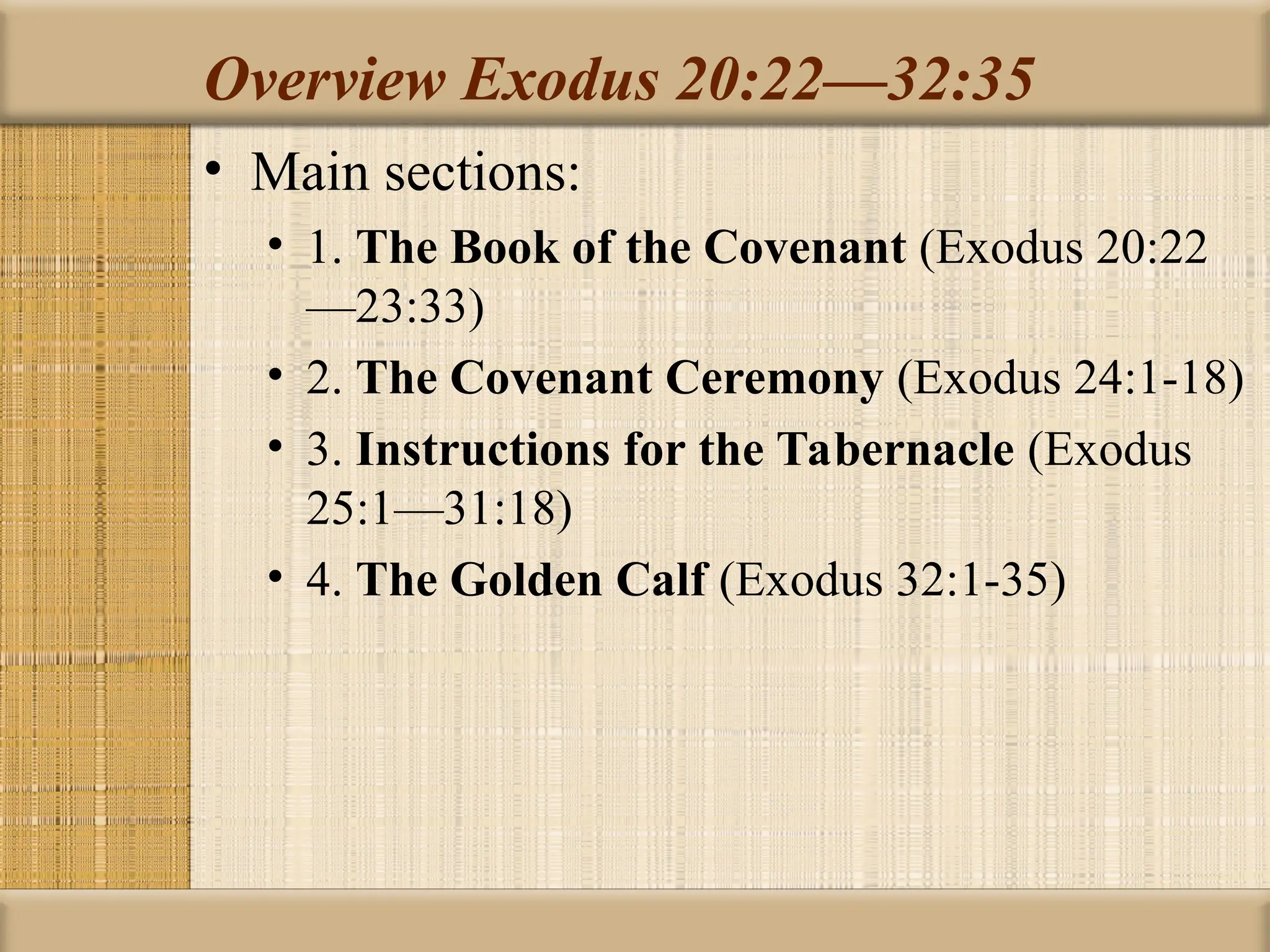
The Instruction Regarding Altars (Exodus 20:22–26)
Concluding the chapter, God provides immediate instructions regarding how He is to be worshiped in the wake of the commandments:
- No Idolatrous Images: God reiterates that the people must not make silver or gold gods alongside Him.
- Altars of Earth or Unhewn Stone: If they build an altar of stone, they must not use chisels or iron tools. Cutting stones would imply human craftsmanship and aesthetic enhancement of the sacred space, keeping worship strictly focused on divine provision rather than human artistry.
- Steps Prohibited: Altars must not have steps, ensuring that the priest's nakedness or vulnerability is not exposed while ascending, maintaining decorum before a holy God.
Common Misconceptions and Interpretations
When studying Exodus 20, several theological and historical nuances are frequently misunderstood:
- Legalism vs. Covenant: Many modern readers assume the Ten Commandments are an impossible hurdle list for earning heaven. In historical context, they are covenant stipulations given to a people already redeemed from Egypt.
- The Sabbath Mandate: Debates persist regarding whether the Sabbath rule is universally binding on New Testament believers in its strict seventh-day formulation, or whether its principle is fulfilled in spiritual rest through Christ.
- Absolute Pacifism vs. "Do Not Murder": The Hebrew word ratsah specifically denotes murder, not all forms of killing. Classical commentators note that this distinction allows for capital punishment and lawful warfare within the ancient Mosaic judicial system, while fiercely condemning unlawful homicide.
Frequently Asked Questions
Are the Ten Commandments in Exodus 20 the same as those in Deuteronomy 5?
Yes, the substance of the Ten Commandments is identical in both Exodus 20 and Deuteronomy 5, though minor variations exist in the wording—particularly in the reasoning provided for the Sabbath command. Exodus roots the Sabbath in creation, while Deuteronomy roots it in the remembrance of slavery and deliverance in Egypt.
How many total commandments are found in the entire book of Exodus?
While the Ten Commandments are the most famous, traditional Jewish scholarship counts 613 total commandments (mitzvot) across the Torah (Genesis through Deuteronomy), with many elaboration statutes following Exodus 20 in chapters 21–23 (often called the Covenant Code).
Why does God describe Himself as visiting the iniquity of fathers upon children?
Exodus 20:5 states that God visits the iniquity of the fathers on the children to the third and fourth generation of those who hate Him. Sociologically and generationally, dysfunctional behaviors, idolatrous patterns, and systemic sins cycle down through family lines. However, individual moral accountability is affirmed elsewhere in scripture (e.g., Ezekiel 18), balancing corporate consequence with personal choice.
What is the theological significance of God speaking directly to the people?
Unlike other ancient Near Eastern law codes where kings claimed to receive laws in secret or through private divine revelation, the Decalogue was spoken audibly to an entire national assembly of hundreds of thousands of witnesses, authenticating its divine origin beyond dispute.
How do different Christian traditions number the Ten Commandments?
There are three primary numbering traditions: the Augustinian/Roman Catholic and Lutheran tradition (which combines the prohibition of other gods and idols into one and splits coveting into two), the Philo/Septuagint/Greek Orthodox tradition, and the Reformed/Protestant tradition. Despite numbering differences, the textual content remains identical.
Conclusion and Next Actions
Studying Exodus 20 bridges ancient history with enduring moral truth. Whether approached from a Jewish, Christian, or historical-critical perspective, the text provides a timeless blueprint for personal integrity, social justice, and reverence for the sacred. To deepen your understanding of this passage, examine the immediate civil case laws that follow in Exodus 21–23, which demonstrate how these ten broad principles were practically applied to everyday legal disputes in ancient Israelite society.