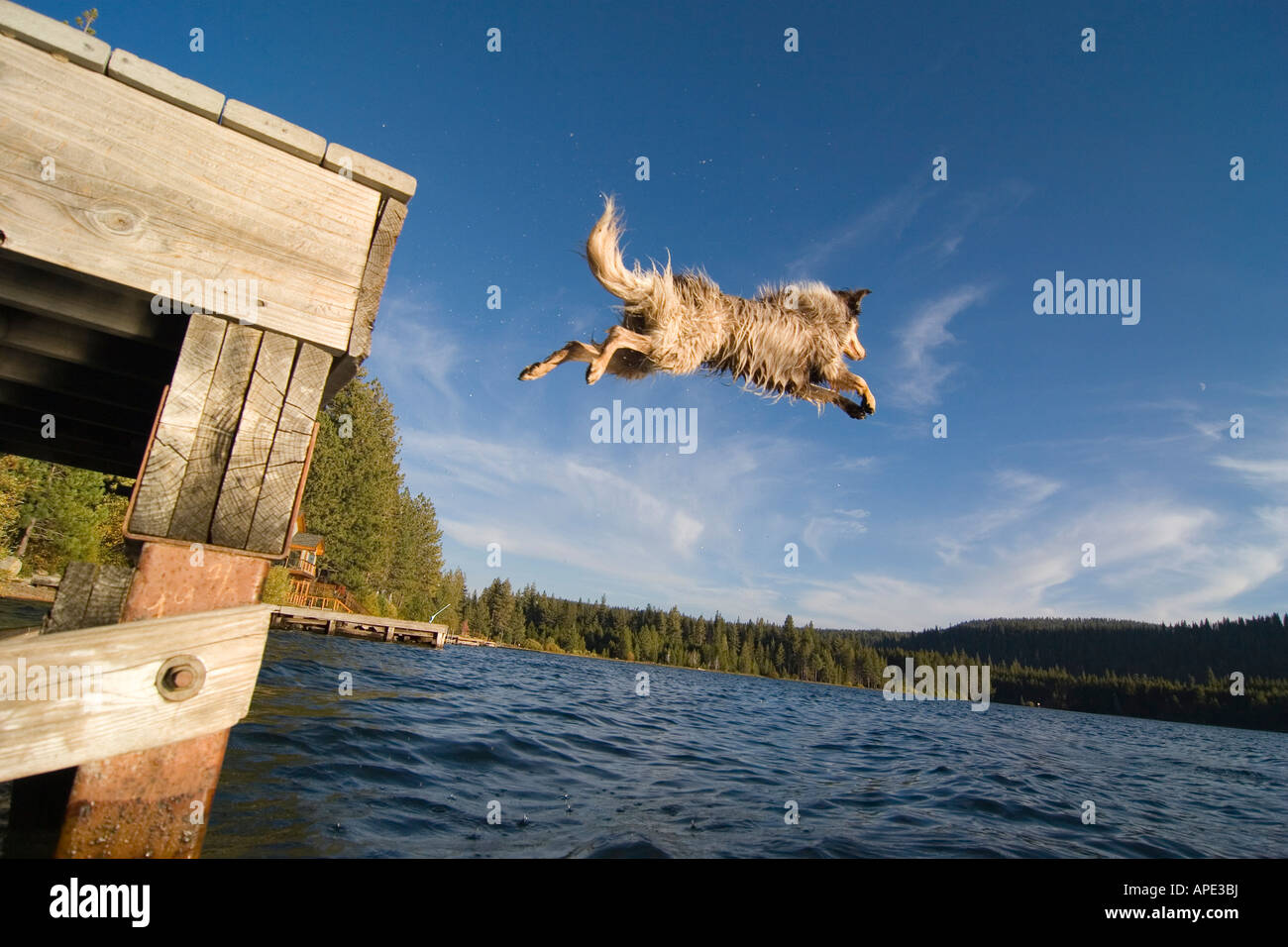
Dogs jump off cliffs primarily due to high prey drive, poor depth perception, or sensory confusion rather than a desire for self-harm. Most incidents occur when a dog chases a bird or small mammal over an edge they fail to perceive. Prevention requires secure leashing in high-risk areas and mastery of emergency "stop" commands.
The sight of a dog leaping into the void is a nightmare for any pet owner. While humans perceive a cliff edge as a definitive boundary between safety and a fatal drop, a dog’s sensory world is constructed differently. To protect a canine companion, one must understand the intersection of canine physiology, predatory instincts, and the physics of high-altitude environments. As we look at the standards for pet safety in 2026, the emphasis remains on proactive management and understanding the biological triggers that lead to these tragic accidents.
Canine Depth Perception and Visual Processing
One of the most common misconceptions is that dogs see the world exactly as humans do. While dogs have a wider field of vision (approximately 240 degrees compared to a human's 180 degrees), their binocular vision—the area where the visual fields of both eyes overlap to provide depth perception—is significantly narrower.
Dogs are specialized for detecting motion rather than fine detail or distant depth. Their eyes contain a high density of rod cells, which excel in low light and motion detection, but fewer cone cells, which handle color and detail. Because of this, a dog standing at the edge of a cliff may not "see" the drop-off in the same way we do. If the ground on the other side of a gap or the base of a cliff is a similar color or texture to the ledge they are standing on, they may perceive a continuous plane of land rather than a vertical drop.
Furthermore, dogs rely heavily on motion parallax to judge distance. This involves moving their head to see how objects shift relative to one another. If a dog is fixated on a moving object—such as a seagull or a squirrel—they may completely bypass this visual processing step, leading them to step into empty space.
The Biological Trigger: High Prey Drive
The most frequent cause of a dog jumping off a cliff is an activated prey drive. This is an instinctive sequence of behaviors: search, eye-stalk, chase, grab-bite, and kill-bite. In many breeds, particularly sighthounds, terriers, and herding dogs, the "chase" instinct is so powerful that it overrides the survival instinct.
When a dog enters a high-arousal state during a chase, they experience a form of "tunnel vision." The prefrontal cortex, which handles higher-level decision-making and impulse control, is effectively bypassed by the amygdala. In this state, the dog is not aware of the cliff, the height, or the danger; they are only aware of the target. This phenomenon is often seen in coastal areas where dogs chase birds off the edges of bluffs. The dog sees the bird flying at "eye level" and assumes there is ground beneath them to support the pursuit.
The "Dog Suicide" Myth: The Case of Overtoun Bridge
No discussion of dogs jumping from heights is complete without addressing the Overtoun Bridge in Scotland. For decades, reports circulated of dogs seemingly "committing suicide" by jumping from the same spot on the bridge. This led to supernatural theories and claims of canine depression.
However, behavioral science and forensic investigations have provided a more grounded explanation. Research conducted by specialists like Dr. David Sands identified that the area beneath the bridge was a nesting ground for mink. Mink have scent glands that produce a powerful, musty odor that is incredibly enticing to dogs.
The bridge’s thick stone parapets (walls) are higher than a dog’s eye level, meaning the dog cannot see the drop on the other side. When the dog catches the overwhelming scent of the mink, they jump over the wall to investigate, unaware that there is a 50-foot drop rather than a grassy bank. This serves as a critical lesson: a dog's nose can lead them into life-threatening situations that their eyes cannot see.
Physics and Biomechanics of a Fall
If a dog does jump or fall, the outcome is dictated by the height, the landing surface, and the dog's weight. Unlike cats, which have a highly developed "righting reflex" and a low terminal velocity relative to their surface area, dogs are less aerodynamic and hit the ground with significantly more force.
Impact Forces and "High-Rise Syndrome"
The term High-Rise Syndrome was originally coined to describe cats falling from apartments, but it applies to dogs as well. Injuries from cliff falls typically include:
- Pneumothorax: A collapsed lung caused by the impact force against the chest wall.
- Mandibular Fractures: Broken jaws often occur because the dog’s head snaps forward upon impact.
- Luxations and Fractures: Distal radius and ulna (forelimb) fractures are common as dogs attempt to "land" on their feet.
- Internal Hemorrhaging: Particularly of the liver and spleen.
The "survival threshold" for dogs is generally much lower than for cats. While a cat might survive a fall from several stories due to their ability to spread their body like a parachute, a dog’s skeletal structure is not designed to absorb such vertical deceleration.
Comparison of Safety Gear for High-Risk Environments
When hiking in cliffside areas or coastal bluffs in 2026, the right equipment is the primary line of defense. The following table compares common restraint systems used for dogs in high-altitude environments.
| Gear Type | Best Use Case | Pros | Cons |
|---|---|---|---|
| Back-Clip Harness | Casual hiking | Reduces neck strain; prevents choking if the dog slips. | Offers little control over a high-energy "lunging" dog. |
| Front-Clip Harness | Training / Pulling | Redirects the dog’s momentum back toward the owner. | Can interfere with a dog's natural gait on uneven terrain. |
| Padded Y-Harness | Technical Terrain | Secure fit; often includes a handle for lifting/stabilizing the dog. | Can be hot in high temperatures; requires precise fitting. |
| Fixed Length Lead (6ft) | High-Edge Zones | Provides maximum control and predictable distance. | Limits the dog’s ability to explore scents. |
| Retractable Leash | NOT RECOMMENDED | Allows freedom of movement. | High failure rate; thin cord can snap; no control at distance. |
Emergency Protocols: What to Do If a Dog Falls
If the worst happens and a dog jumps or falls off a cliff, the owner's immediate actions are critical.
- Do Not Become a Second Victim: Many owners instinctively try to climb down after their dog, leading to human fatalities. Call emergency services or specialized animal rescue teams (like the Coast Guard or mountain rescue).
- Stabilization: If the dog is reachable and alive, do not move them more than necessary. Use a flat board or a coat as a makeshift stretcher to prevent further spinal injury.
- Check for Shock: Symptoms include pale gums, rapid heartbeat, and cool extremities. Keep the dog warm with a blanket.
- Muzzle the Dog: Even the gentlest dog may bite when in extreme pain or shock. Use a bandage or a piece of clothing to gently secure the snout, provided the dog is not vomiting or having difficulty breathing.
- Immediate Veterinary Transport: Even if the dog appears fine, internal injuries (like a ruptured bladder or internal bleeding) can be fatal hours later. A 2026 veterinary standard involves immediate ultrasound (A-FAST) to check for internal fluid.
Training the "Emergency Stop"
The best defense against a dog jumping off a cliff is a "bomb-proof" recall or an emergency stop. Most owners focus on "Come," but in a cliffside scenario, an Emergency Down or Stop is often more effective. This command tells the dog to drop into a lying position exactly where they are, stopping their forward momentum toward the edge.
To train this, start in a low-distraction environment. Use a high-value reward that the dog only receives for this specific command. The goal is to create a muscle-memory response where the dog drops the moment they hear the whistle or shout, regardless of what they are chasing.
Essential Safety Checklist for Coastal and Mountainous Hiking
To ensure a safe outing in 2026, follow these specific guidelines before approaching any cliffside environment:
- Check Wind Conditions: High winds can carry scents from below (like the Overtoun mink) or mask the sound of your voice, making a recall impossible.
- Scout the Terrain: Use updated satellite maps or local trail guides to identify "blind edges"—areas where the trail appears to continue but actually drops off.
- The "Short-Leash" Rule: Whenever you are within 15 feet of a drop-off, the dog must be on a fixed-length lead attached to a secure harness, not a collar.
- Monitor Fatigue: A tired dog is more likely to stumble or make poor tactical decisions when navigating rocky edges.
Frequently Asked Questions
Do dogs understand the concept of a cliff?
Dogs understand height to a degree, but their understanding is limited by their visual physiology. They lack the binocular depth perception of humans and may not recognize a drop-off if the lighting is flat or if they are focused on prey. They do not have a concept of "death" or "suicide"; they see the world as a series of physical challenges and rewards.
Can a dog survive a fall from a cliff?
Survival depends on the height, the angle of the slope, and the landing surface (water vs. rock). Falls from over 30 feet are frequently fatal for dogs due to their weight-to-surface-area ratio. However, dogs have survived significant falls when they hit soft vegetation or steep slopes that allowed them to slide rather than impact directly.
Are certain breeds more likely to jump off cliffs?
Breeds with high prey drives, such as Greyhounds, Whippets, Jack Russell Terriers, and Border Collies, are at higher risk. These breeds are more likely to experience "predatory drift," where their focus on a target becomes so absolute that they lose awareness of their physical surroundings.
Should I use a retractable leash near a cliff?
No. Retractable leashes are highly dangerous in cliffside environments. The thin cords can easily snap if a dog lunges, and the plastic handle is difficult to hold onto if the dog's full weight is pulled by gravity. Furthermore, you cannot "reel in" a dog that is already falling; a fixed, heavy-duty lead is the only safe option.
What is the "High-Rise Syndrome" in dogs?
This is a clinical term for the specific set of injuries dogs and cats sustain when falling from significant heights. In dogs, this usually includes thoracic (chest) trauma, facial fractures, and injuries to the front limbs. Veterinary treatment focuses on stabilizing the lungs before addressing broken bones.
Practical Recommendation
When visiting cliffside locations, never assume your dog's "common sense" will keep them safe. The combination of a powerful nose and a high prey drive can easily lead even the most well-trained dog into a fatal error. Always use a non-retractable lead and a Y-shaped harness when walking near edges. Before your trip, reinforce "Stop" and "Wait" commands using high-value rewards. If you live in or frequently visit high-risk areas, consider enrolling in a "rattlesnake-style" aversion training specifically adapted for terrain boundaries, which teaches dogs to view the edge of a cliff as a "negative" space to be avoided.