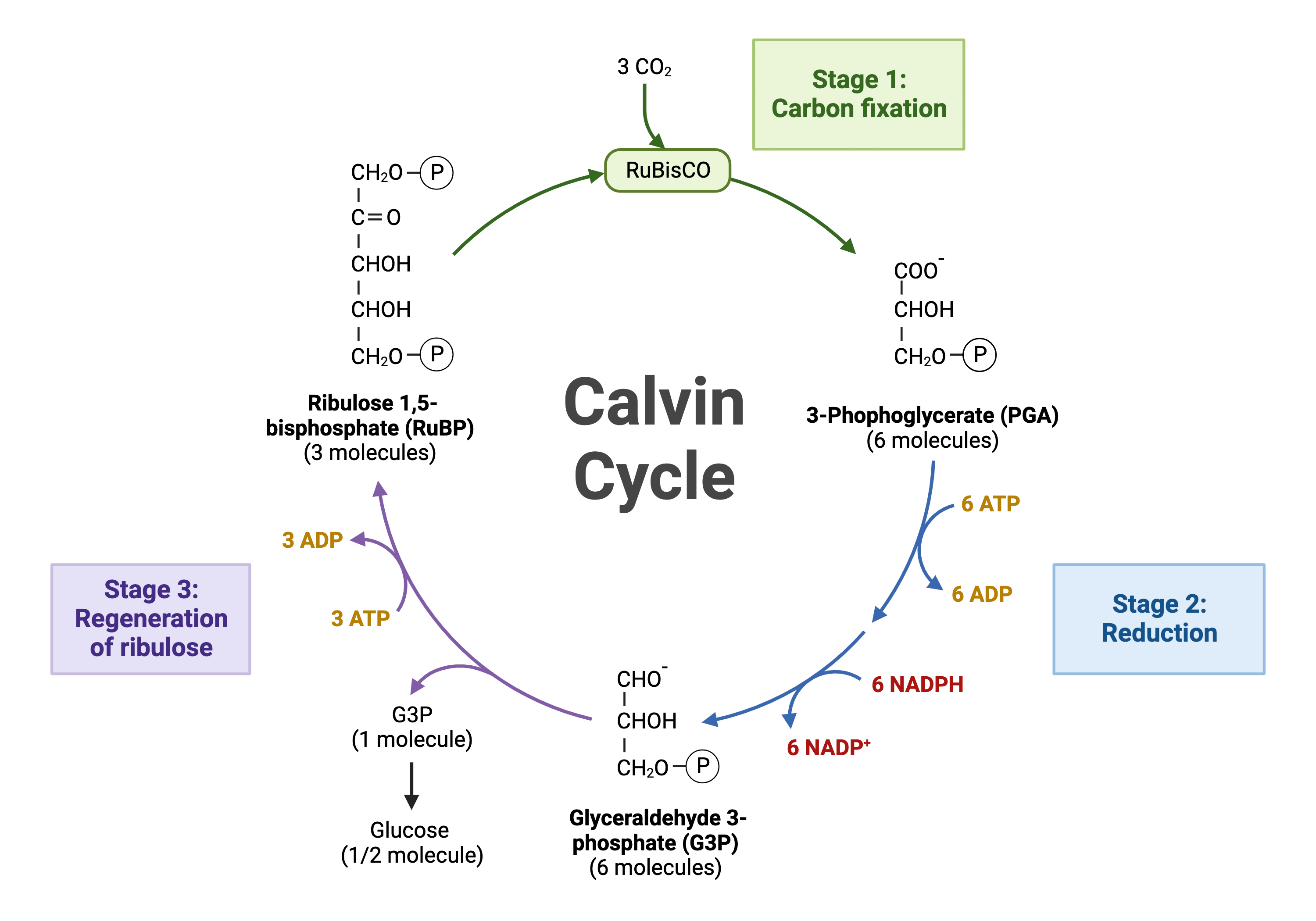
In the Calvin cycle, Adenosine Triphosphate (ATP) serves as the essential energy currency that powers the conversion of inorganic carbon dioxide into organic glucose precursors. ATP provides the necessary chemical energy to phosphorylate 3-phosphoglycerate during the reduction phase and facilitates the structural rearrangement of glyceraldehyde-3-phosphate into ribulose-1,5-bisphosphate during the regeneration phase.
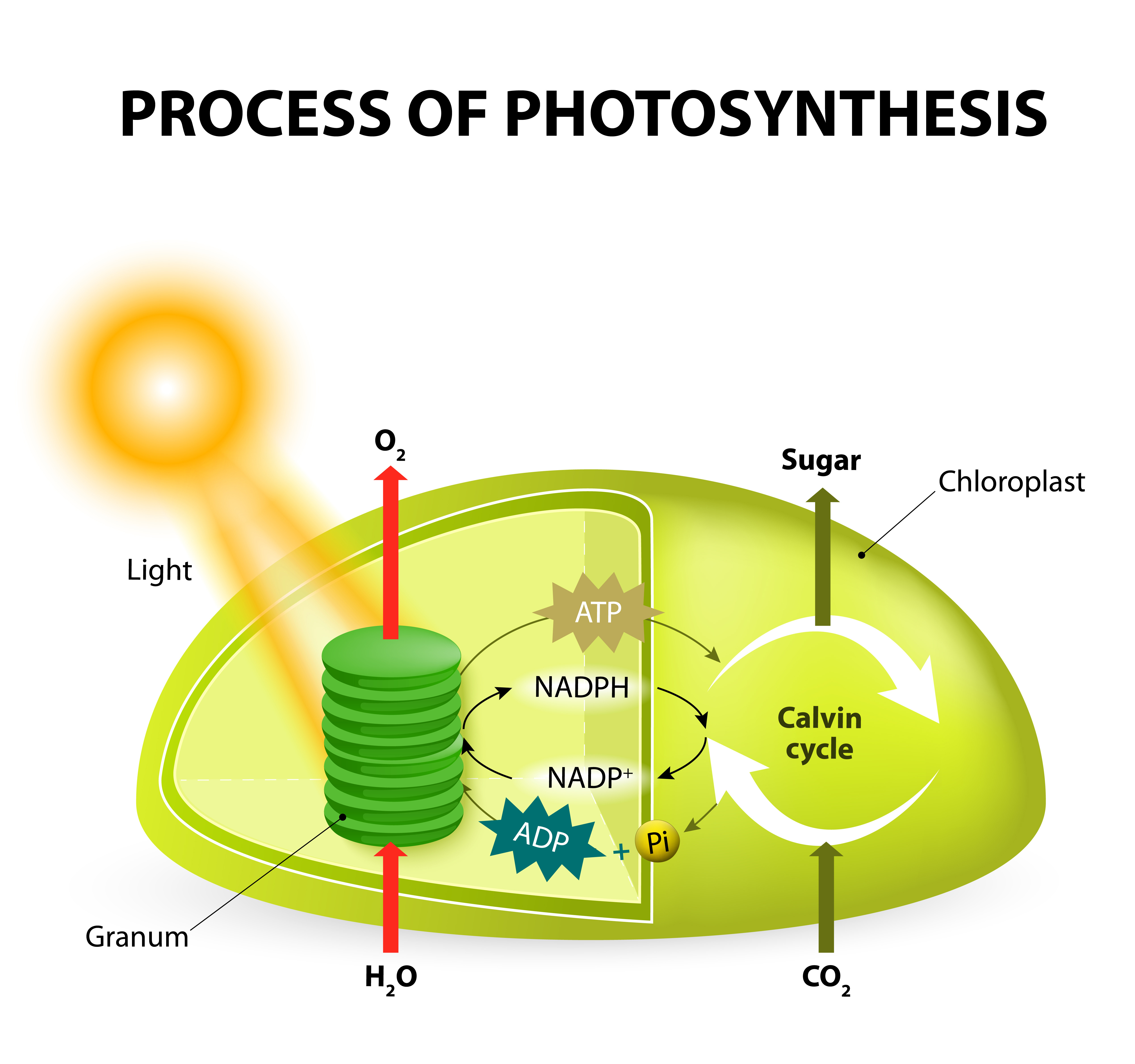
The biological process of photosynthesis is often simplified into two distinct stages: the light-dependent reactions and the light-independent reactions, also known as the Calvin cycle. While the light-dependent reactions capture solar energy to produce oxygen and high-energy molecules, it is the Calvin cycle where the actual "synthesis" part of photosynthesis occurs. Within the stroma of the chloroplast, a complex series of biochemical reactions takes place to manufacture the sugars that sustain nearly all life on Earth.
At the heart of this manufacturing process is ATP. Without a constant supply of this molecule, the cycle would grind to a halt, leaving the plant unable to store energy or build structural components. To understand how ATP fuels the Calvin cycle, we must examine the specific molecular transitions where energy is consumed and how that energy is translated into stable chemical bonds.
The Architectural Context of the Calvin Cycle
The Calvin cycle occurs in the stroma, the fluid-filled space surrounding the thylakoid membranes within the chloroplast. This localization is strategic. The light-dependent reactions occur on the thylakoid membranes, pumping protons and generating ATP and NADPH directly into the stroma. This ensures that the "fuel" (ATP) and the "reducing power" (NADPH) are immediately available for the enzymes of the Calvin cycle.
As of 2026, our understanding of the spatial organization of these enzymes suggests they are not merely floating freely but are often organized into multi-enzyme complexes. This "metabolon" arrangement increases the efficiency of the cycle by channeling intermediates from one enzyme to the next, minimizing the loss of energy as ATP is hydrolyzed.
Stage 1: Carbon Fixation and the Preparation for Energy Input
Before ATP can do its work, the cycle must first "fix" inorganic carbon. This is handled by the enzyme ribulose-1,5-bisphosphate carboxylase/oxygenase, commonly known as RuBisCO. RuBisCO catalyzes the reaction between a five-carbon sugar called ribulose-1,5-bisphosphate (RuBP) and a molecule of carbon dioxide ($CO_2$).
This reaction produces an unstable six-carbon intermediate that immediately splits into two molecules of 3-phosphoglycerate (3-PGA). At this specific juncture, no ATP has been consumed. However, 3-PGA is a relatively low-energy molecule. To transform it into a high-energy sugar like glucose, the system must "prime" the molecule by adding energy and electrons. This is where the fueling role of ATP begins.
Stage 2: The Reduction Phase and ATP’s First Major Role
The reduction phase is the primary "uphill" energetic climb of the Calvin cycle. The goal here is to convert 3-PGA into glyceraldehyde-3-phosphate (G3P), which is a true sugar precursor. This transformation occurs in two distinct steps, the first of which is entirely dependent on ATP.
Phosphorylation of 3-PGA
The enzyme phosphoglycerate kinase facilitates the transfer of a phosphate group from ATP to 3-PGA. In this reaction, one molecule of ATP is hydrolyzed into Adenosine Diphosphate (ADP), and the phosphate is attached to the 3-PGA molecule, forming 1,3-bisphosphoglycerate (1,3-BPG).
Why is this step necessary? By adding a second phosphate group, the molecule becomes more reactive and carries a higher potential energy. This "phosphorylation" is a classic example of ATP fueling a reaction by creating a high-energy intermediate that can more easily undergo subsequent chemical changes.
Reduction by NADPH
Once 1,3-bisphosphoglycerate is formed, it is reduced by NADPH. The enzyme glyceraldehyde-3-phosphate dehydrogenase removes the newly added phosphate group and adds electrons (and a proton) from NADPH. This results in the formation of G3P. While the phosphate group added by ATP is ultimately released, its brief presence was the catalyst that allowed the reduction to occur. Without the initial "push" from ATP, the reduction by NADPH would be thermodynamically unfavorable.
Stage 3: The Regeneration of RuBP
For the Calvin cycle to be a true cycle, the starting material—ribulose-1,5-bisphosphate (RuBP)—must be regenerated. If the plant simply used up all its RuBP to make sugars, the process would stop after a few rotations.
The regeneration phase is a complex series of reshuffling reactions where five molecules of G3P (each containing three carbons) are rearranged to form three molecules of RuBP (each containing five carbons). This process involves several intermediate sugars with three, four, five, six, and seven carbon atoms.
The final step of this rearrangement requires a second input of ATP. The enzyme phosphoribulokinase catalyzes the phosphorylation of ribulose-5-phosphate into ribulose-1,5-bisphosphate. This reaction consumes one molecule of ATP per RuBP regenerated. This investment of energy is vital because RuBP must be in a high-energy, bisphosphorylated state to be receptive to $CO_2$ fixation by RuBisCO in the next turn of the cycle.
Stoichiometry: The ATP "Cost" of Sugar Production
To understand the scale at which ATP fuels the Calvin cycle, we look at the stoichiometry required to produce one net molecule of G3P. To export one G3P molecule for sugar synthesis, the cycle must fix three molecules of $CO_2$.
| Process Step | Molecule Count (for 3 $CO_2$) | ATP Consumed | NADPH Consumed |
|---|---|---|---|
| Reduction Phase | 6 molecules of 3-PGA | 6 ATP | 6 NADPH |
| Regeneration Phase | 5 molecules of G3P $\rightarrow$ 3 RuBP | 3 ATP | 0 NADPH |
| Total per net G3P | — | 9 ATP | 6 NADPH |
| Total per Glucose | — | 18 ATP | 12 NADPH |
As shown in the table, the regeneration phase accounts for one-third of the total ATP consumption in the cycle. This highlights that "fueling" the cycle isn't just about building the sugar; it is equally about maintaining the machinery (RuBP) required to keep the factory running.
The Thermodynamic Necessity of ATP
From a thermodynamic perspective, the Calvin cycle is highly endergonic, meaning it requires a net input of energy. Carbon dioxide is a very stable, low-energy molecule. Glucose and other carbohydrates are complex, high-energy molecules. Moving from a low-energy state to a high-energy state violates the second law of thermodynamics unless energy is coupled from an external source.
ATP provides this coupling. When ATP is hydrolyzed to ADP and inorganic phosphate ($P_i$), the Gibbs free energy change ($\Delta G$) is approximately -30.5 kJ/mol under standard conditions. By coupling this "downhill" (exergonic) reaction with the "uphill" (endergonic) reactions of carbon fixation and regeneration, the plant ensures the overall process remains spontaneous and efficient.
Sources and Regulation of the ATP Supply
The ATP fueling the Calvin cycle is generated through photophosphorylation in the thylakoid membranes. There are two pathways for this:
- Non-cyclic photophosphorylation: Produces both ATP and NADPH in a roughly 1:1 ratio.
- Cyclic photophosphorylation: Produces only ATP.
Because the Calvin cycle requires more ATP than NADPH (a 3:2 ratio), plants often switch to cyclic electron flow to make up the ATP deficit. This physiological flexibility ensures that the Calvin cycle is never "starved" for fuel, even when light conditions change.
Furthermore, the cycle is tightly regulated. In the absence of light, ATP levels in the stroma drop. Enzymes like phosphoribulokinase and RuBisCO are sensitive to these levels and to changes in pH and magnesium concentration that occur when the light-dependent reactions are active. This prevents the cycle from consuming precious ATP reserves during the night when they cannot be replenished.
Potential Disruptions to ATP Fueling
Several factors can interfere with the way ATP fuels the Calvin cycle, leading to reduced agricultural yields or plant stress:
- Phosphate Deficiency: If a plant lacks inorganic phosphate, it cannot regenerate ATP from ADP. This leads to a bottleneck in the Calvin cycle, regardless of how much sunlight is available.
- Temperature Stress: High temperatures can cause the thylakoid membranes to become "leaky" to protons. This dissipates the proton gradient used to make ATP, effectively cutting off the fuel supply to the Calvin cycle.
- Drought and Stomatal Closure: When plants close their stomata to save water, $CO_2$ levels drop. The Calvin cycle slows down, and the lack of ADP and $NADP^+$ recycling can lead to an energy "backup" that damages the photosynthetic apparatus.
Frequently Asked Questions
Why does the Calvin cycle need ATP if it also uses NADPH?
ATP and NADPH serve different functions. ATP provides the "activation energy" and phosphate groups necessary to make the carbon molecules reactive. NADPH provides the high-energy electrons (reducing power) needed to convert those organic acids into sugars. Think of ATP as the power to turn the machine and NADPH as the raw material (electrons) used to build the product.
Is ATP used in the carbon fixation step of the Calvin cycle?
No, the initial fixation of $CO_2$ by RuBisCO does not directly consume ATP. However, the cycle cannot continue past that point without ATP, which is used in the subsequent reduction and regeneration phases.
What happens to the ADP and $P_i$ after ATP is used in the cycle?
The ADP and inorganic phosphate ($P_i$) molecules diffuse back to the thylakoid membranes. There, the enzyme ATP synthase uses the proton gradient generated by the light-dependent reactions to "recharge" them back into ATP.
Can the Calvin cycle run at night using stored ATP?
Generally, no. The Calvin cycle requires a significant amount of ATP—more than the plant can store in the stroma. Additionally, many Calvin cycle enzymes are light-activated. While the cycle can run for a very brief period after the lights go out, it quickly stops as ATP is depleted and enzymes are deactivated.
Does the C4 pathway require more ATP than the C3 pathway?
Yes. The C4 pathway, which plants like corn and sugarcane use to minimize photorespiration, requires additional ATP to pump $CO_2$ into specialized bundle-sheath cells. While the basic Calvin cycle still uses 9 ATP per G3P, the C4 "pump" adds an extra energy cost, usually bringing the total to about 15 ATP per G3P.
Summary of Next Actions for Students and Researchers
To deepen your understanding of how ATP fuels the Calvin cycle, it is recommended to explore the specific molecular structure of phosphoglycerate kinase. Understanding how this enzyme binds both ATP and 3-PGA will clarify the mechanism of energy transfer. For those interested in the broader ecological impact, researching how "ATP-limited" photosynthesis affects plant growth in low-light environments (like forest floors) provides practical context to these biochemical principles. As we move through 2026, advances in synthetic biology are even looking into "redesigning" these ATP-dependent steps to create more energy-efficient crops, making this a pivotal area of ongoing research.