In Arizona, a holographic will is a handwritten document that serves as a legally binding last will and testament, valid even without witnesses or notarization. Under Arizona Revised Statutes § 14-2503, such a will is recognized if the signature and the material provisions are clearly in the testator’s handwriting.
Estate planning in 2026 continues to evolve with digital tools, yet the traditional holographic will remains a vital safety net for Arizona residents. Whether created in an emergency or as a matter of personal preference, these handwritten documents carry the full weight of the law—provided they strictly adhere to specific statutory requirements. Navigating the nuances of Arizona probate law is essential to ensure that a handwritten expression of final wishes is not discarded by the court as invalid.
The Legal Foundation of Holographic Wills in Arizona
The primary statute governing holographic wills in the state is Arizona Revised Statutes (A.R.S.) § 14-2503. This law provides a critical exception to the standard requirements for a formal will. In a typical formal will (governed by A.R.S. § 14-2502), the document must be typed, signed by the testator, and witnessed by at least two credible individuals.
The holographic exception recognizes that a person's unique handwriting serves as a form of authentication that can be just as reliable as witnesses. Because no two people share identical handwriting characteristics, Arizona law allows the court to accept a document that lacks the "formalities" of a traditional will, so long as it is authentically produced by the person whose estate is at stake.
In 2026, while many people utilize Electronic Wills—which were authorized in Arizona under A.R.S. § 14-2518—the holographic will remains distinct. An electronic will requires a digital signature and electronic witnesses or a notary. A holographic will, conversely, is a physical, analog document. It is often the last resort for individuals who do not have access to legal counsel or technology during their final moments.
Three Essential Requirements for Validity
To be upheld in an Arizona probate court, a holographic will must satisfy three core criteria. If any of these are missing, the document may be ruled invalid, and the estate will be distributed according to Arizona’s intestacy laws (which dictate how assets are split among relatives when no will exists).
1. The "Material Provisions" Must Be Handwritten
Arizona law is specific: the "material provisions" of the will must be in the testator's own handwriting. Material provisions include the designation of beneficiaries (who receives the property) and the specific bequests (what they receive).
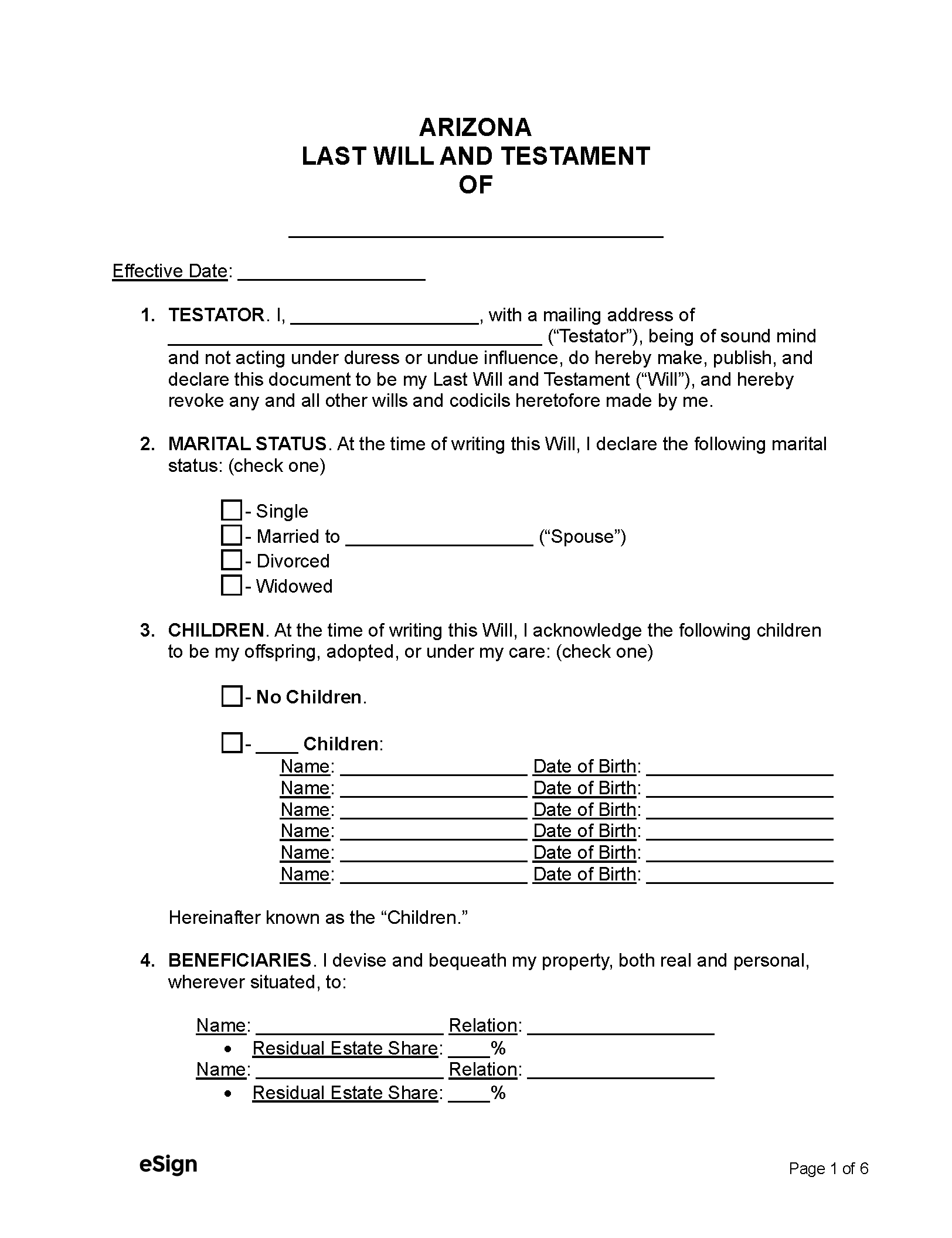
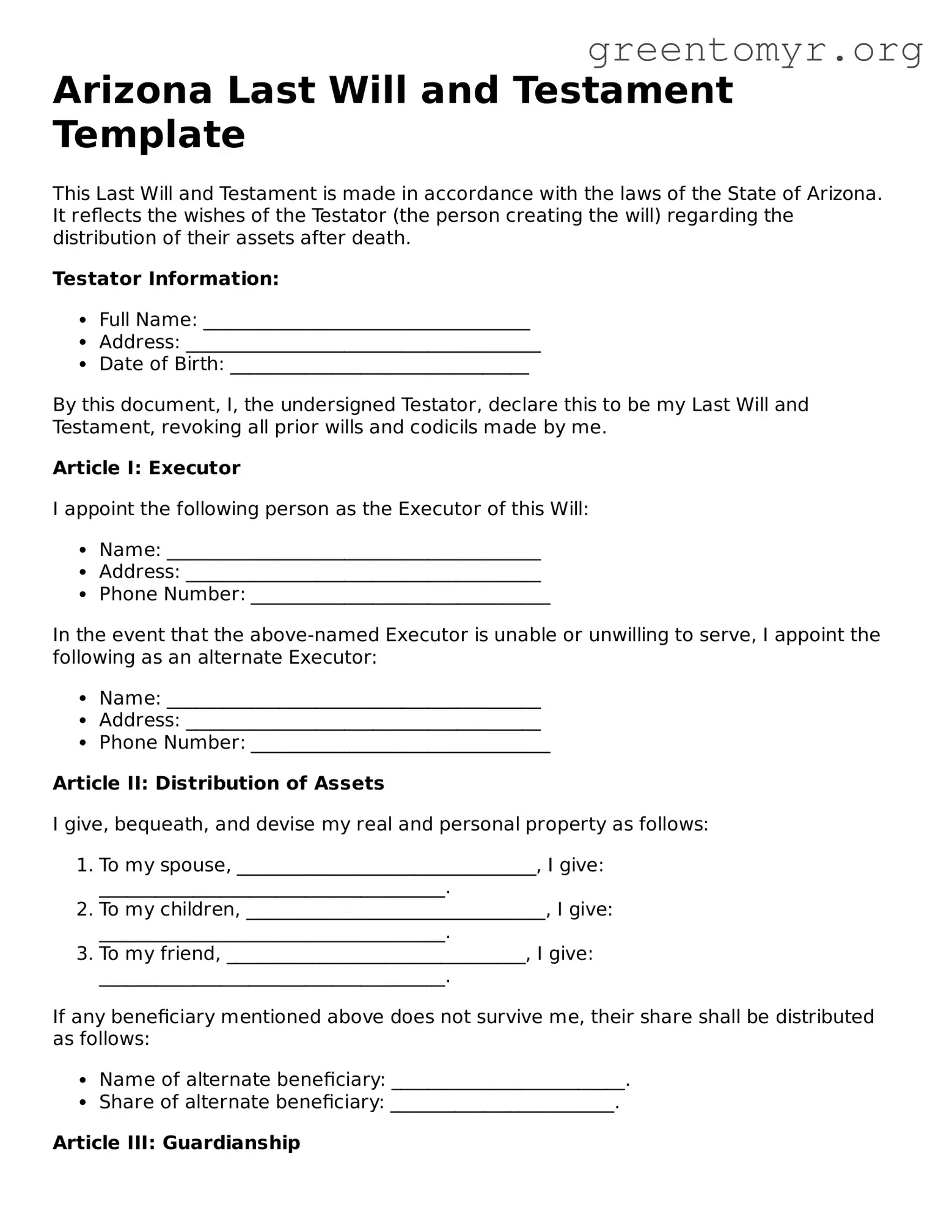
A common mistake occurs when a person uses a pre-printed "Will Kit" or a fill-in-the-blank form. If the essential instructions are typed and the testator only fills in names, the document may fail the holographic test because the material provisions are not handwritten. However, Arizona courts have historically applied the "surplusage theory," where they may ignore typed portions of a document if the handwritten portions can stand alone as a complete will.
2. The Signature
The document must be signed by the testator. While the signature does not necessarily have to be at the very end of the document, placing it there is the best practice to demonstrate that the testator has finished their instructions. The signature must be in the same handwriting as the rest of the material provisions to ensure consistency and proof of origin.
3. Testamentary Intent
The document must clearly show that the writer intended for it to serve as their will. It is not enough to write a letter saying, "I'm thinking about leaving my house to John." The language must be definitive: "I give my house to John upon my death." This is known as testamentary intent. Without clear language indicating that the document is meant to dispose of property after death, the court may view the writing as a mere draft or a letter of intent rather than a binding legal instrument.
The Role of Witnesses and Notaries
One of the most significant advantages of an Arizona holographic will is the lack of a witness requirement. For a formal will to be valid in Arizona, two witnesses must observe the testator signing the document and then sign it themselves.
In a holographic will, no witnesses are required. This makes the holographic will an ideal solution for individuals in isolation, those in hospice care, or those facing sudden life-threatening circumstances. Similarly, notarization is not required for a holographic will to be valid. While a "self-proving affidavit" (which requires a notary) is common in formal wills to speed up probate, a holographic will is proven after death through the testimony of people who can verify the decedent's handwriting.
Comparison of Will Types in Arizona (2026)
| Feature | Formal Will (A.R.S. § 14-2502) | Holographic Will (A.R.S. § 14-2503) | Electronic Will (A.R.S. § 14-2518) |
|---|---|---|---|
| Format | Typed/Printed | Entirely Handwritten | Digital File |
| Witnesses Required | Yes (Two witnesses) | No | Yes (Two or Electronic Notary) |
| Notarization | Optional (for self-proving) | No | Required |
| Signature | Physical Ink | Physical Ink (Handwritten) | Electronic/Digital |
| Ease of Challenge | Harder to challenge | Easier to challenge | Moderate |
| Best Use Case | Complex estates | Emergency or simple estates | Tech-savvy users |
Step-by-Step Guide to Creating a Holographic Will in Arizona
If you choose to create a holographic will, following these steps will minimize the risk of the document being successfully contested in probate.
- Use Plain Paper: Start with a clean, blank sheet of paper. Avoid using company letterhead or paper that has any pre-printed text on it, as this can complicate the "material provisions" requirement.
- State Your Intent Clearly: Begin the document with a statement such as, "This is my last will and testament." This immediately establishes testamentary intent for the court.
- Identify Yourself: State your full legal name, your current residence (to establish Arizona jurisdiction), and your date of birth.
- List Your Beneficiaries: Clearly name the individuals or organizations you wish to inherit your assets. Use full legal names rather than nicknames to avoid ambiguity.
- Assign Specific Assets: Clearly describe what each person is to receive. If you wish to leave everything to one person, state, "I leave my entire estate, including all real and personal property, to [Name]."
- Appoint a Personal Representative: Name an executor (referred to in Arizona as a "Personal Representative") to manage your estate. It is also wise to name an alternate in case your first choice is unable to serve.
- Include a Date: While Arizona law does not strictly require a holographic will to be dated, it is highly recommended. If multiple wills are found, the date proves which one is the most recent and, therefore, the one that should be honored.
- Sign the Document: Sign your name at the bottom of the last page. Do not have anyone else sign it, as adding witnesses to a holographic will—while not invalidating it—can sometimes cause confusion regarding whether you intended it to be a formal or holographic will.
Common Pitfalls and Why Holographic Wills are Often Contested
Despite their convenience, holographic wills are among the most frequently litigated documents in the Arizona probate system. Several factors contribute to this volatility.
Ambiguous Language
Because most holographic wills are written without the guidance of an attorney, the language used is often imprecise. A testator might write, "I want my kids to share my stuff." This leaves the court to decide what "stuff" includes (Real estate? Digital assets? Personal jewelry?) and how it should be shared (Equally? By value?). In 2026, the definition of "assets" has expanded significantly to include cryptocurrency, social media accounts, and digital intellectual property; failing to specify these can lead to prolonged legal battles.
Issues of Capacity and Undue Influence
Opponents of a will often argue that the testator lacked the mental capacity to understand what they were doing at the time of writing. With a formal will, the witnesses can testify to the testator’s state of mind. With a holographic will, there are no witnesses to corroborate that the testator was of "sound mind." Similarly, if a beneficiary is the one who "found" the handwritten will, other family members may claim the beneficiary pressured the decedent to write it (undue influence).
Handwriting Authentication
If a holographic will is contested, the burden of proof lies in authenticating the handwriting. This often requires hiring a forensic document examiner. Family members may need to provide other examples of the decedent's handwriting—such as grocery lists, letters, or signed checks—to compare with the will. If the handwriting is shaky due to illness or age, the authentication process becomes even more difficult.
Arizona Probate: The Process for Handwritten Wills
When a person passes away with a holographic will in Arizona, the document must be submitted to the Superior Court in the county where the decedent resided. The probate process generally follows these stages:
- Petition for Probate: The person named as the Personal Representative files a petition to open probate and validates the will.
- Notification: All legal heirs and potential creditors must be notified that the will is being probated. This gives them a window of time to contest its validity.
- Proof of Handwriting: If no one contests the will, the court may accept it based on an affidavit from someone familiar with the decedent’s handwriting. If it is contested, a formal hearing is scheduled.
- Asset Collection and Debt Payment: The Personal Representative gathers the assets, pays any outstanding taxes and debts, and manages the estate's finances.
- Distribution: Once the court is satisfied that the will is valid and all debts are settled, the assets are distributed to the beneficiaries named in the handwritten document.
Addressing Digital Assets in 2026
A significant challenge for modern holographic wills is the inclusion of digital assets. In 2026, many Arizonans hold significant value in digital realms—ranging from cryptocurrency wallets and NFTs to monetized social media channels and cloud-stored intellectual property.
While a holographic will can legally transfer these assets, the testator must be careful to provide enough information for the Personal Representative to access them. However, for security reasons, one should never write passwords or private keys directly in the will, as the will becomes a public record once filed with the court. Instead, the holographic will should refer to a separate, private "digital asset memorandum" or a password management tool that the executor is authorized to access.
FAQ: Arizona Holographic Wills
Can a holographic will be written on anything other than paper?
Legally, a holographic will must be a "writing." While there are historical cases of wills written on unconventional surfaces (like a tractor fender or a wall), Arizona courts generally look for a portable, durable medium. Writing on a napkin or a scrap of paper is legally permissible, but it significantly increases the risk of the document being lost or damaged before it can be probated.
Does a handwritten will need to be "self-proving" in Arizona?
No. A self-proving will is a specific legal term for a formal will that includes a notarized affidavit, which allows it to be admitted to probate without the testimony of witnesses. A holographic will is never "self-proving" in the traditional sense; it always requires some form of verification of the handwriting after the testator's death.
If I have a typed will, can I change it with a handwritten note?
This is a risky practice. Handwritten changes to a typed will (interlineations) are often ignored by the court unless they meet the full requirements of a holographic codicil. If you want to change your will, it is better to write an entirely new holographic will that states, "I revoke all prior wills and codicils," or to execute a formal amendment with witnesses.
Is a holographic will from another state valid in Arizona?
Arizona law generally recognizes wills that were valid in the place where they were executed. Under A.R.S. § 14-2506, if you wrote a holographic will in a state that also recognizes them (like California or Texas) and then moved to Arizona, the court will typically honor it. However, it is always safer to create a new document that complies with Arizona’s specific statutes upon moving.
What happens if the handwriting is illegible?
If the material provisions of a holographic will cannot be read, the court cannot enforce them. If only part of the will is illegible, the court may enforce the parts it can read and distribute the remainder of the estate through intestacy. Clarity is paramount when drafting any handwritten legal document.
Recommendation for Next Actions
While an Arizona holographic will is a legally valid tool, it should generally be viewed as a temporary or emergency measure rather than a permanent estate plan. The potential for litigation, the difficulty of proving handwriting, and the risks of ambiguous language make it less secure than a formal, witnessed will or a comprehensive living trust.
If you currently rely on a holographic will, consider the following actions:
- Consult an Attorney: Have a legal professional review your handwritten document to ensure it meets the material provision requirements of A.R.S. § 14-2503.
- Formalize Your Plan: If time and resources allow, convert your holographic will into a formal witnessed will or an electronic will. This provides a stronger "presumption of validity" in court.
- Storage: Keep your holographic will in a fireproof safe or a bank safe deposit box, and ensure your named Personal Representative knows where it is located and how to access it. A will is useless if it cannot be found after your passing.