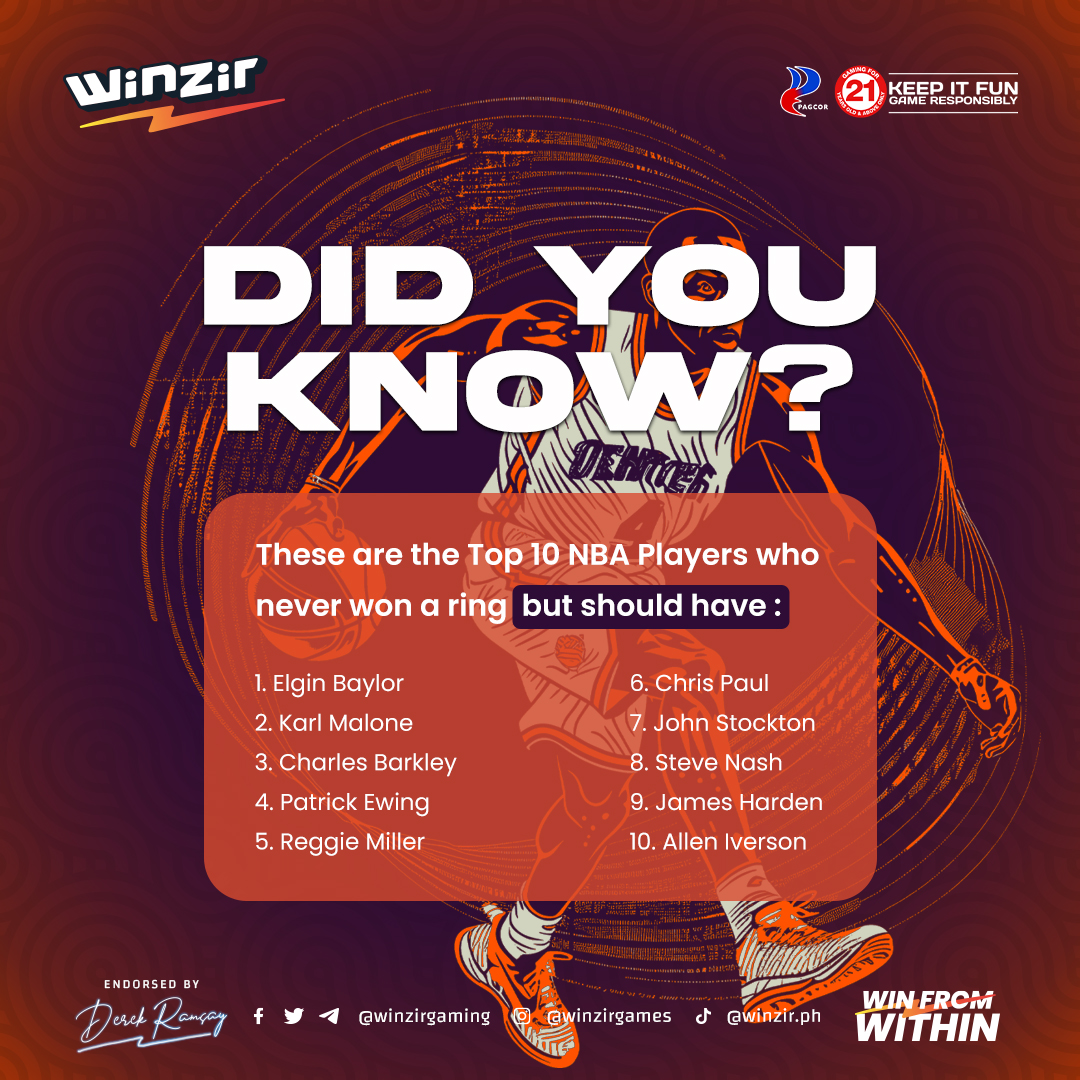
The debate over the greatest basketball players in history often revolves around championship rings, yet some of the game's most exceptional talents never captured an NBA title. These legendary scorers, playmakers, and defenders shaped the sport through individual brilliance, setting records and winning regular-season MVP awards while falling short in the postseason.
In the history of the National Basketball Association (NBA), ultimate team success requires a complex convergence of superstar talent, roster depth, coaching, front-office execution, and physical health. Many all-time greats spent their entire careers carrying inferior rosters, running into legendary dynasties like the Boston Celtics, Chicago Bulls, or Los Angeles Lakers, or suffering untimely injuries during deep playoff runs. Evaluating these players requires looking beyond the absence of a championship trophy to examine their statistics, individual accolades, advanced metrics, and enduring impact on the game of basketball.
1. Elgin Baylor
Elgin Baylor revolutionized the small forward position with an unprecedented blend of high-flying athleticism, body control, and scoring volume. Playing his entire 14-year career with the Minneapolis and Los Angeles Lakers, Baylor averaged 27.4 points and 13.5 rebounds per game, earning Rookie of the Year honors in 1959 and an induction into the Naismith Memorial Basketball Hall of Fame.
Baylor's championship heartbreak is among the most famous in sports history. He reached the NBA Finals eight times during his career but lost every single one, primarily falling to the dominant Boston Celtics dynasty of the 1960s. Fate dealt its cruelest blow at the start of the 1971-72 NBA season. After playing just nine games, Baylor retired due to recurring knee injuries. The Lakers then embarked on an NBA-record 33-game winning streak and won the championship that season. Although the organization awarded him a championship ring, Baylor famously declined to wear it, having not participated in the postseason run.
2. Karl Malone
As one half of the iconic "Pick and Roll" duo with point guard John Stockton, Karl Malone defined consistency and physical dominance at the power forward position. Nicknamed "The Mailman" because he always delivered, Malone played 18 seasons with the Utah Jazz and a final farewell season with the Los Angeles Lakers. He finished his career as the second-leading scorer in NBA history at the time of his retirement, totaling 36,928 points, and won two regular-season MVP awards (1997 and 1999).
Malone reached the NBA Finals twice with Utah, in 1997 and 1998, but both times ran into Michael Jordan and the Chicago Bulls. In a desperate bid for a championship ring, Malone joined the star-studded Lakers in 2003 alongside Kobe Bryant, Shaquille O'Neal, and Gary Payton. However, injuries sidelined Malone during the Finals, and the underdog Detroit Pistons defeated the Lakers in five games, leaving Malone ringless.
3. John Stockton
Operating alongside Karl Malone for nearly two decades, John Stockton set passing and defensive standards that remain untouched in the modern era. Stockton holds the NBA all-time records for career assists (15,806) and career steals (3,265) by staggering margins. A 10-time All-Star and a member of the NBA 75th Anniversary Team, Stockton was the ultimate floor general, combining supreme court vision, pinpoint passing, fierce competitiveness, and durable execution.
Despite his brilliance, Stockton shared Malone's postseason fate. He came within two victories of a title in 1998, but Jordan's iconic jumper in Game 6 sealed the Jazz's fate. Stockton retired in 2003 without a championship ring, despite playing in 1,504 regular-season games and 182 playoff games, exemplifying the tragic reality of elite longevity meeting historical timing constraints.
4. Charles Barkley
Charles Barkley, affectionately known as the "Round Mound of Rebound," packed explosive athleticism, unmatched rebounding tenacity, and offensive versatility into a generously listed 6-foot-6 frame. Barkley was an 11-time All-Star, the 1993 NBA Most Valuable Player, and one of only a few players in league history to accumulate over 20,000 points and 10,000 rebounds.
Barkley carried the Phoenix Suns to the NBA Finals in 1993, putting up heroic performances against Michael Jordan's Chicago Bulls. Despite Barkley averaging 27.3 points, 13.0 rebounds, and 5.5 assists in the series, the Suns lost in six games. Barkley later joined forces with Hakeem Olajuwon and Clyde Drexler on the Houston Rockets late in his career, but injuries and aging rosters prevented them from breaking through to the Finals.
5. Allen Iverson
Allen Iverson possessed a competitive fire and crossover dribble that captured the cultural zeitgeist of the NBA in the late 1990s and 2000s. Standing just 6 feet tall, the Philadelphia 76ers guard won four scoring titles, captured the 2001 regular-season MVP award, and earned 11 All-Star selections. Iverson's fearless drives into the paint against much larger defenders made him a cultural icon and one of the most prolific offensive guards in basketball history.
Iverson's defining playoff moment came in Game 1 of the 2001 NBA Finals against the heavily favored Los Angeles Lakers, where he scored 48 points and famously stepped over Tyronn Lue. Though the 76ers won that single game, the Lakers swept the remaining four. Iverson never returned to the Finals, but his relentless style left an indelible mark on the sport.
6. Steve Nash
As the orchestrator of the Phoenix Suns' "Seven Seconds or Less" offense, Steve Nash changed how the NBA played basketball. A two-time regular-season MVP (2005 and 2006), the Canadian point guard led the league in assists five times and joined the exclusive 50-40-90 shooting club in four different seasons, reflecting extraordinary efficiency from the field, three-point line, and free-throw stripe.
Nash's teams ran into fierce defensive stalwarts and controversial playoff moments, most notably the San Antonio Spurs during their mid-2000s rivalry. Despite reaching the Western Conference Finals multiple times, Nash never advanced to the championship round as a primary player. Late-career stints with the Los Angeles Lakers were derailed by chronic back injuries, leaving him without a ring.
7. Patrick Ewing
Patrick Ewing anchored the New York Knicks' identity during the hard-nosed, defensive-minded era of the 1990s. An 11-time All-Star and the 1986 Rookie of the Year, Ewing averaged 21.0 points, 9.8 rebounds, and 2.4 blocks per game across his 17-year career. His trademark turnaround jumper and elite rim protection made the Knicks perennial contenders in the Eastern Conference.
Ewing reached the NBA Finals twice. In 1994, the Knicks pushed the Houston Rockets to a thrilling seven games before falling short. In 1999, an Achilles tendon injury forced Ewing to miss the entire Finals series against the San Antonio Spurs, where the Knicks lost in five games. While Ewing remains a New York sporting deity, he retired without a title.
8. Reggie Miller
Reggie Miller was arguably the most feared shooter in NBA history prior to the modern three-point explosion, spending his entire 18-year career with the Indiana Pacers. A five-time All-Star and member of the NBA 75th Anniversary Team, Miller averaged 18.2 points per game and shot nearly 40% from beyond the arc for his career. He was renowned for his clutch performances, most famously scoring eight points in nine seconds against the New York Knicks in 1995.
Miller reached the Eastern Conference Finals five times and finally broke through to the NBA Finals in 2000. Facing the formidable Los Angeles Lakers duo of Shaquille O'Neal and Kobe Bryant, the Pacers fought hard before losing in six games. Miller retired in 2005, cementing his status as a legendary shooter who never captured the ultimate prize.
9. Dominique Wilkins
Dominique Wilkins, nicknamed the "Human Highlight Film," was one of the most electric open-court scorers and dunkers in NBA history. Playing the majority of his career with the Atlanta Hawks, Wilkins was a nine-time All-Star and won the 1986 scoring title by averaging 30.3 points per game. He engaged in legendary scoring duels with Larry Bird in the 1988 playoffs, highlighted by a memorable 47-point Game 7 performance.
Despite elite scoring output and nine All-NBA selections, Wilkins and the Hawks repeatedly ran into playoff blocks in the competitive Eastern Conference during the 1980s and 1990s, never managing to advance past the conference semifinals. Wilkins finished his career with 26,668 points, making him one of the highest-scoring players in history without a ring.
10. Pete Maravich
"Pistol" Pete Maravich brought flash, creativity, and unprecedented ball-handling wizardry to the NBA during the 1970s. Before Curry, Magic, or Iverson, Maravich was throwing behind-the-back passes, executing no-look dimes, and pulling up from deep range. He remains the all-time leading scorer in NCAA Division I men's basketball history and averaged 24.2 points per game across a 10-year NBA career primarily with the Atlanta Hawks and New Orleans Jazz.
Maravich earned five All-Star nods and a scoring title in 1977. However, he played for struggling franchises that lacked the supporting casts necessary for deep postseason runs. Chronic knee injuries cut his career short in 1980, and he retired without ever playing on a championship-caliber team.
Comparative Analysis of Ringless Legends
To understand the scope of their achievements, examining their individual accolades side-by-side clarifies why these players remain revered despite missing an NBA championship.
| Player | Position | Career Points Average | MVP Awards | All-Star Selections | Best Postseason Result |
|---|---|---|---|---|---|
| Elgin Baylor | Small Forward | 27.4 PPG | 0 | 11 | NBA Finals (8x) |
| Karl Malone | Power Forward | 25.0 PPG | 2 | 14 | NBA Finals (2x) |
| John Stockton | Point Guard | 13.1 PPG | 0 | 10 | NBA Finals (2x) |
| Charles Barkley | Power Forward | 22.1 PPG | 1 | 11 | NBA Finals (1x) |
| Allen Iverson | Point/Shooting Guard | 26.7 PPG | 1 | 11 | NBA Finals (1x) |
| Steve Nash | Point Guard | 14.3 PPG | 2 | 8 | Conference Finals |
| Patrick Ewing | Center | 21.0 PPG | 0 | 11 | NBA Finals (2x) |
| Reggie Miller | Shooting Guard | 18.2 PPG | 0 | 5 | NBA Finals (1x) |
| Dominique Wilkins | Small Forward | 24.8 PPG | 0 | 9 | Conference Semifinals |
| Pete Maravich | Guard | 24.2 PPG | 0 | 5 | Conference Semifinals |
Frequently Asked Questions
Did any of these players ever win a championship in a different capacity?
Some players eventually earned rings after their playing days concluded. For example, Jerry West famously won multiple titles as an executive for the Los Angeles Lakers after losing several Finals as a player. However, the players on this specific list spent their entire active careers without securing an official championship ring as a player, with the exception of Elgin Baylor's honorary ring that he declined.
Is a championship ring necessary to be considered an all-time great?
No. While analysts and fans frequently debate legacy through team success, individual honors like regular-season MVPs, All-NBA selections, scoring titles, and lifetime statistics hold heavy weight. Players like Karl Malone, Charles Barkley, and Steve Nash are universally recognized among the top players in basketball history despite never holding the Larry O'Brien Trophy.
Why did Karl Malone and John Stockton never win a title?
Malone and Stockton spent their primes with the Utah Jazz franchise during the 1990s, an era dominated by Michael Jordan and the Chicago Bulls. Despite consistent 60-win seasons and expert execution of head coach Jerry Sloan's offensive schemes, the Jazz lost to the Bulls in the NBA Finals in both 1997 and 1998.
Did Allen Iverson come close to winning a title?
Allen Iverson led the Philadelphia 76ers to the 2001 NBA Finals as the league's regular-season MVP. He carried a defensive-minded supporting cast past the Milwaukee Bucks in a grueling seven-game Eastern Conference Finals before falling to the dominant Los Angeles Lakers led by Shaquille O'Neal and Kobe Bryant in five games.
Are there active NBA players currently on this trajectory?
Yes. Several modern superstars who have dominated regular-season play and earned MVP honors have yet to capture an NBA championship. As the league evolves and talent spreads across competitive rosters, many elite contemporary players face the same historical hurdles as their predecessors.
Conclusion and Next Actions
Evaluating basketball greatness strictly through the lens of championship rings overlooks the immense variance of team sports, historical timing, and roster construction. While Elgin Baylor, Karl Malone, Charles Barkley, and their peers never hoisted the Larry O'Brien Trophy as players, their individual brilliance permanently altered the trajectory of the sport. To deepen your appreciation of basketball history, review classic playoff series recordings, analyze historical box scores, and study how rule changes across different decades transformed individual scoring and team strategies.