Taking a dedicated ASVAB practice test for the National Guard is the most effective way to gauge your readiness and ensure you qualify for your desired Military Occupational Specialty (MOS). By simulating the actual exam environment, candidates can identify specific weaknesses across the ten subtests and improve their AFQT score before official testing.
The Armed Services Vocational Aptitude Battery (ASVAB) is more than a simple entrance exam; it is a sophisticated diagnostic tool used by the National Guard to determine both your eligibility for enlistment and your aptitude for specific career paths. Unlike other military branches, the National Guard is a state-based component of the Army, meaning your scores don't just dictate if you can join, but which local units and specialized roles you can fill within your specific state.
As of 2026, the National Guard continues to place a high premium on technical proficiency, particularly in fields related to cybersecurity, engineering, and medical logistics. Achieving a high score on your practice tests is the first step toward securing a position that offers both personal fulfillment and significant civilian-transferable skills.
Understanding the National Guard ASVAB Requirements
Before diving into practice tests, it is essential to understand the benchmarks you must clear. The National Guard follows the same ASVAB standards as the active-duty Army, but the way scores are utilized for state-specific missions can vary.
The AFQT Score: Your Ticket In
The most critical number resulting from your ASVAB is the Armed Forces Qualification Test (AFQT) score. This is not a raw score but a percentile rank, comparing your performance to a reference group of test-takers. For the National Guard in 2026, the minimum AFQT score generally required for enlistment is:
- Tier I (High School Diploma): A minimum score of 31 is typically required.
- Tier II (GED): A minimum score of 50 is generally necessary, although this can vary based on current recruitment needs and "Army Prep" program availability.
A practice test allows you to estimate this percentile. If your practice results consistently fall below 50, you may be limited to a smaller pool of available jobs, even if you meet the minimum 31-point threshold.
Line Scores and MOS Eligibility
While the AFQT determines if you can join, "Line Scores" determine what you will do. These scores are derived from specific combinations of the ten ASVAB subtests. For example, the General Technical (GT) score is one of the most important line scores for National Guard members looking for officer candidate school or high-level intelligence roles. It is calculated using your Word Knowledge, Paragraph Comprehension, and Arithmetic Reasoning results.
The Structure of the ASVAB Practice Test
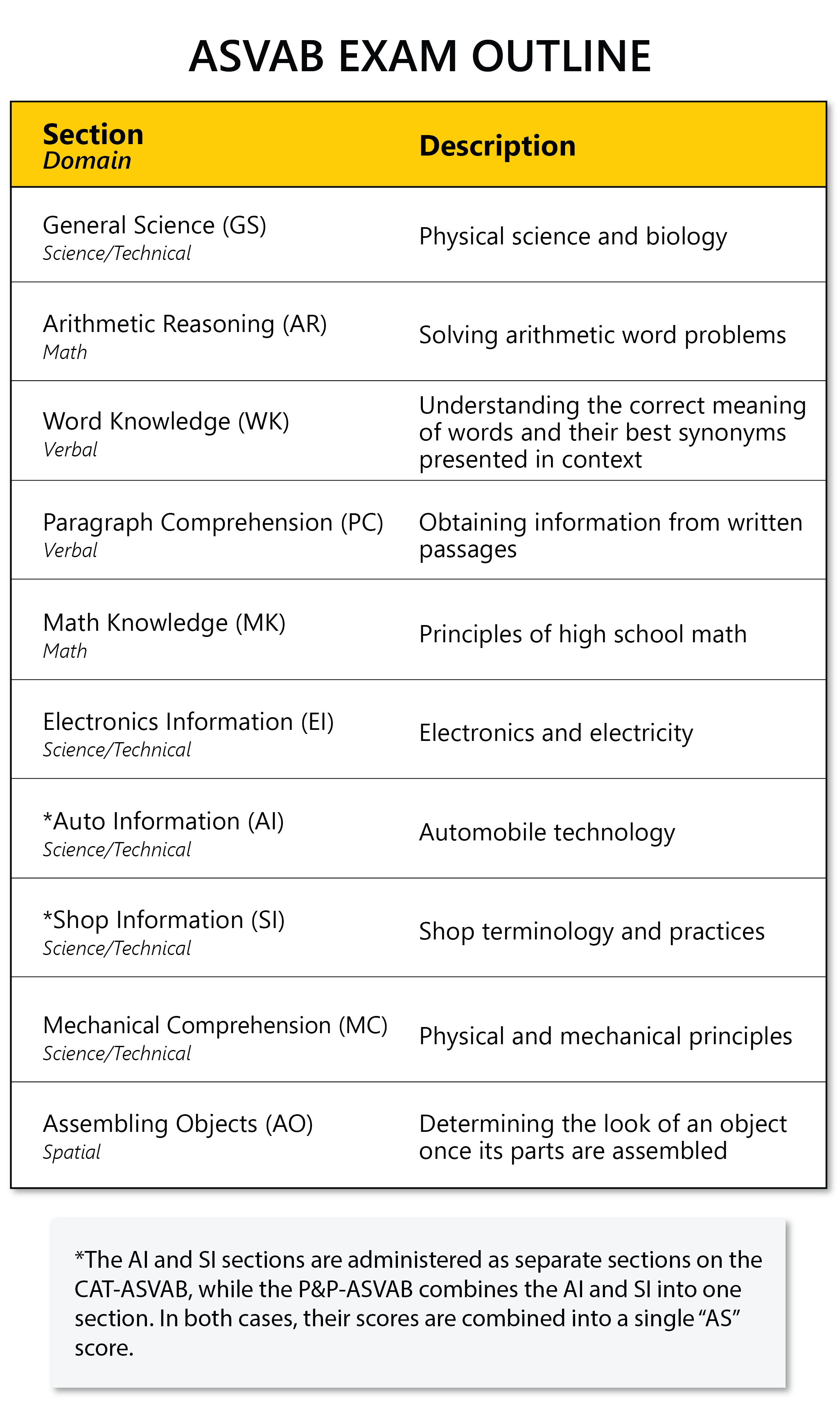
To maximize the utility of a practice test, you must understand the breakdown of the actual exam. The ASVAB consists of ten subtests (though some versions combine or omit specific sections depending on whether it is the CAT-ASVAB or the paper-based version).
| Subtest Name | Abbreviation | Primary Focus | Relevant Guard Careers |
|---|---|---|---|
| General Science | GS | Physical and biological sciences | Medical, Laboratory, Environmental |
| Arithmetic Reasoning | AR | Ability to solve word problems | Finance, Engineering, Logistics |
| Word Knowledge | WK | Vocabulary and word meaning | Administration, Intelligence, Legal |
| Paragraph Comprehension | PC | Ability to obtain information from text | Public Affairs, Human Resources |
| Mathematics Knowledge | MK | Knowledge of mathematical principles | Artillery, Aviation, Cyber |
| Electronics Information | EI | Knowledge of electricity and electronics | Communications, Avionics, Power |
| Auto and Shop Information | AS | Knowledge of tools and automotive systems | Mechanics, Construction, Transportation |
| Mechanical Comprehension | MC | Knowledge of mechanical principles | Engineering, Heavy Equipment |
| Assembling Objects | AO | Spatial relationships and visualization | Mapping, Ordnance, Maintenance |
Effective practice tests should mimic this structure exactly. When using online simulators in 2026, ensure they use the Adaptive Testing model. The Computerized Adaptive Test (CAT-ASVAB) adjusts the difficulty of subsequent questions based on whether you answered the previous one correctly. This means a high-quality practice test should become more difficult as you succeed.
Strategic Preparation for the National Guard ASVAB
Preparation is not just about memorizing facts; it is about mastering the logic of the test. Many candidates struggle not with the material, but with the time constraints and the specific phrasing of military-style questions.
Focusing on the AFQT Core
Since the AFQT is the primary gatekeeper, your practice should prioritize the four "VE" (Verbal Expression) and Math subtests:
- Word Knowledge (WK)
- Paragraph Comprehension (PC)
- Arithmetic Reasoning (AR)
- Mathematics Knowledge (MK)
Your Verbal Expression (VE) score is calculated by combining WK and PC scores. In the 2026 testing environment, the math sections have seen a slight shift toward more practical application problems. Using a practice test to identify if you are faster at mental math versus structured algebraic solving can help you manage your time during the official exam at the Military Entrance Processing Station (MEPS).
Utilizing the PiCAT
A modern alternative to traditional practice tests is the PiCAT (Pending Internet Computerized Adaptive Test). Recruiters often provide access to this unproctored version of the ASVAB. While it can be taken at home, it is not just a "practice" test—it can actually count as your official score if you pass a short verification test at MEPS. Treat the PiCAT with the same level of seriousness as the official exam.
Interpreting Your Practice Test Results
Once you complete a practice test, don't just look at the final percentage. Break down your results to see where you are "leaving points on the table."
- Time Management: Did you rush through the Paragraph Comprehension section? In the real exam, once you submit an answer on the computer, you cannot go back. Practice tests should train you to be decisive yet thorough.
- Conceptual Gaps: If you consistently miss questions in Mechanical Comprehension, you likely need a refresher on basic physics principles like levers, pulleys, and hydraulics.
- The "GT" Factor: Most specialized National Guard jobs require a GT score of 110 or higher. If your practice results for WK, PC, and AR are not yielding a projected GT of 110, you should focus your study efforts exclusively on those three areas.
Resources for National Guard Applicants in 2026
Accessing high-quality study materials is easier than ever, but not all resources are created equal. National Guard applicants should prioritize official or highly-regarded third-party platforms.
- Official ASVAB Site: The ASVAB Program provides the most accurate overview of test mechanics and sample questions.
- March2Success: This is a free, military-sponsored program specifically designed to help students and applicants improve their standardized test scores, including the ASVAB.
- Recruiter-Provided Samples: Your local National Guard recruiter has access to "Enlistment Screening Tests" (EST). These are shorter versions of the ASVAB designed to predict your performance.
- DOD Educational Resources: The Department of Defense often provides updated study guides that reflect any minor changes in testing software or question banks.
Common Pitfalls to Avoid
Many applicants fail to achieve their target score because of avoidable errors during the preparation phase.
- Ignoring the Technical Sections: Even if you aren't aiming for a mechanic role, the Auto and Shop or Electronics sections contribute to your overall line scores. A poor performance here can disqualify you from "Option 4" or other specialized training enlistment incentives.
- Over-reliance on Calculators: Calculators are not permitted during the ASVAB. If you use one during your practice tests, your results will be artificially inflated and will not reflect your actual ability on test day.
- Neglecting the Science Subtest: For those interested in the 68-series (Medical) MOS in the National Guard, the General Science (GS) score is a primary component. Many applicants assume it’s just "common sense," but it covers specific high-school-level chemistry and biology that requires review.
Managing Test Anxiety and Environment
The National Guard often allows for testing at "Mobile Testing Sites" or local armories in addition to the major MEPS centers. Regardless of the location, the environment is strictly controlled.
When taking a practice test at home, try to replicate these conditions:
- Eliminate Distractions: No phone, no music, and no talking.
- Use a Timer: Stick strictly to the time limits allocated for each subtest.
- Physical Preparation: Take the practice test at the same time of day you plan to take the real one (usually early morning).
FAQs
What is the minimum ASVAB score for the National Guard?
In 2026, the minimum AFQT score for enlistment with a high school diploma is 31. Those with a GED generally need a 50. However, these are "floor" scores. Most desirable jobs and enlistment bonuses require significantly higher scores, often in the 50–70 range or higher for technical specialties.
How many times can I retake the ASVAB?
If you are not satisfied with your score, you can retake the test. After your first attempt, you must wait one month to retake it. After the second attempt, another one-month wait is required. If you need to take it a fourth time, you must wait six months. This is why using practice tests to get it right the first time is so crucial.
Does the National Guard accept the PiCAT?
Yes, the National Guard heavily utilizes the PiCAT. It allows applicants to take the full, unproctored ASVAB at home. However, you must go to a testing center (MEPS or a MET site) within 45 days to complete a 20-30 minute "Verification Test" to confirm you didn't cheat. If you fail the verification, you may be forced to take the full ASVAB immediately.
Is the ASVAB practice test harder than the real thing?
Generally, reputable practice tests are designed to be slightly more difficult than the actual exam. This "over-training" ensures that the candidate is well-prepared for the pressure and complexity of the official testing environment.
Can I join the National Guard if I fail the ASVAB?
"Failing" the ASVAB simply means scoring below the 31-point AFQT threshold. If this happens, you cannot enlist immediately. However, the National Guard often offers the "Future Soldier Preparatory Course" or similar academic "camps" for those who score close to the requirement (often between 21 and 30), helping them improve their scores to meet enlistment standards.
Final Recommendation
Your next step should be to contact a local National Guard recruiter and request an Enlistment Screening Test (EST). This is a proctored, shorter version of the ASVAB that serves as the ultimate practice test. It provides an immediate, reliable prediction of your AFQT score. Once you have your EST results, use targeted study guides to focus specifically on the subtests that are holding back your Line Scores. Consistent, timed practice is the only proven method to ensure that on test day, you secure the MOS you want rather than just the one the Guard has available.