The ASVAB is a standardized test used to determine enlistment eligibility and job placement in the National Guard. To join, applicants generally need a minimum Armed Forces Qualification Test (AFQT) score of 31. Higher scores unlock more specialized roles, signing bonuses, and advanced technical training opportunities within your state’s units.
The Armed Services Vocational Aptitude Battery (ASVAB) serves as the primary diagnostic tool for the United States military to measure an applicant’s potential for success in various technical and combat roles. For those looking to join the National Guard in 2026, the test remains the most critical hurdle in the recruitment process. It does not merely determine if a candidate can wear the uniform; it dictates the specific trajectory of their military career, from the day they depart for Basic Combat Training to their eventual transition back into civilian employment.
Understanding the ASVAB's Role in National Guard Recruitment
The National Guard operates differently than active-duty components. Because Guard members serve their local communities and states while maintaining civilian careers, the selection of a Military Occupational Specialty (MOS) in the Army National Guard or an Air Force Specialty Code (AFSC) in the Air National Guard is often influenced by local unit availability. However, regardless of what positions are open in a specific state, an applicant cannot fill a vacancy without meeting the mandatory ASVAB score requirements for that specific job.
The test is designed to measure developed abilities and help predict future academic and occupational success in the military. It is not an IQ test, nor does it measure character or physical fitness. Instead, it focuses on the specific cognitive areas that correlate with the technical demands of modern military equipment and operations. In the context of 2026 recruitment standards, the National Guard continues to utilize the ASVAB to ensure that recruits possess the mathematical and linguistic foundations necessary to handle sophisticated systems, ranging from cyber defense to aviation maintenance.
Educational Prerequisites and Eligibility Tiers
Before sitting for the ASVAB, a candidate’s educational background is categorized into "tiers." These tiers significantly impact the minimum score required for enlistment.
- Tier 1: This category includes high school graduates who have earned a traditional diploma. Tier 1 candidates are the most sought-after by recruiters and generally have the lowest minimum score requirements for entry.
- Tier 2: This includes individuals with a High School Equivalency Diploma (HSED) or General Educational Development (GED) certificate. While the National Guard accepts GED holders, the percentage of Tier 2 accessions is often capped annually. Furthermore, Tier 2 candidates typically must score higher on the AFQT—often a 50 or above—to qualify for enlistment compared to their Tier 1 counterparts.
- Tier 3: This category is for individuals who are not high school graduates and do not have an equivalency degree. In the current 2026 recruiting environment, enlistment for Tier 3 candidates is extremely rare and usually requires a specific waiver or a period of high school attendance that eventually leads to a diploma.
Breaking Down the ASVAB Subtests
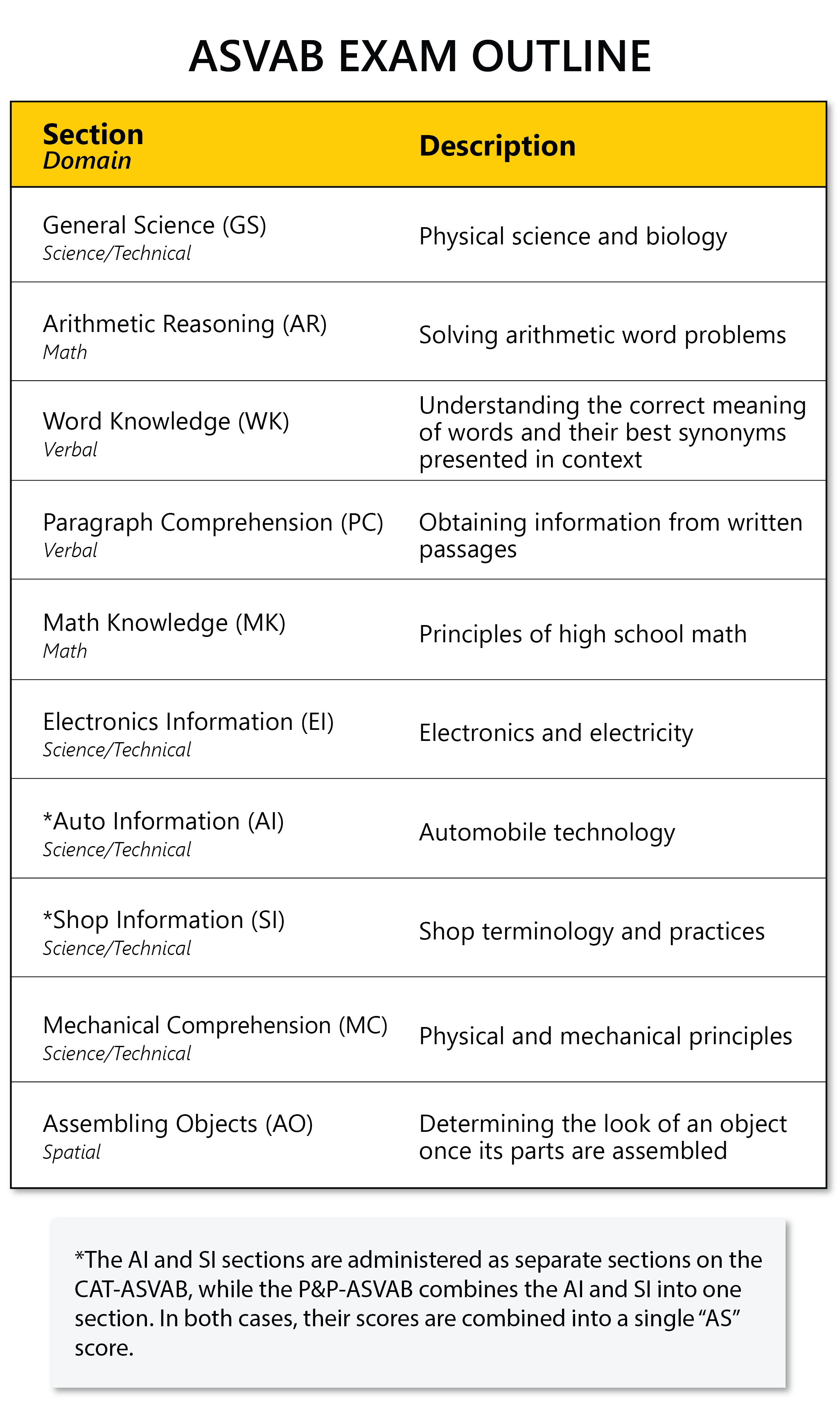
The ASVAB is comprised of ten individual subtests (though some versions may combine or slightly vary the format). Each subtest measures a specific area of knowledge or mechanical aptitude. Understanding these components is essential for targeted study.
- General Science (GS): Measures knowledge of physical and biological sciences. This is relevant for medical and technical roles.
- Arithmetic Reasoning (AR): Evaluates the ability to solve basic arithmetic word problems. This is a core component of the AFQT.
- Word Knowledge (WK): Tests the ability to understand the meaning of words through synonyms. This is another core AFQT component.
- Paragraph Comprehension (PC): Measures the ability to obtain information from written passages, also a core AFQT component.
- Mathematics Knowledge (MK): Evaluates knowledge of mathematical concepts including geometry and algebra. This is the fourth core component of the AFQT.
- Electronics Information (EI): Tests knowledge of electricity, radio principles, and electronics. This is vital for avionics and communication roles.
- Auto and Shop Information (AS): Measures knowledge of automotive maintenance and repair, as well as wood and metal shop practices.
- Mechanical Comprehension (MC): Evaluates knowledge of mechanical and physical principles.
- Assembling Objects (AO): Tests the ability to determine how an object will look when its parts are put together.
- Verbal Expression (VE): This is not a separate test but a scaled score derived from the Word Knowledge and Paragraph Comprehension subtests.
National Guard AFQT Score Requirements
The most important number generated by the ASVAB is the Armed Forces Qualification Test (AFQT) score. This is a percentile score ranging from 1 to 99, indicating how well a candidate performed compared to a reference group of test-takers.
For the Army National Guard, the standard minimum AFQT score for a Tier 1 applicant is 31. However, during periods of high recruitment demand or for specific "critical need" roles, the Guard may offer waivers for scores as low as 21, though these typically come with restrictions on job choices and may require participation in academic preparatory programs.
For the Air National Guard, the standards are typically higher. Most states require a minimum AFQT score of 31 for high school graduates, but many individual units prefer or require scores in the 36 to 45 range to ensure the candidate can handle the highly technical nature of Air Force specialties.
Line Scores and Military Occupational Specialties (MOS)
While the AFQT score determines if you can join the National Guard, your Line Scores determine what job you can do. Line scores are groupings of the individual subtest scores. Each branch of service uses different formulas to calculate these composites.
For the Army National Guard, the line scores include:
- GT (General Technical): VE + AR
- ST (Skilled Technical): GS + AS + MK + MC + VE
- EL (Electronics): GS + AR + MK + EI
- CL (Clerical): VE + AR + MK
- MM (Mechanical Maintenance): AS + MC + EI
For example, if an applicant wishes to become an Intelligence Analyst (MOS 35F), they generally need a high GT score (often 101 or higher). Conversely, a Heavy Vehicle Power Plant Mechanic (MOS 91G) would require a specific score in the MM composite. It is common for an applicant to have a high enough AFQT to join but not a high enough line score for their "dream job." In such cases, studying specifically for the subtests that comprise that line score is the only path forward.
The Testing Process: Locations and Formats
In 2026, applicants typically take the ASVAB in one of three environments:
1. Military Entrance Processing Station (MEPS)
Most candidates take the computer-based version (CAT-ASVAB) at a MEPS location. The CAT-ASVAB is adaptive, meaning the computer selects the next question based on whether the previous answer was correct. This makes the test shorter and more precise than the paper version.
2. Military Entrance Test (MET) Sites
For candidates who do not live near a MEPS, the National Guard utilizes MET sites, often located in federal buildings, National Guard armories, or reserve centers. These may offer either the computer-based or the traditional paper-and-pencil (P&P-ASVAB) format.
3. The PiCAT (Pending Internet Computer Adaptive Test)
The PiCAT is a full-length, unproctored version of the ASVAB that an applicant can take from home. If the scores are favorable, the applicant must then go to a MEPS to take a short "verification test" to ensure they didn't cheat. If the verification test results don't match the PiCAT results, the applicant may be required to take a full, proctored ASVAB immediately.
Comparison of Minimum Entry Scores by Component (2026)
The following table outlines the general score expectations for the National Guard compared to other components. Note that these are baseline figures and are subject to change based on current manning levels and state-specific policies.
| Component | Minimum AFQT (Tier 1) | Minimum AFQT (Tier 2/GED) | Typical Goal for Tech Jobs |
|---|---|---|---|
| Army National Guard | 31 | 50 | 100+ (Line Scores) |
| Air National Guard | 31 | 50 | 50+ (AFQT) |
| Active Duty Army | 31 | 50 | Varied |
| Active Duty Air Force | 36 | 65 | 60+ (AFQT) |
Retesting Policies and Score Validity
If a candidate is unhappy with their score or fails to meet the minimum for their desired MOS, they are permitted to retake the ASVAB. However, the Department of Defense enforces strict waiting periods:
- Second Attempt: One month (30 days) after the initial test.
- Third Attempt: One month (30 days) after the second test.
- Subsequent Attempts: Six months after the third test and every test thereafter.
It is important to note that you cannot "cherry-pick" scores from different attempts. The most recent score is the one that counts, even if it is lower than a previous score. ASVAB scores remain valid for enlistment for two years from the date of the test, provided the applicant has not already joined a service component.
Preparation and Study Strategies for 2026
Relying on "general knowledge" is a common mistake for National Guard applicants. Because the ASVAB includes niche subjects like automotive information and electronics, specific preparation is required.
- ASVAB Career Exploration Program (CEP): This is the official resource provided by the Department of Defense. It offers practice tools and helps link scores to civilian and military career paths.
- Focus on the AFQT: Since the AFQT determines overall eligibility, candidates should prioritize Word Knowledge, Paragraph Comprehension, Arithmetic Reasoning, and Mathematics Knowledge. Improving these four areas provides the highest "return on investment" for study time.
- Utilize Practice Tests: Taking timed practice tests helps mitigate "test anxiety" and allows the applicant to get used to the CAT-ASVAB’s adaptive pacing. Resources from the Official ASVAB Site provide guidance on what to expect.
Frequently Asked Questions
Does the National Guard require a higher ASVAB score than active duty?
Generally, no. The minimum AFQT requirements for the Army National Guard are the same as the Active Duty Army (31 for Tier 1). However, the Air National Guard often maintains higher internal standards or unit-specific requirements that may exceed the baseline Air Force requirement of 31.
Can I retake the ASVAB after I have already enlisted in the National Guard?
Yes. This is known as an "In-Service" ASVAB or the Armed Forces Classification Test (AFCT). Current Guard members often retake the test to improve their line scores to qualify for a "re-class" into a different MOS or to become eligible for Officer Candidate School (OCS), which typically requires a GT score of 110 or higher.
How long does the ASVAB test take?
The computer-based CAT-ASVAB takes approximately 1.5 to 2 hours to complete, although test-takers are generally allotted up to 3 hours. The paper-and-pencil version at MET sites usually takes about 3 hours because it is not adaptive and every test-taker must answer every question.
What happens if my score is too low for the National Guard?
If your score is below 31, you are currently ineligible for enlistment. You should work with your recruiter to identify your weak areas and use the mandatory 30-day waiting period to study. Some states offer "Future Soldier Preparatory Course" programs (often referred to as "ASVAB camp") to help applicants increase their scores.
Will a high ASVAB score get me a bigger enlistment bonus?
Frequently, yes. Many National Guard bonuses are tied to "High Demand" or "Technical" MOS positions. These positions almost always require higher line scores. Therefore, a higher ASVAB score makes you eligible for the jobs that carry the most significant financial incentives.
Final Recommendations for Applicants
For anyone pursuing a career in the National Guard in 2026, the ASVAB should be treated with the same seriousness as a college entrance exam or a professional certification. Your score is the primary leverage you have in negotiations with a recruiter. A high score does more than just secure a job; it provides the foundation for your military education and your eventual marketability in the civilian sector. Before scheduling your test date through a recruiter, take multiple full-length practice exams to ensure your scores are consistently hitting the targets required for your preferred MOS or AFSC.