Titles of speeches are almost always enclosed in quotation marks rather than italicized. This convention identifies a speech as a "short work" or a selection within a larger context, similar to how one formats a poem, a song title, or a chapter in a book. However, specific style guides and the medium of publication can introduce important nuances to this rule.
In the landscape of 2026 professional and academic writing, clarity remains the primary goal of punctuation. Whether you are drafting a thesis, a journalistic report, or a digital transcript, understanding the hierarchy of formatting ensures your work meets the expectations of editors and academic institutions. While the general rule favors quotation marks, the decision often depends on the "container" in which the speech is found.
The Hierarchy of Punctuation: Short Works vs. Long Works
To understand why speech titles are quoted, it is helpful to look at the broader logic of English punctuation. Typographical conventions distinguish between standalone, independent works and shorter pieces that are usually part of a larger collection.
Italics for Independent Works
Italics are reserved for "major" or "long-form" works. These are publications that can stand alone as a single entity. Common examples include:
- Books: The Great Gatsby
- Plays: Hamlet
- Periodicals/Magazines: The New Yorker
- Movies and Television Shows: Inception or Succession
- Albums: Rumours by Fleetwood Mac
Quotation Marks for Contained Works
Quotation marks are used for "minor" or "short-form" works that typically reside inside a larger "container." This category includes:
- Speeches: "I Have a Dream"
- Articles: "The Climate Crisis in 2026"
- Short Stories: "The Lottery"
- Songs: "Bohemian Rhapsody"
- Chapters: "Chapter 1: The Beginning"
Because a speech is traditionally a spoken event that is later transcribed and included in a newspaper, an anthology, or a digital archive, it is classified as a short work.
Style Guide Specifics: MLA, APA, Chicago, and AP
While the "quotes for short works" rule is universal, each major style guide provides specific instructions on how to handle speech titles in text and in bibliographies.
MLA Style (Modern Language Association)
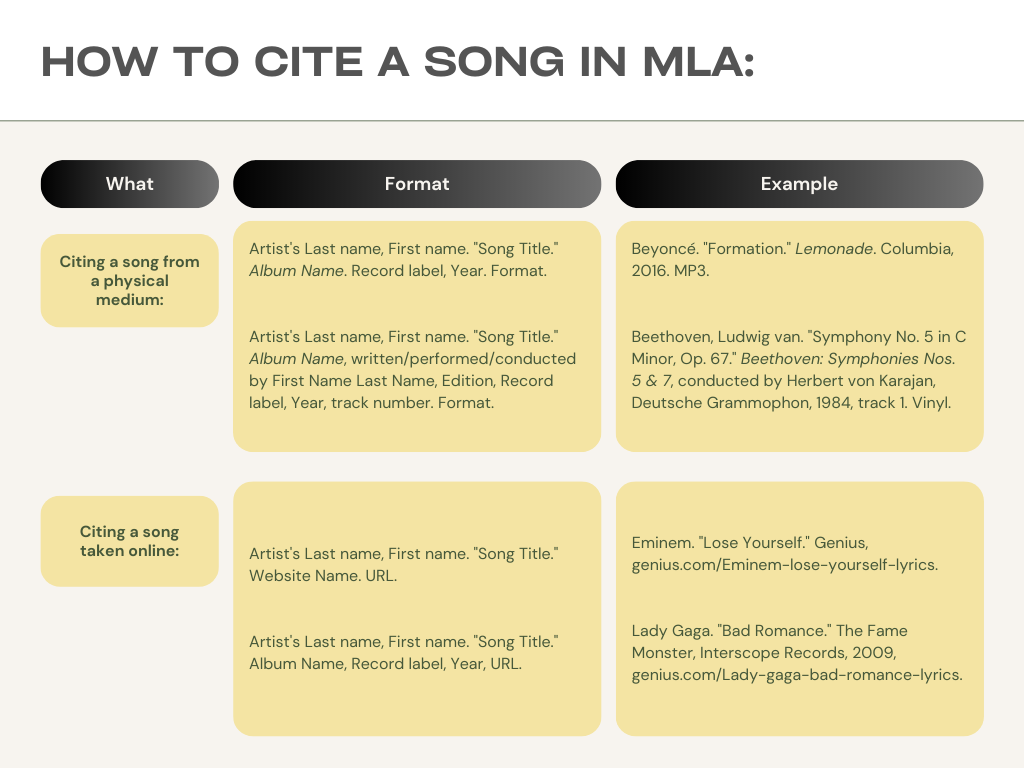
Commonly used in the humanities and liberal arts, MLA Style emphasizes the "Container Theory." According to the most recent guidelines available in 2026, the title of a speech should be placed in quotation marks within the body of your paper.
If the speech is published as part of an anthology, the speech title remains in quotation marks, while the title of the anthology is italicized.
- Example: In his speech "The Gettysburg Address," Abraham Lincoln redefined the American struggle.
- Works Cited Entry: Lincoln, Abraham. "The Gettysburg Address." Great American Speeches, edited by John Smith, Penguin Classics, 2022, pp. 45-47.
APA Style (American Psychological Association)
APA Style, prevalent in the social sciences, follows a similar path for in-text citations but has specific rules for the reference list. In the body of an APA-formatted paper, you use quotation marks for the title of a speech.
However, in the reference list, APA 7th and 8th editions (the standards for 2026) focus on the format of the source. If the speech is a standalone video or a document on a website, the title of the work itself might be italicized in the reference list to indicate it is the primary object being cited.
- In-text Example: King (1963) delivered the "I Have a Dream" speech to thousands of supporters.
- Reference List (Video): King, M. L., Jr. (1963, August 28). I have a dream [Speech video]. American Rhetoric. https://www.americanrhetoric.com/speeches/mlkihaveadream.htm
The Chicago Manual of Style (CMOS)
Chicago Style is the gold standard for historical and formal publishing. It dictates that titles of speeches, even very famous ones, should be in quotation marks and not italicized. This applies to both the text and the bibliography or footnotes.
- Footnote Example: 1. Sojourner Truth, "Ain't I a Woman?" (speech, Women’s Convention, Akron, OH, May 29, 1851).
AP Style (Associated Press)
Journalists following the AP Stylebook use quotation marks for almost all titles, including speeches, songs, and books (AP does not use italics for titles at all). If you are writing a press release or a news article in 2026, you will always put the speech title in quotes.
When to Italicize: The Standalone Exception
There is one major exception to the quotation mark rule: when a speech is published as a standalone book or is the title of a full-length documentary/film.
If a historical speech is so long or significant that it is released as its own hardcover volume, the title of that volume is italicized. For example, if a publisher releases a book titled The Last Lecture which contains only the transcript of Randy Pausch's famous talk, you would italicize The Last Lecture when referring to the book. However, if you are referring to the event of the speech itself, you would still use quotation marks: "The Last Lecture."
Another exception occurs with formal titles of lecture series. While an individual lecture is quoted, the name of the series (like the Reith Lectures) is often italicized in academic contexts to denote the larger program.
Formatting the Content: Direct Quotes vs. Speech Titles
It is vital to distinguish between the title of the speech and the content of the speech.
In-Text Quotations
When you are quoting a specific line from a speech, you use standard quotation marks. If the speech title is mentioned in the same sentence, the punctuation can become complex.
- Incorrect: In I Have a Dream, King said, "I have a dream."
- Correct: In "I Have a Dream," King said, "I have a dream."
Block Quotations
If you are transcribing a portion of a speech that is longer than four lines of prose (in MLA) or more than 40 words (in APA), you must use a block quote. Block quotes do not use quotation marks. Instead, they are indented from the left margin, signaling to the reader that the text is a direct excerpt. In this case, the title of the speech mentioned in the preceding sentence would still be in quotation marks.
Practical Examples and Comparisons
To clarify how these rules apply in different writing environments, refer to the following table which highlights common scenarios encountered by writers.
| Scenario | Title Formatting | Example |
|---|---|---|
| Famous Historical Speech | Quotation Marks | "The Gettysburg Address" |
| Commencement Address | Quotation Marks | "Stay Hungry, Stay Foolish" |
| Speech Published as a Book | Italics | The Last Lecture |
| Keynote Address at a Conference | Quotation Marks | "The Future of AI in 2026" |
| Lecture Title in a Syllabus | Quotation Marks | "Intro to Macroeconomics" |
| Collection of Speeches (Book) | Italics | Great Speeches of the 20th Century |
Common Mistakes to Avoid
Even seasoned writers can stumble when formatting speech titles. Here are the most frequent errors and how to correct them as of 2026 standards.
1. Over-Italicization for Emphasis
Writers often italicize speech titles because they feel the speech is "important" enough to warrant it. Punctuation, however, is a matter of grammatical category, not a measure of importance. No matter how world-changing a speech is, it remains a "short work."
- Avoid: Lincoln's Gettysburg Address is a masterpiece.
- Use: Lincoln's "Gettysburg Address" is a masterpiece.
2. Confusing Speeches with Plays
While both involve spoken words, a play is a multi-act performance intended for the stage and published as a standalone script. A speech is a single oration.
- Avoid: "Death of a Salesman" (This is a play).
- Use: Death of a Salesman.
- Use: "The Perils of Indifference" (This is a speech by Elie Wiesel).
3. Misplacing Punctuation
In American English, commas and periods almost always go inside the quotation marks. In British English, they often go outside unless the punctuation is part of the title itself.
- American: We discussed "I Have a Dream," then moved to the next topic.
- British: We discussed 'I Have a Dream', then moved to the next topic.
Frequently Asked Questions
Do you italicize the "I Have a Dream" speech?
No, you should not italicize the "I Have a Dream" speech. Because it is an individual speech delivered as part of a larger event (The March on Washington), it is enclosed in quotation marks. If you are citing it from a book of collected speeches, the book title would be italicized, but the speech title remains quoted.
How do you format a speech title in a bibliography?
In most bibliographies (MLA and Chicago), the speech title is in quotation marks. In APA, the title is usually in quotation marks within the text, but if the speech is sourced from a standalone webpage or video, the title may be italicized in the reference list depending on whether it is considered a standalone "work" in that specific medium. Always check the "Source" vs. "Container" rule in the latest APA manual.
Are graduation speeches italicized or quoted?
Graduation or commencement speeches are quoted. For example, Steve Jobs' 2005 Stanford Commencement Address is referred to as "You've Got to Find What You Love" or simply "Stanford Commencement Address" in quotation marks.
What if the speech doesn't have an official title?
If a speech does not have a formal title, you should refer to it by the occasion or a descriptive label. These labels are typically not quoted or italicized.
- Example: She gave a speech at the 2026 Environmental Summit.
- Example: King's speech at the March on Washington is legendary.
Do I italicize "The Gettysburg Address"?
Despite its fame and historical weight, "The Gettysburg Address" is placed in quotation marks. It was a brief oration delivered at the dedication of a cemetery and does not meet the criteria for a standalone long-form work like a book or a play.
Professional Recommendation
For the highest level of professional consistency in 2026, always default to quotation marks for speech titles unless you are specifically referring to a speech that has been published as a standalone book. If you are writing for a specific publication, university, or firm, verify which style guide they prefer (MLA, APA, or Chicago). While the core rule remains the same across most of these, the way you handle the surrounding citation—such as the date or the speaker's name—will vary. Keeping a consistent approach to "short work" vs. "long work" formatting will make your writing more authoritative and easier for your audience to navigate.