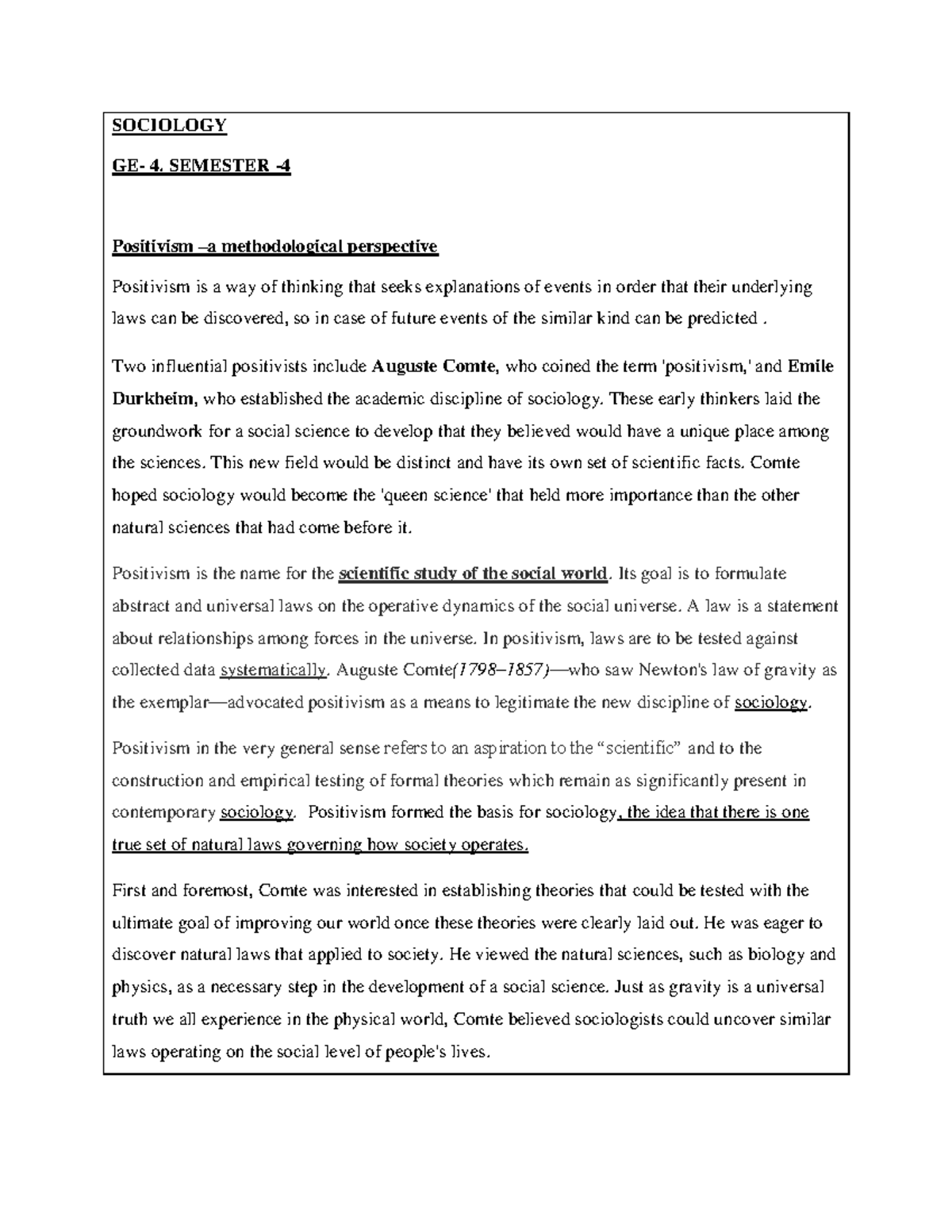
The clearest example of positivism in sociology is Émile Durkheim’s 1897 study, Suicide. Durkheim applied rigorous statistical analysis to demonstrate that individual actions are governed by external "social facts." By identifying patterns in suicide rates across different groups, he proved that society could be studied using objective, scientific methods.
The Foundations of Positivist Sociology
To understand why Durkheim’s work stands as the definitive example of positivism, one must first grasp the philosophical origins of the movement. Positivism was pioneered by Auguste Comte in the early 19th century. Comte argued that society, like the physical world, operates according to absolute laws. He proposed that sociology should be the "queen of sciences," utilizing observation, experimentation, and comparison to uncover the mechanics of human interaction.
In the positivist view, knowledge is only valid if it is derived from sensory experience and logical treatment of such data. This excludes metaphysical speculation or purely intuitive reasoning. By 2026, while sociology has branched into many interpretive and critical frameworks, the positivist tradition remains the bedrock of quantitative research, social statistics, and demographic analysis. The primary goal of a positivist researcher is to remain value-neutral, ensuring that their personal biases do not color the collection or interpretation of data.
The transition from social philosophy to social science required a bridge—a method to prove that the "invisible" forces of society were as real as the "visible" forces of gravity. This bridge was built by Émile Durkheim, who institutionalized sociology by providing it with a distinct object of study: the social fact.
Why Durkheim’s Suicide is the Gold Standard Example
Before Durkheim, suicide was viewed almost exclusively through a psychological or biological lens. It was considered the ultimate private, individual act—the result of a person’s internal mental state, heredity, or personal tragedy. Durkheim challenged this by suggesting that if suicide were purely a matter of individual psychology, the rates of suicide across different societies would be random or purely reflective of the distribution of mental illness.
Durkheim’s genius lay in his decision to ignore the individual "reasons" given in suicide notes and instead focus on the suicide rate of various populations. By shifting the unit of analysis from the person to the group, he identified consistent patterns that psychological factors could not explain. This is the hallmark of positivism: seeking general laws that govern social phenomena rather than investigating unique individual instances.
The Application of Social Facts
Durkheim defined "social facts" as ways of acting, thinking, and feeling that are external to the individual and endowed with a power of coercion. A clear example of a social fact is a language or a currency; you did not create them, yet you must use them to function in society. Durkheim argued that social integration and moral regulation were social facts that exerted pressure on individuals.
In his study, Durkheim used official government statistics from various European countries. He looked at variables such as religion, marital status, and military service. He found, for instance, that suicide rates were consistently higher among Protestants than Catholics, and higher among single people than married people. Because these trends were stable over time and across different regions, Durkheim concluded that the cause of suicide must lie in the structure of the society itself, not in the individual's mind.
Categorizing the Empirical Findings
Durkheim categorized his findings into four distinct types of suicide, each linked to the levels of integration and regulation within a society. This classification remains a primary example of how a positivist creates a theoretical framework based on observed data.
1. Egoistic Suicide
This occurs when there is low integration. When individuals are not sufficiently bound to social groups (like family or a religious community), they experience a sense of isolation and lack of purpose. Durkheim found that Protestantism, which emphasizes individual's relationship with God, provided less social "anchoring" than Catholicism’s communal rituals, leading to higher egoistic suicide rates among Protestants.
2. Altruistic Suicide
This occurs when there is high integration. In these cases, the individual is so deeply integrated into the group that they lose their sense of self. Their life is seen as secondary to the needs of the collective. Examples include ritualistic suicide in traditional societies or modern-day suicide bombers. Here, the social pressure to sacrifice oneself for the group becomes a coercive force.
3. Anomic Suicide
This occurs when there is low regulation, often during periods of rapid social or economic change. "Anomie" refers to a state of normlessness where the old rules no longer apply, and new ones have not yet formed. Durkheim observed that suicide rates spiked not only during economic depressions but also during sudden economic booms, as both disrupted the established social order and left individuals without clear moral guidance.
4. Fatalistic Suicide
This occurs when there is high regulation. When individuals are subject to oppressive discipline and have no hope of changing their circumstances, they may turn to suicide as an escape. Durkheim noted this was more common in over-regulated environments, such as among slaves or prisoners.
Technical Components of the Positivist Method
Durkheim’s work introduced several technical components that define positivist research today. These methods ensure that sociology remains an empirical science rather than a branch of literature or philosophy.
- Hypothesis Testing: Durkheim began with the hypothesis that suicide rates vary inversely with the degree of integration of the social groups of which the individual forms a part.
- Multivariate Analysis: Although he did not have modern software, Durkheim effectively performed multivariate analysis by "controlling" for variables. For example, he compared regions with similar climates but different religions to rule out weather as a cause of suicide.
- Reliability and Validity: By using official government records, he ensured that his data was consistent and could be checked by other researchers. This emphasis on replicability is a cornerstone of the scientific method.
- Correlation vs. Causation: Durkheim was careful to distinguish between things that happen together (correlation) and things that cause one another. He argued that the shared belief systems of a religion (the cause) led to higher integration, which in turn lowered the suicide rate (the effect).
Comparing Positivism and Interpretivism
To understand the specific nature of the positivist example, it is helpful to compare it with the other major branch of sociology: interpretivism. While positivists look for "what" and "how much," interpretivists look for "why" and "what it means."
| Feature | Positivist Approach (e.g., Durkheim) | Interpretivist Approach (e.g., Max Weber) |
|---|---|---|
| View of Society | An objective reality governed by laws. | A subjective reality created by human meaning. |
| Primary Data | Quantitative (Statistics, Surveys). | Qualitative (Interviews, Ethnography). |
| Research Goal | To find general laws and correlations. | To achieve Verstehen (deep understanding). |
| Subjectivity | Researchers must be objective and neutral. | Researchers acknowledge their role in the study. |
| Unit of Analysis | Large-scale social structures (Macro). | Individual interactions and meanings (Micro). |
| Example Study | Analyzing national crime statistics. | Living with a gang to understand their culture. |
The Enduring Relevance of Positivism in 2026
In the current academic landscape of 2026, positivism has evolved into what is often called "post-positivism." Modern sociologists recognize that total objectivity is difficult to achieve, but they still adhere to the rigors of empirical evidence. The use of Big Data, algorithmic analysis of social media trends, and large-scale census projects are the modern descendants of Durkheim’s 19th-century statistical work.
The "clear example" of Durkheim’s suicide study is taught not because his statistics were perfect—modern critics have pointed out flaws in 19th-century record-keeping—but because the logic of the study was revolutionary. It proved that even the most "internal" human experiences are shaped by the "external" social world. This realization is what allowed sociology to claim its place among the sciences.
Criticisms of the Positivist Example
Despite its foundational importance, the positivist approach exemplified by Durkheim has faced significant criticism over the last century. Critics argue that by treating people like "atoms" in a lab, positivism misses the essence of human agency.
- The Problem of Meaning: An interpretivist would argue that Durkheim’s study ignores how the deceased person viewed their own life. If two people commit suicide, one due to debt and one due to heartbreak, a positivist might group them together under "Anomic Suicide," but their lived experiences are vastly different.
- Social Construction of Data: Critics point out that "official statistics" are not objective facts. In the 19th century, a coroner might be less likely to record a death as a suicide if the deceased was a prominent Catholic, out of respect for the family and the church's prohibition of the act. Thus, the data itself might be biased by the very social factors Durkheim was trying to study.
- Determinism: Some argue that positivism is too deterministic, suggesting that individuals are merely puppets of social forces. This can downplay the role of personal choice and resilience.
Step-by-Step: How to Conduct a Positivist Sociological Study
For those looking to apply a positivist framework in 2026, the process follows a structured, scientific path similar to the one Durkheim established.
- Identify a Social Phenomenon: Choose a behavior or event that can be measured (e.g., voting patterns, education levels, or health outcomes).
- Formulate a Testable Hypothesis: Create a statement that predicts a relationship between two variables (e.g., "Higher levels of education correlate with higher voter turnout").
- Operationalize Variables: Define exactly how you will measure your variables. "Education" might be measured by "years of schooling completed."
- Collect Quantitative Data: Use surveys, existing databases, or experiments to gather a large sample of data.
- Analyze the Data: Use statistical tools to look for patterns, correlations, and significance.
- Draw Generalizations: Determine if the data supports the hypothesis and if the findings can be applied to the broader population.
- Peer Review and Replication: Publish the findings and methodology so other researchers can test the results.
Frequently Asked Questions
What is the most famous example of positivism in sociology?
The most famous example is Émile Durkheim’s study titled Suicide, published in 1897. It is widely regarded as the first major work to apply rigorous scientific and statistical methods to a social problem, establishing sociology as a formal academic discipline.
How did Durkheim prove suicide was a social fact?
Durkheim analyzed suicide rates across different countries, religions, and social groups. He found that these rates remained stable over time within specific groups, even though the individuals within those groups changed. This stability suggested that external social forces (integration and regulation) were influencing the behavior, making it a "social fact."
Is positivism still used in sociology today?
Yes, positivism remains a major influence in sociology, particularly in quantitative research. Modern sociologists use advanced statistics, computer modeling, and large-scale surveys to identify social trends. While many now adopt a "post-positivist" view that acknowledges some level of researcher bias, the commitment to empirical evidence and data-driven conclusions remains strong.
What is the difference between Comte’s and Durkheim’s positivism?
Auguste Comte provided the philosophical framework for positivism, arguing that society should be studied scientifically. However, he was more of a philosopher than a researcher. Émile Durkheim took Comte’s ideas and applied them to actual data, creating the methodological tools—like the study of social facts—that turned positivism into a practical research strategy.
Why do some sociologists reject positivism?
Many sociologists, especially those in the interpretivist and critical traditions, reject positivism because they believe social life is too complex to be reduced to numbers. They argue that humans have "agency" and "meaning," which cannot be captured by statistics alone. They also argue that "objective" data is often influenced by the power structures of the society that collected it.
Practical Recommendation
When seeking a clear positivist example in sociology, always start with Émile Durkheim’s Suicide. To fully grasp the concept, compare his quantitative findings with a modern qualitative study on the same topic. This will highlight the strengths of the positivist approach—its ability to show macro-level patterns and generalizable laws—while also showing what is lost when individual subjective meaning is removed from the equation. For students and researchers, the best practice in 2026 is often a mixed-methods approach, which uses positivist statistics to identify a trend and interpretivist interviews to understand the human experience behind the numbers.