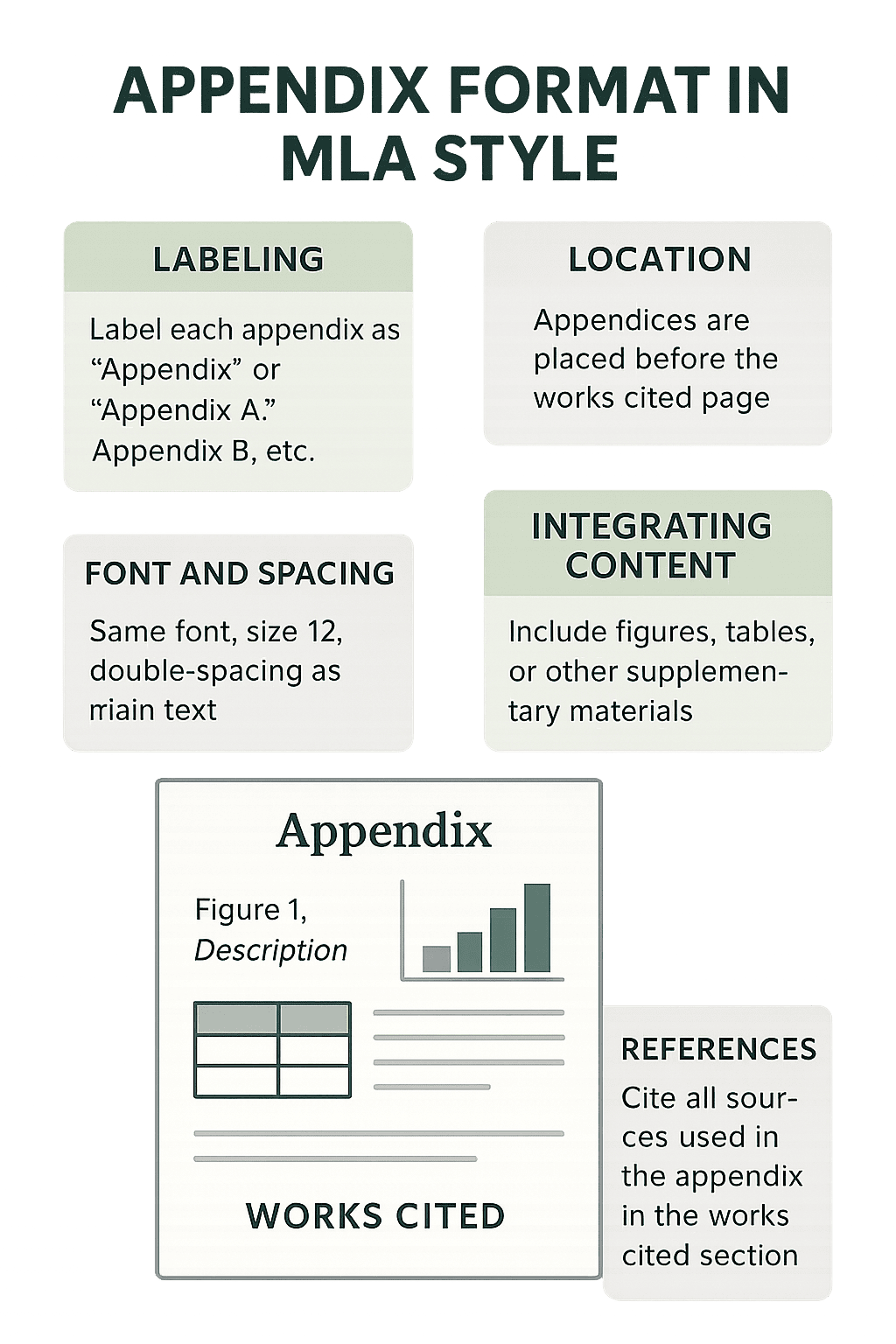
An appendix is a supplementary section appended to the end of a paper, dissertation, or business report that contains detailed data, raw research outputs, survey forms, or complex calculations. Standard appendix formatting requires placing the section on a new page after the reference list (in APA style) or before the works cited list (in MLA style), using a centered bold header such as "Appendix A" followed by a descriptive title, double-spaced body text, and custom table or figure numbering (e.g., Table A1).
What Is an Appendix and When Should You Include One?
An appendix serves as an analytical storage area for technical, empirical, or methodological evidence that is directly relevant to your research findings but too extensive, detailed, or distracting to include in the main narrative of your document. The primary objective of an appendix is to protect the structural flow and readability of your paper while providing complete transparency and supporting proof for peer review, academic evaluation, or institutional audit.
Determining whether information belongs in the main body or an appendix depends on its relationship to your core arguments. Essential evidence—such as key statistical summary tables, primary thematic findings, or critical equations—must remain in the main body. Conversely, granular supporting materials belong in an appendix.
Common Appendix Materials:
- Raw Data & Outputs: Detailed statistical printouts, full datasets, mathematical proofs
- Research Tools: Survey questionnaires, interview protocols, consent forms
- Transcripts: Full participant interview transcripts, focus group notes
- Visual Materials: High-resolution diagrams, complex flowcharts, maps, raw images
When evaluating your supporting data, apply the criterion of independence: if removing a table or passage prevents the reader from comprehending your primary thesis, that material must stay in the main body. If the material simply allows a specialized reader to replicate your study, trace your raw data, or audit your methodology, place it in an appendix.
General Structure and Formatting Rules for Appendices
While individual academic style manuals enforce specific guidelines, standard principles govern the structural arrangement of appendices across both academic writing and corporate technical reporting.
1. Document Placement Order
The placement of an appendix depends on the formatting standard prescribed by your institution, publisher, or style guide:
- APA Style (7th Edition): Appendices appear after the References list, footnotes, and any end-of-document standalone tables or figures.
- MLA Style (9th Edition): Appendices appear immediately after the main body text, before the Works Cited page.
- Chicago Manual of Style (17th/18th Edition): Appendices are positioned after the main text body and prior to the Notes and Bibliography sections (though publisher preferences occasionally place them after notes).
- Business/Technical Reports: Appendices typically follow the conclusion and recommendations section, located after formal reference pages or index files.
2. Title and Lettering Conventions
If your paper contains only one supplementary file, label it simply as Appendix. If your work requires multiple supplementary files, assign each a sequential capital letter in alphabetical order (Appendix A, Appendix B, Appendix C).
Every single appendix must start on a brand-new page. The label (e.g., "Appendix A") is positioned at the top of the page, followed by a clear, descriptive title on the next line.
[Page Break]
Appendix A Full Questionnaire Instrument
[Body text begins double-spaced below the title...]
3. Pagination and Running Headers
Page numbering for appendices should continue seamlessly from the main text body and reference list. Do not reset the page number to 1 unless explicit corporate design guidelines require standalone numbering (e.g., "Page A-1"). In academic formatting, if your references end on page 24, your first appendix page begins on page 25.
Visual Appendix Format Examples by Style Guide
To implement these guidelines accurately, review the structural layouts and code-block mockups below for each major writing style.
APA 7th Edition Appendix Format Example
In American Psychological Association (APA) 7th Edition style, every appendix requires a centered, bold label and title. Double-spacing applies throughout, including headings, text, and bulleted lists. Paragraph indentations must match the standard 0.5-inch indent used in the body text.
Appendix A
Participant Demographic Survey and Questionnaire Items
This appendix presents the complete list of survey items administered to the participant cohort between January 2026 and March 2026. The instrument was deployed digitally via a secure online survey platform.
Section 1: Demographic Variables
- What is your current employment status? a. Employed full-time b. Employed part-time c. Unemployed / Seeking employment d. Retired
- Please specify your completed level of education...
Key APA Rules:
- Header: Centered, bold text. "Appendix" or "Appendix A" on line 1. Title on line 2 (Title Case, bold).
- In-Text Callouts: Refer to appendices explicitly in parenthetical or narrative text: (see Appendix A) or as detailed in Appendix B.
- Tables and Figures: Tables inside Appendix A are labeled Table A1, Table A2; figures inside Appendix B are labeled Figure B1, Figure B2.
MLA 9th Edition Appendix Format Example
The Modern Language Association (MLA) format places appendices before the Works Cited page. MLA allows numeric labeling (Appendix 1, Appendix 2) or alphabetic labeling (Appendix A, Appendix B).
Appendix 1
Archival Letters from the Smith Collection
The following transcription contains the correspondence between Arthur Smith and the editorial board dated May 14, 1942. Spelling and punctuation have been preserved from the original manuscripts housed in the Special Collections Archive.
"We have received the revised proofs for the second chapter. The alterations suggested during the panel review were integrated without compromising the original textual rhythm..."
Key MLA Rules:
- Placement: Located prior to the Works Cited section.
- Header: Centered title, double-spaced text.
- Heading Text: Margins match standard 1-inch margins throughout the document.
Chicago Manual of Style (CMOS) Appendix Format Example
The Chicago Manual of Style utilizes appendices extensively for heavy data, primary source documentation, and complex sub-analyses. CMOS places the appendix section immediately after the text body, before the endnotes and bibliography.
APPENDIX A
Econometric Regression Outputs for Market Volatility
A.1 Data Source and Filtering Criteria The raw dataset was retrieved from the financial modeling repository covering daily trading volumes across Q1 2026. Data points displaying non-standard trading halts were normalized using baseline moving averages.
A.2 Full Model Output Table A.1 summarizes the unadjusted linear regression parameters, standard errors, and associated p-values across all 14 empirical iterations.
Key CMOS Rules:
- Heading: Typically formatted in ALL CAPS or Title Case depending on internal house style guidelines.
- Subheadings: Section numbers such as A.1 or A.2 can be used within long appendices to organize distinct content blocks.
Business and Technical Report Appendix Format Example
Corporate reports, feasibility studies, and engineering briefs use functional, highly structured appendix layouts. Unlike academic documents, corporate appendices frequently incorporate standalone cover sheets, clear section divider pages, and alphanumeric page numbering for easier binder or PDF navigation.
APPENDIX B: SYSTEM ARCHITECTURE LOGS & INFRASTRUCTURE CODE
Document Ref: TECH-2026-AUDIT-APPB Author: Network Security Operations Team Date: April 2026
1.0 Infrastructure Deployment Script
The following automated Terraform script details the cloud platform network configuration evaluated during the security compliance audit.
[code block / technical script output omitted for brevity]
Comparison Matrix of Major Appendix Style Guidelines
The following comparative breakdown highlights how formatting attributes differ across standard style guides:
| Formatting Attribute | APA 7th Edition | MLA 9th Edition | Chicago (CMOS 17th/18th) | Business / Technical Reports |
|---|---|---|---|---|
| Placement | End of paper (after References) | After body text (before Works Cited) | After body text (before Notes/Bibliography) | End of report (after Executive Summary & References) |
| Labeling Format | Appendix A, Appendix B | Appendix 1 or Appendix A | APPENDIX A or Appendix 1 | Appendix A, Attachment 1, or Annex A |
| Title Formatting | Centered, Bold, Title Case on line below label | Centered, Plain/Title Case on line below label | Centered or Left-aligned, ALL CAPS or Bold | Left-aligned, Bold, UPPERCASE with Document Ref IDs |
| In-Text Citation | Narrative or Parenthetical: (see Appendix A) | Parenthetical: (see app. 1) or (see Appendix A) | Narrative: (see appendix A) | Cross-reference link: (refer to Appendix B) |
| Table/Figure Prefix | Prefix letter by Appendix (e.g., Table A1, Figure B2) | Sequential numbering or labeled by section | Prefix letter or standard continuous numbering | Alphanumeric prefix (e.g., Table B-1, Fig. B-2) |
| Page Numbering | Continuous from main body | Continuous from main body | Continuous from main body | Continuous or Section-Based (e.g., B-1, B-2) |
Step-by-Step Guide: How to Format Tables, Figures, and Datasets in an Appendix
Including tables, charts, diagrams, or large datasets in an appendix requires precise structural labeling to maintain clarity for readers and automated indexes.
- Main Text Body Callout: "(see Table A2 in Appendix A)"
- Appendix A: Statistical Datasets
- Table A1: Baseline Participant Characteristics
- [Table Content...]
- Table A2: ANOVA Model Summary for Primary Independent Variables
- [Table Content...]
- Table A1: Baseline Participant Characteristics
- Appendix A: Statistical Datasets
1. Renumbering Tables and Figures
Do not continue the table numbering sequence from your main text body into your appendix. If the last table in your main body text is Table 4, the first table in Appendix A is NOT Table 5.
Instead, restart the numbering sequence for each individual appendix, incorporating the corresponding letter prefix:
- In Appendix A, label tables as Table A1, Table A2, Table A3.
- In Appendix B, label tables as Table B1, Table B2, and figures as Figure B1, Figure B2.
- If your paper contains only a single appendix (labeled simply "Appendix"), prefix items with the letter "A": Table A1, Figure A1.
2. Multi-Page Tables and Continuous Data Sets
When an appendix table spans across multiple pages, repeat the table header row at the top of each subsequent page. At the top of continuing pages, include a clear continuation note:
Table A1 (Continued) Baseline Participant Characteristics
3. Formatting Raw Code, Transcripts, and Images
- Computer Code & Scripts: Use a monospaced font (such as Courier New or Consolas) at a slightly reduced font size (10 pt) to preserve line breaks and indents.
- Qualitative Transcripts: Format speaker identifiers in bold followed by a colon. Use single spacing within dialogue blocks and double spacing between distinct speaker turns.
- Scanned Documents & Images: Ensure high visual quality. Center visual items horizontally on the page and provide standard captioning beneath the graphic object.
How to Reference an Appendix in Your Main Text (In-Text Callouts)
Every appendix included in your work must be explicitly cited within the narrative of your main text body. An appendix that is not referenced anywhere in the main document is considered redundant orphan material and should be removed.
Correct Callout Formats
Integrate references naturally into your prose using parenthetical citations or direct narrative statements:
- Parenthetical Citation (APA/CMOS):
The complete survey instrument administered to all study participants contains 45 Likert-scale items (see Appendix A).
- Narrative Citation (APA/CMOS):
As detailed in Appendix B, the hardware diagnostic procedures were performed over a 72-hour burn-in phase.
- Multiple Appendices Citation:
The baseline demographic variables and the detailed econometric output are provided in Appendices A and B, respectively.
- Specific Element Citation:
Participant response rates fluctuated across geographic regions (see Appendix A, Table A2).
Formatting Rules for Callouts
- Capitalization: Always capitalize the word "Appendix" when referring to a specific labeled section (e.g., "Appendix A"). Use lower-case only when discussing appendices generically (e.g., "the detailed appendices in this report contain additional data").
- Hyperlinking: In digital publications or PDF deliverables, format callouts as internal hyperlinks pointing directly to the target appendix title page.
- Sequential Order: Cite appendices in sequential order throughout your main text body. The text should cite Appendix A first, followed by Appendix B, and then Appendix C.
Common Appendix Formatting Mistakes to Avoid
Avoiding operational and technical layout errors ensures your manuscript passes academic committee reviews and publisher checks.
Common Appendix Mistakes:
- Uncited Appendices: No in-text callout in paper narrative
- Incorrect Labeling: Continuing main table numbers (e.g., Table 5)
- Bloated Main Body: Keeping raw outputs in the paper body
1. Including Material Without In-Text Callouts
Submitting a document with an unreferenced appendix creates confusion during peer review. Audit your manuscript before submission to confirm every appendix has at least one corresponding parenthetical or narrative citation in the main text.
2. Incorrect Table and Figure Labeling
A frequent formatting error is numbering an appendix table as a continuation of main body tables (e.g., labeling an appendix table as "Table 8" following "Table 7" in the text). Always reset numbering and add the section prefix (Table A1).
3. Placing Essential Argumentation in the Appendix
Appendices are reserved for supplementary material. Do not move essential analytical steps, core research questions, or key conclusions into an appendix simply to reduce your main text word count. If a reviewer cannot evaluate your primary conclusions without consulting the appendix, that information must be returned to the main text body.
4. Poor Visual Layout and Formatting Discrepancies
Failing to maintain consistent margins, typography, page numbers, and line spacing across your main body and appendices damages document presentation. Ensure fonts, line spacing (unless displaying monospaced script), and margin parameters remain uniform across all sections.
Frequently Asked Questions
Does an appendix go before or after the reference list?
In APA 7th Edition style, the appendix section is placed after the References list. In MLA 9th Edition style, the appendix is positioned before the Works Cited page. In the Chicago Manual of Style, appendices are placed after the main body text, immediately before the Notes and Bibliography sections.
Do appendices count toward total word count limits?
In most academic and journal publishing guidelines, appendices do not count toward the main text word count limit. However, institutional policies vary. Always review your institution's thesis guidelines or the target journal's submission instructions to verify whether supplementary materials are included in the overall word limit.
How do you format multiple tables within a single appendix?
If an appendix contains multiple tables, label them sequentially using the appendix letter prefix: Table A1, Table A2, Table A3. Each table must feature a bold label, an italicized title (in APA format), clear column headers, and appropriate source notes positioned directly below the table frame.
Can a paper have only one appendix?
Yes, a paper can contain a single appendix. When only one appendix is present, label it simply as Appendix (without a letter) centered at the top of the page. Tables and figures inside a single standalone appendix are prefixed with the letter "A" (e.g., Table A1, Figure A1).
How do you cite sources used inside an appendix?
Sources cited within an appendix are formatted using standard in-text citations (e.g., Smith, 2026). The full reference citations for these sources are generally included in your manuscript's main References list. If an appendix contains an extensive bibliography distinct from the main paper, some style guides permit a dedicated "Appendix References" list at the conclusion of that specific appendix.
Practical Recommendations for Structuring Your Next Document
To ensure your document adheres to professional standards, follow this checklist before finalizing your submission:
- Auditing Document Content: Review your primary narrative. Move raw data tables, full interview scripts, mathematical proofs, and survey tools into the appendix section.
- Establishing Labeling Order: Verify that your appendices are ordered alphabetically based on the sequence in which they are cited in the main text (Appendix A cited first, followed by Appendix B).
- Verifying Table/Figure Codes: Ensure every graphic element in your appendices uses an alphanumeric prefix matching its section (Table A1, Figure B2).
- Checking In-Text Callouts: Search your main text body to confirm every labeled appendix is explicitly cited using formatted callout phrases (see Appendix A).
- Reviewing Layout Mechanics: Confirm that every individual appendix begins on a separate page with consistent margins, running headers, and page numbers matching the rest of the manuscript.
EDITORIAL CATEGORY METADATA: