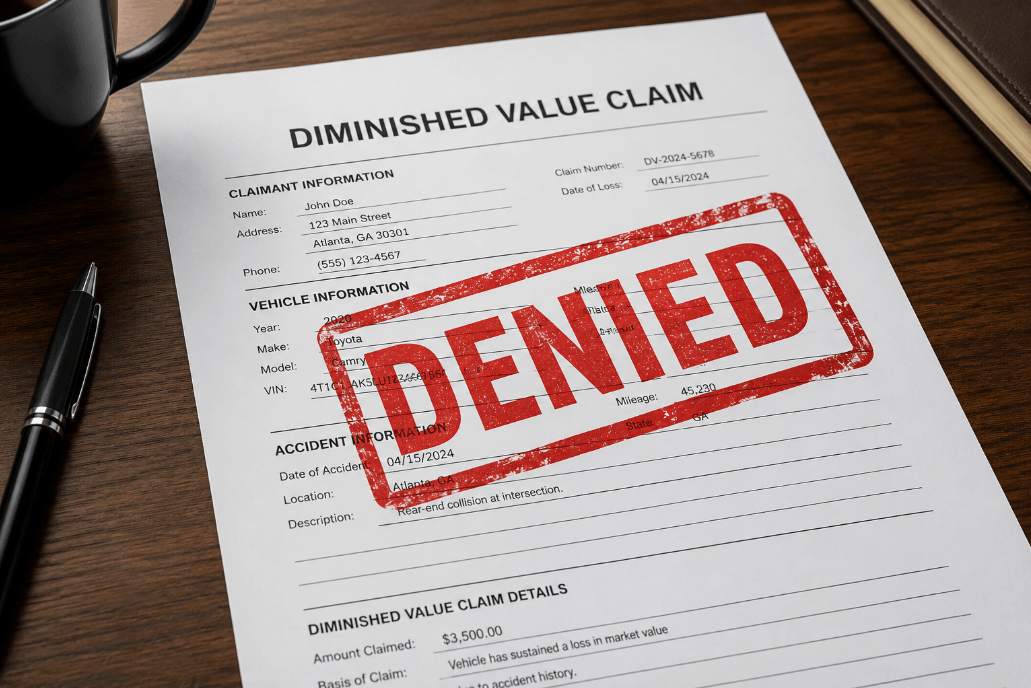
In Georgia, a diminished value claim is a legal request for compensation representing the difference between your vehicle's market value before an accident and its value after being repaired. Because Georgia law requires insurers like Allstate to compensate for this loss in value—even for at-fault drivers—policyholders and third-party claimants can recover significant funds.
The state of Georgia remains a unique jurisdiction in the United States regarding automotive insurance law. Unlike most states, where diminished value is typically only available when you are the "third party" (the person hit by someone else), Georgia allows for "first-party" diminished value claims. This means even if you were at fault for an accident, or if you are filing a claim under your own Allstate collision coverage, you may be entitled to a payout for the "stigma" attached to your vehicle’s accident history.
As of 2026, Allstate continues to process these claims using a standardized approach, often relying on a controversial calculation known as the "17c Formula." Understanding how this formula works, why it may undervalue your vehicle, and how to effectively challenge Allstate’s assessment is critical to ensuring you receive fair market compensation.
The Legal Foundation: Mabry v. State Farm
To understand why Allstate must pay diminished value in Georgia, one must look at the landmark 2001 Georgia Supreme Court case, Mabry v. State Farm Mutual Automobile Insurance Co. This ruling established that the Georgia insurance contract requires insurers to compensate for the loss of value caused by an accident, in addition to the cost of physical repairs.
The court recognized that a vehicle with an accident history is inherently worth less than an identical vehicle with no accident history, regardless of how well the repairs were performed. This is known as Inherent Diminished Value. In Georgia, this isn't just a courtesy; it is a mandatory consideration for insurance companies. Allstate is legally obligated to evaluate every physical damage claim for diminished value and must notify the claimant of their rights regarding this compensation.
Types of Diminished Value Claims with Allstate
When dealing with Allstate in Georgia, your claim will fall into one of two categories:
1. First-Party Claims
If you have a policy with Allstate and you are involved in an accident (whether at-fault or not), you can file a claim against your own collision or comprehensive coverage. Georgia is one of the few states where the law mandates that your own insurer must pay you for the loss of your vehicle's value.
2. Third-Party Claims
If an Allstate policyholder hits you, you are a third-party claimant. In this scenario, you are seeking compensation from the at-fault driver’s liability coverage. Because you have no contract with Allstate in this instance, you are not bound by their internal policy language, which can sometimes provide more leverage during negotiations.
The "17c Formula": How Allstate Calculates Value
Following the Mabry decision, the Georgia Insurance Commissioner’s office initially suggested a formula to help insurers standardize payouts. This became known as the "17c Formula" (named after the paragraph number in the original court documents). While Allstate and other major insurers use this as a "gold standard," it is important to note that the Georgia Department of Insurance has stated that 17c is not the required method of calculation, but rather a suggested starting point.
The 17c Formula follows a specific, four-step mathematical process:
Step 1: Determine the Fair Market Value
Allstate uses tools like NADA, Kelley Blue Book, or their own proprietary software to determine the value of your car immediately before the accident.
Step 2: The 10% Cap
The formula assumes that the maximum amount of diminished value a vehicle can suffer is 10% of its total market value. If your car is worth $40,000, the "Base Loss of Value" is immediately capped at $4,000.
Step 3: The Damage Multiplier
Allstate applies a multiplier based on the severity of the structural damage:
- 1.00: Severe structural damage
- 0.75: Major damage to structure and panels
- 0.50: Moderate damage to panels and parts
- 0.25: Minor damage to panels and parts
- 0.00: No damage (rarely used in a successful claim)
Step 4: The Mileage Multiplier
Finally, a multiplier is applied based on the vehicle's odometer reading:
- 1.00: 0–19,999 miles
- 0.80: 20,000–39,999 miles
- 0.60: 40,000–59,999 miles
- 0.40: 60,000–79,999 miles
- 0.20: 80,000–99,999 miles
- 0.00: 100,000+ miles
Example Calculation: A 2023 SUV worth $50,000 with 30,000 miles and "moderate" damage:
- $50,000 x 10% = $5,000 (Base Loss)
- $5,000 x 0.50 (Damage Multiplier) = $2,500
- $2,500 x 0.80 (Mileage Multiplier) = $2,000 Final Offer
Why the 17c Formula Often Underestimates Loss
The primary criticism of Allstate's reliance on 17c is that it is arbitrary. The 10% cap has no basis in the actual used-car market. For high-end luxury vehicles or brand-new cars, the "stigma" of an accident can often reduce the resale value by 20% or 30%, far exceeding the 10% cap. Furthermore, the mileage multiplier effectively zeroes out any claim for a vehicle with over 100,000 miles, even though a well-maintained truck or luxury car with 105,000 miles still loses significant value after a major accident.
Eligibility Requirements for a Georgia DV Claim
While Georgia is consumer-friendly regarding diminished value, certain criteria must be met to file a successful claim with Allstate in 2026:
- Statute of Limitations: In Georgia, you generally have four years from the date of the accident to file a claim for property damage, which includes diminished value.
- Ownership: You must be the owner of the vehicle. If you lease your car, you typically cannot claim diminished value because you do not own the residual value of the vehicle; the leasing company does.
- Minimum Damage: While there is no legal minimum, if the damage is purely cosmetic (e.g., a small scratch on a bumper), Allstate may argue the loss of value is $0.
- Prior History: If your car has been in three previous accidents, the marginal loss of value from a fourth accident is significantly lower, making a claim harder to justify.
Step-by-Step: Filing Your Claim with Allstate
To ensure you don't leave money on the table, follow this structured process:
- Complete the Physical Repairs: You cannot accurately assess diminished value until the car is fully repaired. Use an Allstate-approved shop or your own preferred mechanic, but ensure all repairs are documented.
- Request a DV Evaluation: Once repairs are finished, contact your Allstate adjuster and formally request a diminished value assessment. In Georgia, they may send you a check automatically, but it is often for a very low amount.
- Review the Offer: If Allstate sends a check, look for language stating "Full and Final Settlement." Do not sign or cash a check if it explicitly waives your right to pursue further diminished value compensation unless you are satisfied with the amount.
- Obtain an Independent Appraisal: This is the most critical step. If Allstate's offer is low, hire a professional independent appraiser who specializes in Georgia diminished value. They will provide a "market-based" report rather than a "formula-based" one.
- Submit a Demand Letter: Send the independent appraisal to Allstate along with a formal demand letter requesting the difference between their offer and the appraised loss.
Comparing Allstate’s Approach to Market Reality
| Feature | Allstate (17c Formula) | Independent Market Appraisal |
|---|---|---|
| Calculation Basis | Fixed percentage and multipliers | Real-world dealer auctions & sales data |
| Value Cap | Strictly capped at 10% of car value | No arbitrary cap; reflects true loss |
| Mileage Impact | Severe; $0 payout if over 100k miles | Gradual; considers vehicle type and rarity |
| Luxury Vehicles | Often significantly undervalued | Accurately reflects high "stigma" costs |
| Negotiation Style | Prefers "Take it or leave it" | Evidence-based; harder for adjusters to ignore |
How to Challenge a Low Offer
If Allstate refuses to budge from the 17c calculation, you have several options:
The Appraisal Clause
Check your Allstate policy for an "Appraisal Clause." This provision allows you and Allstate to each hire an appraiser. If the two appraisers cannot agree, they select a "Umpire" to make a final, binding decision. This is often cheaper and faster than going to court.
Department of Insurance Complaint
If you believe Allstate is acting in bad faith or misrepresenting the law, you can file a complaint with the Georgia Office of Commissioner of Insurance and Safety Fire. While they cannot force a settlement, they can investigate whether Allstate is following state-mandated procedures.
Magistrate Court
For claims under $15,000, Georgia’s Magistrate Court (Small Claims) is a viable option. You do not necessarily need an attorney, and a judge will often look at your independent appraisal as more credible than a generic formula.
Common Mistakes to Avoid
- Waiting too long: Evidence of market value is strongest immediately following the repairs.
- Accepting the first check blindly: Allstate adjusters are trained to close files quickly and cheaply.
- Relying on "Dealer Quotes": A verbal quote from a car dealer saying "I'd give you $5,000 less for this car" is not admissible evidence. You need a certified, written appraisal.
- Ignoring the First-Party Right: Many Georgians don't realize they can claim against their own Allstate policy if they hit a pole or a deer. Don't skip this potential recovery.
Frequently Asked Questions
Can I file a diminished value claim if the accident wasn't my fault?
Yes. In fact, third-party claims (where you are hit by an Allstate insured driver) are the most common. In these cases, you are entitled to the full difference in market value, and you are not limited by the specific language of an insurance policy you didn't sign.
How much does an independent appraisal cost in 2026?
Typically, a professional diminished value appraisal in Georgia ranges from $150 to $400. Considering that an independent report can often increase a settlement offer by $1,000 to $5,000, it is usually a high-return investment.
Does Allstate pay diminished value on leased cars?
No. In a lease agreement, the leasing company (the "Lessor") owns the vehicle. Since they are the ones who will suffer the loss when the car is sold at the end of the lease, only they have the right to claim diminished value.
Will filing a first-party DV claim with Allstate raise my premiums?
If you were at fault for the accident, your premiums may already be impacted by the collision claim itself. Adding a diminished value component to an existing claim typically does not result in a secondary rate hike, but it is always wise to consult with your agent about your specific "Step Rating."
What if my car is totaled?
Diminished value does not apply to totaled vehicles. If a vehicle is a total loss, Allstate is required to pay you the full Fair Market Value of the car (plus tax and tag fees in Georgia). Diminished value only applies to vehicles that are repaired and returned to the road.
Final Recommendation
If you are dealing with an Allstate diminished value claim in Georgia, do not assume their initial offer is the final word. The 17c Formula is a tool designed for the insurance company's convenience, not for your financial protection. Obtain a copy of your repair estimate, verify your vehicle’s pre-accident value through independent sources, and if the gap between Allstate’s offer and your perceived loss is more than $500, hire a certified Georgia auto appraiser to provide the documentation necessary to secure a fair settlement.