Southwest Airlines currently serves over 120 destinations across the United States and 10 countries including Mexico, the Caribbean, and Central America. Unlike traditional hub-and-spoke carriers, Southwest utilizes a point-to-point network, with major operations concentrated in focus cities such as Denver, Chicago Midway, Baltimore/Washington, and Dallas Love Field.
The Evolution of the Southwest Airlines Route Network
As of 2026, Southwest Airlines has solidified its position as the largest domestic carrier in the United States by passenger volume. Its route network is a unique hybrid of the original point-to-point model and a modern "mega-station" approach. In the early days of the airline, the strategy was simple: fly between underserved secondary airports to keep costs low and turnaround times fast. Today, while that DNA remains, Southwest has expanded into some of the nation’s largest international gateways, providing a robust alternative to legacy carriers.
The airline’s growth strategy in 2026 continues to focus on "near-international" markets and deepening its footprint in the Western United States. By avoiding the traditional "hub" system—where passengers are funneled through a single massive airport to reach their final destination—Southwest allows for more direct flights between mid-sized cities. However, certain airports have naturally emerged as "powerhouses" in their system due to geographic location and local demand.
Primary Domestic Focus Cities and Mega-Stations
While Southwest technically does not have "hubs," several airports handle hundreds of daily departures and serve as primary connection points for the transcontinental network. Understanding these major stations is crucial for travelers looking to optimize their flight paths and minimize layover times.
Denver International Airport (DEN)
Denver has ascended to become one of the busiest stations in the Southwest network. Its central geographic location makes it the ideal jumping-off point for travelers moving between the Midwest and the Pacific Coast. In 2026, Southwest occupies a significant portion of Concourse C, offering dozens of gates that facilitate rapid connections. Denver is particularly important for reaching mountain destinations like Bozeman, Steamboat Springs (HDN), and Montrose/Telluride.
Chicago Midway International Airport (MDW)
Midway remains the quintessential Southwest airport. While many legacy carriers moved to O'Hare (ORD), Southwest stayed committed to Midway, turning it into a massive operational base. For travelers in the Great Lakes region, Midway serves as the primary gateway to the East Coast and the South. Its compact size compared to O'Hare allows for the quick gate turns that Southwest is famous for.
Baltimore/Washington International Thurgood Marshall Airport (BWI)
BWI is the undisputed king of Southwest operations on the East Coast. It serves as a massive processing center for traffic moving along the Northeast Corridor and down to Florida. Because BWI is a "base" for flight crews, it often sees the earliest departures and latest arrivals, providing maximum schedule flexibility for business travelers heading into the D.C. and Baltimore metropolitan areas.
Dallas Love Field (DAL)
The spiritual home of Southwest Airlines, Dallas Love Field is located much closer to downtown Dallas than the sprawling DFW International. Because of the Wright Amendment's expiration years ago, Southwest now flies from DAL to destinations across the entire country. It remains a high-frequency airport, especially for "Texas Triangle" routes between Dallas, Houston, and San Antonio.
Other Significant Domestic Bases
- Las Vegas (LAS): A major West Coast focal point and a primary destination for leisure travel.
- Phoenix Sky Harbor (PHX): Acts as a critical bridge for Southwest traffic heading into Southern California and Mexico.
- Nashville International (BNA): Recently expanded to accommodate the massive surge in tourism and business in Tennessee.
- Houston William P. Hobby (HOU): The primary gateway for Southwest’s expansion into Mexico and Central America.
International Destinations and Coastal Gateways
Southwest's international strategy is focused on "short-haul" international flights, primarily to vacation destinations. The airline does not operate wide-body aircraft, meaning they do not fly to Europe or Asia. Instead, they utilize the Boeing 737 fleet to reach high-demand beaches and cultural hubs in the Western Hemisphere.
Mexico and Central America
Southwest has a massive presence in Mexico, serving the most popular tourist corridors.
- Cancun (CUN): Served from nearly every major Southwest focus city in the US.
- Los Cabos (SJD): A primary destination for West Coast and Texas-based travelers.
- Puerto Vallarta (PVR) and Cozumel (CZM): Popular secondary markets with frequent seasonal service.
- Costa Rica: Southwest serves both San Jose (SJO) and Liberia (LIR), catering to eco-tourism.
The Caribbean
The airline's Caribbean network has grown significantly, using Fort Lauderdale-Hollywood International (FLL) and Orlando (MCO) as the primary launching pads.
- The Bahamas: Service to Nassau (NAS) and Freeport.
- Jamaica: High-frequency flights to Montego Bay (MBJ).
- Dominican Republic: Direct routes to Punta Cana (PUJ).
- Puerto Rico: Frequent service to San Juan (SJU), which functions similarly to a domestic destination regarding customs and documentation.
Southwest's Presence in Hawaii
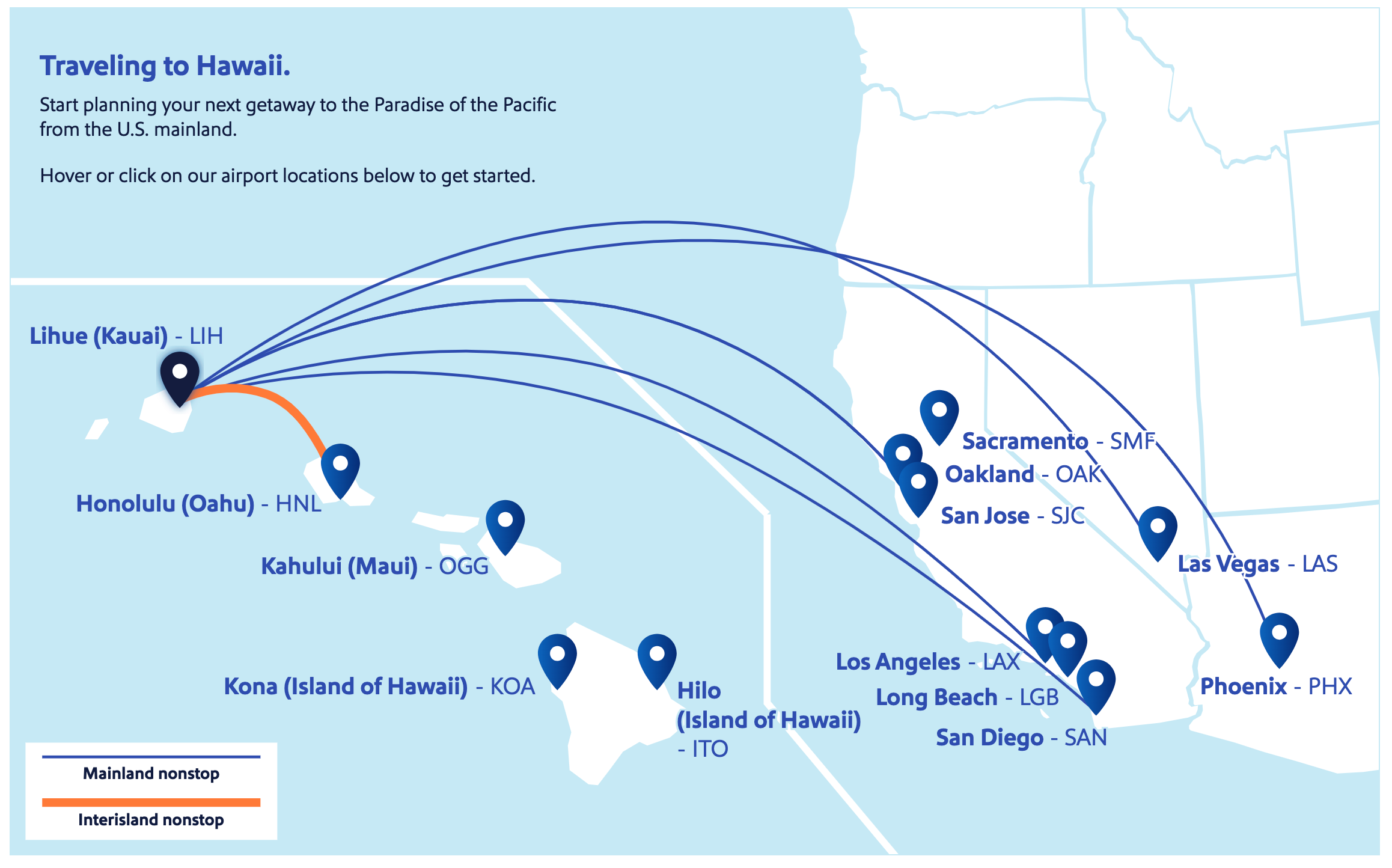
Since entering the Hawaiian market in 2019, Southwest has radically changed the landscape of island travel. By 2026, their Hawaii operations are split into two distinct categories: transpacific flights from the Mainland and "Inter-island" shuttles.
- Mainland to Hawaii: Southwest flies to Hawaii from several California gateways, including Oakland (OAK), San Jose (SJC), Sacramento (SMF), Los Angeles (LAX), and Long Beach (LGB). They also offer service from Las Vegas and Phoenix.
- Inter-island Service: Southwest has become a dominant player in travel between the islands, providing frequent, low-cost flights between Honolulu (HNL), Kahului (OGG), Kona (KOA), Lihue (LIH), and Hilo (ITO).
Technical Comparison of Major Southwest Operational Hubs (2026 Data)
| Airport Name | Airport Code | Primary Role | Geographic Advantage |
|---|---|---|---|
| Denver International | DEN | National Hub | Central US connectivity; Mountain access |
| Chicago Midway | MDW | Midwest Base | High-frequency regional and East Coast flights |
| Baltimore/Washington | BWI | East Coast Anchor | Northeast Corridor and Florida connections |
| Dallas Love Field | DAL | Corporate HQ/Base | Close proximity to Dallas business district |
| Houston Hobby | HOU | International Gateway | Primary departure point for Mexico/Central America |
| Las Vegas Harry Reid | LAS | Leisure/West Hub | Major Southwest point for West Coast traffic |
| Phoenix Sky Harbor | PHX | Southwest Desert Hub | Gateway to SoCal and the Southwest US |
| Orlando International | MCO | Tourism/Caribbean | Connecting Florida to the Midwest/Northeast |
Navigating Secondary Airports
One of the strategic advantages of Southwest is its preference for secondary airports in major metropolitan areas. These airports are often smaller, less congested, and closer to city centers than the primary international airports used by other carriers.
- California: Southwest is a major tenant at Burbank (BUR) and Ontario (ONT), offering alternatives to the congestion of LAX. In the Bay Area, they favor Oakland (OAK) and San Jose (SJC) over San Francisco International (SFO), though they do maintain a presence at SFO.
- New York/New Jersey: While they serve LaGuardia (LGA), they also provide significant service to Islip (ISP) on Long Island, which offers a much faster curb-to-gate experience for residents of the outer boroughs and suburbs.
- Texas: The use of Houston Hobby (HOU) instead of George Bush Intercontinental (IAH) is a classic example of Southwest’s "convenience" strategy, as Hobby is located much closer to the downtown and medical center districts.
Frequently Asked Questions (FAQs)
Does Southwest fly to Canada or Europe?
As of 2026, Southwest Airlines does not fly to Canada or Europe. Their business model relies on a single aircraft type (Boeing 737), which is optimized for domestic and short-haul international flights. Flying to Europe would require different aircraft types and significant changes to their maintenance and staffing infrastructure. Canada has been explored, but high airport fees and taxes have historically kept Southwest from entering that market.
What are the "newest" airports Southwest has added?
In the early 2020s, Southwest underwent a rapid expansion, adding over 18 new airports in a short window. Key additions that have since become staples in their 2026 schedule include Bozeman (BZN), Sarasota (SRQ), Eugene (EUG), and Syracuse (SYR). These additions were designed to capture "work-from-anywhere" travelers and outdoor enthusiasts.
How do I find every airport Southwest flies to from my city?
The most effective tool is the Southwest Airlines Route Map available on their official website. By selecting your "Home" airport, the map will highlight all direct destinations in one color and connecting destinations in another. This is particularly useful because Southwest does not appear on many third-party travel aggregators like Google Flights or Expedia in the same way other airlines do.
Is San Juan, Puerto Rico considered an international flight?
For Southwest passengers, San Juan (SJU) is treated as a domestic flight in terms of documentation. U.S. citizens do not need a passport to fly to Puerto Rico. However, Southwest often groups it with its "International" gate operations in airports like Orlando or Tampa due to the agricultural inspections required when returning to the mainland.
Which Southwest airport is best for international transfers?
Houston Hobby (HOU) and Fort Lauderdale-Hollywood (FLL) are the premier international gateways. Houston is generally better for flights heading to Mexico and Central America, while Fort Lauderdale is the primary hub for the Caribbean and the Bahamas. Both airports feature modern Federal Inspection Services (FIS) facilities designed specifically to handle Southwest’s high-volume international arrivals.
Practical Recommendations for Travelers
To make the most of the airports Southwest flies to, travelers should utilize the Southwest Low Fare Calendar. Because Southwest operates on a point-to-point system, ticket prices can vary wildly depending on whether you are flying into a major focus city or a smaller regional airport.
When planning a trip in 2026, consider the "Alternative Airport" strategy. If you are flying to Southern California, check fares for Burbank (BUR), Long Beach (LGB), and Ontario (ONT) alongside LAX. Often, the time saved in the smaller airport and the lower fare will more than make up for a slightly longer drive to your final destination. Finally, always verify the specific terminal for Southwest at larger airports like Chicago O'Hare (ORD) or Los Angeles (LAX), as they are often situated in terminals that are separate from the main international clusters.