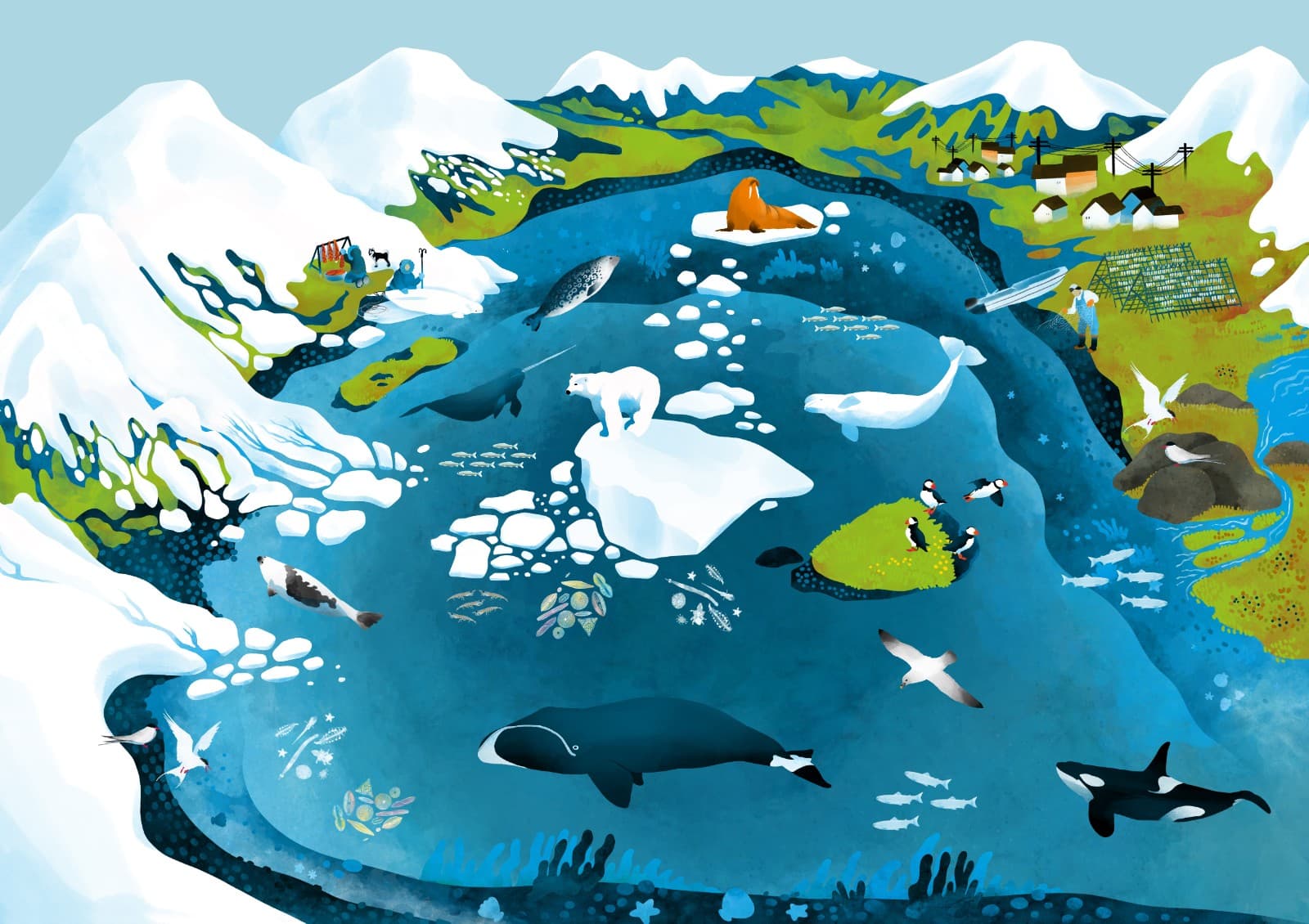
The Arctic Ocean ecosystem is a complex marine environment characterized by extreme seasonality, permanent and seasonal sea ice, and cold-adapted biological communities. It functions through a specialized food web where sea ice serves as both a physical habitat and a primary source of carbon via ice algae, supporting life from microscopic zooplankton to apex predators like polar bears.
The Foundation of Arctic Life: Primary Production and the Cryosphere
At the heart of the Arctic Ocean ecosystem is the relationship between light, nutrients, and ice. Unlike most temperate oceans, the Arctic has two distinct sources of primary production. The first is the phytoplankton bloom, which occurs in the open water as the sun returns in the spring. The second, and perhaps more critical for the ecosystem's unique identity, is sympagic production, or ice algae.
Ice algae, dominated by diatoms such as Melosira arctica, grow on the underside of sea ice. These organisms are adapted to low-light conditions and begin their growth cycle weeks before the open-water phytoplankton. As the ice melts in late spring and early summer, this algae sloughs off, providing a concentrated "pulse" of high-quality food to the seafloor and the water column. This early-season energy boost is vital for the survival of herbivorous zooplankton, which must synchronize their life cycles with these short periods of intense productivity.
In 2026, researchers have observed that the timing of these blooms is shifting significantly. As the ice thins and melts earlier, the mismatch between the availability of ice algae and the reproductive cycles of zooplankton creates a "phenological mismatch." This disruption ripples through the entire food chain, affecting the fat storage and survival rates of higher-trophic-level organisms.
Trophic Architecture: The Arctic Marine Food Web
The Arctic food web is remarkably streamlined compared to the high-diversity systems of the tropics. This lack of redundancy makes it highly efficient but also exceptionally vulnerable to the loss of key species.
The Invertebrate Engine
The bridge between primary producers and larger animals consists of fatty copepods, particularly Calanus glacialis and Calanus hyperboreus. These tiny crustaceans are "lipid-rich," meaning they store enormous amounts of fat. They are the primary food source for many fish and bird species. The high fat content of Arctic zooplankton is what allows the entire ecosystem to survive the long, dark winter months when no new food is being produced.
The Trophic Hub: Arctic Cod
The Arctic cod (Boreogadus saida) serves as the central hub of the Arctic ecosystem. It is the primary link between the invertebrates and the top predators. Arctic cod are uniquely adapted to the cold, possessing antifreeze proteins in their blood that prevent them from freezing in sub-zero waters. They hide in the nooks and crannies of the sea ice to avoid predators, making the presence of ice essential to their survival. Almost every major predator in the Arctic—including seals, whales, and seabirds—relies heavily on Arctic cod for nutrition.
Marine Mammals and Apex Predators
The upper levels of the ecosystem are dominated by specialized mammals:
- Pinnipeds: Ringed seals and bearded seals are the most abundant. Ringed seals depend on sea ice for pupping and resting.
- Cetaceans: The bowhead whale, narwhal, and beluga are the only three whale species that remain in the Arctic year-round. They have evolved without dorsal fins, an adaptation that allows them to swim safely under thick ice without injury.
- Polar Bears: As the apex predator, the polar bear (Ursus maritimus) is almost entirely dependent on sea ice as a platform for hunting seals. Without the ice, bears are forced onto land, where they have limited access to their primary caloric sources.
Physical Oceanography and the Role of Bathymetry
The Arctic Ocean is the smallest and shallowest of the world’s oceans, characterized by vast continental shelves. These shelves, particularly the Siberian Shelf and the Chukchi Shelf, are the most productive areas because they allow for the rapid recycling of nutrients between the seafloor and the surface—a process known as benthic-pelagic coupling.
The water column in the Arctic is highly stratified. A layer of cold, relatively fresh water sits at the surface, maintained by river runoff from the surrounding continents and melting sea ice. Beneath this is the halocline, a layer where salinity increases rapidly with depth. This stratification acts as a barrier, preventing warmer, nutrient-rich Atlantic and Pacific waters from reaching the surface. However, as of 2026, this "capping" effect is weakening in a process known as Atlantification. Warmer Atlantic waters are penetrating deeper into the Arctic basin, bringing more heat and different nutrient profiles, which fundamentally alters the types of species that can survive there.
The 2026 State of the Arctic: Threats and Transformations
The Arctic is warming at more than three times the global average, a phenomenon known as Arctic Amplification. This warming leads to several cascading effects that threaten the stability of the ecosystem.
Loss of Multi-Year Ice
Historically, much of the Arctic was covered by multi-year ice—thick ice that persists through the summer. By 2026, the Arctic has shifted toward a regime dominated by seasonal "first-year" ice. This ice is thinner, saltier, and more prone to breaking up. For species like the ringed seal, first-year ice is often insufficient for building the stable snow caves required for rearing pups.
Borealization of the Arctic
As the waters warm, sub-Arctic species are moving northward. This process, termed "borealization," involves species like Atlantic cod and mackerel expanding their range into the High Arctic. These "invaders" compete with native Arctic cod for food and often prey upon them. This shift doesn't just add new species; it changes the energy flow of the ecosystem, as sub-Arctic species often have lower fat content than their Arctic counterparts, providing less energy to the predators that eat them.
Ocean Acidification
Cold water absorbs carbon dioxide (CO2) more efficiently than warm water. Consequently, the Arctic Ocean is acidifying faster than other regions. This poses a direct threat to calcifying organisms, such as pteropods (sea butterflies) and certain types of plankton, which form the base of the food web. If these organisms cannot form their shells, the entire structure of the food web is at risk of collapse.
Comparison of Arctic Species Resilience (2026 Status)
The following table outlines the current status and primary threats to key species within the Arctic Ocean ecosystem as observed in 2026.
| Species | Primary Habitat | Status (2026) | Primary Threat |
|---|---|---|---|
| Arctic Cod | Under-ice / Pelagic | Declining | Loss of sea ice habitat; competition with Atlantic Cod |
| Ringed Seal | Sea ice (Snow drifts) | Vulnerable | Early ice breakup; lack of snow for dens |
| Polar Bear | Sea ice | Critical (sub-populations) | Reduced hunting window; energy depletion |
| Bowhead Whale | Edge of pack ice | Stable/Recovering | Increased shipping noise; potential for ship strikes |
| Ice Algae | Underside of sea ice | Shifting | Changes in ice thickness and light penetration |
| Calanus glacialis | Pelagic (Deep/Surface) | Threatened | Warming waters; replacement by smaller Atlantic copepods |
Human Impact and Geopolitical Pressures
The retreat of sea ice has opened the Arctic to increased human activity. This introduces new stressors into a previously isolated ecosystem.
- Maritime Traffic: The Northern Sea Route and the Northwest Passage are seeing increased traffic from commercial shipping and tourism. This brings the risk of oil spills, which are nearly impossible to clean up in icy, remote waters, and acoustic pollution, which disrupts the communication of marine mammals like narwhals.
- Resource Extraction: Exploration for oil, gas, and minerals continues to be a point of contention. The infrastructure required for these operations can fragment habitats and introduce pollutants.
- Microplastics: Even the most remote parts of the Arctic Ocean now show significant concentrations of microplastics, which are carried north by ocean currents and atmospheric deposition. These plastics are ingested by zooplankton and move up the food chain, potentially carrying toxins to apex predators and indigenous communities who rely on subsistence hunting.
Conservation and the Path Forward
Conservation in the Arctic requires international cooperation, primarily through the Arctic Council and treaties like the Central Arctic Ocean Fisheries Agreement (CAOFA). In 2026, the focus has shifted toward creating Marine Protected Areas (MPAs) that are "mobile"—designed to shift boundaries based on where the sea ice is most stable.
Restoration of the Arctic ecosystem is not possible through local efforts alone; it is inextricably linked to global carbon emission reductions. However, mitigating local stressors—such as regulating shipping lanes and limiting commercial fishing in high-sensitivity zones—can provide the ecosystem with the "breathing room" it needs to adapt to a changing climate.
Frequently Asked Questions
Is the Arctic Ocean expected to be ice-free in 2026?
While the Arctic continues to see record lows in ice extent, it is not yet entirely ice-free year-round. However, many scientists categorize the current state as "practically ice-free" during peak summer months in certain sectors, meaning there is less than 1 million square kilometers of ice. The winter ice still returns but is significantly thinner and less stable than in previous decades.
How does the melting of the Arctic ecosystem affect the rest of the world?
The Arctic acts as the world's refrigerator. The white surface of the sea ice reflects sunlight back into space (the albedo effect). As the ice melts, the dark ocean absorbs that heat, further warming the planet. Additionally, changes in Arctic water temperature and salinity can disrupt the Global Conveyor Belt (thermohaline circulation), which regulates weather patterns in Europe and North America.
Can Arctic species adapt to warmer water?
Some species have limited plasticity, but many are "stenothermal," meaning they can only survive in a very narrow range of cold temperatures. While some may move further north to stay in cold water, they eventually run out of space at the North Pole. The faster the change occurs, the less likely these specialized species are to adapt or evolve.
What is "Atlantification" and why is it a problem?
Atlantification refers to the increasing influence of warm, salty Atlantic water entering the Arctic Ocean. This heat prevents the formation of sea ice from below and breaks down the protective stratification of the ocean layers. It brings in "temperate" species that outcompete native Arctic life, fundamentally transforming the Arctic into a sub-Arctic environment.
Are there any positive developments for the Arctic ecosystem?
Improved satellite monitoring and international agreements, such as the moratorium on commercial fishing in the High Seas of the Central Arctic Ocean, represent significant steps in proactive management. There is also increasing recognition of Indigenous Knowledge (IK) in co-managing these regions, which provides a more holistic understanding of ecosystem changes.
Practical Recommendations for Engagement
To contribute to the preservation of the Arctic Ocean ecosystem, individuals and organizations should focus on the following actions:
- Support Global Carbon Reduction: The primary driver of Arctic degradation is global warming. Supporting policies and technologies that reduce CO2 emissions is the most direct way to save the sea ice.
- Promote Sustainable Fisheries: Choose seafood certified by organizations like the Marine Stewardship Council (MSC) to ensure that your consumption does not contribute to the overfishing of species moving into the Arctic.
- Advocate for Marine Protected Areas: Support international efforts to designate large-scale, "no-take" zones in the Arctic to protect the remaining multi-year ice refugia.
- Reduce Plastic Use: Since microplastics are a growing threat in the Arctic, reducing single-use plastics and supporting waste-management infrastructure helps prevent these materials from reaching northern currents.