A sales blitz in international trade is an intensive, time-bound commercial campaign designed to penetrate a specific foreign market or secure a high volume of export contracts within a condensed timeframe. By concentrating personnel, marketing resources, and logistical support into a focused "sprint," businesses can overcome inertia, disrupt competitor presence, and establish immediate brand awareness in a new geographic territory.
The Strategic Value of Concentrated Effort
In the context of international trade, market entry is rarely a passive endeavor. Companies often face barriers such as cultural unfamiliarity, complex regulatory environments, and entrenched local competitors. A sales blitz—often referred to as a market entry offensive or a high-impact promotional surge—replaces the "slow-burn" approach of gradual relationship building with a period of high-intensity activity.
The primary objective of this method is to generate momentum. By scheduling back-to-back meetings, hosting intensive product demonstrations, and synchronizing localized digital advertising, a company forces the market to take notice. This strategy is particularly effective when launching a new product version that requires immediate user adoption to achieve economies of scale or when attempting to seize market share during a competitor’s period of vulnerability, such as a major reorganization or supply chain disruption.
Prerequisites for an International Blitz
Before initiating a blitz, organizations must ensure they are operationally ready for the influx of potential orders. An under-prepared company that succeeds in a blitz but fails in fulfillment will suffer long-term reputational damage that far outweighs the short-term gains.
- Market Intelligence and Localization: You must have validated data regarding local consumer demand, pricing sensitivity, and regulatory requirements. Translating marketing materials is not sufficient; you must localize your value proposition to address the specific pain points of the target region.
- Logistical Infrastructure: Ensure your supply chain is resilient. Verify that your freight forwarders, customs brokers, and third-party logistics (3PL) providers are briefed on the projected volume increases.
- Legal Compliance and Documentation: International trade involves complex compliance requirements, including Incoterms 2020, export controls, and local taxation laws. Ensure your legal department has reviewed all template contracts and that your firm is registered to conduct business in the jurisdiction of interest.
- Personnel Readiness: Your team must be trained not just in the product, but in the cultural nuances of negotiation in the target market. A sales representative who uses high-pressure Western tactics in a market that values long-term, trust-based consensus building will often face rejection.
The Phases of a Sales Blitz
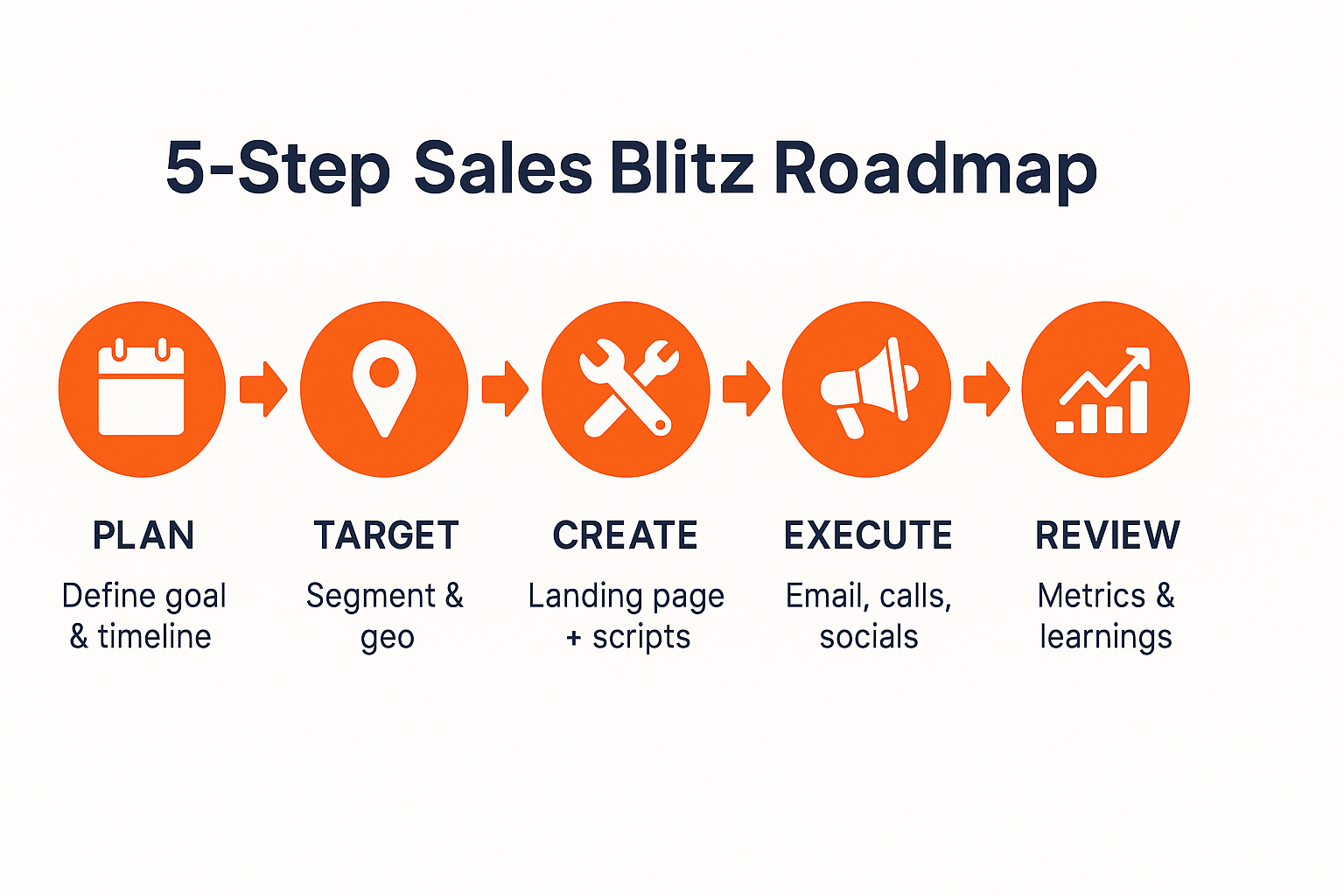
A successful blitz typically spans four distinct phases. While the intensity peaks during the "Blitz Week," the success is predicated on the preparation phase.
Phase I: Intelligence and Targeting (4–8 Weeks Out)
This is the data-gathering stage. Use CRM tools and market research platforms to identify the "low-hanging fruit"—the top 20% of prospects that represent 80% of potential revenue. Build a targeted lead list that includes the key decision-makers (C-suite, procurement heads, or technical leads). During this time, set specific, measurable KPIs, such as number of meetings booked, conversion rate of initial meetings, and projected pipeline growth.
Phase II: The Pre-Heat (2–4 Weeks Out)
Do not go in cold. Use account-based marketing (ABM) to warm up your prospects. Send personalized communication, host virtual webinars tailored to local industry challenges, and leverage local business partners or chambers of commerce to provide testimonials or referrals. By the time your team lands on the ground, they should be familiar faces to the leads they are visiting.
Phase III: The Execution (The Blitz Week)
This is the period of maximum intensity. Your team should operate on a synchronized schedule, maximizing face time. Each evening during the blitz, hold a mandatory "debrief and pivot" session. Review what worked, what didn’t, and adjust the strategy for the following day. This agility is what separates a successful blitz from a disorganized roadshow.
Phase IV: Post-Blitz Consolidation (Ongoing)
The blitz ends, but the work of turning prospects into long-term partners begins. Immediately assign account managers to the newly acquired leads. The most common point of failure in international blitzing is "lead cooling," where the excitement of the initial meeting evaporates because of a slow follow-up process. Send personalized follow-up emails within 24 hours of the meeting and provide the technical documentation requested during the initial discussion.
Comparative Analysis: Traditional Entry vs. Sales Blitz
| Feature | Traditional Market Entry | Sales Blitz |
|---|---|---|
| Pace | Gradual, organic growth | Accelerated, intensive growth |
| Resource Allocation | Spread thinly over time | Concentrated into a short window |
| Risk Profile | Lower daily operational cost | High upfront investment |
| Market Impact | Slow brand recognition | Immediate market disruption |
| Staff Requirement | Minimal staff on-site | Large "strike team" of experts |
Operational Challenges and Risk Mitigation
Operating an intensive campaign internationally introduces risks that do not exist in domestic sales.
- Cultural Misalignment: Even if your product is sound, cultural faux pas can derail your credibility. Hire local consultants who can act as cultural translators. They ensure your messaging is appropriate and that your behavior aligns with local business etiquette.
- Regulatory Surprises: Trade laws can change rapidly. Ensure your compliance team is monitoring local gazettes or trade alerts in real-time. If you are entering a market with fluctuating currency, consider the use of hedging instruments to protect your profit margins.
- Logistics Bottlenecks: A successful blitz will create a surge in demand. If your production capacity cannot scale, you risk losing the very clients you just fought to win. Ensure you have "buffer stock" held in a local bonded warehouse before the blitz begins.
Common Pitfalls to Avoid
Many companies make the mistake of viewing a sales blitz as purely a sales event. In reality, it is a cross-functional exercise.
- Ignoring Technical Support: If you are selling B2B industrial equipment, a sales rep without a technical engineer is often unable to answer the most critical questions. Always pair sales staff with subject-matter experts.
- Neglecting Time Zone Coordination: Ensure your home-office support team is aligned with the local time zone of the blitz. If a potential client needs a custom quote at 2:00 PM local time, your internal team needs to be awake and responsive to provide that document.
- Over-Promising: In the heat of a blitz, there is a temptation to promise custom features or expedited shipping to close a deal. Only promise what the operational team has explicitly green-lit in advance.
Troubleshooting the "Low-Response" Scenario
If you arrive in the target market and find that your meetings are being cancelled or your prospects are not engaged, do not double down on the same tactics.
- Audit Your Messaging: Is your value proposition truly relevant to the current market climate? If you find people are indifferent, pivot your message to focus on a different pain point.
- Leverage Local Influence: If you are struggling to get through the gatekeeper, reach out to your local logistics partners or regional distributors. They have the network and credibility that you currently lack as an "outsider."
- Switch to Virtual Consultations: If physical meetings are proving difficult to secure, offer virtual, low-friction demonstrations that require less commitment from the prospect.
Frequently Asked Questions
1. How long should a sales blitz typically last? Most effective blitzes are scheduled for 5 to 10 working days. This is long enough to gain momentum but short enough to keep the sales team operating at peak energy levels without burning out.
2. What is the most critical factor for success? Preparation is paramount. A blitz cannot fix a fundamental lack of product-market fit. If the market does not want your product, a high-intensity sales effort will only serve to advertise your failures more broadly.
3. How do you handle follow-up across different time zones? Utilize a "follow-the-sun" model. Assign a support team in your home office specifically dedicated to the blitz region, working in shifts that overlap with the target market's business hours to ensure there is no downtime in communication.
4. Can a sales blitz be conducted entirely digitally? Yes, digital blitzes are increasingly common, especially when travel costs are prohibitive or geopolitical risks make physical visits difficult. These rely heavily on high-frequency webinars, virtual trade show participation, and aggressive social media advertising.
5. How do you calculate the ROI of a blitz? Beyond direct revenue, measure the "Customer Acquisition Cost" (CAC) specifically for the blitz, the number of qualified leads added to the pipeline, and the improvement in brand sentiment scores within that region.
Next Steps for Implementation
If you are planning a sales blitz for the 2026 fiscal year, your immediate next step is to conduct a Gap Analysis. Map out your existing capabilities against the requirements of your target market. Identify which resources (staff, marketing collateral, technical documentation) are missing. Once these are secured, select a "pilot city" or region rather than attempting to Blitz an entire country at once. Start small, prove the model, and then scale your blitz efforts across your international territories.