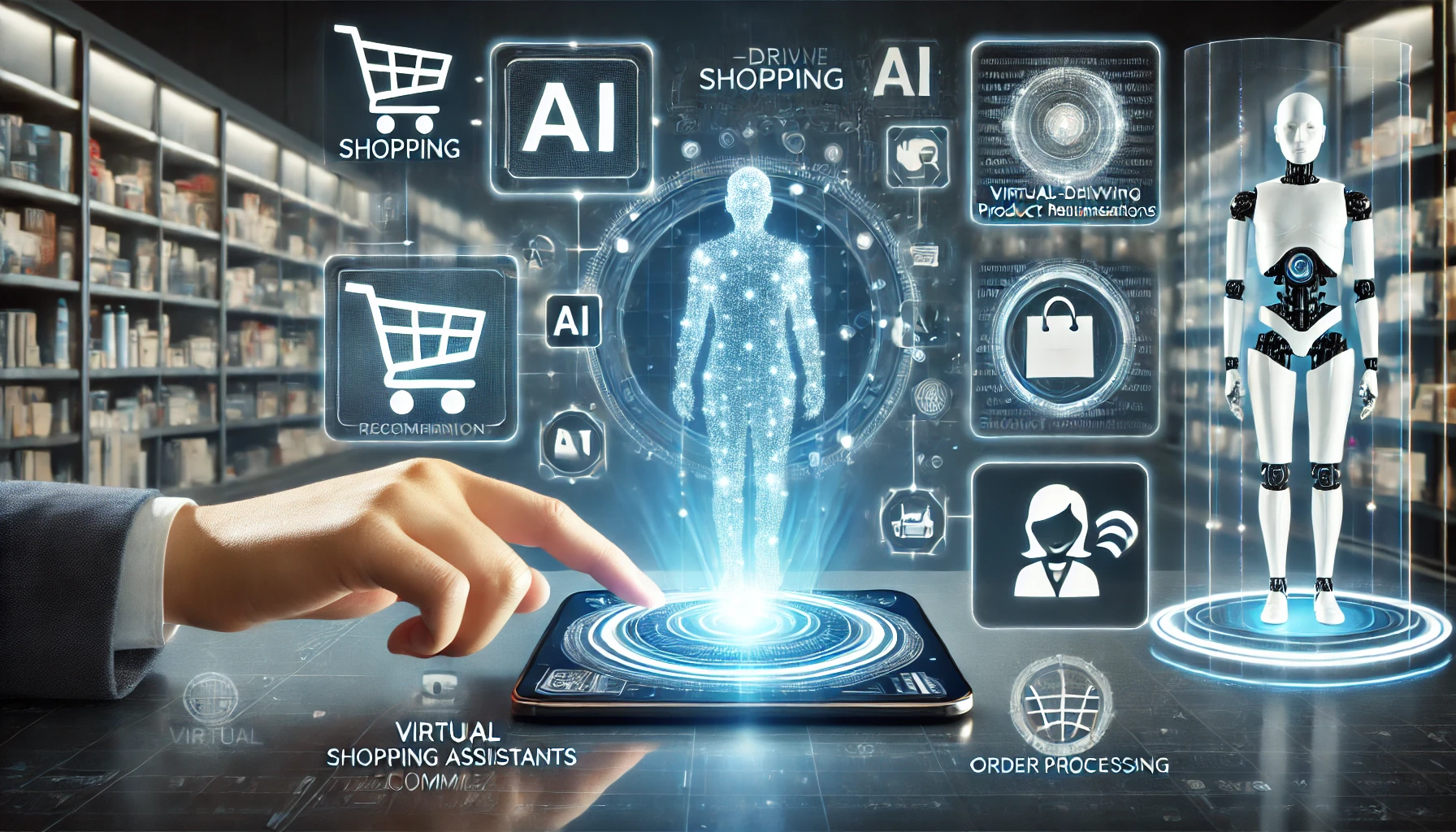
In 2026, an AI-driven online shopping experience leverages autonomous agents and generative models to create a hyper-personalized journey. A primary example is a retailer using multimodal AI to allow customers to upload a photo of a room and receive a fully curated, compatible furniture list that adjusts in real-time based on budget, style, and local inventory.
The Evolution of the AI Retailer in 2026
By 2026, the term "AI retailer" has shifted from businesses that simply use recommendation algorithms to those that integrate artificial intelligence into every layer of the value chain. Traditional e-commerce relied on reactive systems—waiting for a user to type a keyword into a search bar. Modern AI retailers operate on a proactive and generative model.
In this landscape, the online shopping experience is no longer a static grid of products. Instead, it is a dynamic interface that reconstitutes itself for every individual visitor. This transition is driven by the convergence of large language models (LLMs), computer vision, and real-time predictive analytics. For retailers, the goal is to reduce "friction to purchase" by predicting intent before the user explicitly states it.
A Practical Example: The "Aura Home" Shopping Journey
To understand how these technologies manifest, let us examine a hypothetical but technologically grounded example of an AI retailer: Aura Home, a high-end furniture and lifestyle brand.
1. The Discovery Phase: Multimodal Generative Search
Instead of a search bar, the user is greeted by a conversational interface that accepts text, voice, and images. A customer might upload a picture of their current living room and say, "I want to update this space with a 'Japandi' aesthetic, but I need to keep the blue sofa. Show me how it would look with a new coffee table and lighting, keeping the total under $2,500."
The AI does not just search for tags. It uses Computer Vision to segment the image, identifying the dimensions of the room and the specific shade of the blue sofa. It then uses Generative AI to render a 3D visualization of the room with Aura Home’s products integrated into the user’s actual environment.
2. The Evaluation Phase: Autonomous Product Comparison
As the user browses the rendered options, the AI acts as a digital concierge. If the user clicks on a table, the AI provides a "Contextual Summary" rather than a standard product description. It explains why this specific table fits the user's room dimensions and how the materials complement the existing furniture.
Furthermore, the AI can perform real-time durability simulations. It might inform the user, "Based on your previous mentions of having a large dog, this recycled oak finish is 40% more scratch-resistant than the walnut option you viewed earlier."
3. The Transaction Phase: Dynamic Pricing and Logistics
In 2026, pricing is rarely static. Aura Home’s AI calculates a Dynamic Value Proposition. If the user is a loyal customer and the AI detects that the items are in high supply in a nearby warehouse, it might offer a "Sustainability Discount" for consolidated shipping. The checkout process is managed by an autonomous agent that handles payment authentication and schedules delivery windows based on the user’s synced calendar.
Technical Infrastructure of an AI Retailer
Building an experience like the Aura Home example requires a sophisticated technical stack that goes beyond traditional e-commerce platforms like Shopify or Magento.
Semantic Vector Databases
Traditional databases use exact matches. AI retailers use Vector Databases (such as Pinecone or Milvus) to store product information as high-dimensional embeddings. This allows the system to understand that a "minimalist desk" is conceptually similar to a "scandinavian workspace," even if the keywords do not match. This semantic understanding is the backbone of modern search and recommendation engines.
Retrieval-Augmented Generation (RAG)
To ensure the AI does not "hallucinate" (invent product features), retailers use RAG architecture. When a customer asks a question about a product’s warranty or assembly, the system retrieves the specific, verified document from the retailer’s internal knowledge base and uses an LLM to formulate a natural language response. This ensures 100% factual accuracy while maintaining a conversational tone.
Edge Computing and Latency Management
Rendering 3D environments and processing high-resolution images in real-time requires significant computational power. AI retailers in 2026 utilize Edge Computing to process data closer to the user. This reduces latency to sub-100 milliseconds, which is critical for maintaining user engagement during generative tasks.
Comparing Traditional E-commerce vs. AI Retailers
| Feature | Traditional Retailer (Pre-2024) | AI Retailer (2026) |
|---|---|---|
| Search Method | Keyword-based (Exact Match) | Multimodal (Text, Image, Intent) |
| Product Display | Static Photos and Videos | Generative AR and Neural Renders |
| Customer Support | Scripted Chatbots / Humans | Autonomous Agents with RAG |
| Personalization | Segment-based (e.g., "Moms 30-40") | Individual-based (Hyper-Personalized) |
| Pricing | Manual or Rule-based | Real-time Algorithmic/Dynamic |
| Inventory | Reactive Reordering | Predictive Demand Synthesis |
Operational Requirements for Retailers
Transitioning to an AI-driven model is not merely a software update; it requires a fundamental shift in data strategy and organizational structure.
Data Cleaning and Labeling
AI is only as good as the data it consumes. Retailers must move away from "dirty data"—inconsistent product descriptions, poor-quality images, and siloed customer information. In 2026, the primary investment for retailers is in Data Governance. This involves creating a unified "Product Truth" where every SKU is enriched with hundreds of metadata tags that an AI can interpret.
Privacy and the "Zero-Party Data" Shift
With the deprecation of third-party cookies and stricter privacy regulations (like the evolved GDPR and CCPA frameworks), AI retailers focus on Zero-Party Data. This is data that a customer intentionally and proactively shares with a brand. In the Aura Home example, the user shares a photo of their living room. In exchange, the retailer provides a high-value service (the room render). This "Value Exchange" is the cornerstone of 2026 data ethics.
The Role of Human Oversight (RLHF)
Despite the autonomy of these systems, human intervention remains vital. Retailers employ "AI Orchestrators" who use Reinforcement Learning from Human Feedback (RLHF) to fine-tune models. If the AI keeps recommending expensive items to budget-conscious users, the orchestrator adjusts the reward functions to prioritize budget adherence, ensuring the AI remains aligned with the brand's customer service goals.
Common Implementation Mistakes
Retailers often stumble when attempting to integrate AI. Awareness of these pitfalls is essential for a successful rollout.
- Over-Automation: Replacing all human contact with AI can alienate customers, especially in high-ticket luxury segments where human empathy is part of the brand value.
- Neglecting Latency: A generative search that takes 10 seconds to load will have a lower conversion rate than a basic keyword search that takes 200 milliseconds. Speed is a feature.
- Siloed AI Tools: Using one AI for search, another for chat, and a third for email marketing without a unified data layer leads to a disjointed customer experience where the "left hand doesn't know what the right hand is doing."
- Ignoring the "Black Box" Problem: Retailers must be able to explain why an AI made a certain recommendation, especially in regulated markets, to avoid biases.
Cost Considerations and ROI
The initial capital expenditure for an AI-driven retail platform can be significant. However, the 2026 market data suggests a clear ROI path:
- Conversion Rate Optimization (CRO): AI retailers typically see a 25-40% increase in conversion rates due to the relevance of generative search results.
- Reduced Returns: By using AR and "try-on" AI, retailers like Aura Home can reduce return rates by up to 50%, as customers have a much clearer understanding of how the product fits their space or body.
- Operational Efficiency: Autonomous agents can handle up to 85% of customer inquiries, allowing human staff to focus on complex problem-solving and high-value sales.
FAQs
How does an AI retailer handle out-of-stock items in a generative search?
In 2026, AI systems do not simply say "Out of Stock." Instead, the generative engine analyzes the attributes of the missing item and offers a "Synthesized Alternative." It might say, "The mid-century lamp you liked is out of stock, but here is a similar model with the same brass finish and a 15% lower energy consumption rating, available for delivery tomorrow."
Is AI-driven shopping safe for my personal data?
Reputable AI retailers use a "Privacy-by-Design" approach. Photos uploaded for AR rendering are often processed via on-device AI or "Edge Inference," meaning the raw image of your home never actually reaches the retailer's permanent servers. Only the mathematical "features" required for the recommendation are processed.
Can small retailers afford to become "AI retailers"?
While the enterprise-level systems used by major brands are expensive, many "AI-as-a-Service" (AIaaS) providers offer plug-and-play modules for smaller businesses. In 2026, mid-market retailers often use pre-trained models and fine-tune them on their specific inventory, significantly lowering the barrier to entry.
Does AI shopping work for clothing and fashion too?
Yes. The "Virtual Fit" technology is a prime example. AI retailers in the fashion space use "Neural Radiance Fields" (NeRFs) to create a highly accurate digital twin of the customer. This allows the AI to simulate how different fabrics drape and move on the user’s specific body type, solving the long-standing "sizing issue" in e-commerce.
What happens if the AI makes a mistake in a recommendation?
Most 2026 AI retail platforms include a "Feedback Loop." If a user rejects a recommendation, they can click a "Not for me" button, and the AI immediately asks for a reason (e.g., "Too modern," "Wrong color"). This data is used to update the user’s local preference profile in real-time, preventing the error from recurring.
Practical Next Actions for Retailers
To move toward an AI-driven model, retailers should prioritize the following steps:
- Audit Your Data: Ensure your product catalog is structured and digitized. AI cannot sell what it cannot understand.
- Identify a Pilot Use Case: Do not try to automate everything at once. Start with a generative search or an AI-powered customer service agent.
- Invest in API-First Architecture: Ensure your e-commerce platform can easily "talk" to various AI models. A monolithic, closed system will prevent you from integrating the latest AI developments.
- Prioritize User Trust: Be transparent about when a customer is interacting with an AI and how their data is being used to personalize their experience.