A Certified Scrum Master (CSM) is a professional credential provided by the Scrum Alliance that validates an individual's understanding of the Scrum framework, its values, and its practical application. To earn the certification, candidates must attend a mandatory 16-hour course led by a Certified Scrum Trainer (CST) and pass a formal examination. This designation confirms that a professional is equipped to facilitate Agile processes, remove team impediments, and foster a culture of continuous improvement within an organization.
In the evolving professional landscape of 2026, the CSM remains one of the most recognized entry-level certifications for those moving into Agile project management and team leadership. While the fundamentals of Scrum have remained consistent, the application of the framework has expanded far beyond software development into marketing, human resources, and operations. Understanding the nuances of the CSM certification is essential for anyone looking to bridge the gap between traditional management and modern, iterative delivery.
Understanding the Core of the CSM Certification
The CSM certification is not merely a badge of honor; it is an educational journey designed to shift the mindset of a professional from "command and control" to "servant leadership." Administered by the Scrum Alliance—a non-profit organization founded in 2001—the CSM is built upon the foundational principles of the Scrum Guide.
At its heart, the certification focuses on the three pillars of empiricism: transparency, inspection, and adaptation. When you undergo the CSM process, you are learning how to manage complex work where the final outcome is not fully known at the start. The certification ensures that you understand the specific accountabilities, events, and artifacts that make Scrum a functional and effective framework.
Unlike many other professional certifications that allow for self-study, the Scrum Alliance mandates a live (or live-online) interactive training component. This is a critical distinction. The organization believes that the soft skills required for a Scrum Master—such as conflict resolution, coaching, and facilitation—cannot be learned purely through a textbook. The 16-hour training requirement ensures that every CSM holder has engaged in discussions, simulations, and peer-to-peer learning.
The Role of a Certified Scrum Master
To understand the certification, one must understand the role it prepares you for. A Scrum Master is not a "Project Manager" with a different title. In 2026, the distinction is sharper than ever. A traditional Project Manager is often responsible for the "what, when, and how" of a project, managing budgets and timelines directly. A Scrum Master, conversely, is a servant-leader who focuses on the "health" of the team and the "integrity" of the process.
Facilitating the Scrum Events
The CSM is trained to facilitate the four formal events within a Sprint: Sprint Planning, Daily Scrum, Sprint Review, and Sprint Retrospective. The certification ensures the practitioner knows how to keep these events within their time-boxes and ensure they are productive rather than just administrative hurdles.
Removing Impediments
A primary duty of a CSM is "clearing the path" for the developers. This means identifying and eliminating anything that prevents the team from completing their work. This could range from technical debt and lack of resources to organizational bureaucracy and external interruptions.
Coaching the Organization
The CSM certification also covers the Scrum Master's role in the wider organization. A CSM helps stakeholders understand the iterative nature of the work and encourages an environment where experimentation is valued over rigid adherence to a long-term, potentially flawed plan.
Eligibility and Prerequisites for 2026
One of the most appealing aspects of the CSM certification is its accessibility. There are no strict educational or professional prerequisites to begin the journey. You do not need a specific number of years in project management or a specific degree to enroll in a CSM course.
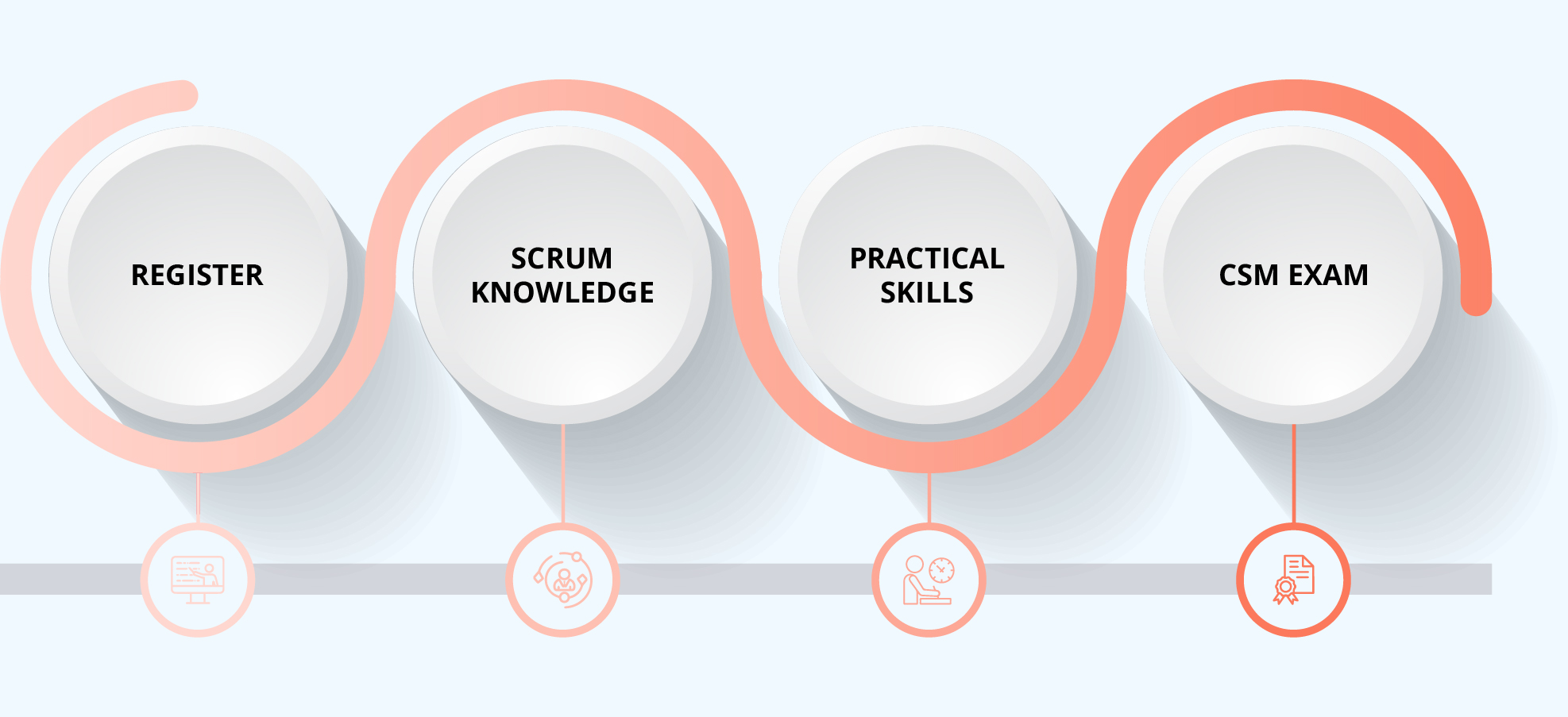
However, the path to certification follows a mandatory sequence:
- Foundational Knowledge: While not strictly required by the Scrum Alliance, it is highly recommended that candidates read the most recent version of the Scrum Guide before attending a class. This allows the classroom time to be used for deep-dives rather than basic terminology.
- Attendance of a CST-Led Course: You must attend a 16-hour course taught by a Certified Scrum Trainer. These courses are offered globally and are available in both in-person and synchronous virtual formats.
- Active Participation: The trainer must verify that you were present and engaged throughout the entire duration of the course. Missing significant portions of the training can disqualify you from taking the exam.
The CSM Examination Process
Once you have successfully completed the 16-hour training, your trainer will register your information with the Scrum Alliance. You will then receive an email invitation to create an account and take the CSM exam.
Exam Specifications
As of 2026, the exam consists of 50 multiple-choice questions. Candidates are given 60 minutes to complete the test. The passing score is 74%, which means you must answer at least 37 out of 50 questions correctly.
Retake Policy
The initial exam fee is typically included in the cost of your CSM course training. If you do not pass on your first attempt, the Scrum Alliance allows for a second attempt at no additional cost. If a third attempt is necessary, a small administrative fee (usually around $25 USD) is charged.
Focus Areas
The exam covers several critical domains, including:
- Scrum Theory: Empiricism, Scrum Values, and the Scrum Team.
- Scrum Accountabilities: The specific roles of the Scrum Master, Product Owner, and Developers.
- Scrum Events: The purpose and execution of the Sprint and its associated meetings.
- Scrum Artifacts: Managing the Product Backlog, Sprint Backlog, and the Increment.
- Definition of Done: Ensuring quality and transparency in delivery.
Comparing CSM with PSM (Professional Scrum Master)
Prospective students often weigh the CSM against the Professional Scrum Master (PSM) offered by Scrum.org. Both are highly respected, but they differ significantly in their approach and requirements.
| Feature | CSM (Scrum Alliance) | PSM I (Scrum.org) |
|---|---|---|
| Prerequisites | Mandatory 16-hour CST course | No mandatory course; self-study allowed |
| Exam Difficulty | Moderate (Focuses on course content) | High (Requires deep theoretical understanding) |
| Passing Score | 74% (37/50) | 85% (68/80) |
| Cost | $400 - $1,500 (Includes course) | ~$200 (Exam only) |
| Renewal | Required every 2 years ($100 + SEUs) | Lifetime validity (No renewal required) |
| Recognition | High (Industry standard for beginners) | High (Valued for technical depth) |
The choice between the two often comes down to learning style. If you value interactive, guided learning and networking, the CSM is the superior choice. If you are a self-starter who prefers a rigorous, one-time exam without the higher cost of a mandatory class, the PSM may be more appropriate.
The Financial Investment: Costs and Value
The cost of obtaining a CSM certification in 2026 varies depending on the region and the specific trainer or training organization you choose. Generally, the price for the mandatory two-day course (which includes the exam fee) ranges from $400 to $1,500 USD.
While this may seem steep compared to self-study certifications, the Return on Investment (ROI) is historically strong. Data from 2025 and early 2026 indicate that professionals with a CSM certification earn, on average, 15% to 20% more than their non-certified counterparts in similar project management roles. Furthermore, many corporate job descriptions for Agile roles list "CSM Certification" as a preferred or even mandatory qualification.
Beyond the initial cost, there is a renewal fee. To maintain your certification, you must pay $100 every two years and submit 20 Scrum Education Units (SEUs). SEUs are earned through continued learning, such as attending Scrum Gatherings, reading books, or participating in webinars.
The Impact on Your Career Path
The CSM is often the "entry drug" into a much larger ecosystem of Agile certifications. It opens the door to advanced designations such as the Advanced Certified Scrum Master (A-CSM) and the Certified Scrum Professional (CSP).
For those not looking to become a full-time Scrum Master, the certification still holds immense value. Product Managers, Business Analysts, and even Executives benefit from understanding the flow of work in a Scrum environment. It provides a common language and a set of shared values that can reduce friction between departments.
In the current 2026 job market, "Agility" is no longer a buzzword but a survival trait for companies. Organizations are looking for leaders who can handle volatility, uncertainty, complexity, and ambiguity (VUCA). The CSM certification is a verified signal to employers that you have the foundational skills to lead teams through these challenges.
Common Pitfalls to Avoid
While the CSM exam has a high pass rate for those who attend the course, the real challenge lies in the application of the knowledge. Many new Scrum Masters fall into these common traps:
- The "Scrum-but" Syndrome: This happens when a team says, "We do Scrum, but we don't do Retrospectives," or "We do Scrum, but we don't have a Definition of Done." The CSM course teaches you why these components are non-negotiable for the framework to function.
- Becoming a "Scribe" or "Secretary": Many new Scrum Masters mistakenly think their job is to just book meetings and take notes. The certification emphasizes that you are a facilitator and coach, not an administrative assistant.
- Ignoring the Human Element: Scrum is based on people and interactions. A common mistake is focusing too much on the mechanics (the tools and the charts) and not enough on the Scrum Values (Respect, Courage, etc.).
Frequently Asked Questions
Can I take the CSM exam without the training course?
No. The Scrum Alliance requires all candidates to complete a 16-hour course with a Certified Scrum Trainer (CST). There is no "exam-only" option for the CSM. This is to ensure that all certified individuals have engaged in the interactive and collaborative elements of the framework.
How long is the CSM certification valid?
The certification is valid for two years. After this period, you must renew it by paying a $100 renewal fee and providing evidence of 20 Scrum Education Units (SEUs) to show you have stayed active in the Agile community and continued your education.
Is the CSM certification worth it for non-software roles?
Absolutely. In 2026, Scrum is widely used in marketing, manufacturing, and even education. The principles of iterative delivery, feedback loops, and team empowerment are universal. Many professionals in non-tech industries find the CSM provides a structured way to manage work that was previously chaotic.
What happens if I fail the exam twice?
If you do not pass the exam on your first two attempts, you can pay a $25 fee for each subsequent attempt. However, if you fail repeatedly, it is highly recommended that you review the Scrum Guide again or reach out to your trainer for additional coaching before trying a third time.
Is the CSM exam proctored?
No, the CSM exam is typically an unproctored, open-book online exam. However, it is timed (60 minutes), and the questions are designed to test your understanding of concepts rather than your ability to find definitions in a book. You are expected to uphold the Scrum Alliance's code of ethics while taking the test.
Final Recommendation: Next Actions
If you are considering a CSM certification, your first step should be to download and read the Scrum Guide. It is a short document (under 20 pages) that contains the "rules of the game." Once you have a basic grasp of the terminology, research Certified Scrum Trainers. Look for trainers who have experience in your specific industry, as their real-world examples will be more relevant to your daily work.
The CSM is more than a credential; it is a gateway to a different way of working. By committing to the 16-hour training and the examination, you are positioning yourself as a leader capable of driving value in a rapidly changing world. Whether you seek to become a full-time Scrum Master or simply wish to improve your team's efficiency, the CSM provides the foundational tools necessary for success in 2026 and beyond.