Homeowners seeking alternatives to Alpha Foundations often find that American Foundation Repair is a top-tier contender, particularly for those in the Midwest or regions with heavy clay soils. While Alpha Foundations is a dominant force in the Southeast through the Groundworks network, American Foundation Repair and national competitors like Ram Jack or Olshan offer specialized piering systems and waterproofing solutions that may better suit specific geological conditions or budget requirements in 2026.
Selecting a foundation repair specialist is a decision that impacts the structural integrity and resale value of your property for decades. In 2026, the industry has shifted toward more data-driven diagnostics, utilizing smart sensors and advanced polymer injections. Whether you are dealing with a sinking slab in Florida or a bowing basement wall in Illinois, understanding the differences between these major players—and the alternatives available—is the first step toward a permanent fix.
Understanding the Landscape: Alpha Foundations vs. American Foundation Repair
To choose the right alternative, one must first understand what Alpha Foundations brings to the table. As a member of the Groundworks family, Alpha Foundations operates primarily in Florida and Georgia. They are known for proprietary systems like PolyRenewal for concrete leveling and specialized helical piers designed for sandy, coastal soils.
The Profile of American Foundation Repair
American Foundation Repair (most notably the prominent entity headquartered in the Chicago area) focuses on the unique challenges of the Midwest. The soil composition here—primarily expansive clay—requires a different engineering approach than the limestone and sand of the South.
American Foundation Repair specializes in:
- Heavy-Duty Steel Piering: Utilizing deep-seated steel piers to reach load-bearing strata through thick clay.
- Basement Wall Stabilization: Employing I-beams and carbon fiber reinforcements for walls buckling under hydrostatic pressure.
- Custom Waterproofing: Integrating interior drain tiles and high-capacity sump systems designed for heavy seasonal rainfall and snowmelt.
Why Seek Alternatives?
Homeowners often look for alternatives to Alpha Foundations for several reasons:
- Regional Availability: Alpha Foundations is geographically limited. If your property is outside the Southeast, you must look elsewhere.
- Proprietary vs. Open Systems: Some homeowners prefer contractors who use non-proprietary parts that can be serviced by multiple companies in the future.
- Cost Variability: Large network-backed companies often have higher overhead, which can reflect in the project quote.
- Specialization: A "one-size-fits-all" approach to foundation repair rarely works due to varying soil mechanics (e.g., the difference between "heave" in the North and "sinkholes" in the South).
Top National and Regional Alternatives in 2026
If Alpha Foundations is not the right fit for your project, several other organizations offer comparable—and in some cases, superior—technology for residential and commercial stabilization.
1. Ram Jack
Ram Jack remains one of the most formidable competitors in the foundation repair space. Their strength lies in their manufacturing; they produce their own American-made steel, which is often cited as the gold standard for durability.
- Technology: They utilize a patented threaded connection system for their piers, which prevents the "coupling" failures sometimes seen in cheaper friction-fit piers.
- Best For: Properties requiring deep vertical support where the stable soil or bedrock is significantly below the surface.
- 2026 Innovation: Ram Jack has integrated "Smart Pier" technology, which allows for real-time monitoring of pile depth and torque during installation, ensuring every pier meets exact engineering specifications.
2. Olshan Foundation Solutions
With over 90 years in the business, Olshan is a primary alternative for those in the Southern and Central United States. They are famous for their Cable Lock ST Plus system, which combines the benefits of concrete piers with the depth-reaching capability of steel.
- Approach: Olshan often emphasizes a "hybrid" solution, arguing that combining materials provides better long-term stability in volatile soils like the "Blackland Prairie" clay of Texas.
- Warranty: They offer some of the most robust transferable warranties in the industry, which is a significant asset during real estate transactions.
3. Supportworks
Supportworks operates as a dealer network rather than a single monolithic company. This means local contractors (such as those competing with American Foundation Repair in the Midwest) use Supportworks' engineered products.
- Solution Set: They are leaders in residential foundation stabilization, particularly with their "Helical Pull-Down" micropiles and "GeoLock" wall anchors.
- Expertise: Because they provide the engineering training for their dealers, the technical depth at the local level is often very high.
Technical Comparison: Piering Systems and Soil Mechanics
The effectiveness of a foundation repair alternative is dictated by how its technology interacts with your local soil. In 2026, the industry categorizes repairs into two main physical interventions: Slab Support and Foundation Stabilization.
Helical Piers vs. Push Piers
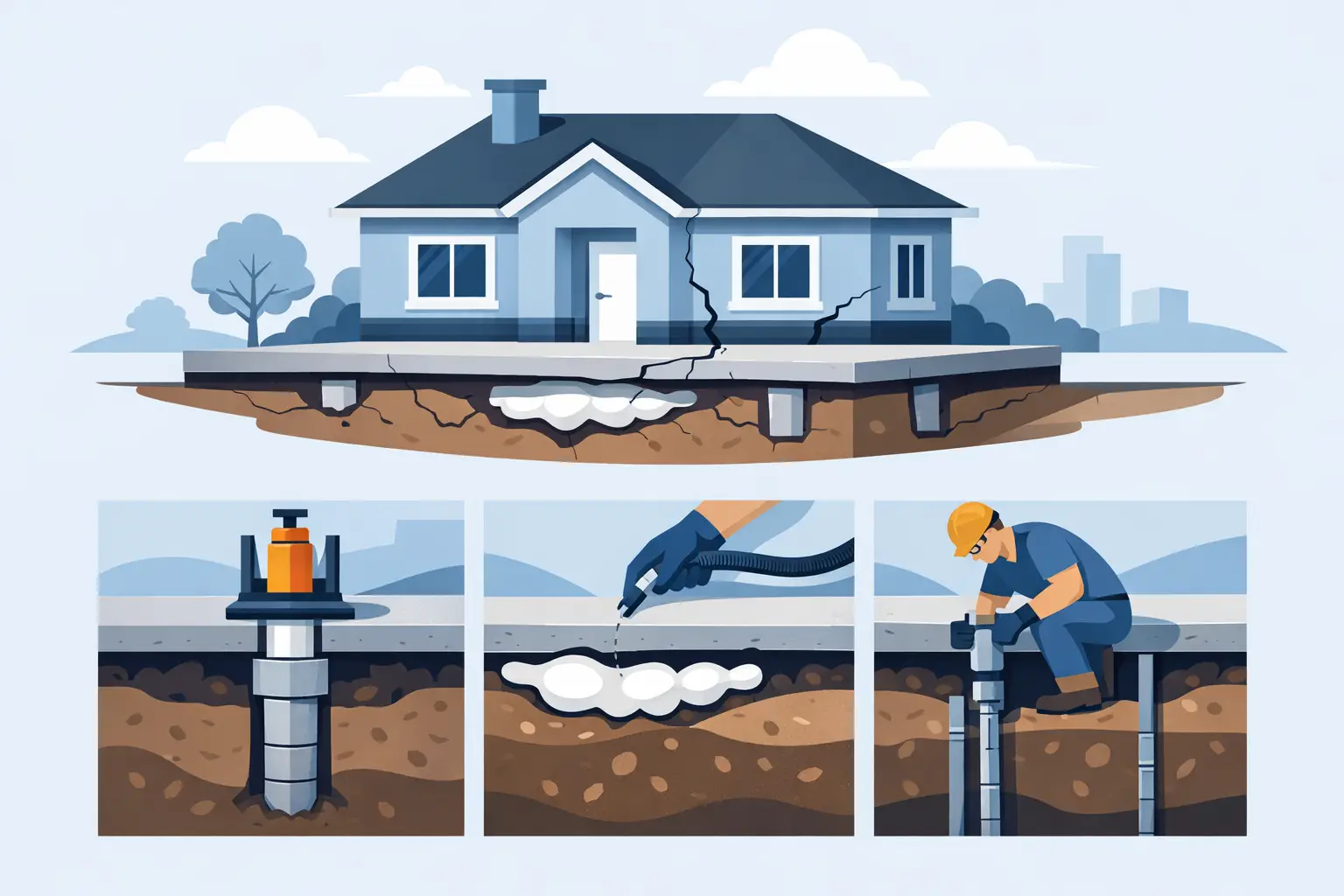
Alpha Foundations often leans toward helical piers, which are screwed into the ground. These are excellent for light structures or areas where the soil has low load-bearing capacity.
In contrast, American Foundation Repair and similar high-clay-region specialists often prefer Push Piers (also known as resistance piers). These use the weight of the structure itself to drive the steel sections into the ground until they hit a "refusal" point—essentially solid rock or extremely dense soil.
| Feature | Helical Piers (Alpha Style) | Push Piers (American/Ram Jack Style) |
|---|---|---|
| Installation Method | Screwed into soil using hydraulic torque. | Driven into soil using structural weight. |
| Best Soil Type | Sandy, loamy, or light clay. | Heavy expansive clay or deep bedrock. |
| Lifting Capacity | High, but limited by soil torque. | Extremely high; uses the house as leverage. |
| Typical Use Case | Decks, porches, new construction. | Major structural settling of multi-story homes. |
| 2026 Average Cost | $2,200 - $3,500 per pier. | $2,500 - $4,200 per pier. |
Polyurethane Injection (The "Poly" Revolution)
By 2026, "mudjacking" (using a concrete slurry to level slabs) has been largely phased out by reputable firms in favor of high-density polyurethane foam. Alpha Foundations markets this as PolyRenewal, but American Foundation Repair and other alternatives use similar industrial-grade closed-cell polymers.
The benefit of these alternatives is the hydrophobic nature of the foam. In 2026 formulations, these polymers do not just lift the concrete; they bind with the soil particles to create a waterproof barrier, preventing future erosion—a common problem in the humid climates where Alpha Foundations operates.
Identifying Signs of Foundation Failure by Region
When choosing between American Foundation Repair and an alternative like Alpha, you must diagnose the "why" behind the damage.
The Midwest & Northeast (Clay and Freeze-Thaw)
In these regions, the primary enemy is adfreeze and hydrostatic pressure. When clay soil gets wet, it expands with immense force. When it freezes, it can "grab" the foundation and lift it (heave).
- Symptoms: Inward bowing basement walls, horizontal cracks in mortar joints, and "wet" basements.
- Recommended Alternative: American Foundation Repair or Supportworks dealers, focusing on I-beam reinforcement and interior drainage.
The Southeast and Gulf Coast (Sand and Limestone)
Here, the issue is often subsidence or void formation due to decaying organic matter or limestone dissolution (karst topography).
- Symptoms: Vertical cracks in brickwork, windows that stick, and "stair-step" cracks in the exterior facade.
- Recommended Alternative: Alpha Foundations or Olshan, focusing on helical piering and soil stabilization.
Cost Considerations and Value in 2026
Foundation repair is a significant investment. In 2026, the average cost for a standard residential foundation stabilization project ranges from $12,000 to $35,000, though complex jobs involving dozens of piers can exceed $60,000.
Factors Influencing the Quote
- Depth to Bedrock: If an alternative like Ram Jack has to drive piers 50 feet deep to find stability, the material cost will increase significantly compared to a 20-foot depth.
- Access: Hand-digging pier locations in tight crawlspaces is more labor-intensive and expensive than using an excavator on an open perimeter.
- Engineering Fees: Many municipalities in 2026 require a third-party structural engineer's report before and after the repair. Some companies include this in their fee; others do not.
Return on Investment (ROI)
A repaired foundation typically provides a 100% to 150% ROI in terms of preserved home value. Homes with unaddressed foundation issues often sell at a 20-30% discount, as most traditional mortgage lenders will not approve financing for a structurally compromised property.
How to Verify a Foundation Contractor in 2026
Before signing a contract with American Foundation Repair, Alpha, or any other alternative, perform the following due diligence:
- Check the "Uptime" of the Warranty: A lifetime warranty is only as good as the company's longevity. Look for firms that have been in business for at least 20 years or are part of a stable national network.
- Verify Licensing and Insurance: Ensure they carry both general liability and specialized "errors and omissions" insurance for structural work.
- Review Engineering Specs: Ask if the piers are ICC-ES certified. This ensures the steel components have been independently tested for load-bearing capacity.
- Digital Diagnostics: In 2026, reputable contractors should use digital floor leveling (manometers) to provide you with a topographical map of your home's current "lean."
Frequently Asked Questions
Does homeowners insurance cover foundation repair?
Generally, no. Most standard policies exclude "earth movement," which includes settling, shrinking, or expanding soil. However, if the foundation damage is a direct result of a "covered peril," such as a major pipe burst under the slab, you may have a claim. Always consult your policy's specific endorsements regarding water backup and foundation coverage.
How long does the average repair take?
For a mid-sized home requiring 8 to 12 piers, the installation typically takes 3 to 5 business days. Concrete leveling using polyurethane foam is much faster, often completed in a single afternoon, with the surface ready for use within 15 minutes of injection.
Can I live in the house during the repair?
Yes. Foundation repair is almost entirely an exterior process. While there will be noise from hydraulic pumps and some vibration, your utilities usually remain connected, and your daily routine is rarely interrupted. The only exception is when interior "slab piers" are required, which involves drilling through the interior floor.
What is the difference between a "lifetime" and a "transferable" warranty?
A lifetime warranty lasts as long as the company exists. A transferable warranty stays with the house, meaning if you sell the property, the new owner is still covered. In 2026, a transferable warranty is a critical selling point that must be documented in the closing papers.
Are there DIY alternatives to professional foundation repair?
For structural stabilization (piering), there is no safe DIY alternative. The equipment required involves thousands of pounds of hydraulic pressure. For minor cosmetic cracks (less than 1/8 inch), you can use DIY epoxy injection kits, but these will not stop the house from moving if the underlying soil is unstable.
Moving Forward with Your Selection
If you are currently weighing American Foundation Repair against Alpha Foundations, the decision should ultimately be driven by your specific geography and the type of soil surrounding your footing. For residents in the North and Midwest, American Foundation Repair offers a localized expertise in clay-driven hydrostatic pressure that is hard to beat. For those in the South, Alpha Foundations' integration with the Groundworks network provides a high level of specialized coastal equipment.
Regardless of your choice, always obtain at least three quotes and insist on a detailed site plan that shows exactly where each pier or anchor will be placed. In 2026, a transparent, data-backed proposal is the hallmark of a contractor who intends to stand behind their work for the life of your home.