Annuity lawyers specialize in the intricate legal frameworks governing insurance-based retirement products, ensuring contracts comply with federal and state laws. They assist clients in resolving disputes, navigating ERISA regulations, managing tax liabilities, and addressing claims of financial misconduct. In 2026, their expertise is vital for protecting assets within increasingly complex multi-layered retirement portfolios.
The Evolving Role of Annuity Lawyers in 2026
As of 2026, the retirement landscape has shifted significantly due to the full implementation of various provisions within the SECURE Act 2.0 and updated Department of Labor (DOL) fiduciary rules. Annuity lawyers have moved beyond simple contract review into the realm of comprehensive litigation and regulatory compliance. Their role is primarily defined by the protection of consumers from predatory sales practices and the interpretation of fine-print clauses that can significantly impact a retiree's liquidity.
Annuity contracts are often hundreds of pages long, filled with "riders" and "provisions" that can change based on market performance or the age of the annuitant. An annuity lawyer acts as a technical interpreter and advocate. They are not financial advisors; rather, they are legal specialists who ensure that the financial advisor and the insurance company have met their legal obligations. This includes verifying that the product was "suitable" for the client at the time of sale—a legal standard that has become stricter under recent federal oversight.
Furthermore, these attorneys handle the complexities of "qualified" versus "non-qualified" annuities. A qualified annuity is funded with pre-tax dollars (like a 401(k) or traditional IRA), meaning it is subject to Required Minimum Distributions (RMDs). In 2026, RMD rules are a frequent source of legal friction, and failure to comply can result in massive tax penalties. Lawyers help clients navigate these timelines to avoid litigation with the IRS.
Understanding the Intersection of Annuities and ERISA
The Employee Retirement Income Security Act of 1974 (ERISA) is the bedrock of federal law governing private retirement plans. When an annuity is offered through an employer-sponsored plan, such as a 401(k) or a 403(b), it falls under ERISA's jurisdiction. This adds a significant layer of complexity that a general practice lawyer may not be equipped to handle.
ERISA-governed annuities require a high standard of fiduciary care. Employers (plan sponsors) have a legal duty to select annuity providers that are financially stable and offer reasonable fees. If an employer fails this duty, and the annuity performs poorly or the insurance company becomes insolvent, employees may have grounds for a lawsuit. Annuity lawyers in this space focus on:
- Fiduciary Breach Claims: Investigating whether plan administrators prioritized their own commissions or relationships over the participants' best interests.
- Disclosure Failures: Ensuring that participants were given clear, non-misleading information about the risks and fees associated with the annuity options in their plan.
- Portability Issues: Navigating the legal hurdles of moving an annuity from an employer plan to an individual IRA without triggering prohibited transaction penalties.
The complexity arises because ERISA often preempts state laws. This means that if you have a dispute over an annuity within a 401(k), you cannot simply sue for "bad faith" under state insurance law; you must follow the strict administrative and federal court procedures dictated by ERISA.
Common Legal Complexities and Contractual Pitfalls
Annuities are often criticized for their opacity, and this is where legal disputes most frequently occur. Lawyers are often called in when the "marketing version" of the product does not match the "legal version" of the contract.
Surrender Charges and Liquidity Restrictions
One of the most litigated areas involves surrender charges. Most deferred annuities have a period (often 5 to 10 years) during which the owner cannot withdraw funds without paying a significant penalty. Annuity lawyers often represent seniors who were sold "long-term" annuities that locked up their money past their life expectancy, arguing that these products were inherently unsuitable or sold under fraudulent pretenses.
Complexity of Variable and Indexed Annuities
Variable annuities and Fixed-Indexed Annuities (FIAs) are hybrids of insurance and investment. They include participation rates, caps, and spreads that determine how much interest is credited based on a market index (like the S&P 500). If the insurance company changes the "cap" or "participation rate" mid-contract in a way that seems arbitrary, an annuity lawyer may investigate whether the company violated the "implied covenant of good faith and fair dealing."
Death Benefits and Beneficiary Disputes
When an annuitant dies, the distribution of the remaining value can become a legal battleground. Disputes often arise between surviving spouses, children from previous marriages, and named beneficiaries. Lawyers assist in interpreting the "pay-out" phase (annuitization) versus the "accumulation" phase, as the legal rights of heirs differ drastically depending on which phase the contract was in at the time of death.
Comparison of Annuity Types and Legal Risk Profiles
The following table outlines the different categories of annuities and the specific legal risks associated with each that often require attorney intervention.
| Annuity Type | Primary Legal Concern | Regulatory Oversight | Common Dispute Trigger |
|---|---|---|---|
| Fixed Annuity | Insurer Insolvency | State Insurance Comm. | Guaranteed rate changes or "teaser" rate expirations. |
| Variable Annuity | Suitability & High Fees | SEC / FINRA | Market losses combined with high mortality/expense risk fees. |
| Fixed-Indexed (FIA) | Misleading Projections | State / DOL | Complexity of indexing formulas and "cap" adjustments. |
| Immediate (SPIA) | Irrevocability | State Insurance Law | Lack of liquidity during unexpected medical emergencies. |
| Qualified Longevity (QLAC) | RMD Compliance | IRS / ERISA | Failure to meet the 2026 RMD age requirements (now 75 for some). |
When to Consult an Annuity Attorney
Deciding when to transition from a financial discussion to a legal one is critical. While a financial advisor helps with growth, an annuity lawyer helps with protection and recovery. You should consider legal counsel in the following scenarios:
- Claim Denials: If an insurance company refuses to pay out a death benefit or a disability rider, a lawyer is necessary to file an appeal or a lawsuit.
- Suspected Fraud or Churning: "Churning" is when an agent convinces you to trade one annuity for another just to generate a new commission. This is often illegal, and a lawyer can help recover the lost value and surrender charges.
- Divorce Settlements: Annuities are complex marital assets. A lawyer ensures that the division of the annuity follows a Qualified Domestic Relations Order (QDRO) if it is an ERISA plan, or properly accounts for tax consequences in a non-qualified plan.
- Incapacity and Power of Attorney: If an annuitant becomes incapacitated, the insurance company may be reluctant to recognize a Power of Attorney (POA) for making withdrawals. Legal intervention can force compliance with state POA laws.
Fiduciary Standards and the SECURE Act 2.0 Impact
By 2026, the provisions of the SECURE Act 2.0 have deeply integrated annuities into the standard retirement plan landscape. One of the most significant legal shifts is the "Safe Harbor" provision for employers. This law protects employers from being sued if the annuity provider they chose for the company plan later goes bankrupt, provided the employer did a "reasonable" search at the time of selection.
However, this "Safe Harbor" is not a blank check. Annuity lawyers now focus on whether the employer's search was truly "reasonable." They look for evidence that the employer ignored lower-cost options or failed to monitor the insurance company's credit rating. For the individual, the SECURE Act 2.0 also expanded the use of Qualified Longevity Annuity Contracts (QLACs), allowing individuals to shield up to $200,000 (adjusted for inflation in 2026) from RMDs. Navigating these limits requires precise legal and tax coordination to avoid "excess contribution" penalties from the IRS.
Furthermore, the Department of Labor's Retirement Security Rule has strengthened the definition of an investment advice fiduciary. This means that as of 2026, most agents selling annuities must legally act in your best interest. If they recommend a high-commission product that is inferior to a lower-cost alternative, annuity lawyers can use this federal rule as the basis for a breach of fiduciary duty claim.
Dispute Resolution: Arbitration vs. Litigation
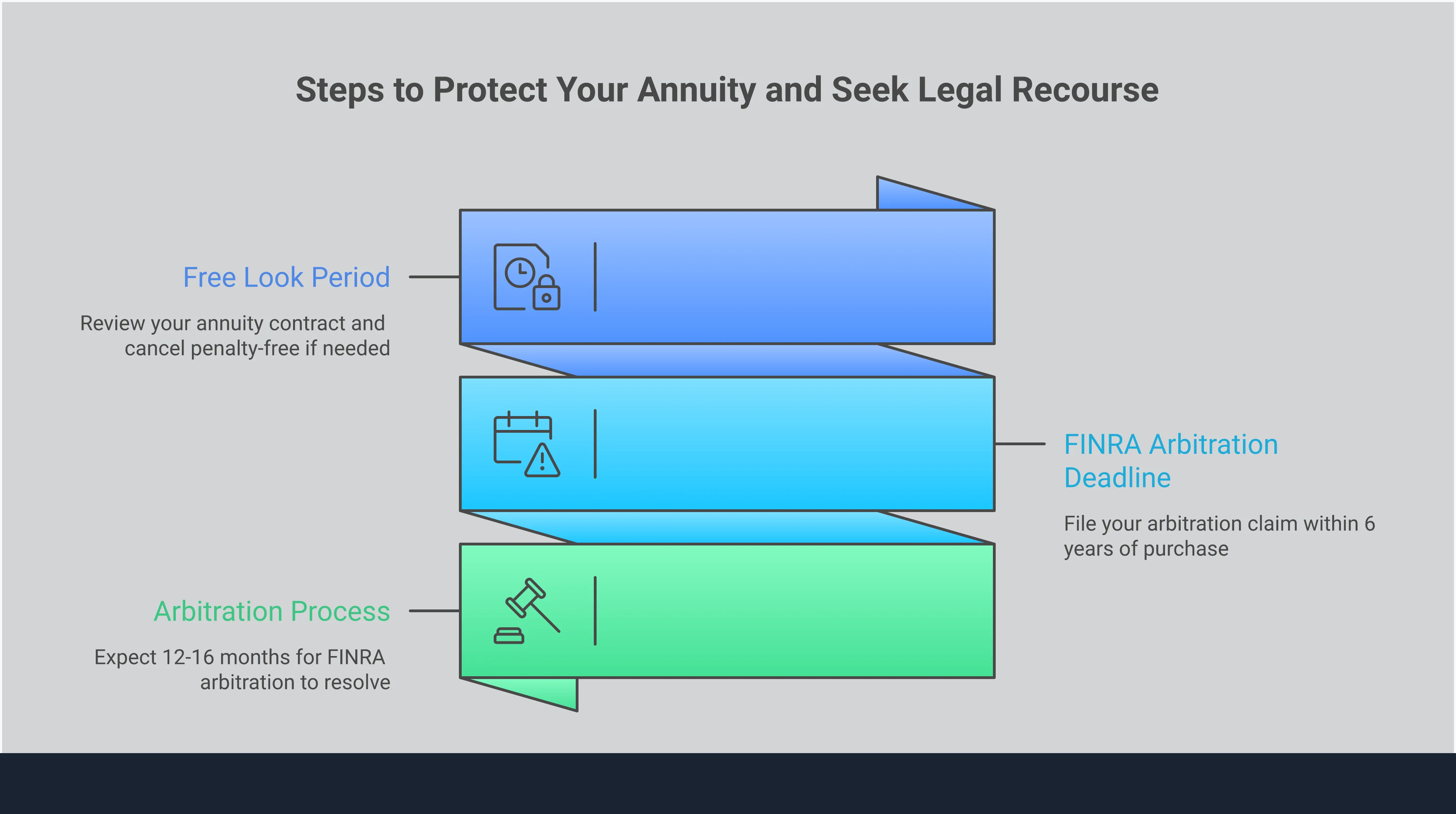
Most annuity contracts sold today contain a mandatory arbitration clause. This means you waive your right to sue in a public court and must instead present your case to a private arbitrator, often through the Financial Industry Regulatory Authority (FINRA) or the American Arbitration Association (AAA).
Annuity lawyers are essential in this process because arbitration is a specialized "mini-trial." The lawyer must:
- Select the Arbitrator: Choosing an arbitrator with a history of fair rulings in insurance cases.
- Discovery: Forcing the insurance company to hand over internal emails and "suitability" forms that may prove they knew the product was a bad fit for the client.
- Expert Testimony: Hiring actuaries or financial analysts to quantify the damages caused by the insurance company’s actions.
While arbitration is often faster than court, it is also final—there are very few grounds for appealing an arbitrator's decision. This makes the initial legal representation critical.
Frequently Asked Questions
Can an annuity lawyer help me get out of a contract with high surrender fees?
Yes, but only if there is evidence of misconduct. A lawyer can challenge surrender fees if they can prove the agent misrepresented the terms, committed fraud, or if the contract itself violates state "free-look" period laws or suitability standards. If the contract was signed voluntarily and all disclosures were made, it is significantly harder to bypass these fees.
What is the difference between a financial advisor and an annuity lawyer?
A financial advisor is focused on asset allocation, market returns, and retirement planning. They are often the ones selling the product. An annuity lawyer is focused on the legality of the contract, regulatory compliance, and dispute resolution. You hire a lawyer when the "plan" has failed or when you believe your legal rights have been violated.
How do annuity lawyers charge for their services?
This depends on the nature of the case. For contract reviews or divorce settlements, they may charge an hourly rate. For litigation or arbitration against an insurance company for fraud or breach of fiduciary duty, many annuity lawyers work on a contingency fee basis, meaning they only get paid if they recover money for you.
Are annuities in a 401(k) protected if the insurance company goes bankrupt?
If the annuity is part of an ERISA-qualified plan, there are some protections, but the primary safety net is the State Life and Health Insurance Guaranty Association. Every state has a limit (often $250,000 to $500,000) on how much of an annuity is protected if the insurer fails. An annuity lawyer can help you navigate these claims to ensure you receive the maximum possible recovery from the state fund.
Can a lawyer help if I inherited an annuity and the company is refusing to pay?
Absolutely. Beneficiary disputes are a major part of an annuity lawyer's practice. They handle issues such as "slayer statutes" (where a beneficiary is accused of causing the death), "undue influence" (where someone was coerced into changing beneficiaries), and technical errors in the change-of-beneficiary forms that the insurance company is using as an excuse to withhold funds.
Practical Recommendations for Retirees
If you are currently holding an annuity or considering one as part of a complex retirement plan in 2026, take the following steps to protect your legal interests:
- Request a "Suitability Report": Ask your agent for the written justification of why this specific annuity is right for your age, risk tolerance, and liquidity needs. Keep this document; it is the primary evidence an annuity lawyer will use if things go wrong.
- Verify Fiduciary Status: Ask in writing, "Are you acting as a fiduciary for this transaction under the current DOL guidelines?" If they hesitate to answer, consult a lawyer before signing.
- Audit Your Beneficiaries: Ensure your beneficiary designations on your annuity match your will and trust. Conflicts between these documents often lead to expensive legal battles.
- Consult a Lawyer Before Large Withdrawals: If you are over 75 and dealing with 2026 RMD rules, or if you are considering a "1035 Exchange" (trading one annuity for another), a quick consultation with an annuity lawyer can prevent permanent tax mistakes.
For more information on your rights as a consumer, you can visit the Official Site of the Securities and Exchange Commission (SEC) or the National Association of Insurance Commissioners (NAIC).