For long-distance running in 2026, the three best treadmills are the NordicTrack Commercial 2450, the Sole F85, and the Horizon 7.8 AT. These models offer the necessary 3.0+ CHP motors, 60-inch running decks, and advanced cushioning systems required to sustain high-mileage training while minimizing joint impact and mechanical fatigue.
Long-distance running places unique demands on home fitness equipment that standard walking or light jogging units simply cannot meet. When an athlete prepares for a marathon or ultramarathon, the treadmill must endure continuous operation for two, three, or even four hours at a time. This requires superior heat management, a robust frame, and a motor that won't stutter under the load of a consistent cadence. As we move through 2026, the integration of smart technology and biomechanical engineering has reached a point where indoor training can effectively simulate the rigors of the road without the same level of orthopedic strain.
Why Long-Distance Running Requires Specialized Treadmills
The primary difference between a casual treadmill and one designed for endurance is the Continuous Horsepower (CHP) rating. While a peak horsepower rating tells you the maximum power a motor can reach briefly, CHP indicates what the motor can maintain indefinitely. For long-distance runners, anything less than a 3.0 CHP motor is a liability. A weaker motor will struggle to maintain belt speed as the runner’s foot strikes the deck, leading to a jerky motion that can alter gait and cause injury over several miles.
Furthermore, heat is the enemy of treadmill longevity. During a 15-mile training run, the friction between the belt and the deck generates significant thermal energy. High-end treadmills utilize larger motor housings, high-grade wiring, and specialized cooling fans to dissipate this heat. Without these features, the control board or the motor itself may fail prematurely, often voiding warranties if the machine was not rated for such "light commercial" levels of use.
Cushioning is the second pillar of long-distance treadmill design. While some runners prefer a firm surface to mimic asphalt, the cumulative impact of high-volume training can lead to stress fractures or tendonitis. Modern treadmills in 2026 utilize variable response cushioning, providing a softer landing zone at the front of the machine and a firmer "push-off" zone at the rear. This engineering helps maintain running economy while protecting the musculoskeletal system.
1. NordicTrack Commercial 2450: Best for Interactive Endurance Training
The NordicTrack Commercial 2450 has long been a staple in the endurance community, and the 2026 iteration continues to lead the market in interactive technology. This machine is specifically designed for runners who find the "dreadmill" experience mentally taxing. By utilizing the iFit platform, the machine automatically adjusts its incline and decline to match the actual terrain of global running routes, from the Boston Marathon course to trails in the Swiss Alps.
Technical Specifications and Performance
The 2450 features a 3.6 CHP motor, which is the "sweet spot" for most marathoners. It provides enough overhead to handle high speeds (up to 12 mph) without straining, even during long tempo runs. The incline range is particularly impressive, moving from -3% to 12%. The inclusion of decline is critical for long-distance runners because it allows for the strengthening of the eccentric muscle contractions required for downhill sections of outdoor races.
The running surface is a spacious 22" x 60", providing ample room for the natural lateral drift that occurs when a runner becomes fatigued. In terms of cushioning, the 2450 uses Runners Flex™ technology, which allows the user to toggle between a vibration-dampening soft setting and a firm setting that mimics the road.
Why It Wins for Long Distance
- ActivePulse™ Technology: In 2026, this feature is more refined, using heart rate telemetry to automatically adjust the treadmill’s speed or incline to keep the runner in a specific aerobic zone. This is invaluable for "Zone 2" training, which forms the bulk of many endurance programs.
- Integrated Cooling: The AutoBreeze™ fans are not just a luxury; they are positioned to cool both the runner and the console area, which is essential for comfort during indoor sessions exceeding 90 minutes.
- Swiveling HD Touchscreen: The 22-inch screen now features enhanced processing power, ensuring that high-definition trail runs load instantly and stay synchronized with the belt movement.
2. Sole F85: Best for Durability and Mechanical Reliability
For the runner who prioritizes a "tank-like" build over flashy subscription services, the Sole F85 remains the gold standard. Sole has built its reputation on frame integrity and motor reliability. The F85 is often cited by heavy-mileage runners as the machine that lasts a decade or more with minimal maintenance.
Engineering and Build Quality
The F85 is powered by a 4.0 CHP motor, one of the most powerful in the consumer market. This motor runs at lower revolutions per minute (RPM) to achieve the same speeds as smaller motors, which significantly reduces noise and wear. The frame is a Z-shape design that minimizes vibration, even when sprinting at the maximum speed of 12 mph.
A standout feature of the Sole F85 is its 22-inch wide running surface and its remarkably high weight capacity (up to 375 lbs). This speaks to the thickness of the steel and the quality of the rollers. Large 2.75-inch rollers help reduce tension on the belt, which prevents the "slipping" sensation that can occur on cheaper models as the belt stretches over time.
The Console and Connectivity
Unlike NordicTrack, Sole does not lock its best features behind a subscription. The 2026 F85 features a 15.6-inch touchscreen with pre-loaded apps (like Netflix, YouTube, and ESPN) and the ability to mirror your phone or tablet screen. This allows long-distance runners to consume their own media or follow custom training plans without a monthly fee.
Why It Wins for Long Distance
- Precision Welded Frame: The stability of the F85 is unmatched in the folding treadmill category. For a runner doing 50 miles a week, a stable deck prevents the micro-oscillations that can lead to hip or ankle discomfort.
- Cushion Flex Whisper Deck: Research has shown that this deck reduces impact by up to 40% compared to running on asphalt, a claim supported by various biomechanical studies.
- Simplicity: The tactile buttons on the handrails allow for quick speed and incline adjustments without having to touch a screen with sweaty hands—a common frustration during high-intensity intervals or long efforts.
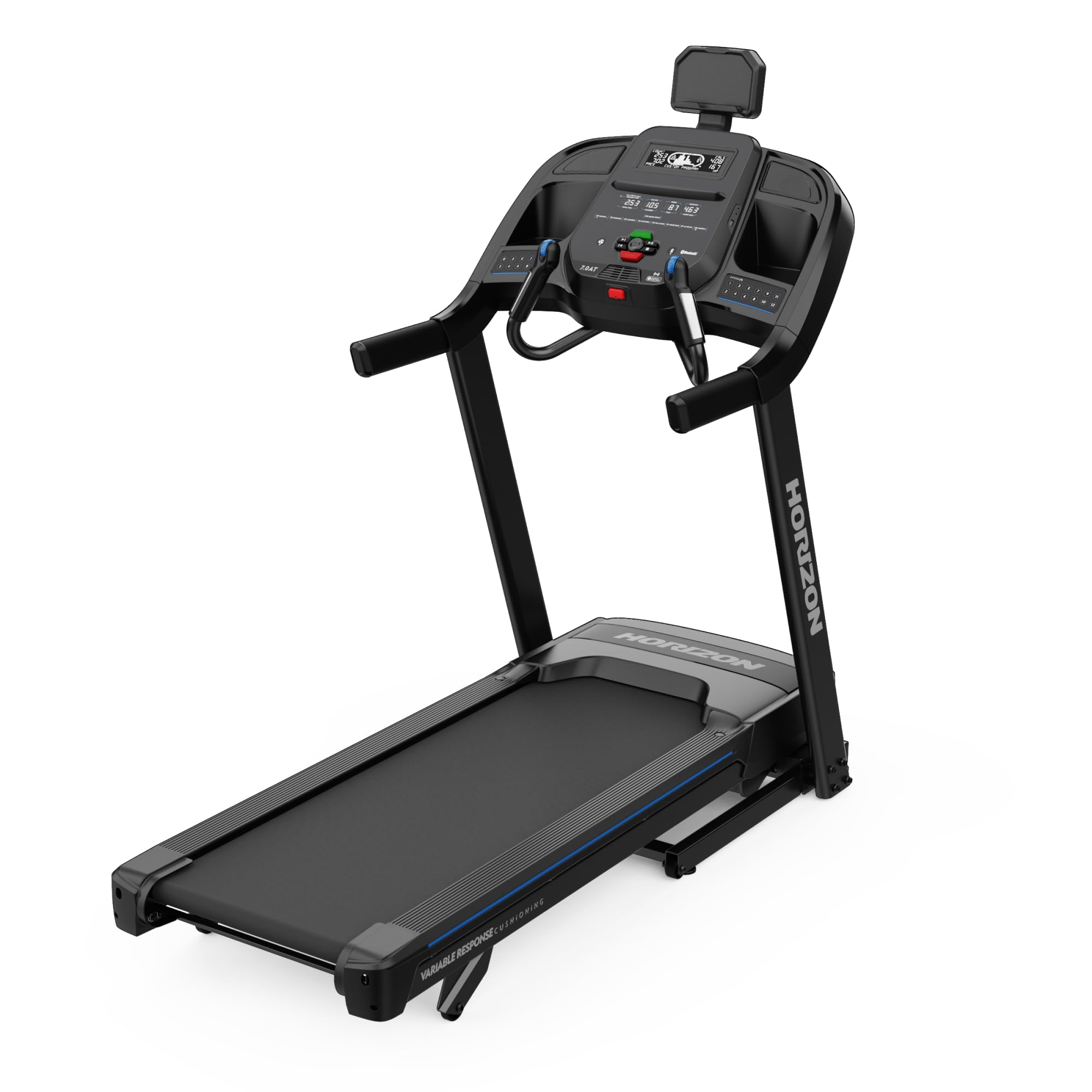
3. Horizon 7.8 AT: Best for App Integration and Interval Response
The Horizon 7.8 AT is designed for the "connected" runner who wants to use third-party platforms like Zwift, Peloton, or Kinomap. It bridges the gap between a traditional treadmill and a high-tech smart trainer.
Rapid Sync Technology
The defining feature of the 7.8 AT is its Rapid Sync motor. Most treadmills take several seconds to adjust speed when you hit a button; the Horizon 7.8 AT responds almost instantly. For long-distance runners who incorporate "fartleks" or hill repeats into their endurance blocks, this responsiveness is a game-changer. The 4.0 CHP motor ensures that even at high speeds and steep inclines (up to 15%), the belt remains smooth.
Ergonomics and Control
Instead of traditional buttons, the 7.8 AT utilizes QuickDial™ controls. These are rolling wheels located on the grips at waist height. You roll the right dial forward to increase speed and the left dial to increase incline. This is significantly more intuitive than hunting for a button on a console while running at a 6:00 minute-per-mile pace.
Why It Wins for Long Distance
- Zwift Integration: The treadmill broadcasts your speed via Bluetooth directly to Zwift, allowing you to run in virtual worlds with thousands of other athletes. This social aspect is one of the best ways to survive a 20-mile indoor training run.
- No-Subscription Freedom: Horizon provides a rugged, high-performance machine without a proprietary software wall. You provide the tablet; they provide the power.
- Rugged Deck Construction: The 3-Zone Variable Response Cushioning provides a very specific feel: soft where your foot lands, neutral in the middle, and stiff at the back to maximize the energy return of your toe-off.
Detailed Comparison of Top 2026 Treadmills
The following table compares the critical metrics that endurance runners should consider when selecting between these three top-tier models.
| Feature | NordicTrack 2450 | Sole F85 | Horizon 7.8 AT |
|---|---|---|---|
| Motor (CHP) | 3.6 CHP | 4.0 CHP | 4.0 CHP |
| Running Surface | 22" x 60" | 22" x 60" | 22" x 60" |
| Incline Range | -3% to 12% | -6% to 15% | 0% to 15% |
| Max Speed | 12 mph | 12 mph | 12 mph |
| Screen Size | 22" Tilt Touchscreen | 15.6" Touchscreen | 9.3" High-Contrast LCD |
| Cushioning | Runners Flex™ (Adj.) | Cushion Flex Whisper | 3-Zone Variable |
| Connectivity | iFit (Integrated) | WiFi, BT, Mirroring | Zwift, Peloton, BT |
| Weight Capacity | 300 lbs | 375 lbs | 375 lbs |
Critical Maintenance for High-Mileage Treadmills
Investing in a high-end treadmill is only the first step. For those running 30+ miles per week, maintenance is non-negotiable to ensure the machine reaches its 2026 life expectancy.
Lubrication
Even "maintenance-free" belts benefit from periodic checks. Friction between the belt and deck is the number one cause of motor failure. Every 150–300 miles, you should check for silkiness under the belt. If the deck feels dry, apply a 100% silicone lubricant.
Vacuuming the Motor Housing
Dust is a conductor and a heat insulator. Once every few months, unplug the machine, remove the motor cover, and use a vacuum to gently remove dust from the electronics and the motor's cooling vents. This simple act can add years to the life of the control board.
Belt Tension and Alignment
A belt that is too tight can wear out the rollers and motor, while a loose belt will slip, creating a safety hazard. Always ensure the belt is centered. If it drifts to one side, use the rear adjustment bolts to realign it immediately.
Common Mistakes When Buying a Long-Distance Treadmill
- Overlooking Ceiling Height: High-end treadmills often have a "step-up height" of 8 to 10 inches. If you have 8-foot ceilings and you are 6 feet tall, you may hit your head when running at a 15% incline.
- Focusing Only on Tech: A massive screen is useless if the motor burns out in six months. Always prioritize the CHP and the warranty (look for lifetime frame and at least 5 years on parts).
- Ignoring the Circuit Requirements: Many 4.0 CHP treadmills require a dedicated 20-amp circuit. Plugging a high-draw machine into a 15-amp circuit shared with a refrigerator or computer will frequently trip the breaker during a run.
Frequently Asked Questions
Can I use a walking treadmill for long-distance running?
Generally, no. Walking treadmills usually have motors under 2.5 CHP and shorter decks (under 55 inches). Running at high speeds for long durations on these machines will cause the motor to overheat and the belt to stutter. Furthermore, the shorter deck does not accommodate the increased stride length that occurs during a running gait, posing a significant trip hazard.
How often should I calibrate my treadmill's speed?
For serious marathon training, you should calibrate your treadmill once every six months or after moving the machine. Most modern consoles have a calibration mode in the settings. You can also verify speed by measuring the belt length and counting revolutions over a timed minute, though most 2026 models with digital controllers are accurate within 0.1 mph.
Is decline training important for marathoners?
Yes. Many major races, including Boston and various "downhill" marathons, involve significant descent. Decline training (-3% or -6%) helps condition the quadriceps and connective tissues to handle the eccentric load of downhill running, which is often what causes muscle failure in the latter stages of a race.
How much should I expect to spend on a quality endurance treadmill in 2026?
A treadmill capable of sustaining 40+ miles per week typically costs between $1,800 and $3,500. While budget models exist under $1,000, they lack the motor durability and cushioning systems necessary to protect your body and your investment over the long term.
Final Recommendation
For the runner who wants a fully immersive experience and world-class coaching, the NordicTrack Commercial 2450 is the premier choice. If your priority is a machine that will withstand thousands of miles with a simple, robust interface, the Sole F85 is the most reliable partner. Finally, for those who want to integrate with various fitness apps and value rapid speed adjustments for intervals, the Horizon 7.8 AT offers the best versatility. Regardless of your choice, ensure your training space has adequate ventilation and a dedicated power circuit to support the high performance of these machines.