In cloud architecture, the concept of a "180 degree" shift or strategy refers to a complete inversion of conventional deployment, security, or scaling paradigms—moving from static, perimeter-bound models to dynamic, decentralized, and zero-trust operational frameworks. This total redirection requires engineering teams to re-evaluate how infrastructure handles failure, data flow, and resource allocation.
Modern enterprise systems require robust blueprints to withstand sudden spikes in traffic, regional hardware failures, and sophisticated security threats. While cloud computing offers nearly infinite scalability and high availability by default, achieving true enterprise-grade resiliency often demands a complete about-face from legacy on-premises design patterns. Understanding the architectural, operational, and security implications of this inversion is essential for system designers, DevOps engineers, and cloud architects building resilient ecosystems in 2026.
The Core Paradigm Shift: From Monolithic to Distributed Inversion
To understand what a 180-degree architectural shift entails, one must first examine the baseline from which modern cloud design evolved. Traditional enterprise architecture was built around physical data centers, fixed server racks, and perimeter-based security models. In these legacy environments, workloads were tightly coupled, and trust was implicitly granted to any device or user operating inside the corporate network boundary.
A 180-degree inversion flips this foundational logic entirely. Instead of relying on a secure castle-and-moat perimeter, cloud-native architectures assume that the network is inherently hostile. Every microservice, container, and API endpoint must authenticate, authorize, and encrypt its communications independently.
This directional change impacts three core pillars of cloud engineering:
- Trust Boundaries: Moving from implicit internal trust to explicit, continuous verification via Zero Trust Network Access (ZTNA).
- Infrastructure Provisioning: Shifting from manual, long-lived server provisioning to ephemeral, immutable infrastructure managed through infrastructure-as-code (IaC).
- Failure Handling: Transitioning from preventative uptime models (preventing hardware from breaking) to reactive and resilient models (assuming hardware will fail and automating fast recovery).
Comparing Legacy and Cloud-Native Paradigms
| Architectural Dimension | Legacy On-Premises Model | 180-Degree Cloud-Native Inversion |
|---|---|---|
| Security Posture | Perimeter defense, implicit internal trust | Zero Trust, explicit verification per request |
| Infrastructure Lifecycle | Long-lived servers, manual patching | Ephemeral containers, immutable images |
| Scalability | Vertical scaling (adding CPU/RAM to a single box) | Horizontal scaling (adding dynamic instances) |
| Deployment Strategy | Monolithic releases, scheduled maintenance windows | Continuous integration and continuous deployment (CI/CD) with blue/green or canary rollouts |
Architectural Pillars Impacted by the 180-Degree Shift
Executing a comprehensive redesign of cloud infrastructure involves transforming multiple interconnected layers of the technical stack. Ignoring one layer while transforming another often introduces critical bottlenecks or security vulnerabilities.
1. Networking and Traffic Management
In traditional networks, routing traffic meant directing packets through physical firewalls, load balancers, and core switches located within a centralized data center. A 180-degree transformation in cloud networking decentralizes this flow.
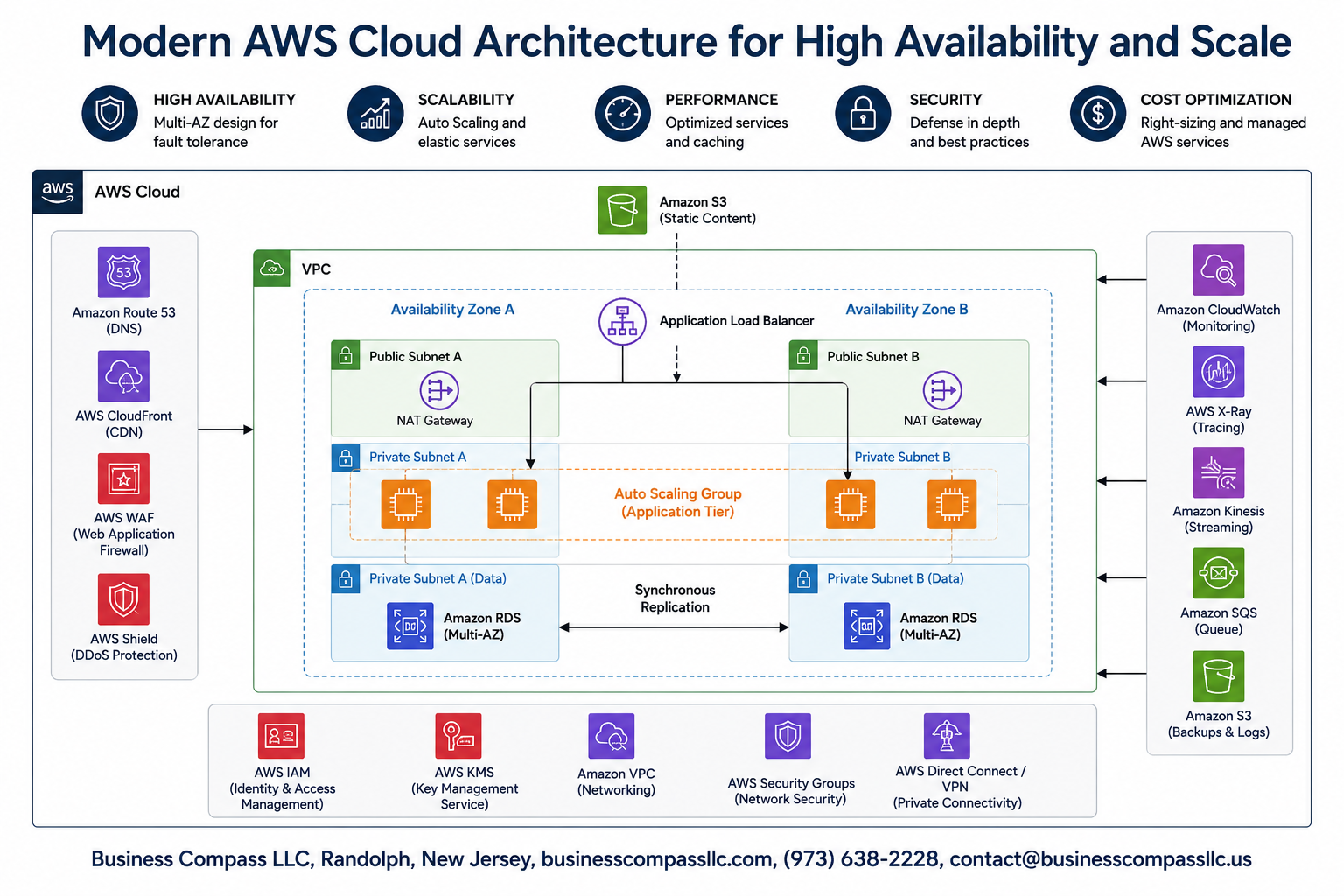
Modern cloud environments utilize software-defined networking (SDN), virtual private clouds (VPCs), and service meshes (such as Istio or Linkerd) to manage east-west traffic between microservices, alongside north-south traffic entering the system from external clients. Traffic management is handled dynamically, with edge routing, Web Application Firewalls (WAF), and content delivery networks (CDNs) pushing logic closer to the end-user rather than relying on a single corporate choke point.
2. Data Persistence and State Management
Stateful applications have historically posed the greatest challenge to cloud migration and redesigns. A legacy database often runs on a massive, high-end bare-metal server with attached storage arrays.
The 180-degree cloud approach decouples compute from storage entirely. Databases are distributed across multiple availability zones using managed relational and NoSQL database services. Architectures leverage distributed consensus algorithms (such as Raft or Paxos) to maintain data consistency across globally dispersed regions, ensuring that if an entire cloud region experiences an outage, read and write operations seamlessly failover to a secondary geographic zone.
3. Observability and Telemetry
When infrastructure is static and physical, operators can physically inspect servers or rely on simple ping checks. In a dynamic cloud ecosystem running thousands of ephemeral containers, visibility must be completely inverted.
Architects adopt the "three pillars of observability"—metrics, logs, and distributed traces—to capture the real-time health of applications. Because services are decoupled, distributed tracing is required to track a single user request as it traverses dozens of independent microservices, identifying latency bottlenecks and failure points instantly.
Operational Benefits of Inverting Traditional Design
Adopting a 180-degree inverted cloud architecture yields substantial operational advantages that directly impact business agility, uptime, and financial efficiency.
- Elimination of Single Points of Failure (SPOFs): By distributing workloads across multiple availability zones and regions, localized hardware or software failures no longer result in catastrophic system downtime.
- Elastic Cost Management: Ephemeral infrastructure allows organizations to spin up resources precisely when demand peaks and scale them down to zero during off-peak hours, optimizing cloud expenditure.
- Accelerated Time-to-Market: Automated CI/CD pipelines enable development teams to push incremental code updates multiple times a day without requiring scheduled downtime windows.
- Enhanced Security Compliance: Continuous compliance monitoring tools integrated into the cloud pipeline automatically detect misconfigurations, unencrypted data stores, or IAM over-permissions before code reaches production.
Common Pitfalls and Implementation Challenges
While the benefits are clear, executing a 180-degree architectural pivot introduces significant technical and cultural hurdles. Organizations frequently underestimate the complexity involved in moving away from familiar legacy patterns.
Re-architecting Monoliths Too Quickly
One of the most frequent mistakes is attempting a "big bang" migration, trying to rewrite a massive monolithic application into microservices all at once. This approach often leads to project failure, massive cost overruns, and prolonged instability. Industry best practices recommend utilizing the Strangler Fig pattern—gradually replacing specific pieces of the monolith with cloud-native services over time.
Cultural and Skill Gaps
Technology transformation requires a corresponding cultural shift. Traditional operations teams accustomed to managing physical servers may struggle with Infrastructure-as-Code paradigms, container orchestration tools like Kubernetes, and automated security pipelines. Investing in continuous education and cross-functional DevOps training is mandatory for long-term success.
Configuration Drift and Complexity
As cloud environments scale, managing thousands of microservices, security policies, and IAM roles introduces immense cognitive load. Without strict governance frameworks and automated policy-as-code tools, environments can suffer from configuration drift, leaving hidden vulnerabilities across the infrastructure footprint.
Practical Steps for Executing a Cloud Architecture Pivot
For engineering organizations planning a comprehensive architectural overhaul, a structured, phased methodology ensures stability and minimizes risk.
- Audit Current Infrastructure: Map existing dependencies, data flows, bottlenecks, and security postures across legacy systems.
- Define Target State Architecture: Establish clear performance, availability, and security metrics that the new cloud environment must satisfy.
- Implement Foundation Services: Set up core networking, centralized identity and access management (IAM), logging, and monitoring baselines before deploying application workloads.
- Migrate Incrementally: Move non-critical workloads first to validate the pipeline, infrastructure-as-code scripts, and operational runbooks.
- Refine and Optimize: Continuously monitor resource consumption, application performance, and security posture, adjusting auto-scaling rules and cost governance policies.
Frequently Asked Questions
What does a 180-degree shift mean in the context of cloud migration?
It refers to abandoning legacy, perimeter-secured, monolithic design patterns in favor of decentralized, ephemeral, zero-trust, and microservices-based cloud architectures that prioritize resilience and horizontal scalability.
Why is Zero Trust a core component of modern cloud architecture?
Because cloud environments erase traditional network boundaries, Zero Trust ensures that every access request is explicitly authenticated, authorized, and encrypted, regardless of whether the request originates inside or outside the cloud network.
How does ephemeral infrastructure improve system reliability?
Ephemeral infrastructure relies on disposable, automated compute instances. If a server or container encounters an error, it is automatically terminated and replaced by a fresh, clean instance, eliminating persistent configuration drift and "server rot."
What is the Strangler Fig pattern in cloud architecture?
It is a software development and migration strategy where legacy system functionality is incrementally replaced by new cloud-native services piece by piece until the old monolith is entirely decommissioned.
How do distributed databases handle multi-region failures?
Distributed databases replicate data synchronously or asynchronously across multiple geographic regions, utilizing consensus protocols to elect new primary nodes automatically if the primary region goes offline.