Earning an associate degree typically requires completing between 60 and 65 semester credit hours, which translates to roughly 20 college-level courses and requires about two years of full-time study. Navigating these educational benchmarks involves understanding the structural breakdown of general education classes, core major requirements, elective credits, and institutional policies regarding transfer credits and grading standards.
Understanding the Foundation of Associate Degree Credits
An associate degree serves as a foundational credential in higher education, positioned between a high school diploma and a bachelor's degree. Across most community colleges, technical schools, and undergraduate institutions, the standard metric for measuring academic progress is the credit hour. Understanding how these credits accumulate is the first step toward mapping out an efficient academic plan.
Most traditional programs operate on a semester system where a standard college course is worth three or four credit hours. To graduate with an associate of arts (AA), associate of science (AS), or associate of applied science (AAS) degree, students must accumulate a specified total number of credits while maintaining a minimum cumulative grade point average (GPA), usually set at 2.0 on a 4.0 scale.
The structural distribution of these credits is designed to produce well-rounded graduates. Institutions generally divide graduation requirements into three primary buckets: general education coursework, major-specific core classes, and general electives. Balancing these categories ensures that students not only gain targeted vocational or academic knowledge but also develop critical thinking, communication, and quantitative reasoning skills.
Breakdown of Credit Categories
To meet graduation standards, students must carefully select classes that fulfill specific institutional and programmatic categories. Failing to meet the exact distribution requirements in any single category can delay graduation, even if the total credit count has been reached.
General Education Requirements
General education credits form the bedrock of any undergraduate curriculum. These courses are designed to provide broad exposure to the humanities, natural sciences, social sciences, mathematics, and written communication.
- Written and Oral Communication: Usually requires 6 credits focusing on composition, research writing, and public speaking.
- Humanities and Fine Arts: Typically ranges from 3 to 9 credits, covering subjects such as literature, philosophy, art history, and theater.
- Social and Behavioral Sciences: Generally demands 3 to 9 credits in fields like psychology, sociology, history, or economics.
- Mathematics and Natural Sciences: Often requires 6 to 8 credits, including college-level math (such as algebra or statistics) and laboratory sciences like biology or chemistry.
Core Program Requirements
Core requirements are specific to the student's chosen field of study. For an Associate of Science in Nursing, these credits will include clinical practice and nursing theory. For an Associate of Applied Science in Information Technology, the core will focus on networking, database management, and programming languages. These specialized courses generally account for 20 to 30 credits of the overall program.
Elective Credits
Electives provide flexibility within the curriculum, allowing students to explore personal interests, prerequisites for a future bachelor's degree, or additional technical skills. Depending on the restrictiveness of the degree program, students may have anywhere from 3 to 15 credits of free or restricted electives to complete before graduation.
| Degree Type | Typical Total Credits | General Education Credits | Core & Technical Credits | Elective Credits | Primary Purpose |
|---|---|---|---|---|---|
| Associate of Arts (AA) | 60–64 | 30–36 | 15–20 | 6–15 | Transfer to a 4-year university for humanities/social science majors |
| Associate of Science (AS) | 60–68 | 30–36 | 20–25 | 3–10 | Transfer to a 4-year university for STEM/science majors |
| Associate of Applied Science (AAS) | 60–72 | 15–20 | 35–50 | 0–10 | Direct entry into the workforce with specialized vocational training |
Credit Systems: Semesters versus Quarters
Not all academic institutions measure progress using the exact same calendar system. While the majority of colleges and universities in the United States operate on a semester schedule, a significant number utilize a quarter system. Understanding the distinction is vital for accurate credit counting and transfer credit evaluations.
Under a semester system, an academic year is divided into two primary terms of roughly 15 to 16 weeks each (fall and spring), often supplemented by shorter summer terms. A standard course is worth 3 semester credits, and a full-time course load is 12 to 15 credits per semester.
Under a quarter system, the academic year is divided into three terms of approximately 10 to 11 weeks each (fall, winter, and spring), plus an optional summer quarter. Because quarter terms are shorter, individual courses typically yield fewer credits—usually 4 quarter credits per class.
To convert quarter credits to semester credits, multiply the quarter credit total by two-thirds (0.67). Conversely, to convert semester credits to quarter credits, multiply by 1.5. Failing to account for this mathematical conversion can lead to credit deficiencies when transferring between institutions or calculating graduation eligibility.
Transfer Credits, AP, and Prior Learning Assessments
Students rarely complete all of their associate degree credits entirely at a single institution. Modern credit frameworks offer several pathways to accelerate degree completion by utilizing external credits and prior learning experiences.
Transfer Credit Policies
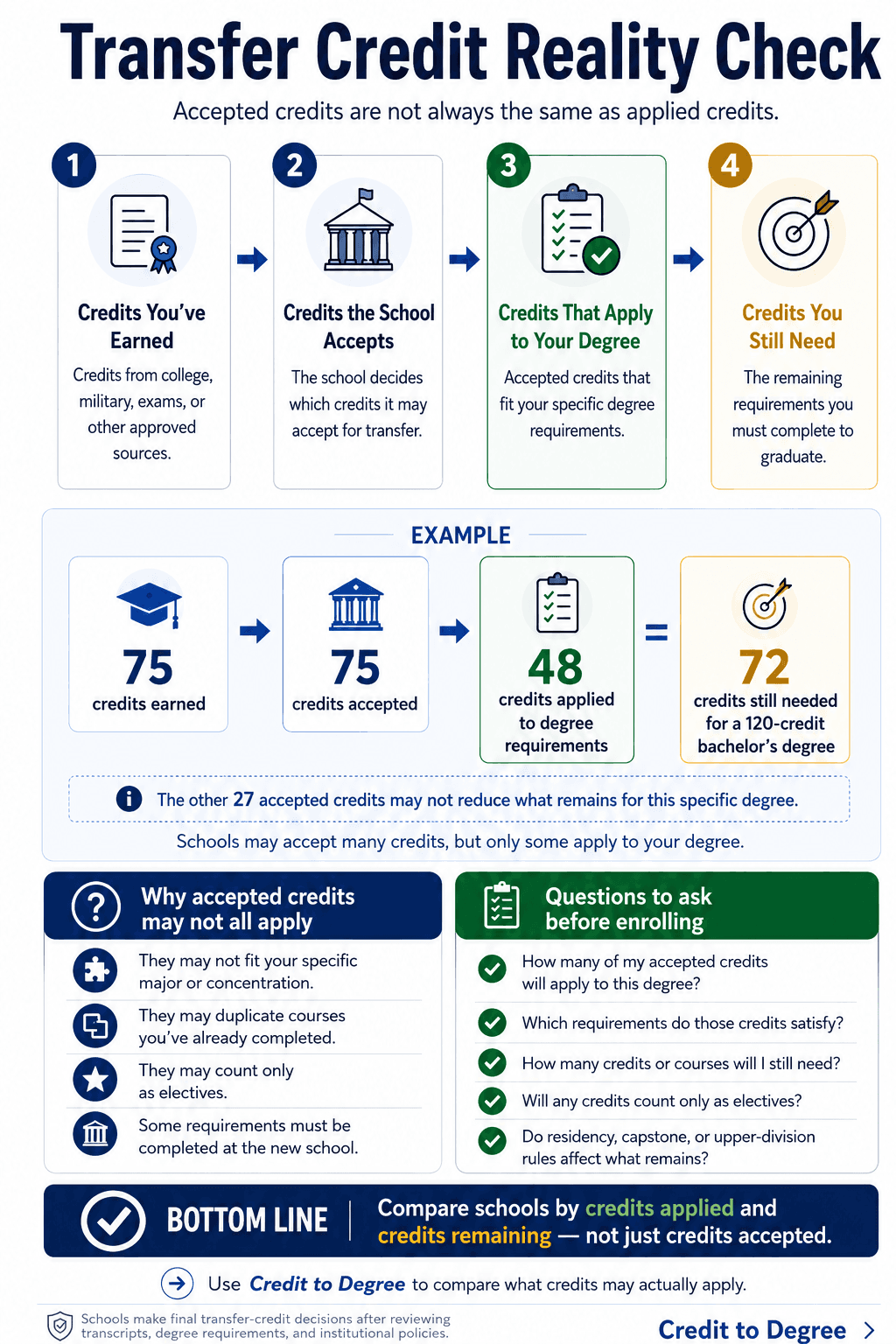
Most colleges allow students to transfer credits earned at other regionally accredited institutions. However, colleges typically enforce a residency requirement, meaning that a specific percentage of total credits—often 25% to 50%—must be earned directly through the graduating institution. Furthermore, courses with a grade lower than a "C" frequently fail to transfer.
Advanced Placement (AP) and Dual Enrollment
High school students entering college with dual enrollment credits or qualifying scores on Advanced Placement (AP) examinations (typically a score of 3 or higher) can apply those credits directly toward their general education or elective requirements, reducing the overall time and financial investment required for graduation.
Prior Learning Assessment (PLA)
Many technical and community colleges offer credit for life experience, military training, or professional certifications through Prior Learning Assessment programs. Students must compile portfolios, pass challenge exams, or demonstrate industry competencies to convert real-world experience into official transcript credits.
Common Mistakes and Pitfalls in Credit Planning
Navigating degree requirements involves subtle details that can easily catch students off guard. Avoiding common administrative and academic missteps ensures a smooth path to graduation.
- Ignoring Course Prerequisites: Enrolling in advanced core classes without completing the mandatory foundational prerequisites can result in forced withdrawal or academic failure.
- Assuming All Credits Transfer: Taking classes without verifying articulation agreements between two-year and four-year institutions often leads to losing credits during the university transfer process.
- Overlooking Minimum Grade Requirements: Earning a passing "D" grade in a general elective might count for overall credits, but core major courses often demand a grade of "C" or higher to satisfy program standards.
- Neglecting Catalog Year Rules: Degree requirements change over time. Students must follow the curriculum guidelines established in the academic catalog of the year they officially declared their major, unless formally granted an extension or update by an academic advisor.
Frequently Asked Questions
How many credits are required for an associate degree?
Most associate degree programs require between 60 and 65 semester credit hours. This total generally breaks down into 20 individual college courses, requiring about two years of full-time enrollment to complete. Programs with heavy clinical or technical components, such as nursing or engineering technology, may occasionally require up to 72 credits.
Can I finish an associate degree in less than two years?
Yes, students can accelerate their timeline by taking heavy course loads, attending summer and winter terms, and leveraging transfer credits, AP exams, or prior learning assessments. Students who enter college with prior credits frequently complete their requirements in 12 to 18 months.
What is the difference between an AA, AS, and AAS degree?
An Associate of Arts (AA) focuses on humanities and social sciences, while an Associate of Science (AS) concentrates on mathematics and natural sciences; both are primarily designed for transfer to a four-year bachelor's degree. An Associate of Applied Science (AAS) is a terminal career-technical degree meant to prepare students for immediate entry into the workforce.
Do all of my community college credits transfer to a university?
Not necessarily. While general education credits usually transfer smoothly under statewide articulation agreements, technical, vocational, or remedial credits may not count toward a bachelor's degree. Students should consult with transfer counselors and review specific university articulation guides before selecting courses.
What happens if I fail a college course?
Failing a course means you earn zero credits for that class, which can impact your cumulative GPA, financial aid eligibility, and graduation timeline. You will typically need to retake the exact course or an approved substitute to replace the missing credits and repair your GPA through grade forgiveness policies if offered by the institution.
Conclusion and Next Actions
Meeting associate degree credit requirements requires careful navigation of institutional guidelines, strategic course selection, and consistent academic progress. To secure a clear path to graduation, schedule a meeting with an academic advisor to review your current transcript audit, verify your remaining general education and core requirements, and confirm that all transfer credits have been formally applied to your student profile.