Asset valuation determines the economic value of a single item, an entire business portfolio, or specific financial instruments through quantitative models, market comparisons, and cash flow projections. Analysts use these techniques to drive strategic mergers, satisfy regulatory tax requirements, manage corporate portfolios, and support accurate financial reporting standards.
Introduction to Asset Valuation
Asset valuation sits at the intersection of accounting, corporate finance, and market economics. Determining what an asset is worth requires more than looking at a historical purchase ledger. It demands a forward-looking analysis of economic benefits, risk profiles, capital structures, and prevailing market conditions. Whether an organization evaluates commercial real estate, intangible intellectual property, machinery, or entire corporate entities, choosing the correct valuation methodology prevents mispriced transactions, tax compliance penalties, and distorted financial statements.
Valuation serves several primary stakeholders. For investors, it uncovers mispriced securities or properties trading below intrinsic value. For corporate executives, accurate valuations guide capital budgeting, divestitures, and collateral management for commercial loans. For regulatory authorities, such as the Internal Revenue Service (IRS) or international financial oversight bodies, valuation standards ensure transparency and prevent tax evasion during asset transfers, estate planning, and corporate restructurings.
Understanding these techniques requires analyzing the underlying premises of value. The premise might assume a business is a going concern, operating into the foreseeable future, or it might evaluate the business under an orderly liquidation or forced liquidation scenario. These fundamental assumptions dictate which data points matter most and steer the choice between income, market, and cost approaches.
The Three Pillar Approaches to Asset Valuation
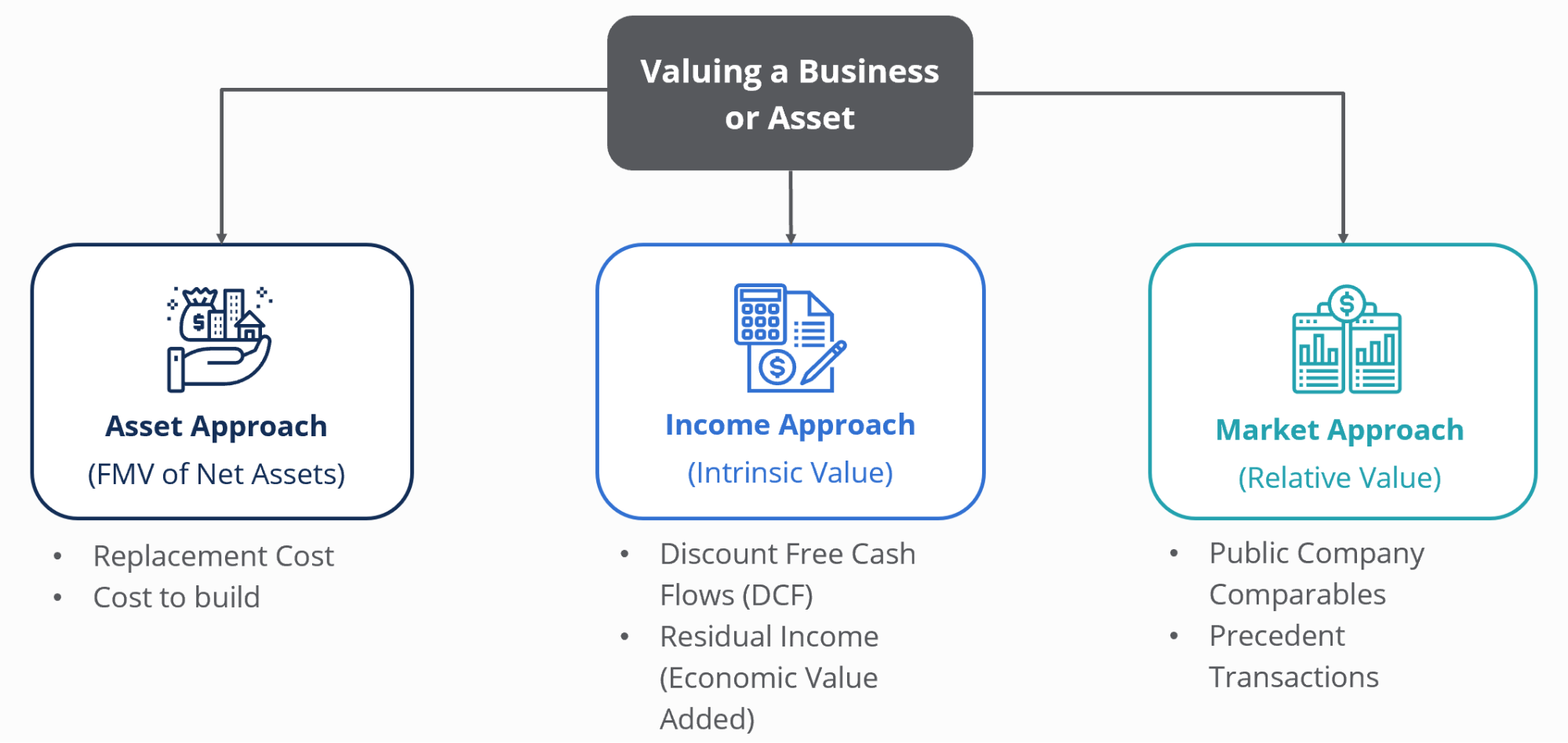
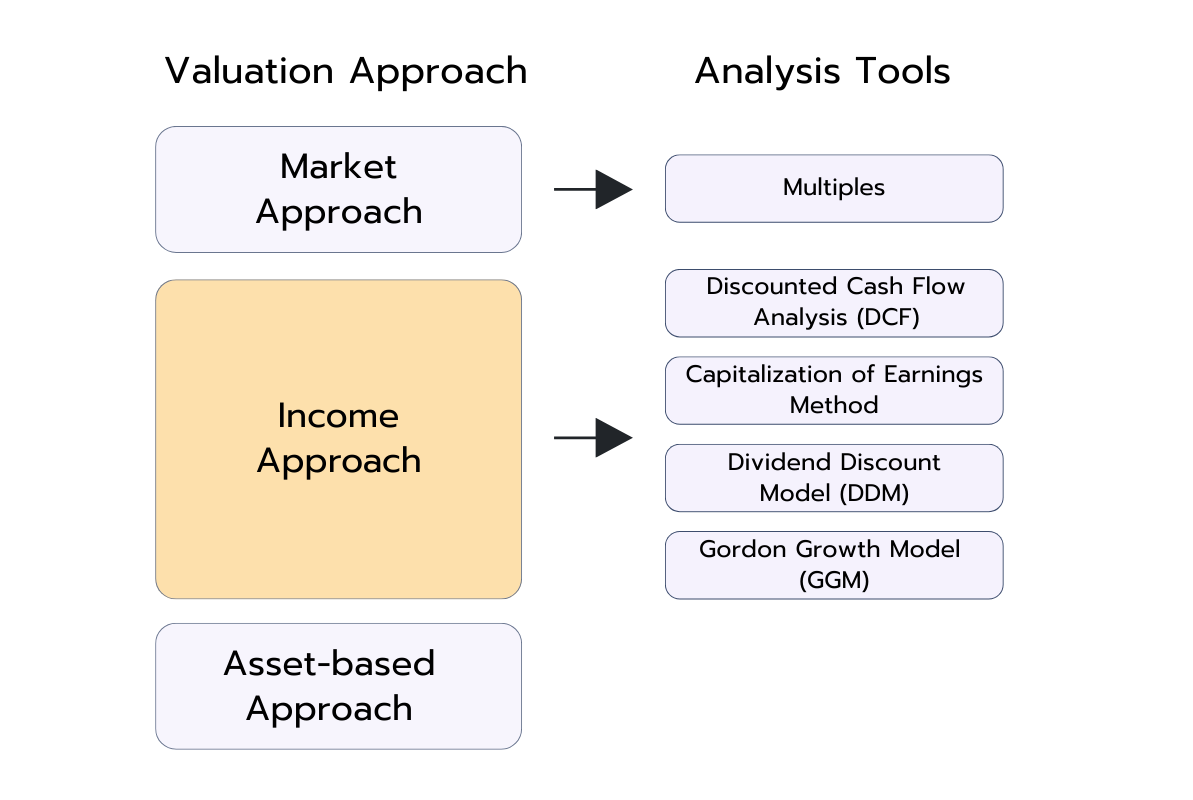
Financial standards, including those outlined by the International Valuation Standards Council (IVSC) and the Financial Accounting Standards Board (FASB), organize asset valuation into three overarching methodologies: the Market Approach, the Income Approach, and the Cost Approach. Analysts rarely rely on a single approach in isolation. Instead, they apply multiple methods and reconcile the results to arrive at a defensible final figure.
- ASSET VALUATION APPROACHES
- MARKET APPROACH
- COST APPROACH (Replacement or Depreciated)
- INCOME APPROACH
- (DCF / Capitalization)
- MARKET APPROACH
1. The Market Approach
The market approach estimates value by comparing the subject asset to identical or comparable assets that have recently been sold or are currently traded in an active market. This methodology rests on the economic principle of substitution: a rational buyer will not pay more for an asset than the cost of acquiring a close substitute of equal utility.
- Comparable Company Analysis (Comps): Commonly used for valuing businesses or equity shares, this technique looks at publicly traded peers within the same industry. Analysts compute valuation multiples—such as Price-to-Earnings (P/E), Enterprise Value-to-EBITDA (EV/EBITDA), or Price-to-Sales (P/S)—and apply them to the financial metrics of the subject company.
- Guideline Transactions Method: This variant examines historical pricing from actual mergers and acquisitions of similar private or public companies. It provides better context for control premiums than public trading comps because entire companies change hands in these transactions.
- Market Data Approach for Real Estate: In property valuation, appraisers inspect recent sales of neighboring properties with similar square footage, age, layout, and condition, making adjustments for specific property enhancements or deferred maintenance.
2. The Income Approach
The income approach converts future economic benefits—such as cash flows, dividends, or cost savings—into a single present-value amount. This approach suits income-generating assets, established businesses, commercial real estate portfolios, and patents with predictable revenue streams.
- Discounted Cash Flow (DCF) Analysis: The DCF model projects an asset's or company's free cash flows over a discrete period (typically five to ten years) and estimates a terminal value for the period beyond. These cash flows are discounted back to present value using a rate that reflects the time value of money and the inherent risk of the investment, known as the Weighted Average Cost of Capital (WACC) for corporate entities.
- Capitalization of Earnings: Used for stable assets with predictable, perpetual earnings, this method divides a single period's normalized earnings or cash flow by a capitalization rate. The capitalization rate represents the expected rate of return minus the expected long-term growth rate of those earnings.
3. The Cost Approach
The cost approach asserts that an asset's value equals the current cost of replacing or reproducing the asset with another of equivalent utility, adjusted for physical deterioration, functional obsolescence, and economic obsolescence. This method is especially useful for specialized industrial machinery, public infrastructure, newly constructed real estate, and assets with limited market comparables or earnings histories.
- Replacement Cost New (RCN): The estimated cost to construct or purchase a modern asset that provides equivalent utility using contemporary materials, design standards, and production techniques.
- Reproduction Cost: The estimated cost to build an exact replica of the subject asset using original materials, construction methods, and design specifications.
- Depreciation Deductions: To arrive at fair market value, the analyst subtracts accrued depreciation across three categories:
- Physical Deterioration: Wear and tear from use and age.
- Functional Obsolescence: Loss in value due to inefficiencies, poor design, or outdated technology.
- Economic Obsolescence: Loss in value driven by external factors, such as zoning changes, environmental regulations, or declining industry demand.
Comparative Analysis of Core Valuation Techniques
| Valuation Technique | Primary Use Cases | Core Strengths | Key Limitations |
|---|---|---|---|
| Discounted Cash Flow (DCF) | Growth companies, unique assets, infrastructure projects, intangible property | Captures future growth potential; rooted in fundamental economic theory | Highly sensitive to minor changes in assumptions (discount rate, growth rates) |
| Comparable Company Analysis | Public equities, private equity acquisitions, standard commercial businesses | Uses real market pricing data; quick to compute when data is available | Hard to find truly identical peers; market distortions can skew multiples |
| Asset-Based / Cost Approach | Real estate, holding companies, distressed firms, specialized machinery | Reliable when earnings are volatile or negative; provides a valuation floor | Ignores intangible goodwill and future earning potential |
| Capitalization of Earnings | Established rental real estate, mature, stable small businesses | Simple calculation for steady-state operations; avoids multi-year forecasting errors | Inappropriate for cyclical businesses or high-growth start-ups |
Specialized Valuation Methods by Asset Class
Different asset categories demand specialized valuation frameworks tailored to their unique operational characteristics, liquidity profiles, and regulatory environments.
Business and Equity Valuation
Valuing a private operating company requires bridging the gap between book value and fair market value. Financial analysts examine historical audited financial statements, normalize earnings by removing non-recurring expenses or owner-specific perks, and construct detailed multi-year forecasts. When valuing minority equity stakes, analysts apply discounts for lack of marketability (DLOM) and minority interest (DLOC) to account for the restricted ability to sell private shares quickly compared to public equities.
Intangible Assets and Intellectual Property
Patents, trademarks, proprietary software, customer lists, and brand equity represent significant portions of corporate balance sheets under accounting standards like ASC 350 and IFRS 3. Valuation specialists deploy three primary techniques for these assets:
- Relief-from-Royalty Method: Assumes the company owns the intellectual property and calculates the value based on the royalties it saves by not having to license it from a third party.
- Multi-Period Excess Earnings Method (MEEM): Isolates the cash flows specifically generated by the subject intangible asset after accounting for returns on contributing assets (such as working capital and fixed assets).
- With-and-Without Method: Compares the total enterprise value of the business with the intangible asset in place against the enterprise value of the business without that specific asset.
Real Estate Valuation
Real estate valuation relies heavily on local market dynamics. Beyond the market (comparable sales) and cost approaches, the income approach is executed through net operating income (NOI) capitalization. Appraisers divide a property's annual NOI by the prevailing market capitalization rate for similar properties in the geographic submarket. They also evaluate lease structures, tenant creditworthiness, and remaining lease terms to gauge income stability.
Step-by-Step Implementation Framework
Executing a professional asset valuation involves a structured workflow that ensures audit-ready documentation and defensible conclusions.
- Define the Scope and Purpose: Identify the asset, the intended use of the valuation (e.g., tax reporting, litigation support, M&A negotiation), the standard of value (e.g., Fair Market Value, Fair Value, Investment Value), and the valuation date.
- Gather and Verify Data: Collect historical financial statements, tax assessments, physical inspection reports, patent filings, and relevant market transaction data. Verify the authenticity and completeness of all documents.
- Perform Economic and Industry Analysis: Evaluate macroeconomic indicators, interest rate trends, regulatory shifts, and competitive pressures within the specific industry vertical affecting the asset.
- Select Valuation Methodologies: Choose at least two appropriate valuation approaches based on data availability, asset type, and the operating environment.
- Execute Calculations and Apply Adjustments: Build financial models, compute market multiples, calculate replacement costs, and apply necessary valuation discounts or premiums.
- Reconcile Results: Review the values derived from each methodology. Weight them according to data reliability and construct a final, justified value conclusion.
- Draft the Valuation Report: Compile assumptions, methodology descriptions, market data sources, and calculations into a comprehensive report for stakeholders or regulatory bodies.
Common Valuation Pitfalls and Errors
Inaccurate valuations frequently stem from systematic methodological errors rather than simple arithmetic mistakes. Recognizing these pitfalls protects financial integrity.
- Unrealistic Growth Projections: Overly optimistic terminal growth rates that outpace long-term gross domestic product (GDP) growth inflate DCF valuations. Projections must align with macroeconomic realities.
- Mismatching Cash Flows and Discount Rates: Nominal cash flows must be discounted using nominal discount rates (accounting for inflation), while real cash flows require real discount rates. Mixing these inputs distorts present value.
- Ignoring Economic Obsolescence in the Cost Approach: Relying solely on physical depreciation while ignoring external factors—such as a declining local labor pool or new disruptive technologies—leads to overvalued physical assets.
- Cherry-Picking Comparable Companies: Selecting peers based on superficial similarities rather than operational risk profiles, capital structures, and market exposures skews market-approach multiples.
Frequently Asked Questions
What is the difference between Fair Market Value and Fair Value?
Fair Market Value represents the price at which an asset would change hands between a willing buyer and a willing seller in an open market, with neither party under compulsion to buy or sell. Fair Value is a broader accounting term defined by regulatory frameworks like IFRS and US GAAP. It often reflects specific reporting rules, such as exit prices in principal markets or the value assigned to assets acquired during a business combination.
How do interest rate fluctuations impact asset valuation?
Interest rates directly influence the discount rates used in income-based valuation models. When central banks raise interest rates, the discount rate rises, which lowers the present value of future cash flows. Higher interest rates also increase borrowing costs, which depresses asset prices across commercial real estate and leveraged corporate acquisitions.
When should the cost approach be prioritized over the income approach?
The cost approach is prioritized when an asset does not generate a distinct, traceable income stream, when historical financial data is unavailable, or when valuing specialized assets like public infrastructure, municipal buildings, or newly constructed industrial facilities where market comparables do not exist.
Why are valuation discounts applied to private company shares?
Private company shares lack the liquidity of publicly traded stocks because investors cannot easily sell them on an open exchange. Analysts apply a Discount for Lack of Marketability (DLOM) to reflect the time, cost, and uncertainty required to convert private equity into cash.
Conclusion and Next Actions
Mastering asset valuation requires balancing quantitative modeling with qualitative market judgment. Whether you are preparing financial statements, underwriting a commercial acquisition, or resolving a tax dispute, grounding your analysis in verified data and established frameworks ensures defensible results.
To proceed, audit your current asset inventory, identify applicable regulatory valuation standards for your jurisdiction, and engage accredited valuation professionals—such as those holding Accredited Senior Appraiser (ASA) or Chartered Financial Analyst (CFA) designations—for complex portfolio assessments or contentious litigation support.