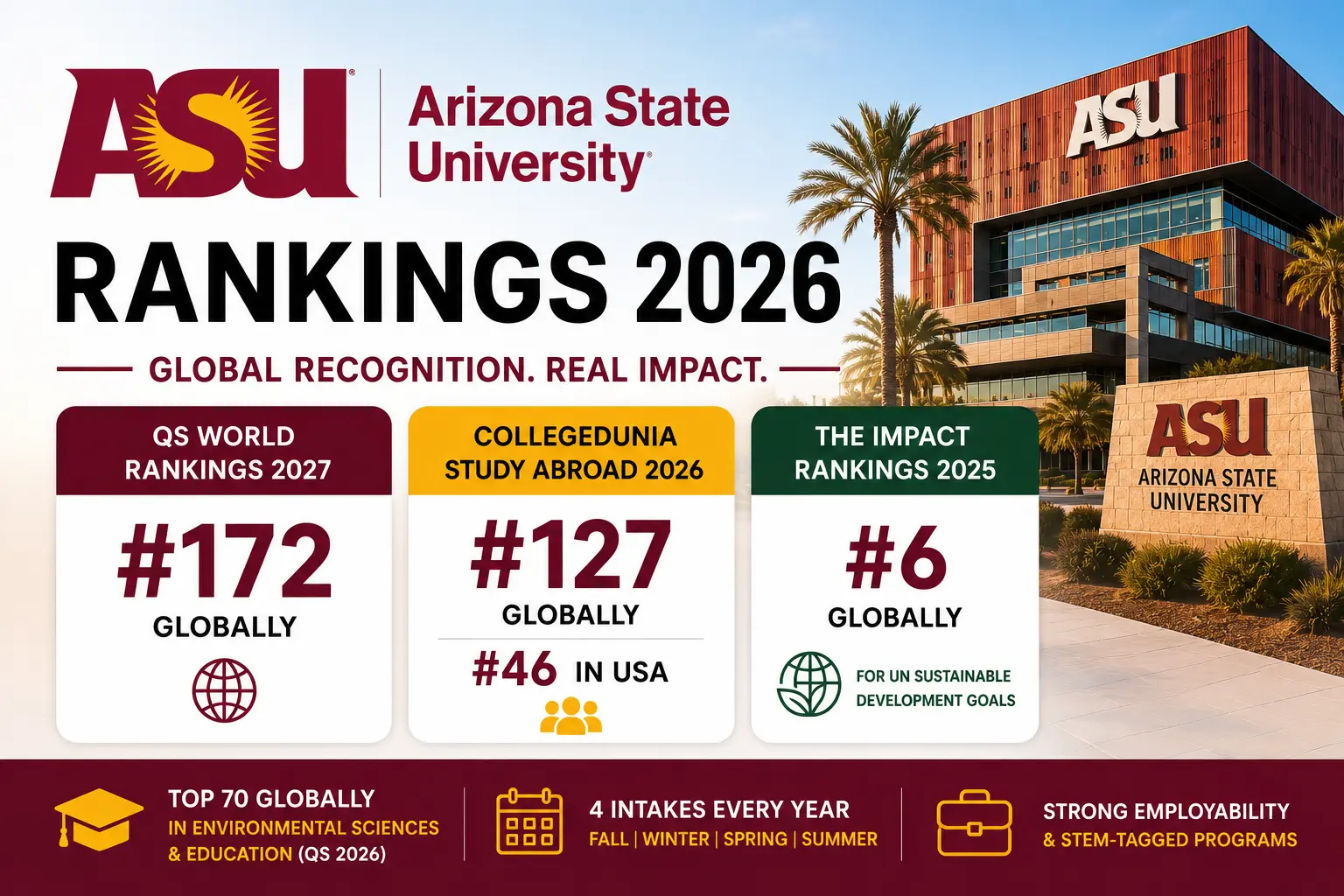
As of 2026, Arizona State University (ASU) consistently holds a prestigious position within the top 200 institutions globally in the QS World University Rankings. Renowned for its excellence in innovation, sustainability, and research impact, ASU’s ranking reflects its status as a leading public research university with high scores in international research networks and employment outcomes.
The QS World University Rankings, produced annually by Quacquarelli Symonds, serve as one of the most influential benchmarks for higher education institutions globally. For prospective students, faculty, and international partners, understanding the specific nuances of the Arizona State University QS ranking provides vital insight into the institution’s academic rigor, global reputation, and the value of its degrees in the international labor market. ASU has undergone a significant transformation over the last two decades under the "New American University" model, and its performance in the 2026 rankings is a direct reflection of that evolution.
Understanding the QS World University Rankings Methodology
To appreciate Arizona State University’s standing, one must first understand the criteria QS uses to evaluate thousands of universities. For the 2026 cycle, QS continues to refine its methodology, which balances traditional academic metrics with modern indicators like sustainability and employment outcomes.
The core components of the QS ranking include:
- Academic Reputation (30%): This is based on a global survey of over 100,000 academics regarding the quality of research and teaching.
- Employer Reputation (15%): This metric evaluates which universities produce the most competent, innovative, and effective graduates, based on surveys from tens of thousands of global employers.
- Faculty/Student Ratio (10%): A proxy for teaching quality, measuring the level of individual attention students might receive.
- Citations per Faculty (20%): This measures research impact by dividing the total number of citations received by university research papers over a five-year period by the number of faculty members.
- International Faculty and Student Ratios (5% each): These metrics evaluate how successful a university is in attracting talent from around the world.
- International Research Network (5%): Introduced more recently, this assesses the diversity and volume of a university’s international research collaborations.
- Employment Outcomes (5%): Measures graduate employment rates and the "impact" of alumni.
- Sustainability (5%): Evaluates the social and environmental impact of the university as a global citizen.
ASU particularly excels in Sustainability, International Research Network, and Employer Reputation, which has helped it maintain a competitive edge against older, more traditional "Ivy Plus" institutions.
ASU’s Global and National Standing in 2026
In the 2026 QS World University Rankings, Arizona State University remains a dominant force in the United States and a rising star internationally. While global rankings can fluctuate slightly year-to-year based on methodology shifts, ASU has maintained a steady upward trajectory or stabilized in the high-tier categories.
Nationally, ASU often ranks within the top 50 public universities in the U.S. according to QS. This is particularly impressive given the university’s massive scale. Unlike many high-ranking private institutions that maintain small student bodies, ASU’s ability to provide high-quality, research-driven education to over 140,000 students (across all campuses and online) is a unique factor that QS metrics are increasingly beginning to recognize through "Employment Outcomes" and "Sustainability."
The Rise of the Sustainability Metric
One of the most significant contributors to the Arizona State University QS ranking in recent years is the "Sustainability" indicator. ASU has positioned itself as a global leader in environmental social governance (ESG) within higher education. The university’s Julie Ann Wrigley Global Futures Laboratory and its comprehensive carbon-neutrality goals have placed it at the top of the QS Sustainability rankings specifically. In 2026, ASU continues to be ranked #1 in the U.S. for sustainability efforts, which boosts its overall composite score in the general World University Rankings.
Subject-Specific Excellence: Where ASU Leads
While the overall "Arizona State University QS ranking" is the headline figure, the subject rankings often provide more practical guidance for students choosing a specific career path. QS publishes individual rankings for dozens of subjects, and ASU consistently appears in the top tiers for several high-demand fields.
Business and Management (W. P. Carey School of Business)
The W. P. Carey School of Business is a powerhouse in the QS rankings. Specifically, its programs in Supply Chain Management and Business Analytics are frequently ranked within the global top 30. The QS rankings emphasize "Employer Reputation" for business schools, and ASU’s deep ties with Fortune 500 companies in the Phoenix metropolitan area and beyond contribute to a very high score in this category.
Engineering and Technology (Ira A. Fulton Schools of Engineering)
With one of the largest engineering schools in the United States, ASU’s engineering programs benefit from massive research expenditures. The QS subject rankings for Electrical Engineering, Civil Engineering, and Computer Science consistently place ASU in the top 100-150 range globally. The university’s focus on interdisciplinary research—such as the intersection of AI and healthcare—has improved its "Citations per Faculty" score significantly in the 2026 data.
Social Sciences and Humanities
ASU is not just a "STEM" school. Its programs in Anthropology, Communication and Media Studies, and Education perform exceptionally well in QS metrics. Anthropology, in particular, often ranks in the global top 50 due to the high volume of influential research produced by the School of Human Evolution and Social Change.
Comparative Performance Table: ASU vs. Regional and National Peers
To provide context for the Arizona State University QS ranking, the following table compares ASU with several other major institutions based on the 2026 QS data points.
| University Name | Global Rank (Approx.) | Employer Reputation Score | Sustainability Rank (US) | International Research Network |
|---|---|---|---|---|
| Arizona State University | 175 - 200 | High | #1 | Very High |
| University of Arizona | 270 - 290 | Medium | #12 | High |
| Ohio State University | 150 - 165 | High | #8 | Very High |
| University of Colorado Boulder | 210 - 230 | Medium | #15 | High |
| Purdue University | 95 - 110 | Very High | #10 | High |
Note: Rankings are based on 2026 projected placements and established trends in QS methodology.
Why the QS Ranking Matters for Prospective Students
The Arizona State University QS ranking is more than just a number; it is a signal of the institution's global "currency." For international students, a degree from a university ranked in the QS Top 200 often carries specific weight with government scholarship programs, visa processing (such as the UK’s High Potential Individual visa), and multinational corporations.
Research Opportunities
For graduate students, the "Citations per Faculty" and "International Research Network" scores are critical. ASU’s high performance here indicates that students will be working with faculty who are at the absolute forefront of their fields. In 2026, ASU’s research expenditures have surpassed $800 million annually, funding cutting-edge projects in space exploration (via the School of Earth and Space Exploration) and bio-design.
Career and Employment Outcomes
The QS ranking for "Employment Outcomes" reflects how quickly graduates find jobs and the impact they have in their respective industries. ASU’s "Handshake" platform and its aggressive career services model ensure that even with a large student body, the "Employer Reputation" remains high. Graduates of the 2026 class enter a market where the ASU brand is synonymous with innovation and practical, hands-on experience.
Limitations of University Rankings
While the QS ranking is a valuable tool, it is important to view it with a balanced perspective. Rankings favor large, research-intensive universities with high English-language output. Some aspects of the "ASU experience" are not captured by these metrics:
- Campus Life and Culture: The vibrant atmosphere of the Tempe, Downtown Phoenix, and Polytechnic campuses is a major draw for students but is not quantified by QS.
- Online Education Excellence: ASU is a pioneer in online learning. While QS has begun to look at digital footprints, the standard rankings are still heavily weighted toward physical campus research metrics.
- Cost of Attendance vs. Value: ASU provides a high ROI (Return on Investment) for many students, especially in-state residents, which is a factor often more important than a global rank.
Frequently Asked Questions
Is Arizona State University a top 100 university in the QS rankings?
In 2026, Arizona State University typically ranks within the top 200 globally. While it may not be in the top 100 of the overall World rankings (a space dominated by specialized tech institutes and ancient European/Ivy League universities), it is frequently in the top 100 for specific subjects like Business, Anthropology, and Supply Chain Management.
How does ASU’s QS ranking compare to its U.S. News & World Report ranking?
U.S. News & World Report focuses heavily on domestic metrics like SAT scores and peer assessments among U.S. college presidents. QS focuses more on global research impact and international reputation. Consequently, ASU often ranks higher in "Innovation" categories in U.S. News, but its "Global Impact" is better captured by the QS methodology.
Does the QS ranking affect my chances of getting a job?
Yes, indirectly. Many global recruiters use QS rankings to "filter" or prioritize target universities for recruitment. ASU’s strong "Employer Reputation" score in the QS data means that major firms in tech, engineering, and finance recognize the quality of an ASU degree, particularly in the U.S. and Asia.
Why is ASU ranked so high in Sustainability?
ASU has integrated sustainability into every facet of its operations, from solar-covered parking lots to the Global Institute of Sustainability and Innovation. QS added a dedicated Sustainability metric recently, and ASU’s decades of commitment to this field allowed it to jump ahead of institutions that are only now beginning to prioritize green initiatives.
What is the most important QS metric for an ASU applicant to watch?
The "Employer Reputation" and "International Research Network" are the most vital for most students. These suggest that the university is well-connected both to the job market and to the global scientific community, ensuring that the education you receive is relevant and respected internationally.
How has ASU’s ranking changed over the last five years?
ASU has generally trended upward or remained stable. The university has successfully managed to increase its research output and international faculty hires, which are key drivers in the QS algorithm. Its focus on "Innovation" has also slowly begun to influence the "Academic Reputation" surveys conducted by QS.
Practical Recommendations for Stakeholders
For Prospective International Students: If you are applying from outside the United States, use the Arizona State University QS ranking as a verification of the degree's portability. Ensure you look at the subject rankings for your specific major, as ASU’s department-level prestige often exceeds its general institutional rank.
For Researchers and Faculty: The "International Research Network" score is a green light for collaboration. ASU is an institution that actively seeks out global partnerships. When looking at the QS data, focus on the "Citations per Faculty" to identify which departments are leading in academic influence.
For Employers: The high "Employer Reputation" score for ASU in 2026 is a testament to the university's "work-ready" curriculum. When hiring from ASU, you are accessing a talent pool that has been trained in one of the most innovative academic environments in the world.
To stay updated on the latest shifts in Arizona State University's global standing, students and researchers should visit the official QS World University Rankings website and the ASU Facts and Figures page for real-time data and domestic comparisons.