In 2026, Arizona State University (ASU) maintains its status as one of the largest public research universities in the United States, with a total student population exceeding 160,000. This massive enrollment is distributed across five physical campuses in the Phoenix metropolitan area and a robust, globally recognized online learning platform.
Arizona State University has undergone a radical transformation over the last two decades, evolving from a regional institution into a global educational powerhouse. By 2026, the university’s commitment to the "New American University" model—which prioritizes inclusion over exclusion—has resulted in a student body that is not only vast in size but also remarkably diverse in terms of geography, socioeconomic background, and academic pursuit. Understanding the nuances of the ASU student population requires looking beyond the raw numbers to examine the distribution across campuses, the surge in online learners, and the demographic shifts that reflect broader trends in American higher education.
Total Enrollment Trends and Growth Drivers
The total student population at ASU has seen consistent year-over-year growth for more than a decade. As of the 2025-2026 academic year, the university serves approximately 162,000 students. This represents a significant increase from the roughly 100,000 students enrolled a decade ago. The primary engine of this growth has been the university’s aggressive expansion into digital education, paired with a steady demand for traditional on-campus experiences in the sun-drenched Phoenix valley.
Several factors contribute to this sustained growth. First, ASU’s partnership-heavy model—including high-profile collaborations with corporations like Starbucks and Uber to provide tuition coverage for employees—has funneled thousands of non-traditional students into the university system. Second, the university has leaned heavily into its "Innovation" branding, consistently ranking at the top of U.S. News & World Report’s innovation list, which attracts students looking for modern, tech-forward curricula. Finally, Arizona’s population growth itself provides a natural pipeline of local students, even as the university increases its recruitment efforts in California, the Midwest, and internationally.
Physical Campus Populations: The Multi-Campus Hub
Unlike many large universities that center around a single massive campus, ASU operates on a "One University in Many Places" model. This means that while each campus has its own distinct identity and academic focus, students are part of the same overall institution.
The Tempe Campus: The Historic Flagship
The Tempe campus remains the largest and most recognizable hub of the university. In 2026, it hosts over 57,000 students. As the center of ASU’s research infrastructure and athletic life, Tempe attracts the majority of traditional first-time freshmen. The population here is characterized by high density, a vibrant Greek life, and a concentration of engineering, business, and liberal arts students. The presence of the Barrett, The Honors College headquarters also ensures a high concentration of high-achieving scholars within this specific population segment.
Downtown Phoenix: The Professional Core
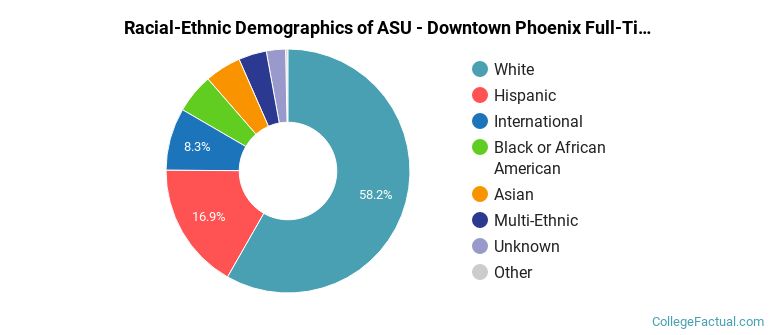
With a student population of approximately 13,000, the Downtown Phoenix campus serves as the professional heart of the university. This campus is home to the Walter Cronkite School of Journalism and Mass Communication, the Sandra Day O’Connor College of Law, and the Edson College of Nursing and Health Innovation. The student body here is notably more career-focused, often engaging in internships with nearby government offices, major media outlets, and healthcare facilities. The demographic skew here leans slightly older and more graduate-heavy compared to the Tempe campus.
Polytechnic and West Valley Campuses
The Polytechnic campus in Mesa and the West Valley campus in Glendale serve specialized needs. The Polytechnic campus, with around 6,000 students, focuses on applied sciences, aviation, and management. It features a more suburban, hands-on learning environment. Meanwhile, the West Valley campus has expanded to nearly 5,500 students, focusing on interdisciplinary arts and sciences. These campuses offer a smaller-college feel while maintaining the resources of a massive university system.
The Digital Frontier: ASU Online Population
Perhaps the most striking aspect of the Arizona State University student population in 2026 is the scale of its online enrollment. ASU Online now accounts for more than 90,000 students, nearly 55% of the total university population. This segment of the student body is distinct from the on-campus population in several key ways.
The average age of an ASU Online student is typically higher (late 20s to early 30s) than the traditional 18-to-22-year-old on-campus student. A vast majority of these students are working professionals, parents, or military service members who require the flexibility of asynchronous learning. By 2026, the online population has become the university's most significant area of demographic growth, particularly among graduate students and degree-completion seekers. This "digital campus" has allowed ASU to scale its mission of accessibility without the physical constraints of classroom space or dormitory capacity.
Demographic Diversity and Representation
ASU takes pride in its designation as a Hispanic-Serving Institution (HSI), a milestone it achieved through intentional recruitment and support programs. In 2026, approximately 28% of the undergraduate student body identifies as Hispanic or Latino. This reflects the university’s commitment to serving the evolving demographic landscape of the Southwest.
The diversity of the student population extends across several metrics:
- First-Generation Students: Nearly one-third of the undergraduate population are the first in their families to attend college.
- International Presence: ASU remains a top choice for international students, with over 15,000 students hailing from more than 150 countries. The largest cohorts typically arrive from China, India, and South Korea, though 2026 has seen an uptick in enrollment from Southeast Asia and Sub-Saharan Africa.
- Socioeconomic Range: Through the use of the Pell Grant and various institutional scholarships, ASU maintains a high percentage of students from low-income backgrounds, fulfilling its "charter" promise to be measured not by whom it excludes, but by whom it includes and how they succeed.
Comparative Enrollment Statistics (Fall 2025 - Spring 2026)
To better visualize how the population is distributed, the following table breaks down the enrollment by modality and level of study.
| Student Category | On-Campus Enrollment | Online Enrollment | Total |
|---|---|---|---|
| Undergraduate | 62,500 | 68,000 | 130,500 |
| Graduate | 14,500 | 17,000 | 31,500 |
| Total | 77,000 | 85,000 | 162,000 |
Note: Figures are estimates based on enrollment trends reported by the ASU University Office of Institutional Analysis.
Academic Distribution: Where Students are Focusing
The size of the population is matched by the breadth of the academic offerings. The W. P. Carey School of Business and the Ira A. Fulton Schools of Engineering are the two largest academic units by enrollment. In 2026, the Fulton Schools of Engineering alone boast over 30,000 students across both on-campus and online modalities, making it one of the largest engineering schools in the world.
There has also been a significant shift toward health-related disciplines. The "ASU Health" initiative, launched in the mid-2020s, has led to a surge in the student population within the Edson College of Nursing and the College of Health Solutions. As Arizona faces a growing demand for healthcare professionals, the university has scaled these programs to accommodate thousands of new students, many of whom are based at the Downtown Phoenix and West Valley campuses.
Challenges of a Massive Student Population
Operating a university with over 160,000 students presents unique logistical and social challenges. One of the most pressing issues in 2026 is the "housing crunch" in the Tempe and Phoenix areas. As the on-campus population continues to grow, the university has had to partner with private developers to increase the supply of student-centric housing. This has led to a dramatic change in the Tempe skyline, now dominated by high-rise luxury apartments marketed toward students.
Furthermore, maintaining a sense of community is difficult at this scale. The university utilizes advanced "ed-tech" and AI-driven advising tools to ensure that students do not feel like just a number. These tools help monitor student progress and provide early interventions for those at risk of dropping out. While the sheer size of the Arizona State University student population provides immense networking opportunities, it also requires students to be more proactive in seeking out smaller sub-communities, such as student organizations, research labs, or specialized interest groups.
The Impact of Population Size on Post-Graduation Outcomes
The scale of the ASU student body creates a massive alumni network, which by 2026 exceeds 650,000 individuals worldwide. This "strength in numbers" provides a significant advantage for graduating students. Large corporations, particularly those in the aerospace, semiconductor (Intel, TSMC), and financial sectors, recruit heavily from ASU because of the sheer volume of qualified candidates.
The university’s population growth is intrinsically linked to the economic development of the "Silicon Desert." As major tech firms move to Arizona, the university scales its student population in corresponding fields to meet the workforce demand. This synergy ensures that despite the massive number of graduates entering the market each year, the regional economy remains capable of absorbing them.
Frequently Asked Questions
Is ASU the largest university in the U.S. by population?
As of 2026, ASU is consistently ranked among the top three largest public universities in the U.S., often competing with the University of Central Florida (UCF) and Texas A&M for the top spot. When including online enrollment, ASU frequently holds the number one position for total unduplicated headcount.
How does the online student population affect campus resources?
Online students generally do not utilize physical campus resources like dorms, dining halls, or gyms, which allows the university to grow its enrollment without overtaxing physical infrastructure. However, they do utilize digital resources, library databases, and remote advising services, which the university has scaled accordingly.
What is the ratio of in-state to out-of-state students?
For the on-campus population, approximately 50-55% are Arizona residents. However, for the online population, the vast majority are out-of-state or international students. This creates a balanced revenue model that allows the university to keep tuition relatively stable for local residents.
Does the large population mean class sizes are huge?
While introductory lectures can be large (300+ students), ASU uses a "hybrid" approach and small-group recitations to maintain engagement. As students move into their major-specific upper-division courses, class sizes typically drop to 25-40 students, similar to much smaller institutions.
How has the international student population changed recently?
While traditional markets like China and India remain strong, ASU has seen significant growth in students from the Middle East and Latin America. The university’s "Global Launch" program has been instrumental in preparing international students for the linguistic and academic rigors of the large ASU environment.
Next Steps for Prospective Students
For those looking to join the Arizona State University student population in 2026, the first step is to identify the preferred learning modality. Students seeking a traditional experience should focus on the Tempe or Downtown Phoenix campuses, while working professionals should explore the 300+ degree programs offered via ASU Online. Given the university's scale, early application is highly recommended to secure on-campus housing and competitive financial aid packages. You can find detailed application requirements and current enrollment windows on the ASU Admissions portal.