Arizona state tax credits for the 2025 tax year allow residents to redirect a portion of their state income tax liability to specific charitable causes, schools, and foster care organizations. Unlike deductions, these credits provide a dollar-for-dollar reduction in taxes owed, effectively giving taxpayers control over how their tax dollars are spent within the state.
Arizona is unique in the United States for its robust system of individual income tax credits. As we move through 2026, taxpayers preparing their 2025 state returns should recognize that these credits represent one of the most powerful tools for local impact and personal financial planning. Because Arizona utilizes a "dollar-for-dollar" system, a $500 credit reduces your tax bill by exactly $500, whereas a deduction would only reduce the income upon which you are taxed. This guide provides a detailed breakdown of the 2025 credit limits, eligibility requirements, and the specific forms needed to claim them before the April 15, 2026, filing deadline.
The Mechanics of Arizona's Dollar-for-Dollar Credits
The primary appeal of the Arizona state tax credit system is its transparency and directness. When a taxpayer makes a qualifying contribution, they are essentially telling the Arizona Department of Revenue (ADOR) to send their tax money to a specific nonprofit or school rather than the general fund.
It is important to distinguish between refundable and non-refundable credits. Most Arizona individual tax credits are non-refundable, meaning they can reduce your tax liability to zero, but the state will not issue a check for any credit amount that exceeds what you owe. However, many of these credits allow for a "carry-forward" period—typically five consecutive years—allowing you to apply the unused portion of the credit to future tax bills.
To maximize these benefits for the 2025 tax year, taxpayers must ensure their contributions are made to organizations that have been officially certified by the state. The ADOR maintains updated lists of these organizations annually, as status can change based on the organization's compliance with state statutes.
Qualifying Charitable Organizations (QCO)
The Credit for Contributions to Qualifying Charitable Organizations (formerly known as the "Working Poor Tax Credit") is one of the most frequently utilized credits. It supports 501(c)(3) organizations that provide immediate basic needs to Arizona residents who receive temporary assistance for needy families (TANF) or are considered low-income.
2025 Limits and Prerequisites
For the 2025 tax year, the maximum credit amounts for QCO contributions are:
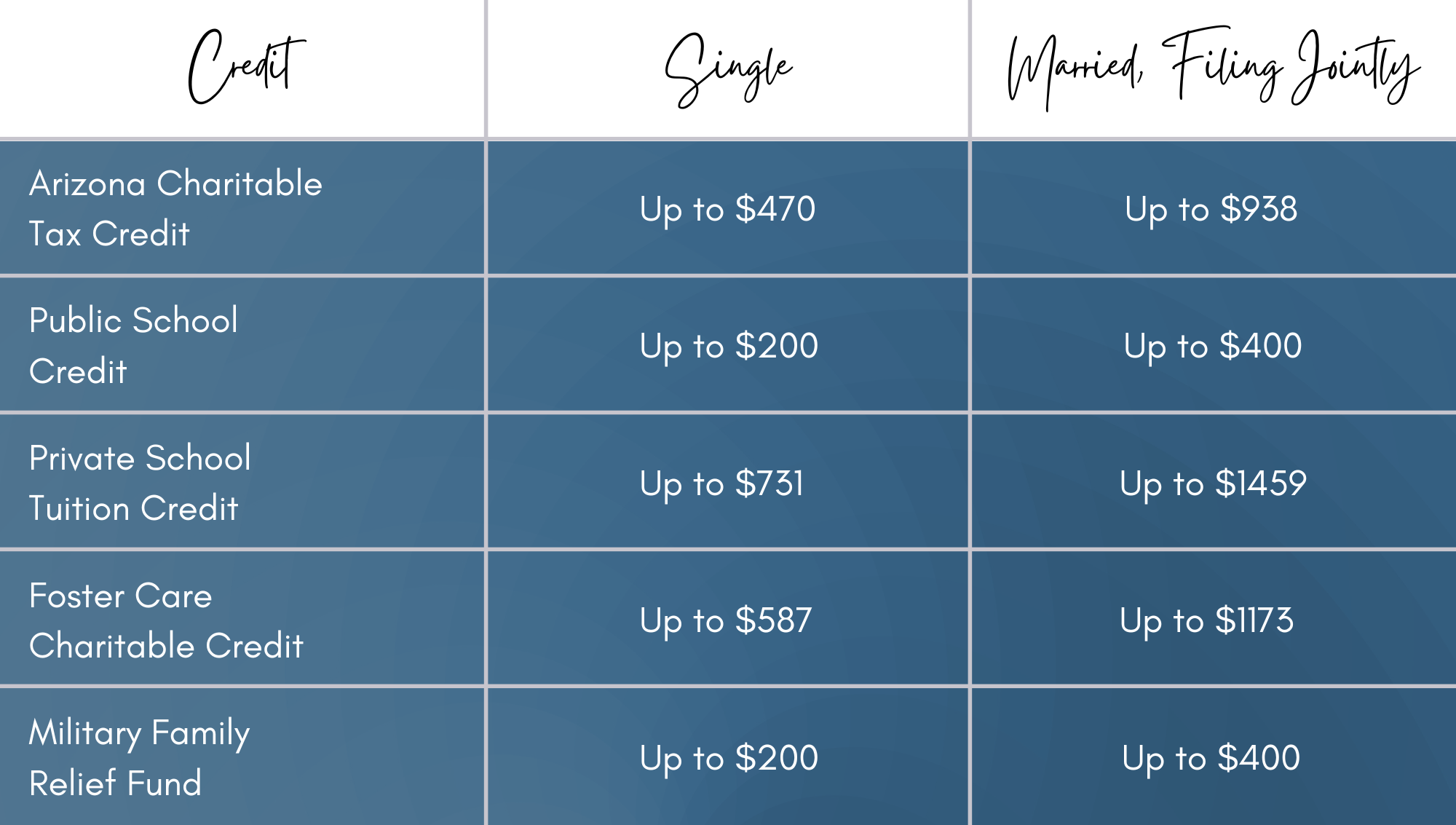
- $470 for single taxpayers or heads of household.
- $938 for married couples filing joint returns.
To qualify, the charity must spend at least 50% of its budget on services for the working poor or those with chronic illnesses/physical disabilities. Taxpayers do not need to itemize their federal deductions to claim this credit on their Arizona return. The contribution must be made in cash (checks and credit card payments count); donations of property or "in-kind" gifts do not qualify for the tax credit.
Reporting Requirements
When filing your 2025 taxes in 2026, you must use Arizona Form 321. You will need the specific five-digit "QCO Code" assigned to the organization by the ADOR. If you donate to multiple charities, the combined total cannot exceed the caps mentioned above, though you can split your total across several different QCOs.
Qualifying Foster Care Charitable Organizations (QFCO)
The QFCO credit is distinct from the general QCO credit. This credit is specifically designed to support organizations that provide ongoing services to at least 200 foster children in the Arizona foster care system.
2025 QFCO Credit Limits
For the 2025 tax year, the limits are:
- $587 for single taxpayers or heads of household.
- $1,173 for married couples filing joint returns.
A significant advantage of the Arizona system is that the QCO and QFCO credits are additive. A married couple could potentially donate $938 to a standard qualifying charity and another $1,173 to a foster care organization, receiving a total credit of $2,111 against their 2025 state taxes, provided their total tax liability is high enough to support it.
Verification and Deadlines
Taxpayers must use Arizona Form 352 to claim this credit. Like the QCO, the organization must have a specific five-digit QFCO code. Contributions made through April 15, 2026, can often be applied to the 2025 tax year, providing a unique "look-back" window for those who realize they have a higher tax liability than anticipated during the filing season.
Public School Tax Credits
Arizona Revised Statutes § 43-1089.01 allows taxpayers to support public schools through credits for fees paid for extracurricular activities or character education programs. This credit is available to any individual payer; you do not need to have a child enrolled in the school to claim the credit.
Eligible Activities
The funds must support activities that require students to pay a fee to participate. Common examples include:
- Sports and athletic equipment.
- Band, choir, and fine arts programs.
- Scientific field trips and outdoor education.
- Standardized testing fees (such as AP or SAT prep provided by the school).
- Career and Technical Education (CTE) programs.
2025 Caps and Carry-Forward
The maximum credit for 2025 is $200 for single filers and $400 for married couples filing jointly. This credit is claimed using Arizona Form 322. If you contribute more than your tax liability for 2025, you can carry the excess credit forward for up to five years. It is vital to keep the receipt provided by the school, as it must state that the funds were for a "qualifying extracurricular activity."
Private School Tuition Organizations (STO)
The private school tax credit is the most complex of the Arizona credits because it is divided into two parts: the "Original" credit and the "Switcher" (or Overflow) credit. These credits allow taxpayers to fund scholarships for students attending private K-12 schools in Arizona.
The Original Individual Income Tax Credit (Form 323)
For the 2025 tax year, the maximum "Original" credit amounts are:
- $731 for single filers.
- $1,459 for married filing jointly.
The "Switcher" Individual Income Tax Credit (Form 348)
If a taxpayer maxes out the Original credit, they can contribute additional funds to the "Switcher" credit. For 2025, the maximum Switcher amounts are:
- $728 for single filers.
- $1,451 for married filing jointly.
Total Potential Impact
Combining both the Original and Switcher credits, a married couple can contribute up to $2,910 to a School Tuition Organization in 2025. These organizations, such as the Arizona Tuition Connection or the Arizona Catholic Schools Consortium, then distribute those funds as scholarships. Taxpayers are permitted to "recommend" a specific student to receive the scholarship, though the STO retains final discretionary authority over the award to comply with federal tax laws.
Comparison of Arizona 2025 Tax Credit Limits
The following table summarizes the maximum allowable credits for the 2025 tax year, which are filed in 2026.
| Credit Type | Single / Head of Household | Married Filing Jointly | Arizona Form |
|---|---|---|---|
| Qualifying Charitable Org (QCO) | $470 | $938 | Form 321 |
| Qualifying Foster Care Org (QFCO) | $587 | $1,173 | Form 352 |
| Public School Activity Fees | $200 | $400 | Form 322 |
| Private School (Original) | $731 | $1,459 | Form 323 |
| Private School (Switcher) | $728 | $1,451 | Form 348 |
| Military Family Relief Fund | $200 | $400 | Form 340 |
Note: The Military Family Relief Fund (MFRF) has an annual cap of $1 million for the entire state. Once this cap is reached, no further credits are issued for that year, even if the individual contribution was made.
The Military Family Relief Fund (MFRF)
The MFRF credit is unique because it is one of the few credits with a "hard cap" at the state level. Administered by the Arizona Department of Veterans' Services, this fund provides financial assistance to the families of service members who have been adversely affected by deployment.
Because the state limits total credits to $1 million annually, these often "sell out" by November or December of the tax year. To claim this credit for 2025, taxpayers must have received an official receipt from the Department of Veterans' Services. If you donate after the cap is met, your donation becomes a standard tax deduction rather than a dollar-for-dollar credit. For 2025, the limits remain $200 (single) and $400 (joint).
How to Claim 2025 Credits on Your Return
Claiming these credits requires precise documentation. When you prepare your Arizona return in 2026, follow these steps:
- Collect Receipts: Ensure you have a receipt for every donation made. The receipt must show the date of the contribution, the name of the organization, and the amount.
- Verify Codes: For QCO and QFCO donations, verify the organization's five-digit code on the Arizona Department of Revenue website.
- Complete Individual Credit Forms: Each credit has its own specific form (321, 322, 323, etc.). You must complete these forms first to calculate the allowable credit.
- Transfer to Form 301: The results from the individual forms are then summarized on Arizona Form 301 (Nonrefundable Individual Tax Credits). This form totals all your credits and applies them against your tax liability.
- Check for Carry-Forwards: If your total credits exceed your tax liability, the software or tax preparer must track the "carry-forward" amounts for the 2026 tax year.
Common Pitfalls and Compliance Issues
While the tax credit system is generous, it is strictly regulated. Errors in filing can result in the denial of the credit and unexpected tax bills.
- The April 15th Rule: Arizona allows contributions made between January 1, 2026, and April 15, 2026, to be claimed on either the 2025 or 2026 tax return. However, you cannot claim the same donation on both years. You must explicitly choose which tax year the contribution applies to.
- Liability Limits: If your total Arizona tax liability (the amount you owe the state before any withholdings are applied) is only $1,000, you cannot benefit from $2,000 in credits in a single year. You can only wipe out the $1,000 you owe. The remaining $1,000 must be carried forward to future years.
- Standard Deduction vs. Itemization: A common misconception is that you must itemize on your federal return to take these credits. This is false. Arizona state tax credits are independent of federal itemization. You can take the standard deduction on your federal return and still claim all Arizona state credits.
- Business Contributions: The credits discussed here are for individual income taxes. While there are corporate versions of some credits (like the STO credit), they have different rules, caps, and application processes.
Frequently Asked Questions
Can I give to both a QCO and a QFCO in the same year?
Yes. The Qualifying Charitable Organization (QCO) credit and the Qualifying Foster Care Charitable Organization (QFCO) credit are entirely separate. For the 2025 tax year, a married couple can give the maximum to both, totaling $2,111 in credits.
What happens if I don't owe any state taxes?
If your tax liability is zero, you cannot use the credits to get a refund from the state. However, because most of these credits have a five-year carry-forward provision, you can still make the donation in 2025 and use the credit in a future year when you do have a tax liability.
Can I donate to a school out of state and get the credit?
No. To qualify for the Arizona state tax credit, the donation must be made to an Arizona public school or an Arizona-certified School Tuition Organization.
How do I know if a charity is qualified for the 2025 tax year?
The Arizona Department of Revenue publishes updated lists of QCOs and QFCOs every year. You should check the 2025 list specifically, as an organization that was qualified in 2024 may have lost its status if it failed to meet the state's reporting requirements.
Is there a deadline for making these contributions?
To apply a contribution to your 2025 tax return, you must make the donation by April 15, 2026. This extension beyond the calendar year gives taxpayers time to calculate their actual tax liability before deciding how much to donate.
Final Recommendation
For Arizona residents, the state tax credit system is an unparalleled opportunity to direct personal tax dollars toward specific community needs. For the 2025 tax year, the most effective strategy is to review your projected state tax liability early in the 2026 filing season. By utilizing the "look-back" period that extends to April 15, 2026, you can make precise contributions to QCOs, QFCOs, and schools that match your actual tax bill, thereby reducing your state liability to zero while supporting the local causes most important to you. Always consult with a qualified tax professional to ensure your specific financial situation aligns with current Arizona Revised Statutes.