Agile development is an iterative and incremental approach to software engineering and project management that prioritizes customer collaboration, flexible planning, and the rapid delivery of functional software. By breaking projects into small, manageable units called iterations, teams can respond to changing requirements and deliver value continuously throughout the entire development lifecycle.
The methodology emerged as a direct response to the limitations of traditional, linear project management models. In the modern landscape of 2026, Agile is no longer just a trend for software startups; it is the foundational operational standard for global enterprises across various industries. This overview examines the core tenets of Agile, its primary frameworks, and the practical steps required to implement it effectively.
The Historical Context: Moving Beyond Waterfall
To understand Agile, one must first understand the methodology it sought to replace: the Waterfall model. Historically, software development followed a rigid, sequential process. Requirements were gathered at the start, followed by design, implementation, verification, and maintenance. While this structure provided a clear roadmap, it was notoriously inflexible. If a customer realized their needs had changed halfway through the development cycle, the cost of pivoting was often prohibitive.
By the late 1990s, the "software crisis" became evident. Projects were frequently over budget, behind schedule, and delivered products that no longer met market needs. In 2001, a group of seventeen software developers met in Snowbird, Utah, to discuss lighter, more responsive alternatives. The result of this meeting was the Manifesto for Agile Software Development, a document that shifted the focus from heavy documentation and rigid planning to adaptability and human-centric interaction.
The Four Values of the Agile Manifesto
The foundation of all Agile practices rests on four central values. These values do not suggest that the items on the right are useless, but rather that the items on the left are more critical for success in a dynamic environment.
- Individuals and Interactions over Processes and Tools: While efficient tools are helpful, the most sophisticated software cannot compensate for a lack of communication. Agile emphasizes that the people doing the work and how they interact are the primary drivers of quality.
- Working Software over Comprehensive Documentation: In the past, teams spent months writing technical specifications before a single line of code was written. Agile prioritizes the delivery of a functional product. Documentation is still necessary, but it should be "just enough" to support the team and the user.
- Customer Collaboration over Contract Negotiation: Traditional models often treated customers as external entities to be managed through strict contracts. Agile invites the customer into the development process, treating them as partners who provide continuous feedback.
- Responding to Change over Following a Plan: A plan is a snapshot of what we know at a specific point in time. As a project progresses, new information emerges. Agile teams embrace this uncertainty, adjusting their trajectory based on real-world evidence rather than sticking to an outdated roadmap.
The Twelve Principles of Agile Software Development
To provide more concrete guidance, the creators of the Manifesto outlined twelve principles. As of 2026, these principles remain the gold standard for measuring the "agility" of a team.
- Customer Satisfaction: Our highest priority is to satisfy the customer through early and continuous delivery of valuable software.
- Welcome Change: Even late in development, change is harnessed for the customer's competitive advantage.
- Frequent Delivery: Deliver working software frequently, from a couple of weeks to a couple of months, with a preference for the shorter timescale.
- Daily Collaboration: Business people and developers must work together daily throughout the project.
- Motivated Individuals: Build projects around motivated individuals. Give them the environment and support they need, and trust them to get the job done.
- Face-to-Face Conversation: The most efficient and effective method of conveying information is face-to-face (or high-fidelity virtual) conversation.
- Working Software as Progress: The primary measure of progress is a functional product.
- Sustainable Development: Agile processes promote sustainable development. Sponsors, developers, and users should be able to maintain a constant pace indefinitely.
- Technical Excellence: Continuous attention to technical excellence and good design enhances agility.
- Simplicity: The art of maximizing the amount of work not done is essential.
- Self-Organizing Teams: The best architectures, requirements, and designs emerge from self-organizing teams.
- Regular Reflection: At regular intervals, the team reflects on how to become more effective, then tunes and adjusts its behavior accordingly.
Primary Agile Frameworks
Agile is an umbrella term; it describes a philosophy rather than a specific set of steps. Organizations implement Agile through various frameworks. Each framework has its own rules, roles, and ceremonies, but they all adhere to the core values mentioned above.
Scrum
Scrum is the most widely adopted Agile framework. It is characterized by fixed-length iterations called Sprints, which typically last between one and four weeks.
- Roles: The Product Owner represents the stakeholders and manages the product backlog. The Scrum Master acts as a coach and facilitator, removing blockers for the team. The Developers are the professionals who do the work.
- Ceremonies: Each Sprint begins with Sprint Planning. Every day, the team holds a Daily Scrum (a 15-minute stand-up) to synchronize work. At the end of the Sprint, the Sprint Review showcases the work to stakeholders, and the Sprint Retrospective allows the team to discuss process improvements.
- Artifacts: The Product Backlog is an ordered list of everything needed in the product. The Sprint Backlog contains the items selected for the current Sprint. The Increment is the sum of all backlog items completed during the Sprint.
Kanban
Kanban is a visual system for managing work as it moves through a process. Unlike Scrum, Kanban does not use fixed-length iterations. Instead, it focuses on continuous flow.
- Visualizing Work: Teams use a Kanban board with columns representing different stages of the process (e.g., To Do, In Progress, Testing, Done).
- WIP Limits: A core tenet of Kanban is limiting "Work in Progress." By restricting how many tasks can be in a specific column at once, teams identify bottlenecks and ensure they finish work before starting new tasks.
- Lead Time and Cycle Time: Progress is measured by how long it takes for a task to move through the entire system.
Extreme Programming (XP)
XP focuses heavily on the technical aspects of software development. It aims to improve software quality and responsiveness to changing requirements through specific engineering practices.
- Pair Programming: Two developers work at one workstation. One writes code while the other reviews each line as it is typed.
- Test-Driven Development (TDD): Developers write a failing automated test before writing the code required to make the test pass.
- Continuous Integration: Developers integrate their code into the main repository several times a day to avoid integration conflicts.
Lean Software Development
Derived from Lean manufacturing principles, this framework focuses on optimizing efficiency by eliminating "waste." In software, waste can be anything from unnecessary features and partially completed work to bureaucratic delays and defects.
Comparing Methodologies
The choice of framework often depends on the team's culture, the nature of the project, and the level of external constraints.
| Feature | Waterfall | Scrum | Kanban |
|---|---|---|---|
| Approach | Linear/Sequential | Iterative/Time-boxed | Continuous/Flow-based |
| Flexibility | Low; changes are difficult | High; changes between Sprints | Very High; changes anytime |
| Roles | Specialized (PM, BA, QA) | Scrum Master, PO, Team | No mandated roles |
| Delivery | Single release at the end | Incremental after every Sprint | Continuous delivery |
| Best For | Predictable, stable projects | Complex, evolving projects | Operational/Maintenance work |
| Primary Metric | Milestones & Deadlines | Velocity & Sprint Goal | Cycle Time & Throughput |
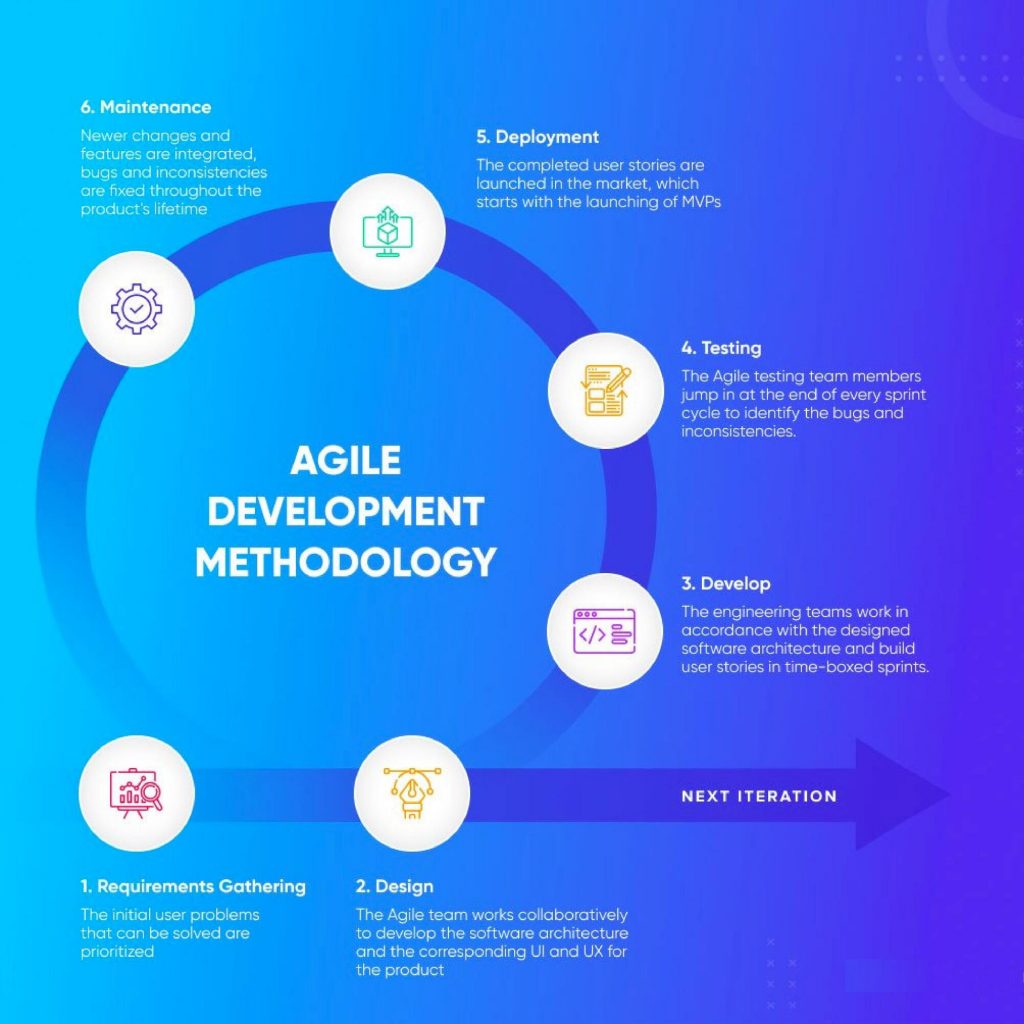
The Agile Lifecycle: How It Works in Practice
While frameworks differ, a typical Agile project follows a general lifecycle that repeats with every iteration.
- Concept/Discovery: The Product Owner and stakeholders define the high-level vision and objectives.
- Inception: The team identifies members, defines the initial product backlog, and establishes the technical environment.
- Iteration/Construction: This is where the actual work happens. The team pulls items from the backlog, designs, codes, and tests them.
- Release/Transition: The completed increment is verified and deployed. For many modern teams, this happens multiple times during an iteration via Continuous Deployment pipelines.
- Production: The software is monitored in the live environment for performance and user feedback.
- Retirement: While not part of every cycle, Agile includes planning for the end-of-life for legacy features or systems.
Key Benefits of Agile Development
Organizations transition to Agile because it offers measurable advantages over traditional models:
- Improved Quality: By testing throughout the cycle rather than just at the end, defects are caught and fixed earlier, reducing the cost of rework.
- Increased Predictability: Frequent iterations allow teams to establish a stable "velocity," making it easier to predict when specific features will be ready.
- Stakeholder Engagement: Continuous visibility into the progress builds trust between the development team and the business.
- Market Alignment: Because the product is developed in small increments, the organization can pivot its strategy based on market feedback or competitor moves.
- Team Morale: Empowering teams to self-organize and make their own technical decisions often leads to higher job satisfaction and lower turnover.
Common Challenges and Implementation Pitfalls
Transitioning to Agile is not merely a matter of changing how meetings are held; it requires a fundamental shift in organizational culture. Common hurdles include:
- Lack of Management Support: If leadership still demands rigid long-term deadlines and detailed upfront plans, the Agile team will struggle to operate.
- "Fake" Agile (Water-Scrum-Fall): This occurs when a team uses Scrum ceremonies but still follows a Waterfall mindset—for example, by having a massive requirements phase or a long, separate testing phase at the end.
- Resistance to Culture Change: Agile requires transparency and the admission of failure early. In cultures where "bad news" is punished, Agile will fail.
- Underestimating Training Needs: Teams cannot simply "be" Agile without understanding the why behind the practices. Professional training and coaching are often required.
Agile in 2026: Beyond Software
By 2026, the principles of Agile have permeated almost every business function. Marketing teams use Kanban to manage campaign launches; HR departments use Sprints to redesign employee onboarding; and manufacturing firms use Agile principles to accelerate R&D. The core concept—that the world is too volatile for five-year plans—is now an accepted business reality.
Frequently Asked Questions
Is Agile only for software development?
While Agile originated in the software industry, its principles of iterative delivery and feedback loops are now applied to hardware engineering, marketing, education, and general business management. Any project with high uncertainty and a need for rapid feedback can benefit from an Agile approach.
What is the difference between Agile and Scrum?
Agile is the overarching philosophy or mindset guided by the Manifesto and its twelve principles. Scrum is one specific framework that implements the Agile philosophy through defined roles, events, and artifacts. You can think of Agile as the "category" and Scrum as a "specific brand" within that category.
Does Agile mean there is no documentation?
No. This is a common misconception. The Agile Manifesto values working software over comprehensive documentation, meaning that teams should prioritize creating a product rather than just writing about it. Documentation is still vital for compliance, maintenance, and user training, but it should be concise and provide actual value.
Can Agile work for large, distributed teams?
Yes, though it requires more coordination. Frameworks like the Scaled Agile Framework (SAFe) or Large-Scale Scrum (LeSS) were specifically designed to help large organizations synchronize multiple Agile teams. In 2026, the use of advanced collaboration platforms has made distributed Agile the standard operating model.
How do you measure success in an Agile project?
Success is primarily measured by the delivery of value to the customer. Metrics often include "Business Value Delivered," "Cycle Time" (the time from starting a task to finishing it), and "Customer Satisfaction Scores." Unlike Waterfall, meeting a specific date is less important than ensuring the product being built is actually what the market needs.
Final Recommendation
For organizations or individuals looking to adopt an Agile approach, the most effective first step is to focus on the Agile Mindset before the tools. Start with a single pilot team and a well-defined framework like Scrum. Ensure the team has a dedicated Product Owner and a Scrum Master who can protect them from external distractions. By starting small and emphasizing the "inspect and adapt" cycle, you can build the internal evidence needed to scale Agile across the broader organization.