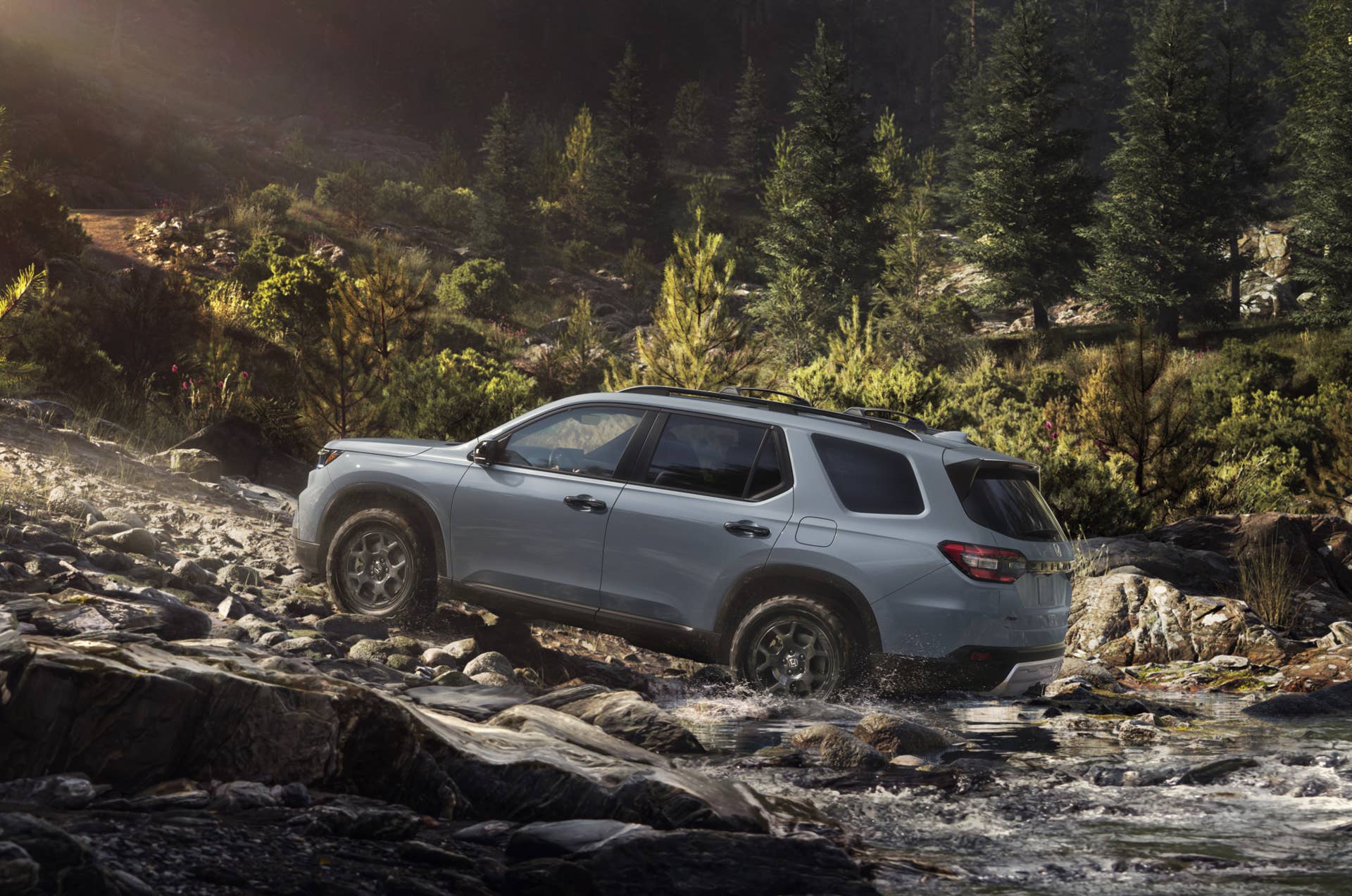
The 2025 Honda Pilot TrailSport receives an official EPA fuel economy rating of 20 mpg combined (18 mpg city / 23 mpg highway). This lower efficiency compared to standard Pilot models stems directly from its rugged off-road hardware, including a 1.0-inch suspension lift, steel skid plates, all-terrain tires, and standard torque-vectoring all-wheel drive, paired with a naturally aspirated 3.5-liter V6 engine.
Understanding the EPA Fuel Economy Ratings for the 2025 Honda Pilot TrailSport
The Environmental Protection Agency (EPA) rates the 2025 Honda Pilot TrailSport at 18 miles per gallon in the city, 23 miles per gallon on the highway, and 20 miles per gallon combined. To put these figures into perspective, non-off-road Honda Pilot models equipped with All-Wheel Drive (AWD) achieve an EPA-estimated 19 city / 25 highway / 21 combined mpg, while front-wheel-drive (FWD) configurations earn up to 19 city / 27 highway / 22 combined mpg.
The 1-to-2 mpg penalty on the TrailSport trim is not an engineering defect; it is a calculated trade-off for mechanical capability. The EPA testing cycle evaluates vehicles under standardized laboratory conditions using chassis dynamometers to simulate city stop-and-go traffic and steady highway cruising. However, because the EPA test protocol factors in total vehicle test weight, tire rolling resistance, and aerodynamic drag coefficients, the hardware additions that make the TrailSport capable on unpaved trails directly impact its laboratory fuel economy results.
| Drivetrain / Trim | City MPG | Highway MPG | Combined |
|---|---|---|---|
| Front-Wheel Drive (FWD) | 19 mpg | 27 mpg | 22 mpg |
| Standard AWD (LX, EX-L) | 19 mpg | 25 mpg | 21 mpg |
| TrailSport AWD | 18 mpg | 23 mpg | 20 mpg |
With an 18.5-gallon fuel tank, a 20 mpg combined rating translates to a theoretical total driving range of approximately 370 miles per tank in mixed conditions. On pure highway journeys at conservative speeds, the TrailSport can cover over 420 miles between fill-ups. Understanding how and why the TrailSport consumes fuel at this rate requires examining the specific mechanical components that differentiate it from the rest of the Honda Pilot lineup.
Mechanical and Aerodynamic Factors Influencing TrailSport Fuel Economy
The fourth-generation Honda Pilot platform, redesigned starting in the 2023 model year and continuing refined into 2025, utilizes a modern structural chassis paired with a traditional, high-displacement powertrain. While many competitors have transitioned to small-displacement turbocharged four-cylinder engines or hybrid setups, Honda retained a naturally aspirated V6 for the Pilot.
- 3.5L DOHC V6 Engine (285 hp / 262 lb-ft)
- 10-Speed Automatic Transmission
- i-VTM4 AWD System (Continuous Drag)
- Raised Chassis (8.3" Clearance): Increases Frontal Aerodynamic Drag
- All-Terrain Tires (Aggressive Tread): Higher Unsprung Mass & Resistance
1. Powertrain Architecture: 3.5-Liter DOHC V6 Engine
Under the hood of every 2025 Honda Pilot TrailSport is a 3.5-liter 24-valve DOHC V6 engine (engine code J35Y8). This engine produces 285 horsepower at 6,150 rpm and 262 lb-ft of torque at 5,000 rpm. Unlike previous iterations of Honda's 3.5-liter V6 that utilized SOHC VTEC designs, the DOHC layout features direct fuel injection and Variable Cylinder Management (VCM).
VCM allows the engine to deactivate one bank of three cylinders during low-load highway cruising to save fuel. However, because the TrailSport experiences higher overall mechanical drag and aerodynamic resistance than standard trims, the VCM system cannot engage as frequently or stay active as long. When the vehicle requires more continuous power to overcome air and rolling resistance, the engine must operate on all six cylinders, consuming more fuel.
2. Transmission Gearing and Final Drive Ratios
The engine is paired with a Honda-designed 10-speed planetary automatic transmission. The wide overall ratio spread allows the transmission to keep engine revolutions low at highway speeds—often below 1,800 rpm at 65 mph in 10th gear.
However, the transmission control unit (TCU) in the TrailSport is calibrated to support its 5,000-pound towing capacity and off-road crawl requirements. To prevent gear hunting when driving over uneven terrain or pulling heavy loads, the transmission aggressively downshifts at smaller throttle inputs compared to standard Pilot trims, briefly increasing engine speed and fuel consumption.
3. Aerodynamics and Ride Height Considerations
Aerodynamic drag increases exponentially with vehicle speed. The 2025 Honda Pilot TrailSport features an off-road tuned suspension that lifts the vehicle by 1.0 inch compared to standard models, resulting in 8.3 inches of ground clearance.
This added height increases the vehicle's frontal surface area exposed to oncoming air and allows more high-velocity air to pass underneath the vehicle chassis. The underbody of the TrailSport features heavy-gauge steel skid plates protecting the oil pan, transmission, and fuel tank. While these plates shield vital components from rocks and trail debris, they create turbulent underbody airflow compared to the smooth, plastic aerodynamic belly pans found on road-oriented Pilot trims. Additionally, the TrailSport's unique front and rear bumpers feature modified recovery hooks and altered approach/departure angles, eliminating the lower front air dam that usually deflects air around the front tires on highway-focused trims.
4. Tire Tread Pattern, Rolling Resistance, and Unsprung Mass
The TrailSport comes standard with 18-inch shark gray alloy wheels wrapped in Continental TerrainContact A/T (265/60R18) all-terrain tires.
| Feature | TrailSport (All-Terrain) | Touring (All-Season) |
|---|---|---|
| Tire Model | Continental TerrainContact | Bridgestone / Michelin |
| Tread Design | Deep Knobby Off-Road Block | Smooth Highway Rib |
| Rolling Resistance | High | Low |
| Rotational Mass | Heavy (~32–34 lbs per tire) | Standard (~27–29 lbs) |
| Impact on Highway MPG | Reduces Efficiency 1-2 MPG | Maximizes Fuel Economy |
All-terrain tires use softer rubber compounds, deeper tread voids, and reinforced sidewalls to grab loose dirt, gravel, and snow. These attributes create significantly higher rolling resistance on flat asphalt compared to the low-rolling-resistance all-season tires fitted on the Pilot Touring or Elite trims. Pushing a high-resistance tread block across pavement requires more torque from the powertrain at every speed, which directly reduces fuel economy by 1 to 2 mpg overall. Furthermore, the added weight of the reinforced tire carcasses increases unsprung rotational mass, demanding more energy every time the vehicle accelerates from a stop.
5. i-VTM4 All-Wheel Drive System Parasitic Loss
Unlike simple mechanical AWD systems that rely on brake intervention or a single center coupling, Honda’s i-VTM4 (intelligent Variable Torque Management) AWD system uses an electro-hydraulically controlled rear differential with individual clutch packs for each rear wheel.
The system can send up to 70% of the engine’s torque to the rear axle, and 100% of that rear torque to either the left or right wheel. While this provides superior traction on trails and in slippery conditions, the constant engagement of hydraulic pumps, clutch packs, and dual rear driveshafts creates inherent mechanical friction (parasitic loss). Even when driving straight on dry pavement, the components inside the rear differential rotate, creating fluid shear stress and mechanical drag that absorbs engine horsepower before it reaches the road.
2025 Honda Pilot Fuel Economy Breakdown Across All Trims
To understand where the TrailSport fits within the 2025 Honda Pilot lineup, compare its EPA ratings against the other available trim levels:
| Trim Level | Drivetrain | City (MPG) | Highway (MPG) | Combined |
|---|---|---|---|---|
| LX / EX-L / Touring | FWD | 19 | 27 | 22 |
| LX / EX-L / Touring | AWD | 19 | 25 | 21 |
| TrailSport | AWD (Standard) | 18 | 23 | 20 |
| Elite | AWD (Standard) | 19 | 25 | 21 |
| Black Edition | AWD (Standard) | 19 | 25 | 21 |
The data shows that upgrading from a standard AWD Pilot (such as the EX-L AWD or Elite) to the TrailSport costs 1 mpg in the city, 2 mpg on the highway, and 1 mpg combined. Over 15,000 miles of driving per year, this difference equals roughly 35 to 40 additional gallons of gasoline consumed annually.
TrailSport Efficiency vs. Off-Road Midsize 3-Row SUV Competitors
The midsize three-row off-road SUV category has grown rapidly. Manufacturers utilize diverse powertrain strategies—ranging from naturally aspirated V6s and turbocharged four-cylinders to hybrid-assisted systems—to balance off-road capability with fuel efficiency mandates.
| Make & Model | Engine Type | HP | City MPG | Hwy MPG | Combined MPG |
|---|---|---|---|---|---|
| 2025 Honda Pilot TrailSport | 3.5L V6 (N/A) | 285 | 18 | 23 | 20 |
| Kia Telluride X-Pro | 3.8L V6 (N/A) | 291 | 18 | 24 | 20 |
| Hyundai Palisade XRT | 3.8L V6 (N/A) | 291 | 19 | 24 | 21 |
| Ford Explorer Timberline | 2.3L Turbo I4 | 300 | 19 | 27 | 22 |
| Subaru Ascent Wilderness | 2.4L Turbo Flat-4 | 260 | 19 | 25 | 21 |
| Toyota Grand Highlander AWD | 2.4L Turbo I4 | 265 | 20 | 26 | 22 |
| Toyota Grand Highlander Hybrid | 2.5L Hybrid I4 | 245 | 36 | 32 | 34 |
Detailed Competitor Comparison Analysis
- Kia Telluride X-Pro & Hyundai Palisade XRT: Both Korean competitors use naturally aspirated 3.8-liter V6 engines paired with 8-speed automatic transmissions. The Telluride X-Pro matches the Pilot TrailSport exactly with a 20 mpg combined rating (18 city / 24 hwy), proving that large naturally aspirated V6 engines driving all-terrain hardware consistently land at the 20 mpg mark.
- Ford Explorer Timberline: Ford utilizes a smaller 2.3-liter EcoBoost turbocharged four-cylinder engine matched with a 10-speed transmission. The downsized turbo engine provides higher torque low in the rev range and yields better highway fuel economy (27 mpg highway / 22 combined), outperforming the Pilot TrailSport by 4 mpg on the open road.
- Subaru Ascent Wilderness: Subaru pairs a 2.4-liter turbocharged boxer-four engine with a Continuously Variable Transmission (CVT). Despite having standard symmetrical AWD and 9.4 inches of ground clearance, the Wilderness achieves 21 mpg combined (19 city / 25 hwy), beating the TrailSport by 1 mpg across all metrics due to CVT tuning and engine displacement.
- Toyota Grand Highlander Hybrid: For buyers prioritizing fuel economy above all-terrain prowess, Toyota’s hybrid powertrain delivers 34 mpg combined. However, the Grand Highlander Hybrid lacks the mechanical rear differential lock, skid plates, trail suspension, and tire clearance found on the Pilot TrailSport.
Real-World Driving Dynamics: Why Real Mileage May Differ
EPA ratings serve as standardized comparison metrics, but real-world fuel economy in the 2025 Honda Pilot TrailSport varies depending on environmental conditions, driving style, and vehicle maintenance.
- Heavy Payload / Towing: Reduces MPG by 15% - 40%
- Cold Weather / Winter Fuel: Reduces MPG by 10% - 15%
- High Highway Speeds (>75 mph): Reduces MPG by 12% - 20%
- Roof Racks & Cargo Boxes: Reduces MPG by 8% - 15%
- Proper Tire Pressure Maintenance: Optimizes Efficiency (+2% - 5%)
High-Speed Highway Cruising
The EPA highway test cycle averages approximately 48 mph and tops out at 80 mph for only brief periods. On American highways where traffic flows at 75 to 80 mph, aerodynamic drag on the lifted TrailSport increases dramatically. Independent real-world tests show that driving the TrailSport continuously at 75 mph often drops actual highway fuel economy from the EPA rating of 23 mpg down to 19–21 mpg.
Ambient Temperature and Winter Blend Fuels
Cold ambient air increases air density, which heightens aerodynamic drag. Additionally, winter-grade gasoline blends contain slightly lower energy density (measured in BTUs) than summer blends due to higher butane content. In cold climates, engine warm-up cycles take longer, during which the engine control unit (ECU) runs a rich fuel-to-air mixture. Owners driving in winter conditions should expect city fuel economy to drop to 15–17 mpg.
Rooftop Accessories and Cargo Drag
Many TrailSport owners purchase the vehicle for outdoor recreation, equipping it with OEM or aftermarket roof crossbars, cargo baskets, kayak mounts, or rooftop tents. Mounting un-aerodynamic gear to the roof rails disrupts airflow over the top of the vehicle, adding substantial drag. Driving at highway speeds with an empty roof rack can penalize fuel efficiency by 1 to 2 mpg; adding a cargo box can reduce highway efficiency by up to 3 to 5 mpg.
Financial Analysis: Annual Fuel Costs and Ownership Economics
Understanding the long-term cost of operating a vehicle rated at 20 mpg combined is vital for prospective buyers. The 2025 Honda Pilot TrailSport is engineered to run on regular unleaded gasoline (87 octane), meaning owners do not need to purchase expensive premium fuel to achieve rated performance.
Annual Fuel Cost Calculation
To calculate baseline operating expenses, consider a standard benchmark of 15,000 miles driven per year (55% city / 45% highway) using a sample regular unleaded gas price of $3.55 per gallon.
| Trim / Vehicle | Combined MPG | Gallons Used/Yr | Est. Annual Fuel Cost |
|---|---|---|---|
| Pilot FWD | 22 mpg | 681.8 gal | $2,420 |
| Pilot Standard AWD | 21 mpg | 714.3 gal | $2,535 |
| Pilot TrailSport AWD | 20 mpg | 750.0 gal | $2,662 |
| Competitor Hybrid (34 MPG) | 34 mpg | 441.2 gal | $1,566 |
As the data illustrates, choosing the TrailSport trim over a standard Pilot AWD trim costs approximately $127 more per year in fuel under average driving conditions. Over a typical 5-year ownership period (75,000 miles), the total fuel penalty of the TrailSport compared to a standard AWD Pilot is roughly $635—a minor financial premium for its off-road capabilities and rugged styling.
Practical Strategies to Maximize Fuel Efficiency in the Pilot TrailSport
If you own or are considering purchasing a 2025 Honda Pilot TrailSport, adopting specific driving habits and maintenance routines can help you meet or exceed the 20 mpg EPA combined rating.
| Action | Technical Description & Benefit |
|---|---|
| Utilize ECON Mode | Softens throttle mapping & forces early upshifts |
| Monitor Cold Tire PSI | Maintains 35 PSI cold to lower tire rolling resistance |
| Manage Highway Speeds | Driving at 65-68 mph reduces aerodynamic drag exponent |
| Remove Roof Crossbars | Eliminates parasitic air turbulence when not carrying gear |
| Utilize Idle-Stop | Prevents unnecessary fuel burn during city idling |
1. Leverage Integrated Drive Modes Correctly
The 2025 Pilot TrailSport features seven driver-selectable modes: Normal, ECON, Sport, Trail, Sand, Tow, and Snow.
- ECON Mode: Adjusts throttle response to be less aggressive, alters transmission shift schedules to shift into higher gears earlier, and reduces climate control compressor load. Using ECON mode in city driving prevents unnecessary fuel enrichment during acceleration.
- Avoid Sport Mode for Commuting: Sport mode holds lower gears longer to keep engine rpm high in the powerband and sharpens throttle sensitivity, which noticeably increases fuel consumption.
2. Maintain Optimal Tire Pressure
All-terrain tires are sensitive to pressure drops. A drop of 5 PSI across all four tires increases rolling resistance significantly. Check cold tire pressure at least once a month using a high-quality gauge, keeping the tires set to Honda’s recommended 35 PSI (cold) printed on the driver’s door jamb placard.
3. Smooth Throttle Application and Coasting
The 3.5-liter V6 engine consumes the highest volume of fuel during initial step-off from a dead stop. Accelerating smoothly and allowing the 10-speed transmission to execute crisp upshifts keeps engine speed below 2,500 rpm. Furthermore, taking advantage of the vehicle's momentum by lifting off the accelerator early when approaching red lights triggers fuel cut-off mode, where the injectors temporarily stop spraying fuel while the engine decelerates.
4. Remove Aerodynamic Accessories When Not in Use
If you purchase aftermarket or OEM roof racks, remove crossbars and accessories when you are not actively hauling gear. Keeping the roof profile smooth minimizes high-speed drag and reduces wind noise inside the cabin.
Frequently Asked Questions
Does the 2025 Honda Pilot TrailSport require premium gasoline?
No. Honda specifies that the 2025 Pilot TrailSport runs on regular unleaded gasoline rated at 87 octane or higher. Using premium 91 or 93 octane fuel will not significantly increase horsepower or fuel economy under normal operating conditions, as the engine's compression ratio (11.5:1) and ignition timing maps are calibrated for 87 octane fuel.
Why does the TrailSport get lower gas mileage than the Pilot Elite trim?
Although both trims feature the same 3.5-liter V6 engine and i-VTM4 AWD system, the TrailSport has a raised ride height (8.3 inches vs 7.3 inches), heavy all-terrain tires with high rolling resistance, steel underbody skid plates, and altered bumper profiles that create more aerodynamic drag. These hardware differences reduce the TrailSport’s EPA rating by 1 mpg city and 2 mpg highway compared to the Elite trim.
What is the real-world driving range of the 2025 Pilot TrailSport?
The TrailSport is equipped with an 18.5-gallon fuel tank. At its EPA combined rating of 20 mpg, total range is approximately 370 miles. In highway driving at the EPA rated 23 mpg, maximum theoretical range is around 425 miles. Leaving a safe 2-gallon reserve before refueling, drivers can expect a realistic range between 310 and 380 miles per tank.
Does the 2025 Honda Pilot offer a hybrid powertrain option?
No. As of the 2025 model year, Honda does not offer a hybrid version of the Pilot. All 2025 Pilot models utilize the naturally aspirated 3.5-liter DOHC V6 engine. Buyers seeking a 3-row midsize hybrid crossover must look at alternatives such as the Toyota Grand Highlander Hybrid or Mazda CX-90 PHEV.
How does the TrailSport's fuel economy compare to the Kia Telluride X-Pro?
The 2025 Honda Pilot TrailSport and the Kia Telluride X-Pro feature identical combined fuel economy ratings of 20 mpg. The Telluride earns 18 mpg city / 24 mpg highway, giving it a 1 mpg edge on the highway, while the Pilot TrailSport matches it in city driving (18 mpg) and combined performance. Both vehicles experience similar efficiency trade-offs due to their elevated suspensions and all-terrain tires.
Final Recommendation and Buyer Action Plan
The 2025 Honda Pilot TrailSport’s 20 mpg combined EPA fuel economy rating is competitive for a midsize three-row SUV equipped with genuine off-road hardware, skid plates, and a naturally aspirated V6 engine. While it incurs a minor 1-to-2 mpg penalty compared to street-focused Pilot trims, the real-world financial difference equals only about $120 to $150 in additional fuel expenses per 15,000 miles driven annually.
- Choose the Pilot TrailSport if: You require 8.3 inches of ground clearance, continuous torque-vectoring AWD performance for snow, mud, or unpaved trails, and a factory-backed 5,000-lb towing package paired with rugged off-road styling.
- Choose a Standard Pilot AWD Trim (EX-L, Touring, Elite) if: Your daily driving consists primarily of highway commuting, urban errands, and paved road road-trips where maximizing fuel economy (up to 25 mpg highway) and enjoying a quieter highway ride on low-rolling-resistance tires takes priority over off-road capability.
To maintain optimal fuel efficiency throughout ownership, monitor tire pressures monthly, remove unused rooftop gear, and utilize ECON mode during urban commuting.