Workers' compensation insurance functions as a mandatory safety net designed to provide wage replacement and medical benefits to employees injured on the job, in exchange for relinquishing the right to sue the employer for negligence. Disambiguating specific numerical designations or historical fund names, such as references involving "1877," requires examining state-specific statutory frameworks, historical state funds, or organizational policy numbers to ensure proper compliance and coverage verification.
The Foundations of Workers' Compensation Insurance
Workers' compensation is a form of business insurance that provides cash benefits and/or medical care for employees who suffer injuries or illnesses arising out of, and in the course of, employment. Unlike general liability insurance or commercial property coverage, workers' compensation is heavily regulated at the state level rather than the federal level (with specific exceptions like the Federal Employees' Compensation Act or the Longshore and Harbor Workers' Compensation Act).
The historical compromise underpinning modern workers' compensation is often termed the "historical bargain." Employees give up their right to file a civil tort lawsuit against their employer for workplace negligence, gaining in return a strict liability system where they do not need to prove fault to receive swift medical care and partial wage replacement. Employers, conversely, cap their financial exposure to predictable insurance premiums, avoiding potentially catastrophic jury verdicts resulting from workplace accidents.
Navigating this system requires an understanding of how policies are structured, how premiums are calculated, and how specific identifiers—such as policy numbers, bureau codes, or historical state fund designations—interact with regulatory compliance.
Decoding Policy Identifiers, Bureau Codes, and Historical References
When encountering specific alphanumeric combinations or numeric references like "1877" in the context of insurance funds or workers' compensation, it is vital to determine whether the number represents a state fund bureau code, a specific statutory enactment year, a docket number, or an individual policy identifier.
Policy Numbers vs. Bureau Identifiers
Insurance carriers and rating bureaus, such as the National Council on Compensation Insurance (NCCI) or independent state rating bureaus, assign specific codes to classify industries and track employer compliance.
- Carrier Policy Numbers: Unique sequences assigned by the issuing insurance company to identify a specific employer's contract.
- Classification Codes: Four-digit codes established by rating bureaus to categorize employer operations based on exposure risk (e.g., clerical vs. heavy construction).
- State Fund References: Some states operate exclusive or competitive state funds. Historical legislation dates or unique administrative fund codes are occasionally referenced in claims management or legal briefs.
The Significance of State-Specific Jurisdiction
Because workers' compensation law is governed entirely by individual states, rules regarding mandatory coverage thresholds, exemptions for corporate officers, self-insurance permits, and second-injury funds vary dramatically across state lines. An identifier valid in one state's administrative system may carry an entirely different meaning or non-existence in another. Employers operating across state lines must secure extraterritorial coverage or multi-state endorsements to ensure continuous protection.
Core Components of Workers' Compensation Coverage
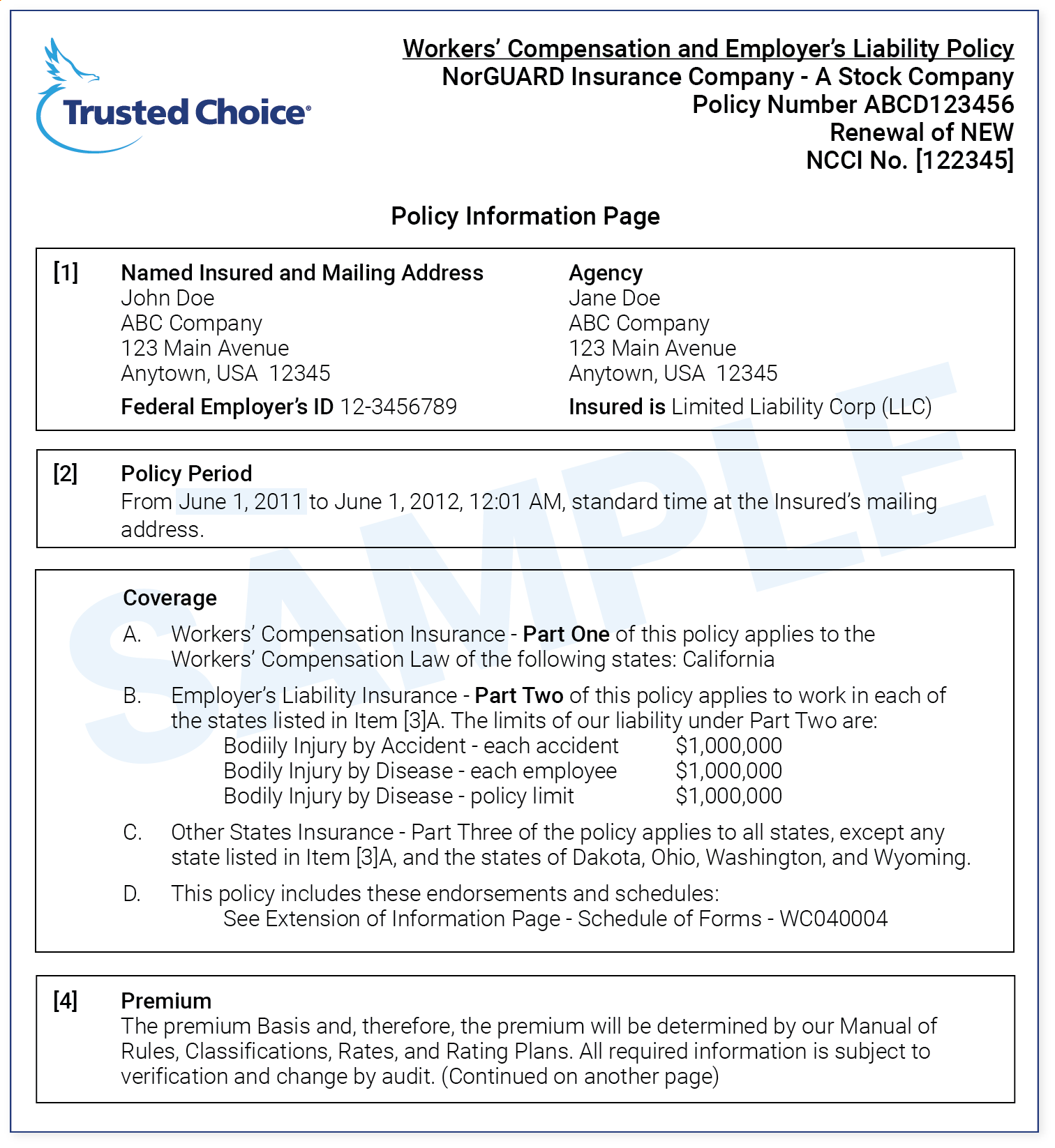
A standard workers' compensation policy is divided into distinct sections that dictate what is covered, the extent of liability, and the geographic boundaries of the agreement.
| Policy Part | Standard Coverage Description | Statutory or Voluntary |
|---|---|---|
| Part One: Workers' Compensation | Pays all statutory medical and wage-loss benefits required by state law. | Mandatory in almost all jurisdictions. |
| Part Two: Employers' Liability | Protects the employer against common-law suits brought by employees for bodily injury or disease not barred by exclusivity statutes. | Included standard with limits (e.g., $100/$500/$100). |
| Part Three: Other States Insurance | Extends coverage to operations conducted in states listed in the policy declarations. | Varies by operational footprint. |
Understanding these divisions helps employers recognize that workers' compensation is not merely a single medical payment mechanism, but a dual-layered risk mitigation tool that addresses both statutory mandates and common-law employer liabilities.
Determining Eligibility and Mandatory Coverage Requirements
Compliance requirements for securing workers' compensation insurance depend heavily on the legal structure of the business, the industry sector, and the number of employees on the payroll.
Employer Obligations and Thresholds
- Employee Count Thresholds: While states like Texas make workers' compensation largely optional for most private employers, the vast majority of U.S. states mandate coverage for businesses that employ a specific number of workers—often starting at a single employee (full-time or part-time).
- Corporate Officers and Sole Proprietors: Statutes frequently dictate whether owners, partners, and corporate officers must be included in coverage calculations or whether they retain the legal right to opt-out.
- Independent Contractor Misclassification: A frequent source of regulatory penalties involves misclassifying statutory employees as independent contractors. State regulators and insurance auditors examine control, financial independence, and the course of business to determine if workers' compensation premiums are owed for contracted laborers.
Premium Calculation Factors
Insurance carriers determine annual premiums using a formula rooted in payroll and risk exposure: $$\text{Premium} = \left(\frac{\text{Payroll}}{100} \times \text{Classification Rate}\right) \times \text{Experience Modification Rate (Mod Rate)}$$
The Experience Modification Rate is a particularly critical metric for mid-to-large businesses. It compares an employer's actual historical losses against the expected losses for similar businesses within the same industry. An EMR below 1.0 indicates a safer-than-average safety record, resulting in premium discounts, while an EMR above 1.0 triggers surcharges.
Steps for Verifying Coverage and Managing Claims
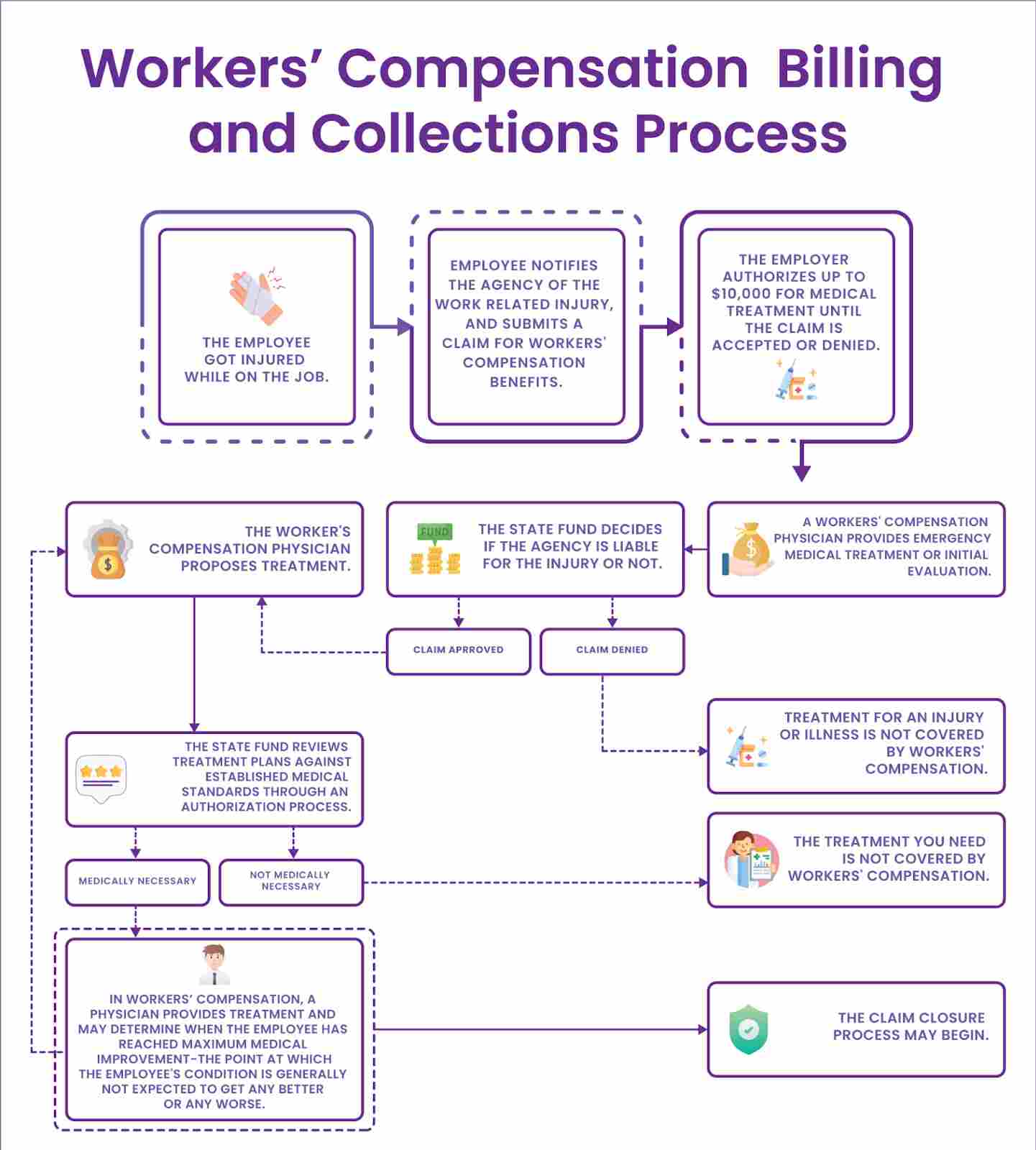
For businesses, HR professionals, and injured workers alike, navigating the administrative lifecycle of a workers' compensation policy requires adherence to strict procedural steps.
- Verify Active Policy Status: Employers should routinely check with their state's workers' compensation board or insurance commissioner database to confirm that coverage remains active and policies have not lapsed due to non-payment or administrative error.
- Immediate Incident Reporting: When a workplace injury occurs, the employee must report the incident to the employer within statutory timeframes (which can range from a few days to 30 days depending on the state).
- Filing the First Report of Injury (FROI): The employer or insurance administrator must file a FROI with the state workers' compensation agency and the insurance carrier to initiate the claim lifecycle.
- Medical Authorization and Treatment: Treatment must typically be sought through designated medical provider networks (such as an HMO or PPO approved by the state or the insurance carrier) to ensure expenses are fully compensable under the policy.
- Dispute Resolution: If a claim is contested regarding compensability, extent of disability, or permanent impairment ratings, the matter is channeled through administrative law judges, mediation boards, or state industrial commissions before escalating to traditional courts.
Disclaimer: Workers' compensation laws, premium calculations, and statutory thresholds are subject to frequent legislative updates and vary entirely by jurisdiction. Employers and injured workers should consult the official state labor department or qualified legal and insurance professionals for guidance tailored to their specific circumstances.
Frequently Asked Questions
What should I do if a workers' compensation claim is denied?
If a claim is denied, the injured worker typically receives a notice of controversy or denial outlining the legal or factual basis for the rejection. The next step involves filing an appeal or request for a hearing with the state's workers' compensation division. Gathering medical records, witness statements, and contemporaneous reports of the workplace accident is essential for the administrative hearing process.
Can an employer pass the cost of workers' compensation insurance to employees?
No. In virtually all jurisdictions, shifting the cost of workers' compensation premiums to employees via payroll deductions or direct fees is strictly illegal. The financial burden of maintaining statutory coverage rests entirely upon the employer.
How do experience modification rates (EMRs) affect small businesses?
Small businesses with lower payroll totals often do not qualify for an experience modification rate, meaning their premiums are calculated strictly using payroll figures and standard classification rates. EMRs typically apply only to businesses that meet specific annual premium threshold minimums established by rating bureaus.
What constitutes an injury "arising out of and in the course of employment"?
To be compensable, the injury must generally occur while the employee is actively fulfilling job duties or acting at the direction of the employer. Injuries sustained during a standard, uncompensated daily commute to and from work are generally excluded, whereas travel explicitly required by the employer's business operations is typically covered.
How long does an employer have to report a workplace injury?
Reporting deadlines vary significantly by state law, but employers are generally required to notify their insurance carrier and state regulators within 7 to 10 days of receiving notice of an injury. Failing to report injuries promptly can result in administrative fines and regulatory penalties for the employer.
Are remote workers covered under standard workers' compensation policies?
Yes, telecommuting employees are generally covered for injuries that arise out of and in the course of employment, even while working from a home office. However, determining whether a domestic slip-and-fall or repetitive strain injury is work-related often requires careful investigation into the employee's work schedule and designated home-office workspace.
Conclusion
Managing workers' compensation obligations requires strict adherence to state statutory requirements, accurate payroll reporting, and proactive workplace safety programs. Whether evaluating specialized fund identifiers or maintaining standard commercial policies, businesses must prioritize compliance to protect both their workforce and their financial stability. Regularly audit classification codes, maintain clear lines of communication with insurance carriers, and consult official state regulatory bodies to ensure seamless coverage execution.