When using the net worth method to reconstruct or verify income, discovering that calculated income significantly exceeds reported income serves as a primary indicator of unreported funds, pointing toward potential tax evasion, omitted business receipts, or undocumented cash flows. This discrepancy often triggers forensic accounting reviews or compliance investigations by financial regulators.
Introduction to the Net Worth Method
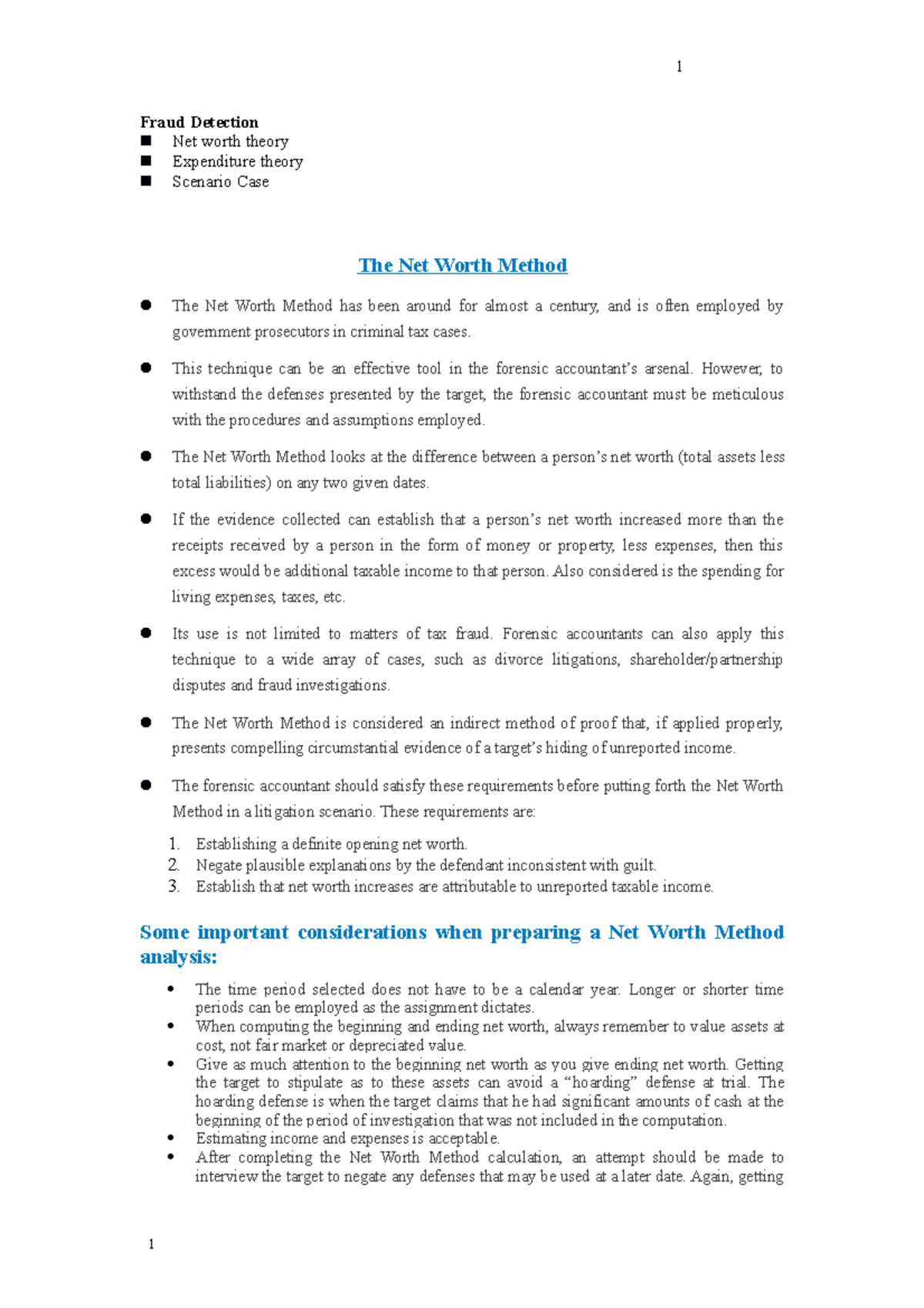
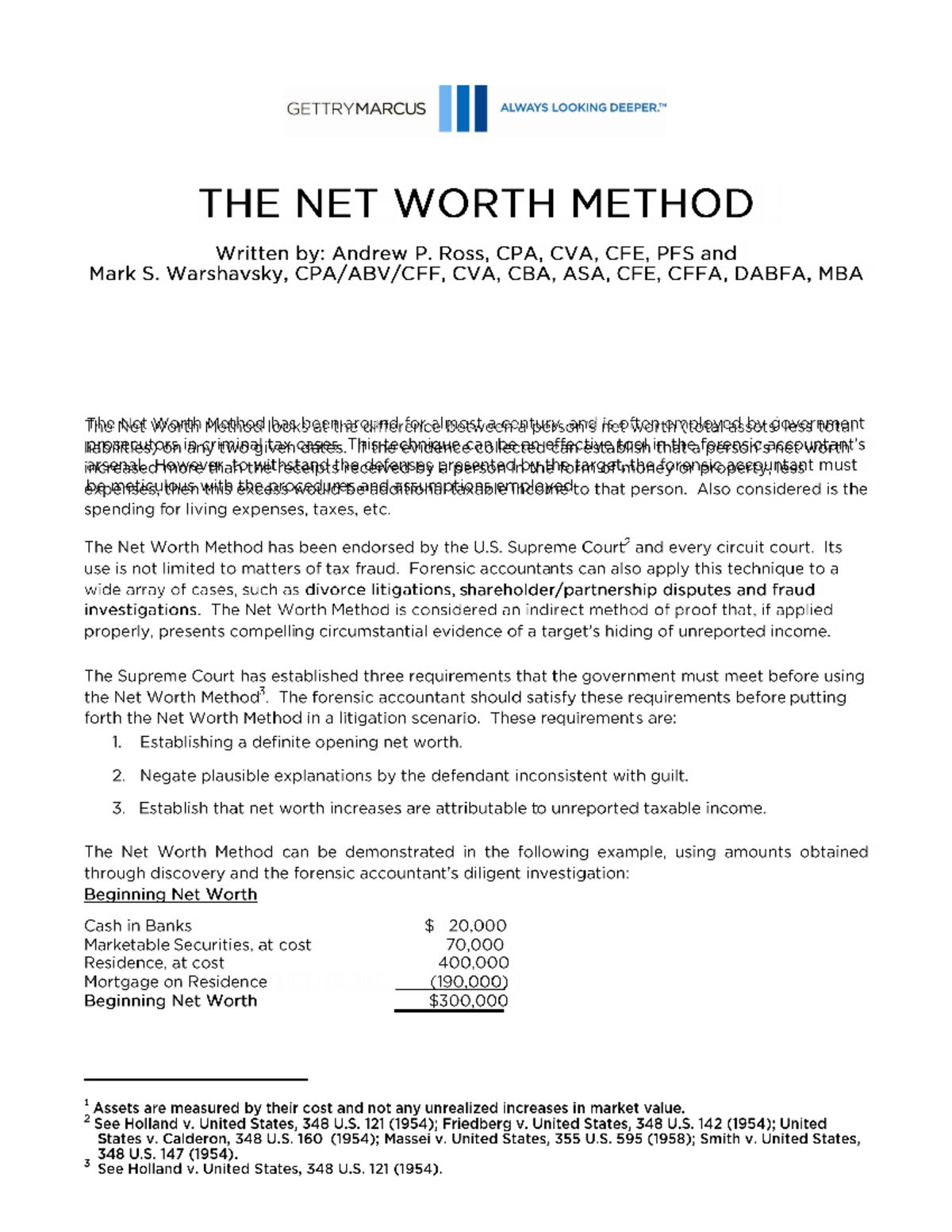
The net worth method is an indirect technique used by accountants, forensic auditors, and tax authorities—such as the Internal Revenue Service (IRS)—to determine an individual's or entity's true income when direct records are incomplete, unreliable, or entirely missing. When financial statements, ledgers, or receipts fail to reflect a true economic picture, investigators look at the change in a taxpayer's net worth over a specific period, factoring in living expenses and known non-deductible outlays.
In the process of performing this calculation, a critical observation frequently emerges: the calculated income derived from net worth increases and living expenses vastly outpaces the income reported on tax returns or financial disclosures. Resolving this discrepancy requires a comprehensive understanding of accounting principles, legal standards of proof, and the specific adjustments necessary to distinguish taxable income from non-taxable windfalls, gifts, inheritances, or asset revaluations.
Core Mechanics of the Net Worth Calculation
To understand why income discoveries occur during this analytical process, one must examine the foundational equation of the net worth method. The technique measures the difference between assets and liabilities at two distinct points in time—typically the beginning and the end of a calendar or tax year.
The Basic Net Worth Equation
The fundamental formula relies on tracking changes in economic standing over a 12-month period:
- Total Assets minus Total Liabilities = Net Worth at the start of the period.
- Total Assets minus Total Liabilities = Net Worth at the end of the period.
- The difference between the ending net worth and the beginning net worth represents the increase (or decrease) in net worth.
Adjusting for Living Expenses and Non-Taxable Items
An increase in net worth does not automatically equate to taxable income. To arrive at the figure representing corrected or actual income, auditors must layer in personal consumption and remove non-taxable inflows. The standard analytical progression follows this structure:
- Increase in Net Worth: Ending net worth minus beginning net worth.
- Plus Living Expenses: Personal expenditures, housing costs, utilities, travel, and leisure that do not build permanent assets.
- Equals Adjusted Net Worth Increase: The raw pool of funds utilized or accumulated.
- Minus Non-Taxable Receipts: Inheritances, life insurance proceeds, bona fide gifts, and loan proceeds.
- Plus Non-Deductible Losses: Capital losses or penalties that reduced net worth but did not offset income reporting in the same manner.
- Equals Corrected Income: The estimated total income generated during the period.
When this final calculated figure is compared against the figures recorded on official filings, any positive variance signals a major observation point for financial examiners.
Key Observation: When Calculated Income Exceeds Reported Income
The most common and impactful observation in net worth analysis is a substantial, unexplained positive variance between the calculated income and the reported income. When an individual's assets grow significantly—such as through the acquisition of real estate, luxury vehicles, or stock portfolios—and their personal spending remains high, yet their reported income sits at a fraction of those expenditures, a financial imbalance is identified.
Potential Drivers of Discrepancies
An observation of excess calculated income can stem from several distinct financial behaviors, both licit and illicit:
- Unreported Cash Receipts: Small business owners or independent contractors failing to record cash sales in their primary point-of-sale systems or general ledgers.
- Omitted Investment Gains: Capital gains from cryptocurrency transactions, foreign bank accounts, or private equity investments that bypassed standard reporting mechanisms.
- Illegal Income Streams: Proceeds from unlawful activities where traditional reporting is intentionally bypassed.
- Improperly Categorized Transfers: Legitimate non-taxable receipts (like an inheritance) mistakenly treated as taxable income, or vice versa, due to poor record-keeping.
Legal and Compliance Implications
In regulatory and legal contexts, such as civil tax audits or criminal tax fraud investigations, proving intent is paramount. The net worth method alone does not prove fraud; rather, it establishes a circumstantial case that income was omitted. Tax authorities must generally establish an opening net worth with reasonable certainty and investigate reasonable leads provided by the taxpayer regarding non-taxable sources of funds before making a final assessment.
Comparison of Direct vs. Indirect Accounting Methods
To appreciate why the net worth method yields these stark income observations, it helps to contrast it with direct accounting methods. The table below outlines the operational differences between direct auditing and the net worth indirect approach.
| Feature | Direct Method (Books and Records) | Indirect Method (Net Worth Method) |
|---|---|---|
| Primary Focus | Individual transactions, invoices, receipts, and bank statements. | Overall change in asset and liability balances over time. |
| Data Requirements | Complete, organized primary accounting books. | Asset inventories, debt balances, and estimated living expenses. |
| Primary Vulnerability | Fails when books are missing, destroyed, or fraudulent. | Relies on approximations and circumstantial evidence. |
| Primary Observation | Discrepancies found via missing invoices or ledger errors. | Discrepancies found via unexplained asset growth exceeding income. |
| Use Case | Routine accounting, standard tax preparation, and audits. | Forensic investigations, tax evasion probes, and chaotic records. |
Investigating and Reconciling Net Worth Discrepancies
When an auditor or financial analyst observes that calculated income exceeds reported income, a structured investigative and reconciliation process must follow. Skipping steps or failing to account for specific asset classifications can lead to flawed legal assessments or erroneous financial conclusions.
Step 1: Establish a Reliable Opening Net Worth
The accuracy of the entire calculation hinges on the starting date. Analysts must compile a comprehensive list of all assets (cash, bank accounts, real estate, investments, personal property) and all liabilities (mortgages, credit lines, personal loans) as of the opening date. Overstating opening net worth artificially lowers the apparent income of the subsequent period, making this baseline verification critical.
Step 2: Track Asset and Liability Movements
Every acquisition, disposition, or debt payoff during the period must be tracked. If a taxpayer purchases a commercial property mid-year, the source of the down payment and subsequent mortgage principal payments must be identified. If the funds came from an existing bank account that was already counted in the opening net worth, double-counting must be avoided.
Step 3: Quantify Personal Living Expenses (PLE)
Determining living expenses is often the most contentious part of the net worth method. Analysts rely on bank statements, credit card records, utility bills, and lifestyle benchmarks to estimate cash spent on food, clothing, entertainment, and medical care. Where receipts are absent, standard statistical tables or reasonable estimations are applied, though these remain open to challenge by the taxpayer.
Step 4: Pursue Leads on Non-Taxable Sources
Under legal standards established in landmark court cases (such as Holland v. United States), investigators are obligated to pursue reasonable leads provided by the taxpayer that could explain the net worth increase through non-taxable means. If a taxpayer claims a relative provided a large cash gift, the investigator must attempt to verify or refute that claim through bank records, witness statements, or estate documents.
Frequently Asked Questions
What happens if living expenses are estimated incorrectly in a net worth analysis?
An overestimation of living expenses artificially inflates the calculated income, making the taxpayer appear to have earned more than they actually did. Conversely, underestimating living expenses understates the true income figure. Because of this sensitivity, analysts must ground living expense estimates in documented expenditures wherever possible.
Can the net worth method be used for corporations as well as individuals?
Yes, the net worth method can be adapted for corporations or partnerships, though it is most commonly associated with individuals and sole proprietors. For corporate entities, the analysis focuses on corporate asset accumulation, retained earnings, and hidden distributions to shareholders rather than personal living expenses.
Is an increase in net worth always considered taxable income?
No. An increase in net worth reflects economic growth, which can stem from non-taxable sources such as gifts, inheritances, life insurance payouts, municipal bond interest, or unrealized asset appreciation. The analytical process must explicitly subtract these non-taxable items to isolate true taxable income.
What is the burden of proof when tax authorities use the net worth method?
In civil tax cases, the government or auditor's determination generally carries a presumption of correctness, and the taxpayer bears the burden of proving the assessment wrong. In criminal tax fraud cases, the prosecution must prove beyond a reasonable doubt that an understatement of tax occurred and that it was willful.
How do unrealized capital gains affect the net worth method?
Unrealized gains—such as an increase in the market value of stocks or real estate still held by the taxpayer—increase the ending net worth. However, under standard tax rules, unrealized gains are generally not taxable until the asset is sold or disposed of. Adjustments must be made to separate paper gains from realized cash flows.
Practical Recommendations and Next Actions
For professionals and individuals navigating a net worth analysis or facing an audit where income discrepancies have been observed, adhering to rigorous documentation standards is essential.
- Maintain Meticulous Records: Keep permanent records of all asset acquisitions, loan agreements, gifts received, and inheritances to protect against arbitrary indirect method assessments.
- Engage Forensic Specialists: If facing a complex tax audit or legal dispute involving indirect income calculations, retain a qualified Certified Public Accountant (CPA) or forensic accountant experienced in net worth reconstructions.
- Document All Non-Taxable Inflows Immediately: Ensure that any large cash transfer, loan, or inheritance is supported by a paper trail, wire receipts, or legal documentation at the time the transaction occurs.
- Review Opening Balances Thoroughly: Challenge any unsupported assumptions regarding opening net worth figures, as errors at the starting line compound throughout the entire multi-year calculation.