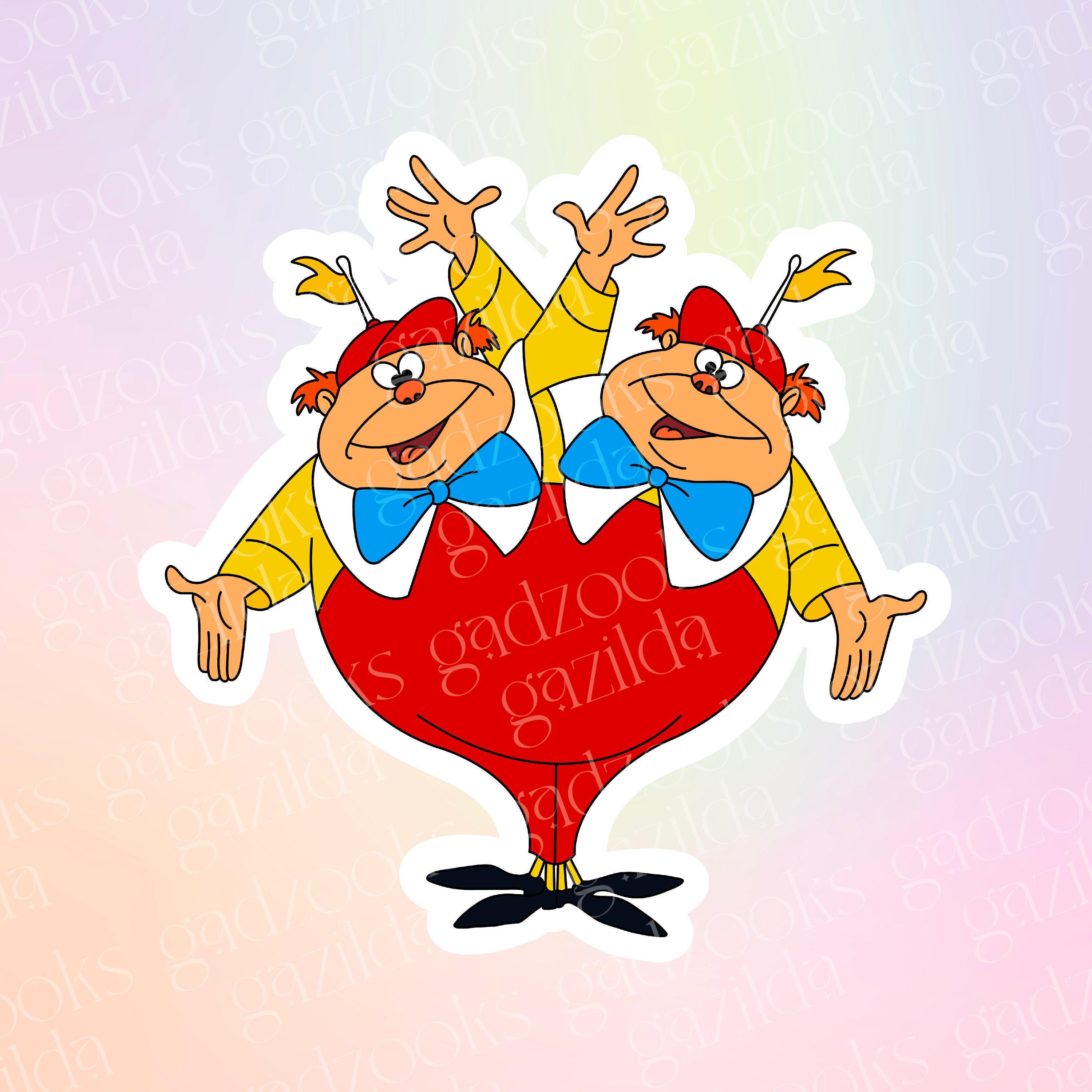
The twin brothers in "Alice in Wonderland" are named Tweedledum and Tweedledee. First introduced by Lewis Carroll in the 1871 novel Through the Looking-Glass, and What Alice Found There, these rotund, identical siblings are famous for their circular logic, "contrariwise" arguments, and their recitation of the poem "The Walrus and the Carpenter."
In the cultural landscape of 2026, Tweedledum and Tweedledee remain two of the most recognizable figures in literary history. While they are often associated with the original 1865 Alice's Adventures in Wonderland due to various film adaptations, their origins and most significant philosophical contributions actually belong to Carroll's sequel. These brothers represent more than just comic relief; they embody the mirror-logic of the Looking-Glass world and the peculiar frustrations of childhood social structures.
The Literary Origins of Tweedledum and Tweedledee
To understand the "Alice in Wonderland" twins, one must first look beyond Lewis Carroll. Unlike many of his original creations, such as the Cheshire Cat or the Mad Hatter, Tweedledum and Tweedledee were already established figures in British nursery rhymes long before Carroll penned his sequel.
The names first appeared in print in an epigram by the poet John Byrom (1692–1763), where they were used to satirize a feud between the famous composers George Frideric Handel and Giovanni Bononcini. Byrom’s verse suggested that the differences between the two musicians were as negligible as the difference between "Tweedledum and Tweedledee." By the time Carroll wrote Through the Looking-Glass, the names had become synonymous with two people who are essentially indistinguishable or who argue over trivialities.
Carroll took these existing folk figures and gave them physical form. In the book, they are described as "fat little men" who resemble oversized schoolboys. Their most defining physical characteristic is their identical nature; Alice initially thinks they are a pair of giant eggs. They are so similar that Alice notices they have "DUM" and "DEE" embroidered on their collars to tell them apart, though they often act in such unison that the distinction hardly matters.
The Logic of "Contrariwise": Character Traits and Behavior
The twins operate on a principle they call "contrariwise." This is not merely a verbal tic but a fundamental law of their existence. In the Looking-Glass world, everything is inverted, and the twins represent the linguistic manifestation of this inversion.
When Alice meets them, she finds them standing under a tree with their arms around each other's necks. Their interaction with Alice is characterized by a refusal to follow standard conversational norms. If Alice says one thing, they immediately argue the opposite, regardless of the truth. This "contrariwise" philosophy serves several purposes in the narrative:
- Instructional Obstruction: They prevent Alice from moving forward by engaging her in endless, cyclical dialogue.
- Mirror Symmetry: They represent "enantiomorphs"—objects that are mirror images of each other. Just as your left hand looks like your right hand but cannot be superimposed upon it, Tweedledum and Tweedledee are identical yet opposite.
- The Inversion of Maturity: Despite being "men," they behave like petulant toddlers, highlighting Carroll's frequent theme of the absurdity of adult behavior when viewed through a child's eyes.
The Battle over the Rattle
One of the most famous sequences involving the brothers is their decision to have a "battle." This event is a literal enactment of the nursery rhyme that preceded the book:
"Tweedledum and Tweedledee / Agreed to have a battle; / For Tweedledum said Tweedledee / Had spoiled his nice new rattle."
Carroll’s brilliance lies in how he depicts this battle. Instead of a heroic or even a dangerous conflict, it is a choreographed display of cowardice and bureaucracy. The brothers spend an immense amount of time "dressing up" for the fight, using bolsters, blankets, hearth-rugs, and coal-scuttles as armor. They are more concerned with the protocol of the fight than the fight itself. The conflict is ultimately resolved not by a winner emerging, but by the arrival of a giant "monstrous crow" that frightens them both away.
The Philosophical Core: The Red King’s Dream
Perhaps the most haunting contribution the twins make to the "Alice" mythos is the sequence involving the Red King. While Alice is with the twins, they come across the Red King snoring loudly in the grass. Tweedledee informs Alice that the King is dreaming of her, and that if he were to wake up, she would "go out like a candle" because she is merely a "sort of thing in his dream."
This introduces the concept of solipsism and the fragility of existence—heavy themes for what is ostensibly a children's book. The brothers use this logic to gaslight Alice, making her cry until Tweedledum tells her she won't make herself any more real by crying. This scene elevates the twins from mere comic sidekicks to existential gatekeepers, questioning the reality of the protagonist herself.
Comparing Adaptations: From Disney to Tim Burton
The visual representation of the twins has shifted significantly over the decades. Because they are so visually distinct, filmmakers have often taken liberties with their design to fit the tone of their specific adaptation.
| Feature | 1951 Disney Animation | 2010 Tim Burton Film | Lewis Carroll (Original) |
|---|---|---|---|
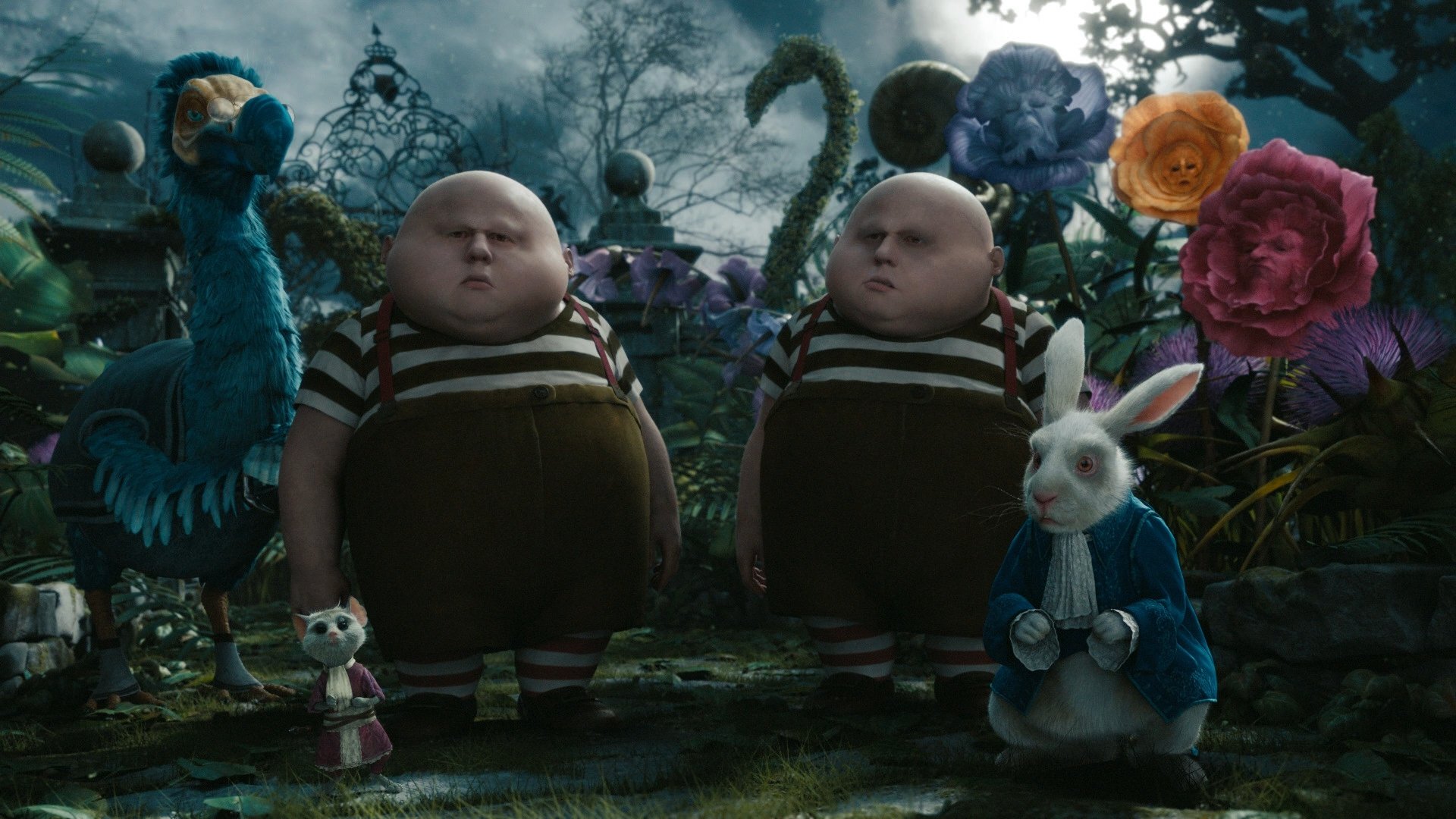
| Physical Appearance | Short, round, yellow shirts, red caps. | Tall, pale, CGI-distorted, striped shirts. | Fat little men, schoolboy collars. |
| Voice/Personality | Bubbly, musical, high-pitched. | Slow-witted, timid, monotone. | Argumentative, pedantic, rhythmic. |
| Primary Role | Comic relief; tell the Walrus story. | Guides for Alice; members of the resistance. | Philosophical obstacles; poem reciters. |
| Brotherly Dynamic | Symbiotic and playful. | Slightly fearful of the Red Queen. | Competitive and ritualistic. |
The 1951 Disney Interpretation
In the classic Disney animated version, the twins are merged into the plot of the first book. They are depicted as harmless, bouncy characters who speak in rhyme and song. This version solidified the "Walrus and the Carpenter" sequence as a core part of the Alice cinematic experience. J. Pat O'Malley voiced both brothers, giving them a synchronized, vaudevillian quality that removed the darker existential undertones of the book.
The 2010 Tim Burton Interpretation
In Tim Burton's live-action/CGI hybrid, the twins (played by Matt Lucas through motion capture) are depicted as somewhat grotesque, pale figures. In this version, they are known as "Tweedles." They serve as Alice’s guides in "Underland" and are portrayed as loyal but dim-witted allies. Burton’s version leans into the "uncanny valley" effect, making the brothers appear more like strange, doll-like creatures than human beings.
The Significance of "The Walrus and the Carpenter"
You cannot discuss the "Alice in Wonderland" twins without discussing the poem they recite. "The Walrus and the Carpenter" is a masterpiece of nonsense verse, consisting of 18 stanzas that tell the story of a Walrus and a Carpenter who trick a group of young oysters into going for a walk on the beach, only to eat them all.
The twins use this poem to further delay Alice, but the poem itself serves as a mirror to the twins' own nature. The Walrus and the Carpenter are also a "pair" who work together for a selfish goal, much like the twins work together to frustrate Alice. The poem touches on themes of betrayal, the consumption of the innocent, and the arbitrary nature of authority—themes that resonate throughout Alice’s journey in Wonderland.
Historical and Artistic Influence
The imagery of Tweedledum and Tweedledee was famously established by John Tenniel, the original illustrator for Carroll's books. Tenniel’s depictions of the twins—with their rotund bellies, wide stances, and blank expressions—set the standard for every subsequent artist.
In the 20th and 21st centuries, the twins have transcended the "Alice" books to become a general metaphor in politics and media. The term "Tweedledum and Tweedledee" is frequently used by political commentators to describe two candidates or parties that appear different on the surface but are essentially identical in their policies or lack of substance. This cultural shorthand is a testament to the enduring power of Carroll's characterization.
Frequently Asked Questions
Which book do the twins actually appear in?
While many people associate them with the first story, Tweedledum and Tweedledee appear only in the sequel, Through the Looking-Glass, and What Alice Found There (1871). Most movies combine the two books into one narrative, which is why they are often seen in "Wonderland" adaptations.
Are Tweedledum and Tweedledee villains?
They are not villains in the traditional sense. They do not wish Alice physical harm, but they are antagonistic in their refusal to help her and their attempts to undermine her sense of reality. They represent the "annoying" aspect of childhood peers rather than true malice.
What is the main difference between Tweedledum and Tweedledee?
Literally, there is no difference mentioned by Carroll other than the names on their collars. Symbolically, they are reflections of one another. In some interpretations, Tweedledum is seen as the more assertive of the two (as he is the one who initiates the "battle"), but they generally act as a single unit.
Why do they recite "The Walrus and the Carpenter"?
The twins recite the poem to Alice to provide a moral lesson or simply to pass the time. Within the narrative structure, it serves to highlight the "eat or be eaten" nature of the world Alice is navigating, disguised as a whimsical nonsense rhyme.
Who played the twins in the most recent movies?
In the 2010 Alice in Wonderland and the 2016 sequel Alice Through the Looking Glass, both brothers were played by British actor Matt Lucas. Using CGI and motion capture, Lucas was able to portray both characters simultaneously.
Final Summary and Practical Insight
The "Alice in Wonderland" twins, Tweedledum and Tweedledee, are essential pillars of Lewis Carroll’s literary world. They represent the intersection of nursery rhyme folklore and sophisticated Victorian nonsense. For readers and viewers in 2026, they serve as a reminder of the power of "mirror-logic"—the idea that sometimes the most identical things can be the most confusing, and that the simplest arguments are often the hardest to win.
If you are studying these characters for a literary project or simply revisiting the films, focus on their symmetry. Their clothing, their speech patterns, and even their "battle" are all perfectly balanced. To truly understand the twins is to understand the "Looking-Glass" world itself: a place where you must run as fast as you can just to stay in the same place, and where two brothers can be exactly the same, yet entirely "contrariwise."