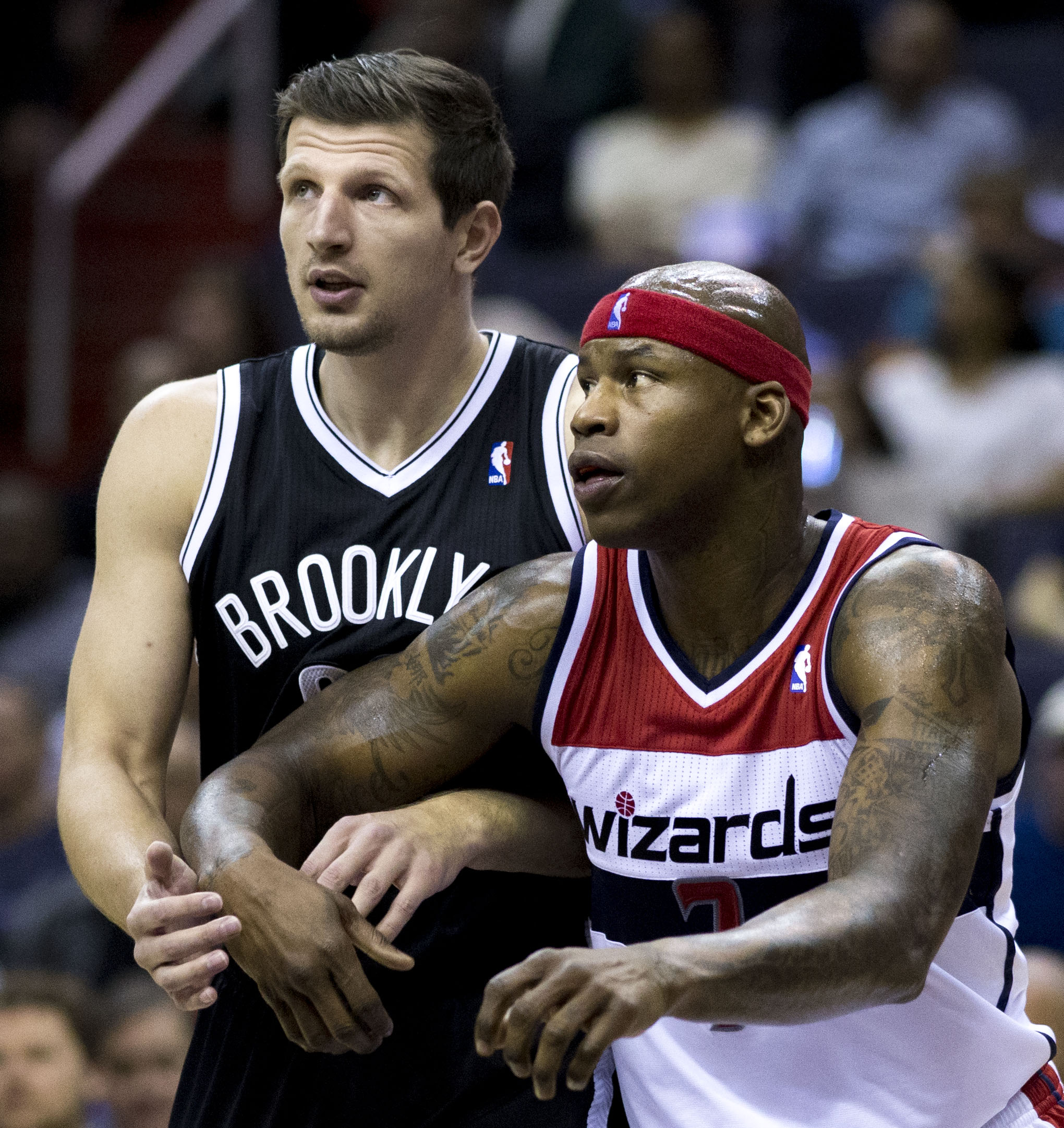
Al Harrington carved out a notable 16-season career in the National Basketball Association (NBA) as a versatile, sweet-shooting forward who successfully evolved alongside the changing tactical landscape of the league. Drafted straight out of high school in 1998, he transitioned from a raw, athletic youngster into a lethal stretch four capable of spacing the floor, banging in the paint, and serving as a productive offensive spark plug off the bench for multiple franchises.
Introduction to Al Harrington and Early Promise
To understand Al Harrington’s professional basketball trajectory, one must examine an era when NBA franchises frequently drafted high-potential prospects directly out of secondary school. Born on February 17, 1980, in Orange, New Jersey, Harrington established himself as a dominant national prospect at St. Patrick High School in Elizabeth, New Jersey. His combination of size, fluid movement, and perimeter skill caught the attention of scouts nationwide, culminating in his selection by the Indiana Pacers in the first round (25th overall) of the 1998 NBA Draft.
Entering the league at just 18 years old, Harrington faced a steep learning curve. He joined a veteran-laden Indiana Pacers squad coached by Larry Bird, featuring established stars like Reggie Miller, Jalen Rose, and Rik Smits. Consequently, his early years required immense patience, behind-the-scenes development, and acceptance of limited playing time. However, this foundational period under Bird’s demanding mentorship molded his work ethic and basketball IQ, setting the stage for a long and productive career across seven different NBA franchises.
The Indiana Pacers Years: Developing into a Rotation Mainstay
Harrington’s initial stint with the Indiana Pacers spanned from 1998 to 2004, a period marked by team success and personal growth. In his first few seasons, his minutes were restricted. The Pacers reached the 2000 NBA Finals, where Harrington experienced championship-level basketball from the bench, absorbing invaluable professional habits.
As the roster transitioned and older veterans departed, Harrington's role expanded significantly. During the 2001-02 season, he appeared in 43 games before suffering a significant knee injury (a torn ACL) that temporarily halted his momentum. However, he returned stronger for the 2002-03 campaign, averaging 12.2 points and 6.0 rebounds per game.
Under coach Isiah Thomas and later Rick Carlisle, Harrington became a quintessential sixth man. In the 2003-04 season, he posted 13.3 points and 6.4 rebounds per contest, finishing as the runner-up for the NBA Sixth Man of the Year Award behind Antawn Jamison. His ability to play both forward positions, attack closeouts, and defend multiple assignments made him a critical asset as the Pacers captured the best record in the Eastern Conference that year.
Expanding Horizons: Atlanta Hawks and Indiana Return
Seeking a starting role and a larger offensive responsibility, Harrington was traded to the Atlanta Hawks in the summer of 2004 in exchange for Stephen Jackson. In Atlanta, he experienced a different phase of his career, playing for rebuilding teams where his statistical output peaked.
During the 2004-05 and 2005-06 seasons with the Hawks, Harrington enjoyed some of the most statistically productive years of his career. In the 2005-06 season, he posted career highs in points (18.6 per game) and rebounds (7.8 per game), establishing himself as a focal point of the offense. Operating primarily as a power forward, he demonstrated an expanded face-up game, capable of driving past slower defenders or stepping out to knock down mid-range jumpers.
| Team / Franchise | Seasons Active | PPG (Approx.) | RPG (Approx.) |
|---|---|---|---|
| Indiana Pacers | 1998–2004, 2006-07 | 10.3 | 4.9 |
| Atlanta Hawks | 2004–2006 | 17.5 | 6.9 |
| Golden State Warriors | 2006–2008 | 16.5 | 6.4 |
| New York Knicks | 2008–2010 | 19.2 | 5.8 |
| Denver Nuggets | 2010–2012 | 11.3 | 5.4 |
Following his time in Atlanta, Harrington returned to the Indiana Pacers via a trade during the 2006-07 season. His second stint in Indiana was relatively brief, as the franchise shifted toward a youth movement, leading to another relocation that would place him at the center of one of the most memorable playoff upsets in league history.
The Golden State Warriors and "We Believe" Era
In January 2007, Harrington was traded to the Golden State Warriors alongside Stephen Jackson, Baron Davis, and Matt Barnes. Under head coach Don Nelson, Harrington found a system that perfectly maximized his offensive skill set. Nelson’s fast-paced, small-ball system required big men who could run the floor, pass, and shoot three-pointers—traits that Harrington possessed in abundance.
The culmination of this stint was the historic 2006-07 regular season finish, where the eighth-seeded Warriors stunned the top-seeded Dallas Mavericks in the Western Conference First Round. Harrington played a vital role in this series, stretching the floor against Dirk Nowitzki and providing crucial scoring and veteran composure. His time in Golden State cemented his reputation as a modern stretch four ahead of his time, proving that frontcourt players could impact the game effectively from beyond the arc.
New York Knicks and Denver Nuggets: Late-Career Evolution
As his career progressed into its second decade, Harrington adapted his game further, emphasizing three-point shooting to preserve his value in an increasingly perimeter-oriented league.
Traded to the New York Knicks in November 2008, Harrington experienced playing under head coach Mike D'Antoni in a high-octane offensive system. In the 2008-09 season with the Knicks, he averaged 20.7 points per game—his highest single-season scoring average—frequently operating as a stretch center or power forward who kept defenses stretched to the breaking point. His knack for trailing the break and firing deep three-pointers fit seamlessly into D'Antoni's offensive philosophy.
In 2010, Harrington signed with the Denver Nuggets, where he spent two productive seasons. Serving primarily off the bench under George Karl, he maintained his scoring efficiency, averaging over 10 points per game and helping the Nuggets consistently secure playoff berths in a rugged Western Conference. His veteran presence in the locker room and ability to ignite offensive runs as a reserve proved invaluable for Denver's postseason aspirations.
Final Seasons and International Stint
Harrington wrapped up his NBA playing days with brief stints with the Orlando Magic during the 2012-13 season and the Washington Wizards during the 2013-14 campaign. Throughout these final years, his role shifted entirely to veteran mentor and situational floor-spacer. He imparted wisdom to younger players while providing occasional scoring bursts.
Following his NBA career, Harrington played briefly for Fujian Sturgeons in the Chinese Basketball Association and later joined the Adelaide 36ers in Australia's National Basketball League (NBL) for the 2014-15 season before officially retiring from professional basketball.
Legacy and Tactical Evolution as a Stretch Four
When evaluating Al Harrington’s overall impact on basketball history, his greatest legacy lies in how he bridged the gap between traditional power forwards and modern stretch fours. Drafted in an era dominated by physical, back-to-the-basket post players, Harrington steadily expanded his shooting range until three-pointers became the primary staple of his offensive repertoire.
By the end of his 16-season career, Harrington had appeared in 981 regular-season games, averaging 13.5 points and 5.6 rebounds per contest while shooting over 35% from three-point range. He proved that frontcourt players could thrive by stepping away from the paint, paving the way for the pace-and-space revolution that later defined the modern NBA.
Frequently Asked Questions About Al Harrington's Career
When did Al Harrington enter the NBA?
Al Harrington entered the NBA in 1998 after being selected 25th overall by the Indiana Pacers in the first round of the NBA Draft. He was drafted directly out of St. Patrick High School in New Jersey, bypassing college basketball entirely during an era when prep-to-pro prospects were common.
Which teams did Al Harrington play for during his career?
Over his 16-season NBA career, Harrington played for seven different franchises: the Indiana Pacers, Atlanta Hawks, Golden State Warriors, New York Knicks, Denver Nuggets, Orlando Magic, and Washington Wizards. He also played internationally in China and Australia after his NBA tenure concluded.
Was Al Harrington part of the "We Believe" Warriors team?
Yes, Harrington was a key contributor to the 2006-07 Golden State Warriors squad affectionately known as the "We Believe" team. Acquired via trade in January 2007, he helped propel the eighth-seeded Warriors to a historic first-round playoff upset over the top-seeded Dallas Mavericks.
What is Al Harrington's legacy as a player?
Harrington is best remembered as an early pioneer of the "stretch four" position. Over his career, he successfully transitioned from a traditional interior forward into a perimeter-oriented scorer who could shoot three-pointers, drive past slow defenders, and space the floor, foreshadowing the modern tactical style of today's NBA.
Did Al Harrington win any individual NBA awards?
While Harrington did not win a major individual season award, he finished as the runner-up for the NBA Sixth Man of the Year Award during the 2003-04 season with the Indiana Pacers, recognizing his stellar production coming off the bench for the league's top defensive team.