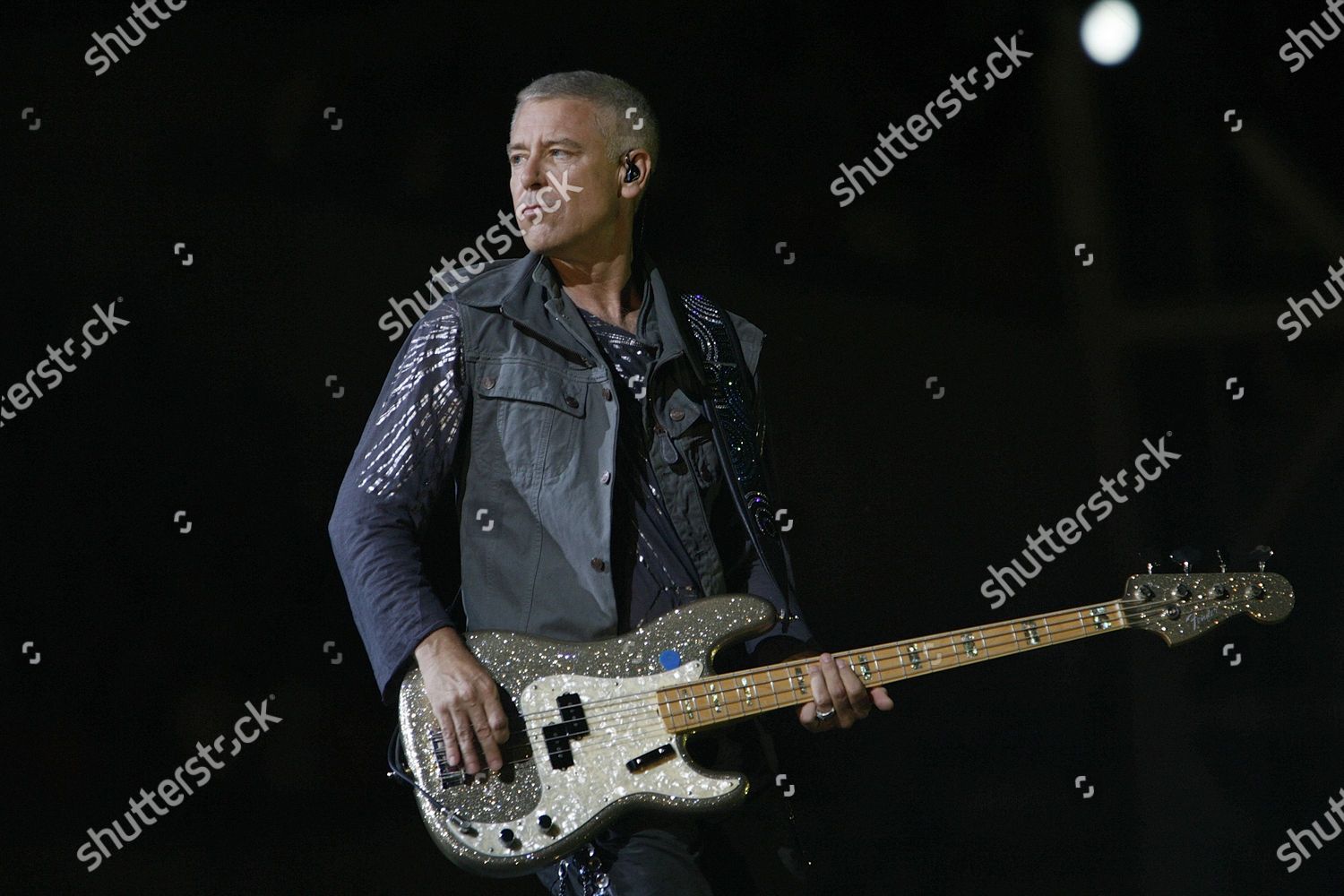
Adam Clayton is the English-born Irish musician best known as the bass guitarist for the legendary rock band U2. Since co-founding the group in Dublin in 1976, Clayton has provided the melodic, steady low-end foundation that anchors U2’s stadium-filling sound, combining rock, post-punk, pop, and electronic influences across a career spanning five decades.
The Sonic Architect: Adam Clayton’s Role in U2’s Sound
In a band renowned for the expansive, delay-heavy guitar textures of The Edge and the expressive vocal delivery of Bono, Adam Clayton fulfills a crucial role. Rather than competing for melodic space in the upper mid-range frequencies, Clayton anchors U2's rhythm section with deep, hypnotic grooves that leave room for atmospheric guitar layers to blossom.
Clayton’s playing style is characterized by rhythmic economy, steady tempo control, and a warm, assertive bass tone. Unlike traditional hard rock bassists who mirror the guitar riff note-for-note, Clayton often counterpoints guitar patterns or holds down repetitive, meditative ostinatos. This approach provides the steady harmonic spine over which the rest of the band builds dynamic builds and breakdowns.
Together with drummer Larry Mullen Jr., Clayton forms one of the most enduring rhythm sections in popular music history. Their partnership relies on a shared discipline: Mullen provides precise, march-infused or syncopated drum patterns, while Clayton locks into the kick drum, driving the band’s anthemic energy without unnecessary complexity.
| Role / Element | Contributor |
|---|---|
| Vocal / Lead Melody | Bono |
| Textural / Delay | The Edge (Guitar & Keyboards) |
| Rhythmic Anchor | Adam Clayton (Bass) + Larry Mullen Jr. |
Signature Basslines and Musical Milestones
Clayton's catalog features some of the most recognizable bass riffs in modern rock history. His evolution from self-taught post-punk player to master of arena-rock grooves reflects both personal growth and U2's stylistic shifts over the decades.
"New Year’s Day" (1983)
Featured on U2’s breakout album War, "New Year’s Day" established Clayton as a potent force in early 1980s alternative rock. Built around an octave-jumping bassline originally adapted during a soundcheck jam while attempting to learn Visage's "Fade to Grey," the song showcases Clayton taking the primary melodic lead. The driving bassline propels the track, carrying the verse melody while The Edge shifts between piano chords and sharp guitar stabs.
"With or Without You" (1987)
On The Joshua Tree, producer Brian Eno, Daniel Lanois, and U2 aimed for minimalism and atmospheric space. "With or Without You" features one of Clayton's most famous bass patterns: a steady four-bar progression (D – A – Bm – G) playing straight eighth notes. Clayton’s strict adherence to this sequence without variation creates tension across the song's gradual swell, allowing the infinite-sustain guitar and vocals to reach an emotional climax.
"Bullet the Blue Sky" (1987)
A stark contrast to the pop sensibilities of "With or Without You," "Bullet the Blue Sky" highlights Clayton’s heavy blues-rock influence. His thick, distorted bass riff acts as an ominous counterweight to The Edge’s soaring slide guitar and feedback effects, demonstrating how low-end weight can convey tension and political urgency.
"Mysterious Ways" (1991)
For 1991’s Achtung Baby, U2 recorded at Hansa Studios in Berlin, reinventing their sound with industrial music, dance rhythms, and alternative rock influences. Clayton embraced funk and dance grooves on "Mysterious Ways," using an envelope filter (auto-wah) to craft a bouncing, syncopated line. The track highlights his ability to adapt to club-influenced rhythm concepts while retaining a rock foundation.
"Vertigo" (2004)
On How to Dismantle an Atomic Bomb, Clayton delivered one of the band’s punchiest post-punk revival riffs. The verse features a driving, fuzz-laden bass line that carries the low end underneath muted guitar chords, reminding listeners of U2’s garage-rock roots from the late 1970s.
Gear, Basses, and Technical Rig Breakdown
Throughout his career, Clayton has built an extensive equipment collection comprising vintage classics, modern custom instruments, and signature artist models. His tone balances low-end clarity, warm midrange bark, and reliable punch designed to cut through stadium acoustics.
| Category | Details |
|---|---|
| Primary Instruments | Fender Jazz Bass, Fender Precision Bass |
| Secondary Guitars | Warwick Adam Clayton Signature, Gibson |
| Amplification | Aguilar DB 751, Ampeg SVT Classic |
| Key Effects | Dunlop Bass Wah, Electro-Harmonix POG, Tech 21 SansAmp Bass Driver DI |
Signature Instruments and Key Guitars
- Fender Precision Bass: A cornerstone of Clayton’s collection, the P-Bass has supplied the fundamental tone for much of U2’s mid-tempo and heavy rock material. Fender released the Adam Clayton Signature Precision Bass, featuring a Purple Sparkle finish, matching headstock, and custom-voiced split single-coil pickups designed to replicate his preferred 1960s vintage models.
- Fender Jazz Bass: Used extensively on tracks requiring faster note articulation and brighter midrange response (such as "New Year’s Day"). His signature Fender Jazz Bass comes in Sherwood Green Metallic with a matching headstock, block inlays, and custom shop pickups.
- Warwick Basses: In the late 2000s and 2010s, Clayton collaborated with German builder Warwick to create custom instruments, including the Warwick Adam Clayton Signature Streamer CV featuring a distinctive reverse headstock and custom pickup configuration.
- Gibson & Epiphone Thunderbird / Les Paul Basses: Clayton frequently used Gibson Thunderbirds during the PopMart and Elevation tours for their thick, mid-heavy roar.
Amplification and Signal Processing
To achieve a powerful tone across large venues, Clayton relies on high-headroom amplification systems:
- Aguilar Amplification: In recent decades, Clayton has relied heavily on Aguilar DB 751 tube/solid-state hybrid heads paired with Aguilar DB 412 and DB 810 speaker cabinets, offering high power output and clean, warm low-end translation.
- Ampeg SVT: The classic Ampeg SVT head and 8x10 cabinet remain staples of his recording setups, offering natural tube compression and aggressive harmonic overdrive when driven hard.
- Signal Routing: His live rig splits the bass signal into multiple channels—typically a clean, deep direct signal (via D.I. boxes like the Tech 21 SansAmp or Avalon U5) combined with an amplified mic'd cabinet signal running subtle overdrive or chorus effects.
Adam Clayton Gear Overview Across Eras
| Era / Album | Primary Basses | Primary Amplification | Key Effects / Processing | Representative Track |
|---|---|---|---|---|
| Early Era (Boy, War) | Ibanez Musician, Fender Precision Bass | Marshall & Fender Bass Amps | Clean signal, light chorus | "New Year's Day" |
| Unforgettable Fire / Joshua Tree | Fender Precision Bass, Fender Jazz Bass | Ampeg SVT, Trace Elliot | Minimal effects, heavy D.I. compression | "With or Without You" |
| Achtung Baby / Zoo TV | Gibson Thunderbird, Fender Jazz | Ampeg SVT | Korg A3, Envelope Filters, Fuzz | "Mysterious Ways" |
| Pop / PopMart Tour | Fender Precision, Gibson Les Paul Bass | Ampeg SVT, Ashdown | Synthesizer filters, distortion | "Discothèque" |
| 2000s - Present | Fender Signature P-Bass & Jazz Bass, Warwick | Aguilar DB 751 & DB 412 Cabinets | Dunlop Bass Wah, EHX POG, SansAmp D.I. | "Vertigo" |
Biography and the Formation of U2
Adam Charles Clayton was born on March 13, 1960, in Chinnor, Oxfordshire, England. His father, Brian Clayton, was an Royal Air Force pilot who later became a commercial pilot, leading the family to relocate to Malahide, County Dublin, Ireland, when Adam was five years old.
Early Life and Mount Temple School
Clayton spent his early years attending boarding schools before transferring to Mount Temple Comprehensive School in Dublin. Mount Temple was notable at the time for being one of Ireland's first co-educational, non-denominational secondary schools.
In September 1976, fellow student Larry Mullen Jr. posted a notice on the school bulletin board looking for musicians to form a band. Clayton responded, along with Paul Hewson (Bono), David Evans (The Edge), and David's brother Dick Evans. The group initially assembled in Mullen’s kitchen under the name "Feedback," later changing their name to "The Hype" before finally settling on U2 in 1978.
| Date | Event |
|---|---|
| Sept 1976 | Larry Mullen Jr. posts notice at Mount Temple School. |
| Late 1976 | Group forms as "Feedback" (Bono, Edge, Clayton, Mullen, Dick Evans). |
| Early 1978 | Renamed "The Hype"; Dick Evans departs. |
| March 1978 | Band officially renames itself "U2". |
| March 1980 | Signs record deal with Island Records. |
From Band Manager to Full-Time Bassist
In U2's early years, Clayton was not only the bassist but also acted as the band's initial informal manager. Possessing an outgoing personality, sharp fashion sense, and ambitious drive, Clayton negotiated early concert bookings, handled publicity outreach, and arranged transportation for the group across Dublin.
He managed the band until late 1978, when the group hired professional band manager Paul McGuinness. McGuinness guided U2's commercial strategy for decades, allowing Clayton to focus entirely on his development as a musical director and bassist.
Personal Journeys, Recovery, and Philanthropy
Beyond his musical contributions, Clayton's personal life and journey through addiction recovery have shaped his public legacy and philanthropic efforts.
Overcoming Addiction and the 1993 Sydney Turning Point
During U2’s explosive rise to global megastardom in the late 1980s and early 1990s, Clayton struggled with severe alcoholism. The crisis reached its peak during the massive Zoo TV Tour in late 1993. On November 26, 1993, Clayton suffered an alcohol-induced blackout and was unable to perform at U2’s concert in Sydney, Australia.
Bass technician Stuart Morgan filled in for Clayton that night—marking the only time a member of U2 has missed a concert performance since the band's rise to prominence.
Following the Sydney incident, Clayton committed to sobriety, completely relinquishing alcohol and drug use. He has remained sober ever since, citing that moment as a vital turning point that saved his life, his health, and his position in the band.
| Date | Milestone |
|---|---|
| Nov 1993 | Misses Zoo TV Sydney show due to alcohol crisis; enters recovery immediately after. |
| 1994+ | Maintains full sobriety; restructures lifestyle. |
| May 2017 | Honored with MusiCares Stevie Ray Vaughan Award for dedication to addiction recovery support. |
Advocacy, Mental Health, and MusiCares Recognition
Following his recovery, Clayton became an advocate for addiction treatment and mental health awareness. He has openly discussed the emotional pressure of touring, public scrutiny, and the stigma surrounding addiction in the music industry.
In May 2017, Clayton was honored at the 13th annual MusiCares MAP Fund Benefit Concert in Los Angeles, receiving the Stevie Ray Vaughan Award in recognition of his dedication to supporting fellow musicians struggling with addiction. During his acceptance speech, Clayton publicly thanked his bandmates—Bono, The Edge, and Larry Mullen Jr.—for their unwavering support during his darkest moments, stating:
"We have a pact with each other. In our band, no one will be a casualty. We all come home, or no one comes home. Leaving no one behind."
In addition to addiction advocacy, Clayton is an active patron of the arts, a contemporary art collector, and a supporter of various global charities, including U2's co-founded initiatives like DATA, the ONE Campaign, and Product Red.
Awards, Recognition, and Legacy in Rock History
As a core member of U2, Adam Clayton’s career achievements place him among the most commercially successful and critically honored bassists in modern music history.
| Category | Milestone |
|---|---|
| Album Sales | Over 175 million records sold worldwide |
| Grammy Awards | 22 competitive awards |
| Hall of Fame | Inducted into Rock & Roll Hall of Fame (2005) |
| Major Tours | 360 Tour, Joshua Tree 30th Anniversary, U2:UV at Sphere Las Vegas (2023–2024) |
- Rock and Roll Hall of Fame: Inducted in 2005 alongside his U2 bandmates in their first year of eligibility.
- Grammy Awards: Winner of 22 Grammy Awards, including Album of the Year for The Joshua Tree (1987) and How to Dismantle an Atomic Bomb (2004), as well as Record of the Year for "Beautiful Day" (2000) and "Walk On" (2001).
- Innovations in Arena Sound: Clayton’s live setups helped pave the way for modern stadium bass amplification, proving how modern low-end management can maintain clarity in giant, reverberant venues.
Frequently Asked Questions (FAQ)
What bass guitar does Adam Clayton primarily play?
Adam Clayton primarily plays Fender Precision Basses and Fender Jazz Basses. Fender produces official Adam Clayton Signature models for both styles. Over his career, he has also frequently used Warwick signature basses, Gibson Thunderbirds, and vintage Gibson Les Paul bass models.
Is Adam Clayton an original member of U2?
Yes. Adam Clayton co-founded U2 in September 1976 alongside Bono, The Edge, and Larry Mullen Jr. He was also the group's early manager before Paul McGuinness took over the role in late 1978.
Has Adam Clayton ever missed a U2 concert?
Yes, Adam Clayton missed one concert in his entire career with U2: a show in Sydney, Australia, on November 26, 1993, during the Zoo TV Tour, due to severe alcohol intoxication. His bass technician, Stuart Morgan, played in his place. Clayton entered recovery immediately after and has remained sober ever since.
Is Adam Clayton Irish or English?
Adam Clayton holds both English birth origin and Irish identity. He was born in Chinnor, Oxfordshire, England, but moved to Ireland with his family at age five, growing up in Dublin where he met his U2 bandmates.
What are Adam Clayton’s most famous U2 basslines?
Some of Clayton’s most celebrated basslines include "New Year’s Day," "With or Without You," "Mysterious Ways," "Bullet the Blue Sky," "Gloria," and "Vertigo."
Key Takeaways for Bassists and Rock Fans
Adam Clayton’s enduring career offers practical lessons for musicians and producers:
- Play for the Song: Technical speed is secondary to song arrangement. Clayton’s steady execution on "With or Without You" proves that simple lines often create the strongest musical foundations.
- Tone is Spatial Management: By focusing on rich, clean low frequencies and controlled midrange bite, a bassist creates space for guitars, keyboards, and vocals to shine.
- Rhythmic Locking: The bond between bass player and drummer forms a band's backbone. Clayton and Larry Mullen Jr.'s tight partnership has sustained U2's signature sound for half a century.