Attribution in psychology refers to the process by which individuals explain the causes of behavior, events, and outcomes, categorizing them as internal dispositions or external situational forces. This cognitive mechanism shapes how people interpret social interactions, evaluate their own performance, and navigate the complexities of daily life.
Introduction to Attribution Theory
The human mind has an innate drive to understand why things happen. Whether trying to figure out why a colleague snapped during a meeting, why a student failed an exam, or why a favorite sports team lost a championship match, people constantly search for causal explanations. This psychological need to make sense of the world forms the bedrock of attribution theory, a framework originally pioneered by social psychologists like Fritz Heider, and later expanded by figures such as Harold Kelley and Bernard Weiner.
At its core, attribution is the cognitive process by which individuals interpret behaviors and events, assigning causes to them. These explanations generally fall into two broad categories: internal (dispositional) attributions, which point to a person's character, traits, abilities, or feelings, and external (situational) attributions, which point to environmental factors, luck, social pressure, or unpredictable circumstances.
Understanding these causal mechanics is essential not only for academic psychology but also for everyday interactions, mental health management, workplace dynamics, and educational strategies. By examining specific patterns and biases in how people attribute cause and effect, psychologists can map out the predictable ways human perception deviates from objective reality. The following sections explore five key examples of attribution in psychology, breaking down the mechanics, real-world manifestations, and psychological impacts of each concept.
1. The Fundamental Attribution Error
The fundamental attribution error (FAE)—sometimes referred to as correspondence bias—is perhaps the most widely recognized phenomenon in attribution research. It describes the tendency for observers to underestimate situational influences and overestimate internal dispositions when explaining other people's behavior.
When witnessing a stranger commit a negative action, the human brain rapidly leaps to conclusions about that person's character rather than considering the environmental pressures they might be facing.
Mechanics and Manifestations
Imagine driving on a highway and having another driver cut you off aggressively, forcing you to slam on your brakes. The immediate, automatic thought for many drivers is: "What a reckless, selfish, and terrible person." In this scenario, an internal attribution is made instantly. The observer attributes the behavior entirely to the driver's personality.
However, situational factors are almost entirely ignored. Perhaps the driver is rushing a family member to the hospital emergency room, has just received devastating news, or genuinely did not see your vehicle due to a blind spot.
Social psychologists attribute this bias to perceptual salience. When observing another person, that person is the focal point of attention—the "figure" against the background of the environment. Because the person stands out, their behavior is noticed and scrutinized, while the situational context fades into the background and is easily overlooked.
Real-World Implications
The fundamental attribution error permeates professional environments, educational settings, and judicial systems. In the workplace, a manager might witness an employee submitting a report late and immediately attribute the delay to laziness or poor time management (internal attribution), completely missing the systemic IT failure, understaffing, or conflicting high-priority tasks that actually caused the bottleneck (external factors). Recognizing the FAE allows leaders and educators to look beyond initial negative impressions and investigate systemic or situational barriers before issuing penalties.
2. The Self-Serving Bias
While the fundamental attribution error governs how people judge others, the self-serving bias dictates how individuals evaluate their own successes and failures. This attributional pattern involves attributing positive outcomes to internal, personal traits while attributing negative outcomes to external, situational factors.
This mechanism acts as a psychological defense system designed to protect self-esteem and maintain a positive self-image.
Mechanics and Manifestations
Consider a student receiving an "A" on a difficult university midterm examination. If asked why they performed so well, a student operating under the self-serving bias is likely to say: "I got an A because I am intelligent, disciplined, and worked extremely hard." This is an internal attribution that links success to stable, positive personal characteristics.
Conversely, if that same student fails the next exam, receiving a failing grade, the explanation shifts dramatically. The student is likely to argue: "The exam was unfair, the professor taught the material poorly, and the room was too loud." Here, the failure is externalized, protecting the student's ego from acknowledging a lack of preparation or capability.
Psychological Function and Limits
Psychologists view the self-serving bias as a normal, adaptive mechanism for preserving mental health and motivational drive. Believing in personal agency and efficacy encourages individuals to tackle challenging goals.
However, excessive reliance on this bias can hinder personal growth. When people refuse to internalize responsibility for their mistakes, they lose the opportunity to learn from them. Furthermore, individuals experiencing clinical depression often exhibit a reversed pattern, internalizing failures while externalizing successes, which underscores the delicate balance of healthy attributional styles.
3. Actor-Observer Bias
The actor-observer bias is an extension of the fundamental attribution error that highlights a profound discrepancy in how people explain their own behavior versus the exact same behavior in others. Coined by psychologists such as Edward Jones and Richard Nisbett, this bias occurs when individuals attribute their own actions to situational causes while attributing the identical actions of others to internal dispositions.
Mechanics and Manifestations
To understand the actor-observer bias, consider the act of tripping and falling in a public place.
- As the Actor: If you are the person who trips over a cracked sidewalk pavement, you immediately look down at the ground and think, "The city needs to fix this broken concrete; that crack is completely hidden." You attribute your clumsiness to an external factor (the bad pavement).
- As the Observer: If you are standing across the street and watch a stranger trip over that exact same crack, you are likely to think, "How clumsy and uncoordinated; they really need to watch where they are going." You attribute their fall to an internal factor (their personal lack of grace).
This asymmetry arises because actors have access to a wealth of internal information about their own thoughts, feelings, past history, and shifting environmental contexts. Observers, by contrast, lack this internal data stream and must rely on visible behavior alone, making dispositional explanations much easier to reach.
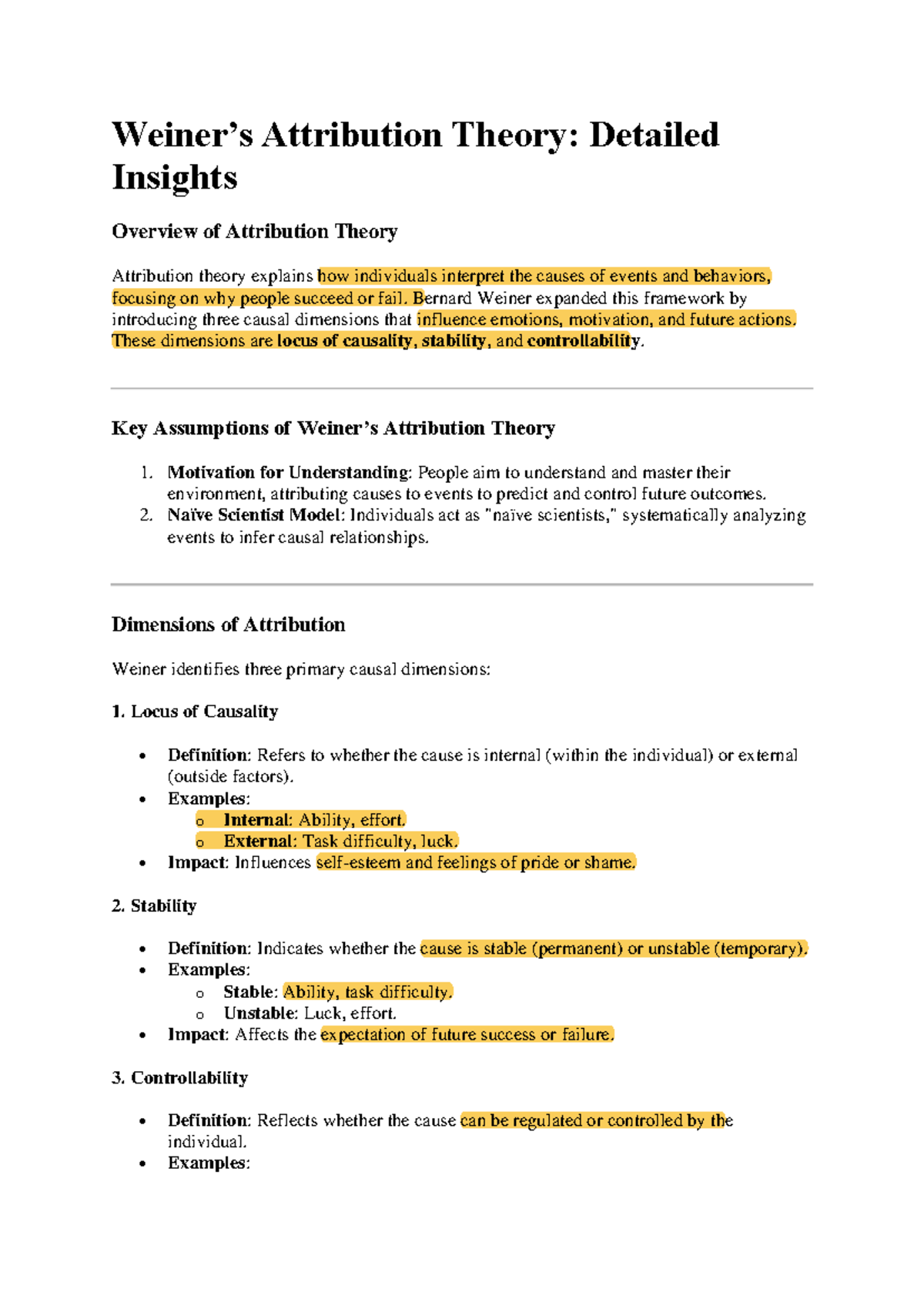
4. Weiner’s Attribution Theory of Achievement
In the realm of motivation and education, psychologist Bernard Weiner expanded attribution theory by creating a comprehensive framework for how people explain success and failure, particularly in achievement-oriented settings. Weiner proposed that causal attributions can be categorized across three distinct dimensions: locus, stability, and controllability.
The Three Dimensions
- Locus (Internal vs. External): Whether the cause originates within the person (e.g., ability, effort) or outside the person (e.g., task difficulty, luck).
- Stability (Stable vs. Unstable): Whether the cause is permanent and unchanging over time (e.g., intelligence, long-term difficulty) or temporary and fluctuating (e.g., mood, momentary luck, specific effort exerted on a single day).
- Controllability (Controllable vs. Uncontrollable): Whether the individual can voluntarily alter or influence the cause (e.g., amount of study time) or whether it lies beyond their control (e.g., innate talent, accidental interruptions).
Practical Application in Education and Therapy
Weiner’s model demonstrates that the specific combination of these dimensions profoundly impacts future motivation and emotional responses. For instance, if a student fails a math test and attributes it to a stable, internal, and uncontrollable factor ("I am just naturally stupid at math"), they will likely experience learned helplessness and give up trying.
Conversely, if the student attributes the failure to an unstable, internal, and controllable factor ("I didn't study the right chapters this time, but I can change my study habits for the next test"), they retain hope, agency, and motivation to improve. Therapists and educators frequently use cognitive reframing to help individuals shift their attributions toward controllable, unstable factors to foster resilience.
5. Defensive Attribution (Optimistic Bias and Just-World Hypothesis)
Defensive attribution encompasses a set of attributional tendencies designed to protect individuals from feelings of vulnerability, anxiety, and the terrifying realization that catastrophic events can happen to anyone at random. Two primary manifestations of defensive attribution are the just-world hypothesis and unrealistic optimism.
The Just-World Hypothesis
Originally formulated by Melvin Lerner, the just-world hypothesis is the cognitive bias that the world is inherently fair and orderly—that people ultimately get what they deserve and deserve what they get ("karma" in a psychological sense).
When individuals witness misfortune befalling an innocent person (such as a crime victim or someone experiencing a sudden illness), psychological discomfort arises. To resolve this anxiety, observers often engage in victim-blaming, attributing the misfortune to internal flaws or poor choices made by the victim ("They shouldn't have been walking in that neighborhood," or "They must have lived an unhealthy lifestyle").
By convincing themselves that the victim somehow caused their own suffering, observers preserve their comforting illusion that they themselves are safe from similar tragedies as long as they make "smart" choices.
Unrealistic Optimism
Another form of defensive attribution is optimistic bias, where individuals believe that they are less likely than others to experience negative events (such as divorce, job loss, or illness) and more likely to experience positive events. People attribute their safety to their own superior traits or precautionary behaviors, shielding themselves from the uncomfortable reality of statistical probabilities.
Comparison of Attributional Biases and Models
| Attribution Concept | Primary Focus | Internal/External Tendency | Typical Real-World Example |
|---|---|---|---|
| Fundamental Attribution Error | Explaining others' behavior | Overestimates internal traits | Assuming a late coworker is lazy rather than stuck in traffic. |
| Self-Serving Bias | Explaining one's own outcomes | Internal for success, external for failure | Crediting a promotion to hard work, but blaming a missed deadline on bad luck. |
| Actor-Observer Bias | Comparing self vs. other behaviors | External for self, internal for others | Blaming the weather for your own car accident, but calling another driver reckless. |
| Weiner’s Achievement Theory | Analyzing success/failure causes | Varies across Locus, Stability, Controllability | Believing math failure is due to changeable study habits (controllable) vs. innate ability (stable). |
| Defensive Attribution | Protecting against vulnerability | Blaming victims or minimizing personal risk | Believing financial ruin only happens to those who are financially irresponsible. |
Frequently Asked Questions
What is the main difference between internal and external attribution?
Internal (dispositional) attribution assigns the cause of a behavior to a person's internal traits, such as personality, intelligence, motivation, or mood. External (situational) attribution assigns the cause to external environmental factors, such as social pressure, physical surroundings, luck, or task difficulty.
How does the fundamental attribution error affect daily relationships?
The fundamental attribution error can lead to chronic interpersonal conflict, misunderstandings, and resentment. When friends, partners, or family members make mistakes, individuals prone to this error immediately blame the other person's character rather than checking for situational stress, leading to unfair judgments and damaged trust.
Can attribution styles be changed through therapy?
Yes. Cognitive-behavioral therapy (CBT) and other psychotherapeutic modalities actively work to identify and reframe maladaptive attributional styles. Therapists help clients recognize when they are engaging in self-defeating attributions—such as internalizing failures and externalizing successes—and guide them toward balanced, realistic evaluations of agency and circumstance.
Is the self-serving bias universal across all cultures?
Research indicates that while the self-serving bias is widespread, its expression varies across cultural contexts. Individualistic Western cultures tend to display pronounced self-serving biases to maintain personal self-esteem. In contrast, collectivistic Eastern cultures often display self-effacing biases, where individuals attribute success to external group support and community effort, prioritizing social harmony over individual ego.
Why do people engage in victim-blaming via the just-world hypothesis?
Victim-blaming is a psychological defense mechanism rooted in anxiety reduction. Believing that the world is fundamentally unfair and that terrible things happen to good people purely by chance creates deep existential dread. By attributing a victim's misfortune to their own actions, observers maintain the comforting illusion of personal control and predictability in an unpredictable world.
Conclusion and Next Actions
Attribution in psychology provides a powerful lens for decoding the hidden mechanics of human thought, social perception, and motivation. By recognizing how mental shortcuts—such as the fundamental attribution error, self-serving bias, and defensive attribution—skew interpretations of reality, individuals can cultivate greater empathy, emotional intelligence, and self-awareness.
To apply these insights practically, begin by monitoring your own reactions during high-stress conflicts or unexpected setbacks. Before jumping to negative conclusions about a colleague's mistake or a stranger's rudeness, pause to consider what situational pressures might be at play. Similarly, evaluate your own successes and failures with objective balance, acknowledging both personal effort and environmental context to foster continuous personal growth.