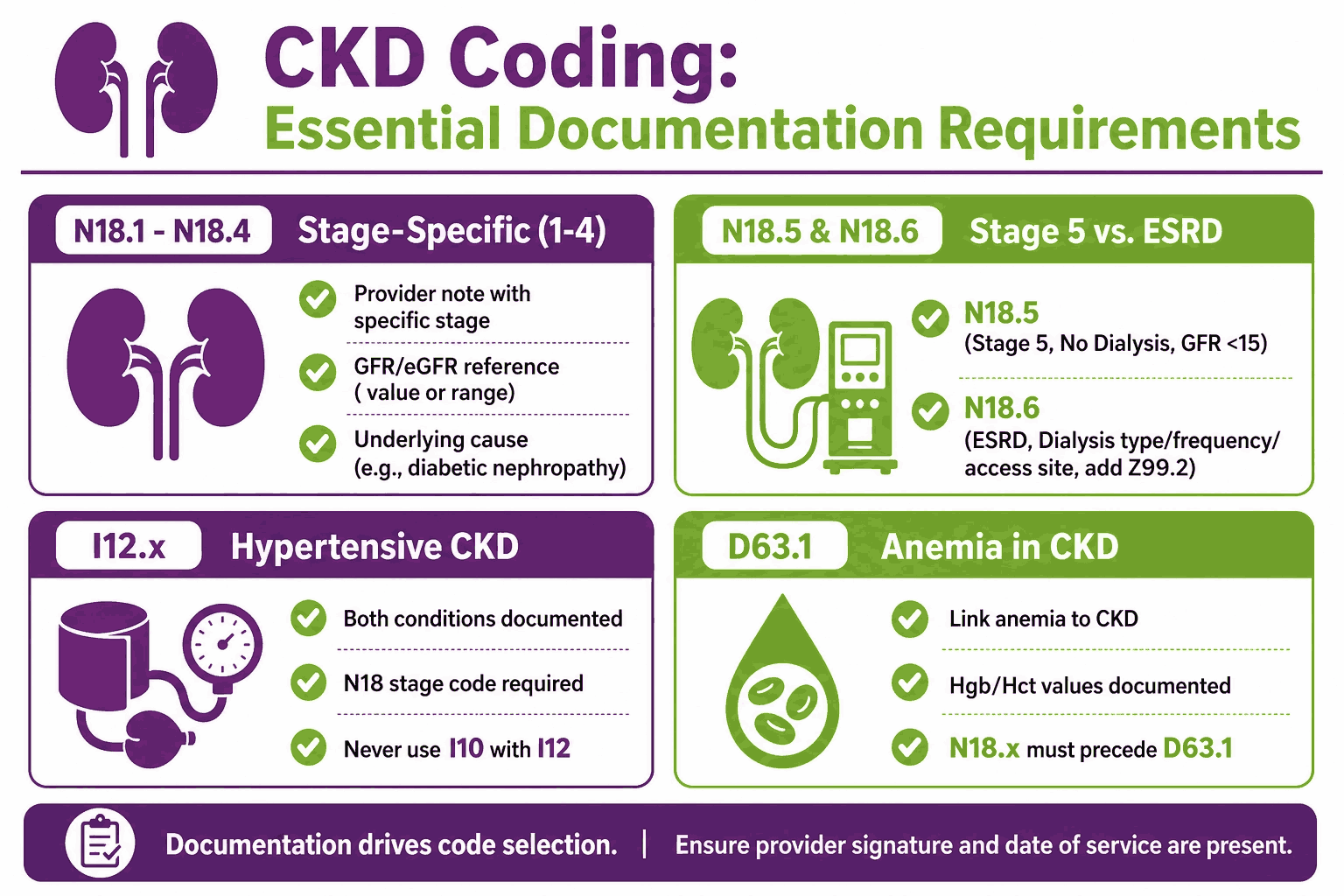
The ICD-10 code D63.1 serves as the standardized medical billing and diagnostic classification for anemia in chronic kidney disease (CKD). While the base code remains stable, clinical documentation must align with updated 2025 reporting requirements to reflect the severity of the CKD and the causal relationship between the renal impairment and the patient's anemic state.
The Role of ICD-10-CM in Chronic Kidney Disease Management
The International Classification of Diseases, 10th Revision, Clinical Modification (ICD-10-CM) is the bedrock of healthcare data reporting in the United States. For clinicians and medical coders, the accurate application of codes is not merely an administrative task; it is a clinical requirement that ensures medical records reflect the true complexity of a patient's health.
When a patient is diagnosed with anemia secondary to chronic kidney disease, the system requires a two-pronged coding approach. Chronic kidney disease is defined by the progressive loss of kidney function, often categorized by the Glomerular Filtration Rate (GFR). Anemia, a common complication of CKD, occurs primarily due to a deficiency in erythropoietin production by the damaged kidneys. The code D63.1—Anemia in chronic kidney disease—functions as a manifestation code, meaning it describes a condition caused by an underlying disease process.
Clinical Documentation Requirements for D63.1
To meet the 2025 documentation standards, providers must establish a clear "causal link" between the CKD and the anemia. Merely listing both diagnoses on a chart is often insufficient for auditors. The medical record must explicitly state "anemia due to chronic kidney disease" or "anemia of chronic kidney disease" to justify the use of D63.1.
If the documentation fails to make this connection, billing software or auditors may reject the claim, leading to delayed reimbursement or the need for retrospective chart queries. Because CKD is a staging-based condition, the coding sequence must always list the underlying CKD stage first (e.g., N18.30 for Stage 3a), followed by the manifestation code D63.1.
Sequencing and Coding Hierarchy
In the ICD-10 coding hierarchy, manifestation codes are designed to provide context to the primary systemic illness. When coding for a patient with this condition in 2026, the coder must follow these specific steps:
- Identify the Primary Diagnosis: Select the code representing the stage of the chronic kidney disease. Under current guidelines, the stage must be documented (Stage 1 through 5, or End-Stage Renal Disease).
- Apply the Manifestation Code: Append D63.1 to acknowledge the anemia.
- Check for Additional Conditions: If the patient has iron deficiency anemia or is receiving erythropoietin-stimulating agents (ESAs), additional codes (such as those in the D50 range) may be required to fully capture the complexity of the treatment plan.
By following this sequence, the healthcare record paints an accurate picture of the patient’s metabolic health. It informs insurance providers, researchers, and public health entities about the prevalence of anemia as a specific, treatable complication of renal failure.
Comparative Coding Analysis
Understanding why specific codes are chosen over others is vital for accurate clinical reporting. The following table contrasts D63.1 with related anemia codes to clarify common areas of confusion.
| Code | Description | Clinical Context |
|---|---|---|
| D63.1 | Anemia in chronic kidney disease | Used when anemia is a direct result of renal failure. |
| D63.0 | Anemia in neoplastic disease | Used for anemia secondary to cancer or chemotherapy. |
| D50.0 | Iron deficiency anemia | Used for anemia caused by low iron, regardless of kidney status. |
| D64.9 | Anemia, unspecified | Used only when specific documentation is unavailable. |
The distinction is critical because D63.1 carries specific reimbursement weight and clinical significance that "unspecified" codes (like D64.9) do not. Relying on unspecified codes often triggers insurance audits or leads to an incomplete patient clinical profile.
The Impact of 2025 Updates on Clinical Workflow
The 2025 updates to ICD-10-CM have emphasized greater precision in how providers document the progression of kidney disease. With the 2026 clinical landscape, the push for specificity remains the primary focus. Providers are now expected to use more granular staging for CKD, which directly affects how D63.1 is interpreted.
For instance, a patient with Stage 4 CKD (N18.4) paired with D63.1 suggests a high-risk scenario that requires significant medical intervention, such as frequent laboratory monitoring or the administration of injectable medications. In contrast, Stage 2 CKD (N18.2) with D63.1 might represent a very different treatment trajectory. The coding must reflect these nuances to ensure that the patient's care plan is both clinically appropriate and fiscally supported.
Addressing Common Coding Challenges
One of the most frequent errors in coding for D63.1 is the failure to re-verify the CKD stage. Chronic kidney disease is often progressive; a patient who was Stage 3 in 2024 may have progressed to Stage 4 by 2026. Coders must ensure that the CKD stage code on the claim matches the most recent laboratory results and provider documentation in the 2026 encounter notes.
Another challenge involves the use of "rule-out" diagnoses. In an outpatient setting, one cannot code a condition as confirmed if it is documented as "suspected," "probable," or "rule out." If a physician notes "anemia, possibly secondary to CKD," the coder should not use D63.1. Instead, they should code the signs and symptoms (e.g., fatigue, R53.83) until the physician confirms the diagnosis of anemia as a secondary complication.
Ethical Considerations in Documentation
Accurate coding is not only about reimbursement; it is an ethical obligation to ensure patient safety and quality of care. When a medical record accurately reflects the patient's anemia secondary to CKD, it triggers automated alerts in many electronic health record (EHR) systems regarding potential medication interactions or the need for specific renal-friendly supplements.
Furthermore, aggregate data from these codes are used by policy makers to allocate resources for dialysis centers and renal clinics. By providing precise documentation, clinicians contribute to a data-driven understanding of the national health burden of chronic kidney disease.
Frequently Asked Questions
Can D63.1 be used as a primary diagnosis? No. Under ICD-10-CM guidelines, D63.1 is a manifestation code. It must always be sequenced after the code for the underlying chronic kidney disease (N18 series).
What is the difference between D63.1 and iron deficiency anemia in a CKD patient? D63.1 describes anemia resulting from the kidneys' inability to produce enough erythropoietin. If the patient also has iron deficiency, they may require both codes—D63.1 for the renal-related anemia and the appropriate iron deficiency code (D50.x)—to describe the full clinical picture.
Does the 2025 update change how I document the stage of CKD? The 2025 update reinforces the necessity of using the specific stage codes (N18.1–N18.6) based on GFR levels. Coders should avoid using unspecified CKD codes whenever a definitive stage is provided in the lab or clinical findings.
What should I do if the provider documentation is unclear? Coders should utilize the physician query process. If the link between the patient’s CKD and anemia is not clearly documented, do not assume a diagnosis. Query the provider to clarify if the anemia is indeed attributed to the kidney disease before applying the D63.1 code.
Are there specific laboratory markers required to support D63.1? While the ICD-10 code itself is based on the physician’s diagnosis, the documentation in the medical record should be supported by lab findings such as low hemoglobin levels and decreased estimated glomerular filtration rates (eGFR) consistent with a diagnosis of CKD.
Conclusion and Next Actions
For healthcare professionals managing patients in 2026, the path to accurate coding for anemia in CKD lies in clear communication between the clinician and the billing department. Ensure that all clinical notes explicitly link the anemia to the chronic kidney disease and verify that the CKD stage is current.
If you are a billing professional, review the latest N18 staging guidelines to ensure compatibility with D63.1. If you are a clinician, adopt the practice of stating the diagnosis as "Anemia secondary to Stage X Chronic Kidney Disease" to satisfy audit requirements and improve the accuracy of the patient’s electronic medical record. Consistent adherence to these standards not only streamlines the reimbursement process but also supports the clinical integrity of the entire patient care continuum.