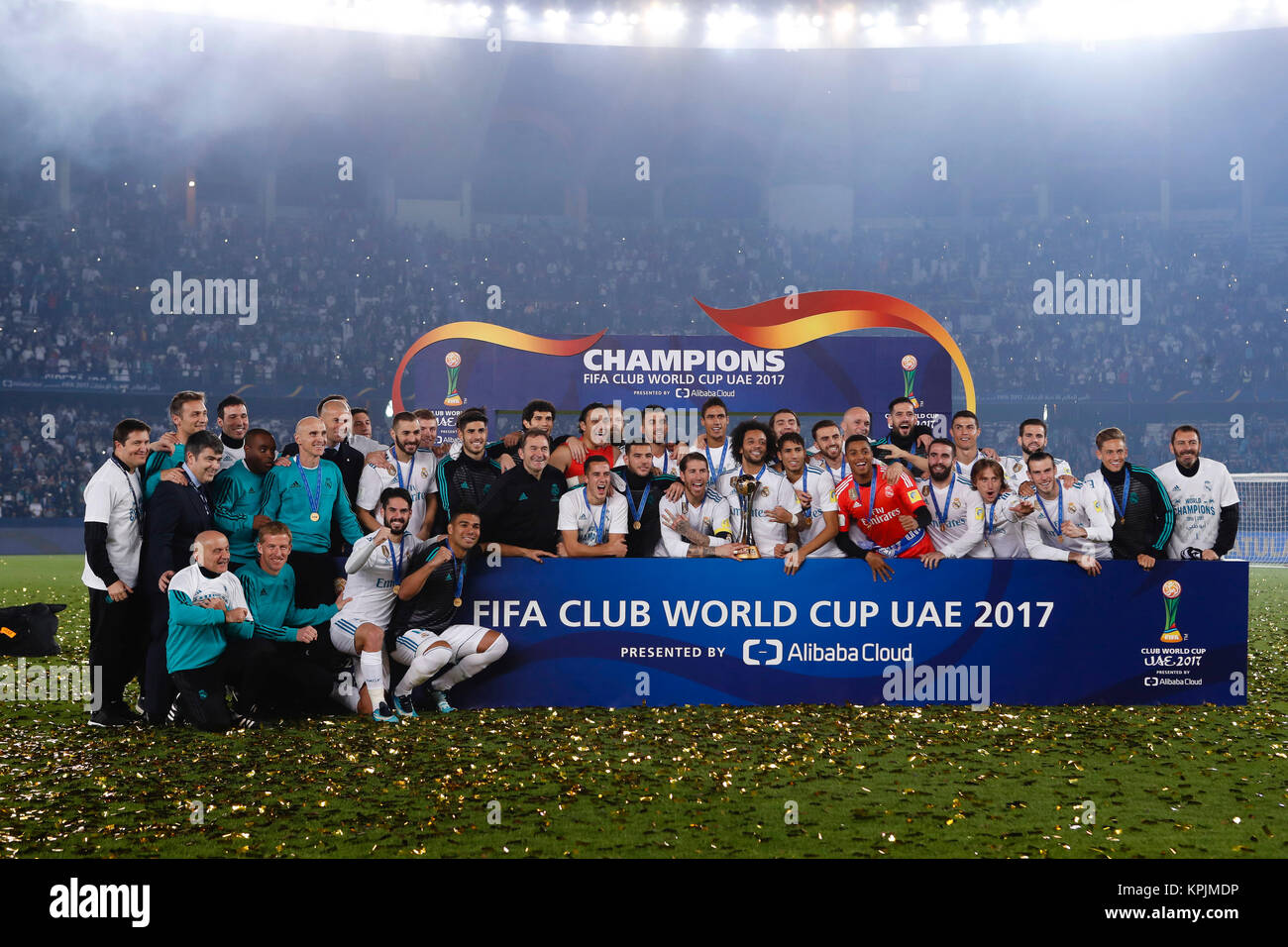
On December 16, 2017, European champions Real Madrid defeated South American champions Grêmio 1–0 in the FIFA Club World Cup Final at Zayed Sports City Stadium in Abu Dhabi. A 53rd-minute free kick by Cristiano Ronaldo broke the deadlock, securing Real Madrid’s third FIFA Club World Cup title and making them the first team in history to successfully defend the crown.
Tournament Context and the Path to Abu Dhabi
The 2017 FIFA Club World Cup brought together the champion clubs from each of FIFA’s six continental confederations, along with the national league champion from the host nation, the United Arab Emirates. The final represented a classic intercontinental showdown between the winners of Europe's UEFA Champions League and South America's CONMEBOL Copa Libertadores.
2017 FIFA Club World Cup Final Path
- UEFA Champions League Winner: REAL MADRID
- Semifinal vs. Al Jazira: Won 2–1
- Copa Libertadores Winner: GRÊMIO
- Semifinal vs. Pachuca: Won 1–0 (AET)
- THE FINAL: Real Madrid 1–0 Grêmio (Zayed Sports City Stadium, Abu Dhabi)
Real Madrid’s European Dominance
Real Madrid entered the tournament after a historical 2016–17 campaign managed by Zinedine Zidane. In June 2017, Madrid became the first club in the modern UEFA Champions League era to retain the European title, defeating Juventus 4–1 in the Cardiff final.
However, their path to the Club World Cup final in Abu Dhabi was far from seamless. In the semifinal against host team Al Jazira, Real Madrid fell behind to a goal from Romarinho before mounting a second-half comeback. Second-half goals from Cristiano Ronaldo and substitute Gareth Bale secured a hard-fought 2–1 victory, revealing minor defensive vulnerabilities while emphasizing Madrid's firepower.
Grêmio’s Copa Libertadores Triumph
Grêmio qualified for the tournament after winning the 2017 Copa Libertadores under head coach Renato Portaluppi (Renato Gaúcho). The Porto Alegre side displayed tactical discipline, defensive resilience, and swift counter-attacking ability throughout their South American campaign, culminating in a 3–1 aggregate victory over Argentine side Lanús in the Libertadores final.
In their Club World Cup semifinal against CONCACAF champions Pachuca of Mexico, Grêmio endured a grueling 120-minute battle. A sublime extra-time goal from winger Éverton Soares secured a 1–0 victory, setting up the final against Real Madrid. However, Grêmio suffered a major structural blow ahead of the tournament: midfielder Arthur Melo, the engine of their Libertadores success, sustained a severe ankle injury in the second leg against Lanús and was ruled out of the squad.
Team Lineups and Tactical Configurations
Both managers fielded strong starting lineups for the final, reflecting the high stakes of the fixture.
Real Madrid: 4-3-1-2 Diamond / Flexible 4-3-3
Zinedine Zidane deployed his preferred big-match formation, placing Isco behind the forward pairing of Cristiano Ronaldo and Karim Benzema, supported by a world-class central midfield trio.
- Goalkeeper: Keylor Navas
- Defenders: Daniel Carvajal (RB), Raphaël Varane (CB), Sergio Ramos (CB, C), Marcelo (LB)
- Midfielders: Luka Modrić (CM), Casemiro (DM), Toni Kroos (CM)
- Attacking Midfielder: Isco
- Forwards: Karim Benzema, Cristiano Ronaldo
Zidane’s tactical approach focused on controlling midfield tempo through Kroos and Modrić, utilizing Marcelo and Carvajal to provide width, and allowing Isco floating freedom between Grêmio's defensive and midfield lines.
Grêmio: 4-2-3-1 Defensive Low-Block
Renato Gaúcho arranged Grêmio in a compact 4-2-3-1 system designed to absorb pressure, restrict central spaces, and exploit quick transitions through Luan and Fernandinho.
- Goalkeeper: Marcelo Grohe
- Defenders: Edílson (RB), Pedro Geromel (CB), Walter Kannemann (CB), Bruno Cortez (LB)
- Midfielders: Jailson (DM), Michel (DM)
- Attacking Midfielders: Ramiro (RM), Luan (AM), Fernandinho (LM)
- Forward: Lucas Barrios (ST)
Without Arthur to retain possession under pressure, Grêmio’s midfield shifted from a possession-oriented shape to a destructive double-pivot featuring Jailson and Michel. Pedro Geromel and Walter Kannemann formed a central defensive pairing tasked with containing Ronaldo and Benzema inside the penalty box.
Detailed Match Play-by-Play and Key Moments
The match was officiated by Mexican referee César Arturo Ramos before an audience of 41,094 spectators at the Zayed Sports City Stadium.
Match Timeline: Real Madrid 1–0 Grêmio
- 0': Start of Match
- 2': 🟨 Yellow Card: Casemiro (Real Madrid) - Foul on Luan
- 18': ⚽ Shot: Luka Modrić narrow miss wide of the post
- 28': 🟨 Yellow Card: Pedro Geromel (Grêmio) - Foul on Ronaldo
- 45': Halftime (0–0)
- 53': ⚽ GOAL! Cristiano Ronaldo (Real Madrid) - Direct Free Kick (1–0)
- 58': 🚫 Disallowed Goal: Ronaldo (Offside call on Benzema in build-up)
- 63': 🔄 Sub: Jael replaces Lucas Barrios (Grêmio)
- 65': ⚽ Shot: Luka Modrić strike tipped onto post by Marcelo Grohe
- 71': 🔄 Sub: Dudu replaces Ramiro (Grêmio)
- 73': 🔄 Sub: Lucas Vázquez replaces Isco (Real Madrid)
- 79': 🔄 Sub: Gareth Bale replaces Karim Benzema (Real Madrid)
- 84': 🔄 Sub: Maicon replaces Michel (Grêmio)
- 90': Fulltime (1–0)
First Half: Tactical Gridlock and Madrid's Spatial Control
From the opening whistle, Grêmio set out to deny Real Madrid central penetration. Within the first two minutes, Grêmio displayed their physical intent, but it was Madrid midfielder Casemiro who received the match's first yellow card for a late challenge on Luan.
Real Madrid quickly established dominance in possession, holding over 60% of the ball throughout the first half. Modrić and Kroos dictated the rhythm of play, constantly shifting Grêmio’s defensive block from side to side.
- 18th Minute: Modrić collected a cleared corner outside the box and struck a powerful left-footed half-volley that whistled just wide of Marcelo Grohe’s far post.
- 28th Minute: Pedro Geromel was booked after a heavy tackle on Cristiano Ronaldo near the left edge of the penalty box.
- 38th Minute: Ronaldo engineered a pocket of space inside the box after stepping past Edílson, but his shot was deflected out for a corner by Kannemann.
Despite Madrid’s pressure, Grêmio’s central defense held firm. Edílson attempted a long-range free kick from over 35 yards that flew over Keylor Navas's crossbar, marking Grêmio's sole real sight of goal in the opening 45 minutes. The half ended 0–0, with Grêmio failing to record a single shot on target.
Second Half: Ronaldo Breaks the Wall
Real Madrid increased their tempo early in the second period, pressing higher up the pitch and forcing Grêmio into rushed clearances.
The defining moment of the final arrived in the 53rd minute. Cristiano Ronaldo won a free kick roughly 25 yards out from goal after being brought down by Jailson. Ronaldo took his trademark stance and fired a low, dipping strike toward the bottom right corner. The ball found a split in the Grêmio wall—passing directly between Jailson and Lucas Barrios—and bounced past the diving Marcelo Grohe into the bottom corner of the net.
Free Kick Trajectory (53rd Min)
- CRISTIANO RONALDO [ Ball ]
- Dipping Low Strike
- [Jailson] [Barrios] (Wall split open)
- [ Marcelo Grohe ] (Diving left, unable to reach)
- ⚽ GOAL (1–0)
Just five minutes later, in the 58th minute, Ronaldo thought he had doubled Real Madrid's lead. Benzema headed down a long ball into Ronaldo's path, who finished past Grohe into the roof of the net. However, the assistant referee raised the flag for offside against Benzema during the buildup, keeping the score at 1–0.
Closing Stages and Tactical Adjustments
With Grêmio trailing, Renato Gaúcho made offensive adjustments, introducing striker Jael for Lucas Barrios in the 63rd minute and Dudu for Ramiro in the 71st minute. However, Grêmio struggled to construct meaningful attacks through midfield, as Casemiro expertly shielded Madrid's backline.
- 65th Minute: Luka Modrić uncorked a driving right-footed shot from 25 yards out. Grohe made an extraordinary fingertip save, pushing the ball onto the base of his right-hand post to prevent a second goal.
- 79th Minute: Zidane brought on Gareth Bale for Karim Benzema. Within minutes of entering the pitch, Bale cut inside from the right wing and struck a curling effort toward the top corner, forcing another acrobatic save from Grohe.
Grêmio pushed body numbers forward in the final five minutes, but Real Madrid’s defensive unit of Ramos and Varane comfortably neutralised long balls into the penalty area. The referee blew the final whistle after three minutes of stoppage time, confirming Real Madrid's 1–0 victory.
Match Statistics and Performance Indicators
The technical data from the final illustrates Real Madrid's structural control over the match. Grêmio defended resolutely inside their penalty box, but failed to test Keylor Navas throughout the 90 minutes.
| Metric | Real Madrid | Grêmio |
|---|---|---|
| Final Score | 1 | 0 |
| Possession (%) | 62% | 38% |
| Total Shots | 20 | 1 |
| Shots on Target | 7 | 0 |
| Shots Off Target | 9 | 1 |
| Blocked Shots | 4 | 0 |
| Corner Kicks | 9 | 1 |
| Offsides | 1 | 2 |
| Fouls Committed | 7 | 12 |
| Yellow Cards | 1 (Casemiro) | 1 (Geromel) |
| Red Cards | 0 | 0 |
| Pass Accuracy (%) | 89% | 78% |
Tactical Analysis: How Real Madrid Outplayed Grêmio
1. Luka Modrić's Midfield Dominance
Luka Modrić was named the official Player of the Match and awarded the Golden Ball as the overall player of the tournament. The Croatian midfielder delivered a masterful performance, recording 106 touches and completing 91% of his passes.
Modrić operated in the right-half space, exploiting the gap between Grêmio left-back Bruno Cortez and central midfielder Michel. His ability to turn under pressure completely rendered Grêmio’s low-block pressing ineffective. Modrić constantly switched play to Marcelo on the left wing, forcing Grêmio’s defensive line to stretch laterally.
Modrić's Midfield Spatial Control
- [Toni Kroos / Casemiro] (Dictating Tempo)
- [ LUKA MODRIĆ ]
- [Marcelo] (High Left)
- [Carvajal] (High Right)
- [ LUKA MODRIĆ ]
2. The Impact of Arthur Melo's Absence
Grêmio’s inability to build sustained attacks stemmed largely from the missing profile of Arthur Melo. In the Copa Libertadores campaign, Arthur acted as Grêmio’s primary press-resister, dropping between the center-backs to carry the ball forward.
Without Arthur, Jailson and Michel lacked the technical composure to play through Real Madrid’s high press. As a result, Grêmio turned to direct long balls toward Lucas Barrios, who was comfortably contained by Sergio Ramos and Raphaël Varane in aerial duels.
3. Full-Back Positioning and Wing Suppression
Zidane instructed Marcelo and Daniel Carvajal to occupy extremely advanced positions on the flanks. This tactical directive pinned Grêmio’s wingers—Fernandinho and Ramiro—deep inside their own half.
Because Ramiro and Fernandinho were forced to double-team Madrid's full-backs alongside Cortez and Edílson, Grêmio lacked wide outlets when they did regain possession. Luan was isolated in the center, frequently forced to drop into his own defensive third just to receive the ball.
4. Defending the Wall Split
The match's sole goal highlighted a fundamental defensive flaw in set-piece execution. When Ronaldo stepped up to take the 53rd-minute free kick, Grêmio's wall jumped unevenly.
Jailson and Lucas Barrios split apart as they left the ground, creating an opening directly in line with the bottom right corner of the net. Ronaldo took advantage of this gap, striking the ball at 97 km/h through the barrier.
Historical Significance and Tournament Legacy
The 2017 FIFA Club World Cup Final held historic significance for both Real Madrid and the broader landscape of international club football.
Real Madrid 2017 Five Trophies
- La Liga Title
- UEFA Champions League
- Supercopa de España
- UEFA Super Cup
- FIFA Club World Cup
Real Madrid's Historic Five-Trophy Year
The victory in Abu Dhabi crowned a historical calendar year for Real Madrid. In 2017, under Zinedine Zidane, Madrid captured five major trophies:
- La Liga (2016–17)
- UEFA Champions League (2016–17)
- Supercopa de España (2017)
- UEFA Super Cup (2017)
- FIFA Club World Cup (2017)
This marked the most successful calendar year in Real Madrid’s history in terms of trophies won.
First Consecutive FIFA Club World Cup Champions
Real Madrid became the first club to win consecutive FIFA Club World Cup titles (2016 and 2017), a record they extended further by winning a third straight title in 2018 against Al Ain. The 2017 triumph brought Madrid's total world club titles to six—including their three Intercontinental Cup victories (1960, 1998, 2002).
Individual Tournament Awards
Following the final, FIFA presented the tournament's official awards:
- Golden Ball (Best Player): Luka Modrić (Real Madrid)
- Silver Ball: Cristiano Ronaldo (Real Madrid)
- Bronze Ball: Jonathan Urretaviscaya (Pachuca)
- FIFA Fair Play Award: Real Madrid
Frequently Asked Questions
Who scored the winning goal in the 2017 Club World Cup final?
Cristiano Ronaldo scored the winning goal in the 53rd minute via a direct free kick that passed through Grêmio's defensive wall into the bottom corner.
Who won the Golden Ball as the tournament's best player?
Luka Modrić won the Golden Ball for his performance throughout the tournament and his midfield display in the final against Grêmio.
Why did Arthur Melo miss the 2017 Club World Cup final for Grêmio?
Arthur Melo suffered a severe ankle injury during the second leg of the 2017 Copa Libertadores final against Lanús, ruling him out of Grêmio's squad for the FIFA Club World Cup.
What record did Real Madrid set by winning the 2017 final?
Real Madrid became the first club in history to retain the FIFA Club World Cup trophy, having also won the 2016 edition against Kashima Antlers.
Where was the 2017 FIFA Club World Cup final played?
The match took place at the Zayed Sports City Stadium in Abu Dhabi, United Arab Emirates, in front of an attendance of 41,094.
Who was the referee for the 2017 final match?
The match was refereed by César Arturo Ramos of Mexico, representing the CONCACAF confederation.
Concluding Summary
The 2017 FIFA Club World Cup final encapsulated Real Madrid’s era of global dominance under Zinedine Zidane. Through elite technical execution from Luka Modrić and Toni Kroos, defensive stability from Sergio Ramos, and decisive individual brilliance from Cristiano Ronaldo, Madrid neutralized South American champions Grêmio. The victory capped off a five-trophy year for Real Madrid and cemented their team's place in modern football history.