Preparing a mortgage application begins long before submitting final paperwork, as lenders require comprehensive documentation of income, assets, credit history, and employment to complete the Uniform Residential Loan Application, known formally as Fannie Mae Form 1003 or the Residential Loan Application. Understanding the pre-application requirements ensures borrowers can compile the necessary financial disclosures, anticipate qualification hurdles, and streamline the underwriting process for conventional or government-backed home loans.
Navigating the mortgage landscape requires careful attention to detail, particularly when preparing to fill out the Form 1003. This standardized document serves as the foundation for nearly all residential mortgage applications in the United States, capturing vital data about the borrower, the property, the loan terms, and the financial profile of the applicant. Before a loan officer or automated underwriting system can process this application efficiently, borrowers must gather specific documentation and meet baseline qualification criteria. Missing information or undocumented income sources can stall loan processing, delay closing dates, or lead to outright denial. This comprehensive guide breaks down every facet of 1003 pre-application requirements, equipping prospective homebuyers and refinancers with the knowledge needed to navigate the initial mortgage phase successfully.
The Role and Purpose of Fannie Mae Form 1003
The Uniform Residential Loan Application (URLA), commonly referenced as Form 1003, is the industry-standard document used by lenders to collect all relevant financial and personal information from a borrower. Formally adopted by Fannie Mae and Freddie Mac under the guidance of the Federal Housing Finance Agency (FHFA), the 1003 layout standardizes how mortgage data is presented, evaluated, and verified across different financial institutions.
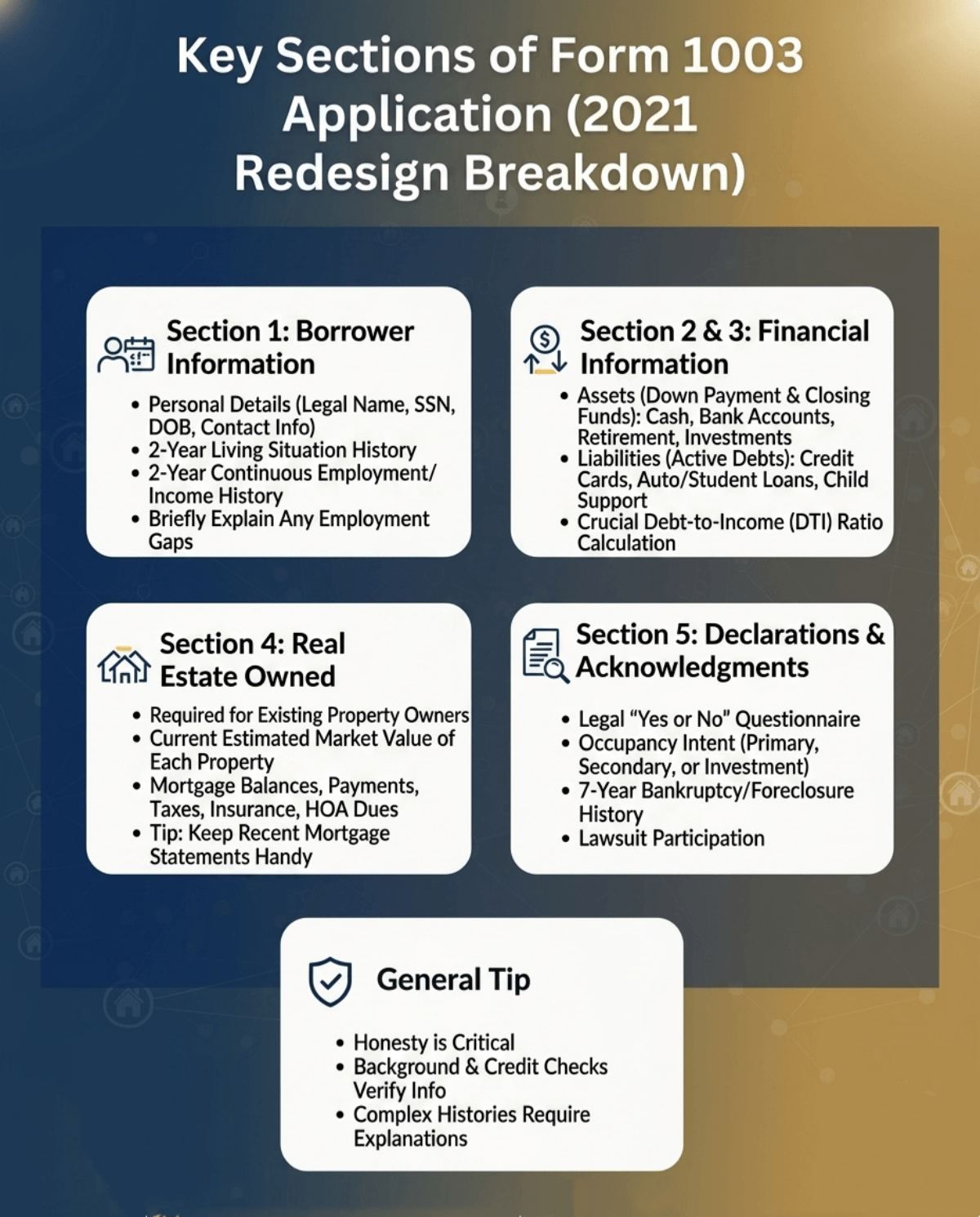
When a borrower sits down with a loan officer or completes an online mortgage portal, they are essentially populating the fields of the 1003. The document is divided into multiple sections that cover borrower personal information, employment history, monthly income and combined housing expense, assets and liabilities, real estate owned, and declarations regarding legal or financial challenges. Because every underwriting decision relies heavily on the data entered into this form, the pre-application stage focuses entirely on verifying the accuracy and completeness of these data points before the formal application is signed and submitted.
Core Financial Prerequisites for the 1003 Application
Before initiating a Form 1003, borrowers must assemble a robust financial portfolio. Lenders do not rely on self-reported estimates; every number entered into the application must be backed by verifiable paper trails. The core financial prerequisites generally fall into four main categories: income verification, asset documentation, liability accounting, and credit profile establishment.
Income Documentation Requirements
Lenders must verify an applicant’s capacity to repay the loan under the Ability-to-Repay (ATR) and Qualified Mortgage (QM) rules established by the Consumer Financial Protection Bureau (CFPB). For traditional W-2 employees, pre-application requirements typically include:
- The most recent 30 days of consecutive pay stubs showing year-to-date earnings.
- W-2 forms from the past two consecutive tax years.
- Written Verification of Employment (VOE) executed by the lender to confirm active employment status and base salary.
For self-employed borrowers, independent contractors, or individuals earning significant commission and bonus income, the requirements are more rigorous. Lenders generally require complete federal personal and business tax returns for the past two years, including all schedules and K-1 forms, accompanied by a year-to-date profit and loss (P&L) statement and a balance sheet.
Asset and Liquidity Verification
To satisfy down payment requirements, closing costs, and post-closing reserve requirements, borrowers must document liquid and semi-liquid assets. Pre-application asset requirements mandate:
- Complete bank statements for all checking, savings, and money market accounts for the past two to three consecutive months. All pages must be included, even if intentionally blank.
- Statements for investment accounts, brokerage accounts, retirement funds (such as 401(k) or IRA portfolios), and certificates of deposit.
- Documentation for any earnest money deposit already paid, including the cancelled check and the corresponding bank withdrawal slip.
- Clear paper trails for any large deposits appearing in bank accounts that are not part of standard payroll, as lenders must verify that these funds are not undocumented loans.
Liabilities and Debt Accounting
The 1003 requires a comprehensive accounting of all current debts, liabilities, and financial obligations. Borrowers must compile a list of all open credit lines, including credit cards, auto loans, student loans, personal loans, and existing mortgages or home equity lines of credit. While lenders pull a tri-merge credit report to capture these liabilities automatically, having an accurate accounting ahead of time prevents discrepancies between the credit report and the declarations section of the 1003. Furthermore, any court-ordered financial obligations, such as child support or alimony payments, must be documented with executed legal agreements and proof of payment history.
Document Checklist for Form 1003 Preparation
| Document Category | Specific Items Required | Primary Purpose on Form 1003 |
|---|---|---|
| Identification | Government-issued photo ID, Social Security Card or ITIN documentation | Verifies identity, legal residency, and matches credit bureau files. |
| Employment & Income | Recent pay stubs, W-2s, 2 years of tax returns (if self-employed) | Populates Section 1 (Borrower Information) and Section 2 (Financial Information - Income). |
| Assets | 2-3 months of bank, retirement, and investment account statements | Populates Section 2 (Assets) to prove down payment and reserve capacity. |
| Real Estate | Mortgage statements, homeowner insurance policies, property tax bills for current properties | Populates Section 3 (Financial Information - Real Estate Owned) for existing properties. |
| Declarations | Letters of explanation for past bankruptcies, foreclosures, or credit inquiries | Addresses legal and financial questions found in Section 5 (Declarations). |
Understanding Credit Profile and Scoring Prerequisites
Credit score benchmarks heavily influence pre-application readiness. While different loan programs—such as FHA, VA, USDA, and conventional loans backed by Fannie Mae or Freddie Mac—have varying minimum credit score thresholds, lenders generally pull a tri-merge credit report covering data from Equifax, Experian, and TransUnion.
During the pre-application phase, borrowers should review their credit reports for errors, outdated collection accounts, or fraudulent activity. Disputing inaccuracies before submitting the 1003 can prevent unexpected credit score drops that might alter the loan's pricing or eligibility. Additionally, lenders evaluate credit utilization ratios, late payment histories, and the age of open credit lines. Maintaining a low credit utilization ratio—ideally below 30% of total available revolving credit—is a critical pre-application step that directly improves debt-to-income calculations.
Calculating the Debt-to-Income (DTI) Ratio
The Debt-to-Income (DTI) ratio is one of the most critical metrics derived from the 1003 application. Lenders look at two distinct DTI figures: the front-end ratio (housing ratio) and the back-end ratio (total debt ratio).
- Front-End Ratio: Calculated by dividing the proposed monthly housing expense (principal, interest, property taxes, homeowners insurance, and any applicable HOA dues or private mortgage insurance) by the borrower's gross monthly income.
- Back-End Ratio: Calculated by dividing the sum of all monthly debt obligations (housing expense plus recurring monthly debts like auto loans, student loans, credit card minimums, and child support) by the gross monthly income.
Most conventional mortgage programs look for a back-end DTI ratio below 43% to 45%, though automated underwriting systems may approve ratios up to 50% or higher if the borrower exhibits compensating factors, such as substantial cash reserves or high credit scores. Pre-application preparation involves calculating these ratios in advance to ensure they fall within acceptable program limits.
Property and Loan Term Considerations on the 1003
Beyond personal and financial data, the 1003 requires explicit details about the transaction and the subject property. Pre-application requirements mandate that borrowers have a clear understanding of the loan product they are seeking and the nature of the property they intend to finance.
Transaction Details
Borrowers must specify whether the loan is for a purchase, refinance, or construction project. They must also declare the intended occupancy status:
- Primary Residence: A home where the borrower will live for the majority of the year, offering the most favorable interest rates and lowest down payment options.
- Second Home: A secondary property occupied by the borrower part-time, typically subject to stricter reserve requirements.
- Investment Property: A property purchased primarily to generate rental income, which carries higher interest rates and stiffer down payment prerequisites.
Property Specifications
Having a firm grasp of the property type is essential for completing the application accurately. Lenders categorize properties as single-family detached homes, condominiums, planned unit developments (PUDs), cooperatives, or multi-family properties (2 to 4 units). Each property category carries distinct underwriting guidelines and documentation requirements, such as HOA questionnaires for condominiums or lease agreements for multi-family investment properties.
Common Pitfalls and Troubleshooting During the Pre-Application Phase
Even well-prepared applicants can encounter stumbling blocks during the 1003 preparation phase. Recognizing common mistakes helps borrowers avoid unnecessary delays.
Making Major Financial Changes
One of the most dangerous missteps a borrower can make between pre-application and final loan closing is altering their financial profile. This includes changing jobs, opening new credit card accounts, financing a vehicle purchase, or making large, unexplained cash transfers between bank accounts. Lenders pull a refresh credit report and re-verify employment just prior to closing; any unapproved changes can result in immediate loan denial.
Incomplete Paper Trails
Submitting partial bank statements or omitting pages that contain terms and conditions notices will halt underwriting progress. Lenders require every page of financial statements, numbered sequentially, to verify that no undisclosed loans or liabilities exist.
Discrepancies in Employment History
The 1003 requires a continuous two-year employment history. Gaps in employment must be explained in writing. If a borrower transitioned between industries, returned to school, or experienced a period of unemployment, providing a clear letter of explanation backed by documentation prevents underwriters from viewing the gap as an unmitigated risk.
Frequently Asked Questions About 1003 Requirements
What is the primary purpose of Fannie Mae Form 1003?
Form 1003 is the standardized residential loan application document used across the mortgage industry. Its primary purpose is to collect comprehensive personal, financial, employment, and property data from borrowers in a uniform format that allows lenders and automated underwriting systems to evaluate creditworthiness and risk.
Do I need to complete the 1003 myself, or does the lender do it?
While borrowers provide all the underlying data and documentation, loan officers, mortgage brokers, or digital loan portals typically enter the information into the official 1003 software. However, the borrower must review, verify, and legally sign the completed application, certifying that all statements are true and accurate under penalty of federal law.
How far back do lenders look at my financial history on the 1003?
Lenders typically require a two-year history of employment and residence. For financial assets, bank statements and investment accounts cover the most recent two to three months. Tax returns, when required for self-employed or commission-based applicants, cover the past two consecutive tax years.
What happens if I have a large cash deposit in my bank account that cannot be explained?
Lenders require a clear paper trail for all funds used for down payments and closing costs. Unexplained cash deposits—often referred to as mattress money—cannot be used for a mortgage unless the borrower can document their legal source through tax records, asset sales, or verifiable business income, as lenders must comply with strict anti-money laundering regulations.
Can I apply for a mortgage on a 1003 if I am self-employed?
Yes, self-employed individuals use the standard 1003 application. However, the pre-application requirements are more complex, requiring two years of personal and business tax returns, profit and loss statements, and balance sheets to establish a stable and qualifying net income baseline.
Final Recommendations for Prospective Borrowers
Preparing for the mortgage application process requires organization, transparency, and proactive financial management. Before initiating the Form 1003, take time to pull your credit reports, resolve outstanding errors, consolidate your financial documents into easily accessible digital folders, and calculate your debt-to-income ratio. Working closely with a qualified loan officer during the pre-application phase ensures that your documentation meets investor guidelines, paving the way for a smooth underwriting experience and a successful home purchase or refinance.