As of 2026, there is no federal legislation, administrative mandate, or official announcement indicating that the Federal Direct PLUS Loan program for parents is going away or being discontinued. Despite ongoing debates regarding the rising cost of higher education and federal student aid reform, these loans remain a permanent and active component of the U.S. Department of Education’s financial aid offerings for eligible parents of undergraduate students.
Defining the Parent PLUS Loan Program
To understand why questions persist regarding the availability of this program, it is helpful to clarify what Parent PLUS loans are and how they function within the federal ecosystem. The Federal Direct PLUS Loan program is designed to help parents of dependent undergraduate students pay for education-related expenses not covered by other financial aid. Unlike subsidized or unsubsidized loans for students, these loans are disbursed directly to the school, and the parent—not the student—is solely responsible for repayment.
Eligibility for these loans is not based on financial need, but rather on the student’s enrollment status at an eligible institution and the parent’s credit history. Because they serve as a critical bridge for families who do not qualify for need-based aid but still face a gap between the Cost of Attendance (COA) and other sources of funding, the program represents a significant portion of the federal student aid portfolio.
Why the Misconception Persists
The frequent inquiry regarding whether Parent PLUS loans are "going away" is largely fueled by the broader political discourse surrounding federal student loan reform. Since 2020, there have been various legislative proposals and administrative initiatives aimed at changing how federal aid is structured.
1. The Debate on Capping Borrowing
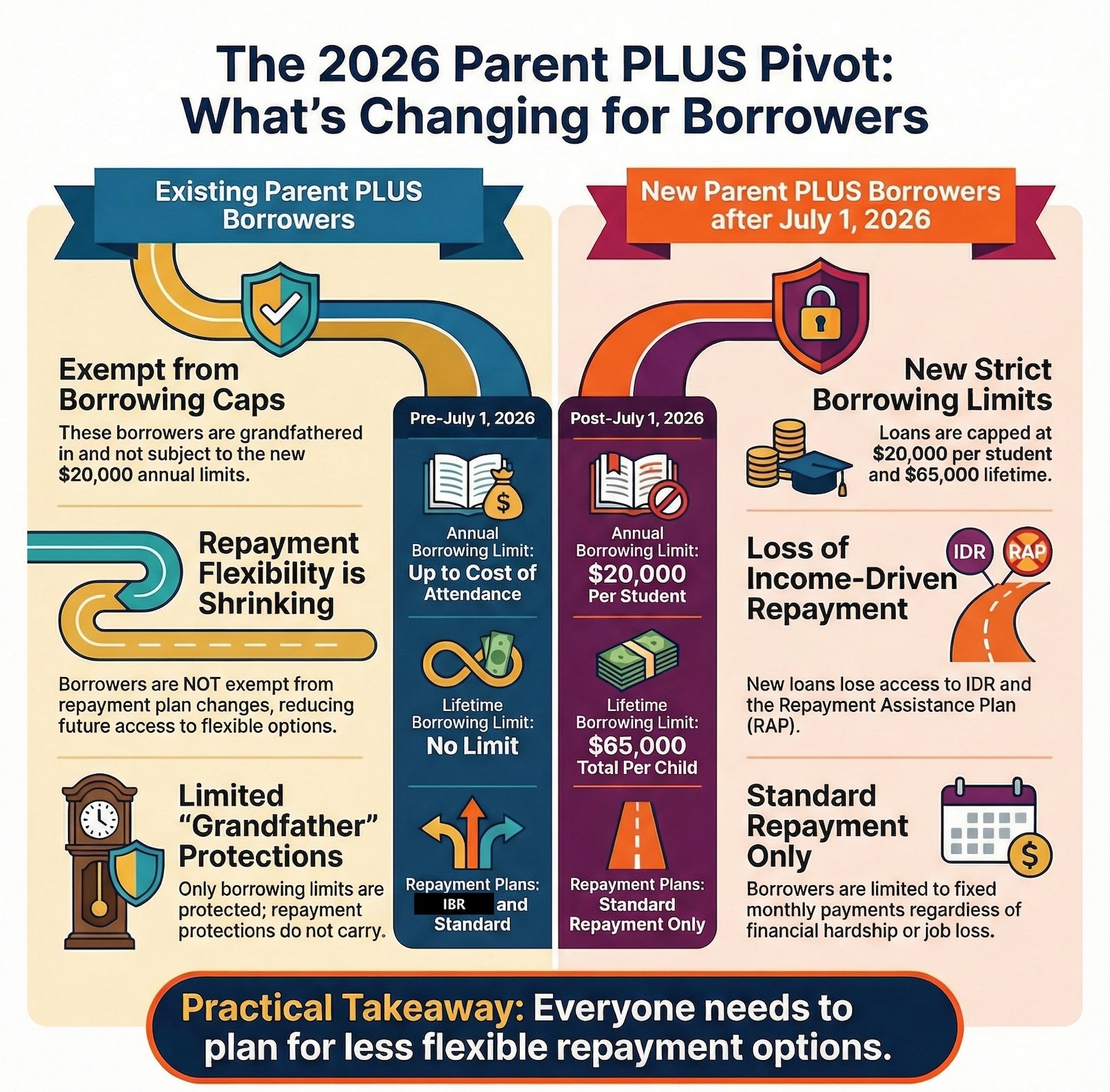
Policy analysts and education advocates often argue that because Parent PLUS loans have no borrowing limit—other than the school’s cost of attendance minus other financial aid—they enable colleges to raise tuition prices without constraint. Consequently, there have been recurring proposals in Congress to introduce borrowing caps or to restrict eligibility. While these proposals have surfaced periodically, none have resulted in the termination of the program.
2. Loan Forgiveness Exclusions
A major point of confusion for borrowers arose during the rollout of various federal debt relief programs. Many student loan forgiveness initiatives, such as the Public Service Loan Forgiveness (PSLF) program or one-time account adjustments, have had complex rules regarding Parent PLUS loans. Historically, these loans were excluded from many relief programs. When borrowers realized they were ineligible for certain types of broad debt cancellation, the perception grew that the government was distancing itself from the program or "phasing it out" through neglect, even though the loan product itself remains fully operational.
3. Shift in Repayment Plans
The introduction and subsequent litigation regarding the SAVE (Saving on a Valuable Education) plan caused significant turbulence in the federal loan sector. Because Parent PLUS loans were ineligible for the most generous income-driven repayment options, many families felt that the federal government was treating these loans differently than other student debt. This disparity has led many to mistakenly conclude that the program is being deprecated.
Current Status and Operational Reality
As of 2026, the Department of Education continues to process new applications for Parent PLUS loans. There is no sunset clause attached to the legislation that authorizes these loans. When a parent logs into the StudentAid.gov portal, the application remains fully accessible, provided the borrower meets the standard eligibility requirements:
- Relationship: You must be the biological or adoptive parent of the student.
- Dependency: The student must be a dependent undergraduate student.
- Enrollment: The student must be enrolled at least half-time at an eligible institution.
- Credit Check: You must not have an "adverse credit history," unless you meet specific requirements to document extenuating circumstances or obtain an endorser.
- Citizenship: You must be a U.S. citizen or eligible non-citizen.
If you are currently researching funding for a future semester, you can rely on the fact that this program exists as a tool for financing higher education. The federal government has made no move to shutter the application process, nor has it ceased servicing existing loans.
Comparison of Federal Loan Options
To provide context on how Parent PLUS loans fit into the broader federal landscape, the following table compares them with other primary federal borrowing vehicles.
| Loan Type | Primary Borrower | Credit Check Required | Annual Borrowing Limit |
|---|---|---|---|
| Direct Subsidized Loan | Student | No | Varies by year ($3.5k–$5.5k) |
| Direct Unsubsidized Loan | Student | No | Varies by year ($5.5k–$20.5k) |
| Direct PLUS Loan (Parent) | Parent | Yes | Cost of attendance minus other aid |
| Direct PLUS Loan (Grad) | Graduate Student | Yes | Cost of attendance minus other aid |
This table illustrates that while Parent PLUS loans are unique in their lack of a hard dollar-amount cap, they are distinct from student-focused loans because of the mandatory credit evaluation. This credit component is precisely why the program is viewed as "higher risk" by some policy experts, which keeps it in the crosshairs of legislative debate.
Understanding the "Adverse Credit" Component
One of the most frequent reasons parents are denied is the "adverse credit" rule. This is not a traditional credit score requirement—there is no minimum FICO score required to qualify. Instead, the Department of Education looks for specific negative indicators, such as:
- Accounts that are 90 days or more delinquent.
- Accounts in collection within the last five years.
- Defaults, foreclosures, or repossessions.
If a parent is denied due to an adverse credit history, the program does not simply "go away" for that family. They have two primary options:
- Obtain an Endorser: Find someone without an adverse credit history who agrees to repay the loan if the parent does not.
- Document Extenuating Circumstances: File an appeal with the Department of Education demonstrating that the adverse credit history is inaccurate or the result of documented extenuating circumstances.
Navigating Repayment Risks
Because Parent PLUS loans are not currently eligible for many of the lower-payment plans that assist student borrowers, the financial burden can be high. This is where most confusion regarding the "future" of the program lies. Many parents who take out these loans are surprised by the speed of the repayment terms.
While you cannot consolidate a Parent PLUS loan into a plan like SAVE, you can consolidate it into a Direct Consolidation Loan to become eligible for the Income-Contingent Repayment (ICR) plan. This is a crucial distinction. The fact that this specific path exists and remains open in 2026 confirms that the government continues to support the management and repayment of these loans, rather than eliminating the program.
Future Outlook: Legislative Vigilance
While the program is not going away, it is subject to the political climate. Families should monitor federal developments regarding:
- Borrowing Caps: Legislative efforts to cap the total amount a parent can borrow annually.
- Interest Rates: These are set annually by Congress based on the 10-year Treasury note. While the program itself remains, the cost of borrowing fluctuates every July 1st.
- Forgiveness Eligibility: Ongoing legal battles continue to test whether Parent PLUS loans will ever be included in broad student debt cancellation efforts.
For current and prospective students, the most reliable source of information is always the official Federal Student Aid website. Government agencies will provide direct updates on any changes to loan availability or program requirements. Avoid third-party websites that suggest the program is ending, as these often use alarmist language to drive traffic or market private loan alternatives.
Frequently Asked Questions
Is the government phasing out Parent PLUS loans?
No. There is no official government policy, timeline, or legislative act currently phasing out the Parent PLUS loan program. It remains a permanent feature of the Title IV federal financial aid system.
Can I still apply for a Parent PLUS loan for the 2026-2027 academic year?
Yes. You can apply through the official StudentAid.gov portal. Ensure that you have completed the FAFSA (Free Application for Federal Student Aid) for your student, as most schools require this to process the Parent PLUS loan application.
Why do some people say these loans are disappearing?
The rumor often stems from high-level policy debates. Because Parent PLUS loans lack borrowing caps and have historically been excluded from certain forgiveness programs, they are frequently discussed in legislative proposals aimed at reforming higher education. Some observers interpret these discussions as a sign of an impending shutdown, which is factually incorrect.
Are there alternatives if I don't want a Parent PLUS loan?
Yes. Before turning to federal loans, many families exhaust scholarships, grants, and work-study opportunities. If federal loans are not sufficient or desired, private student loans are an alternative, though they typically lack the federal protections, deferment options, and income-driven repayment paths available to federal borrowers.
If I already have a Parent PLUS loan, will it be cancelled?
Currently, no automatic cancellation program exists for Parent PLUS loans. While various forgiveness programs exist for specific types of federal loans (such as PSLF), Parent PLUS loans have distinct requirements. Always verify your loan status and eligibility for specific programs through your official loan servicer rather than relying on social media or news headlines.
Does the lack of a borrowing limit mean I should take out as much as I want?
It is highly recommended that you approach these loans with caution. Because these loans are in the parent’s name, they cannot be transferred to the student. Over-borrowing can lead to significant financial strain for parents nearing retirement. It is often wise to treat these loans as a last-resort option after exhausting all "free" money and lower-cost student loans.
Recommendation for Borrowers
If you are considering a Parent PLUS loan, your first step should be to calculate the total cost of education and compare it against your available household budget and retirement savings. Do not base your decision on rumors about the program disappearing; instead, base it on the current terms and interest rates published by the Department of Education.
Contact your student's college financial aid office to discuss the specific requirements for your situation. They can provide a clear view of how these loans fit into the student's overall financial aid package and help you understand the potential long-term impact on your household finances.