An attribute is a property, key, or quality assigned to an entity within a structured system, database, or conceptual framework. A characteristic is an inherent, distinguishing feature or trait that naturally defines the identity, behavior, or physical state of a person, object, or process.
While everyday speech often treats these terms as interchangeable synonyms, precise technical disciplines—including database architecture, quality engineering, statistical process control, and linguistics—maintain sharp distinctions between them. Misusing these terms in professional contexts can lead to flawed schema designs, improper statistical testing, or ambiguous technical documentation.
This guide breaks down the etymological roots, domain-specific definitions, statistical classifications, and system architecture applications of attributes versus characteristics to ensure accurate application in technical and professional writing.
Semantic Foundations: Etymology and Core Meaning
Understanding the conceptual boundary between an attribute and a characteristic begins with their etymology and core linguistic functions.
- Source Context
- ATTRIBUTE (Assigned)
- Extrinsic
- Metadata
- Categorical
- CHARACTERISTIC (Inherent)
- Intrinsic
- Essential
- Distinguishing
- ATTRIBUTE (Assigned)
The Concept of an Attribute
The word attribute originates from the Latin attribuere, meaning "to assign, allot, or bestow upon." Historically, an attribute is something ascribed or attached to an entity by an external observer or an administrative system.
In formal logic and metadata management, an attribute represents a designated property value paired with an entity. For example, assigning an account_status of "active" or a job_title of "Senior Data Engineer" to an employee assigns extrinsic metadata to an entity record. The entity possesses these attributes because a system or authority assigned them, not because they naturally emerged from the entity's physical biological structure.
The Concept of a Characteristic
The word characteristic stems from the Ancient Greek charaktēristikos, derived from charassō, meaning "to engrave, mark, or stamp." A characteristic is an essential, distinguishing mark carved into the very identity or physical constitution of an object, organism, or system.
Characteristics are typically intrinsic and descriptive rather than administrative. A physical element’s atomic number, a material’s tensile strength, or a person’s genetic markers represent characteristics. They describe what the entity naturally is or how it intrinsically behaves, regardless of whether an external computer database cataloged those traits.
Context 1: Database Architecture and Software Engineering
In computer science and data modeling, the term attribute dominates system design, whereas characteristic rarely appears as a formal keyword or structural primitive.
Entity-Relationship (ER) Modeling and Relational Databases
In relational database theory—introduced by Edgar F. Codd and expanded by Peter Chen in his foundational 1976 Entity-Relationship (ER) model paper—an attribute is a defined unit of data that describes an entity.
In a relational table representing a Customer entity:
- Table (Entity Set):
Customer - Columns (Attributes):
customer_id,first_name,email_address,credit_score - Rows (Entity Instances): Individual data records filling those attribute fields
In this context, attributes are named properties within a schema definition. Engineers define data types (e.g., VARCHAR, INTEGER, BOOLEAN), nullability constraints, and default values for each attribute.
CREATE TABLE customer ( customer_id INT PRIMARY KEY, first_name VARCHAR(50) NOT NULL, -- Attribute: String representation of name email_address VARCHAR(100) UNIQUE, -- Attribute: Unique contact identifier created_at TIMESTAMP DEFAULT CURRENT_TIMESTAMP -- Attribute: Metadata timestamp );
Object-Oriented Programming (OOP) and UML
In Object-Oriented Programming and Unified Modeling Language (UML) specifications maintained by the Object Management Group (OMG), an attribute (often referred to as a field, property, or member variable depending on the programming language) represents a structural property of a class.
For example, in Python or Java, a Vehicle class might possess attributes such as fuel_capacity or current_speed. Here, the class definition acts as a blueprint, and the attributes hold the state data for individual object instances.
Software engineering rarely uses the term "characteristic" in code syntax or schema declarations because software fields require formal data types, memory allocation parameters, and clear programmatic access boundaries—qualities historically encapsulated by the term attribute.
Context 2: Quality Management, ISO Standards, and Statistics
While computer science relies heavily on attributes, quality engineering and statistical manufacturing rely on precise distinctions between characteristics and attribute data.
Quality Management (ISO 9000 Standards)
The International Organization for Standardization, in its ISO 9000:2015 Quality Management Systems standard, explicitly defines a characteristic as a "distinguishing feature." ISO standards further divide characteristics into distinct operational classes:
- Physical Characteristics: Weight, length, electrical conductivity, or mechanical resistance.
- Sensory Characteristics: Taste, smell, visual clarity, or surface texture.
- Behavioral Characteristics: Courtesy, honesty, or response time in service delivery.
- Temporal Characteristics: Punctuality, reliability, or availability.
In ISO quality frameworks, a product or service's characteristics are evaluated against customer specifications or regulatory standards to determine compliance.
Statistical Process Control: Attribute Data vs. Variable Data (Characteristics)
In Statistical Process Control (SPC) and Six Sigma methodology, engineers make a critical technical distinction between Attribute Data and Variable Data (which measures quality characteristics):
- Quality Inspection
- Attribute Data (Discrete/Count)
- Pass / Fail
- Go / No-Go Gauge
- Scratch Count (3)
- Binary Defective
- Variable Data (Continuous/Measured)
- Shaft Diameter (12.04 mm)
- Temperature (98°C)
- Tensile Strength
- Attribute Data (Discrete/Count)
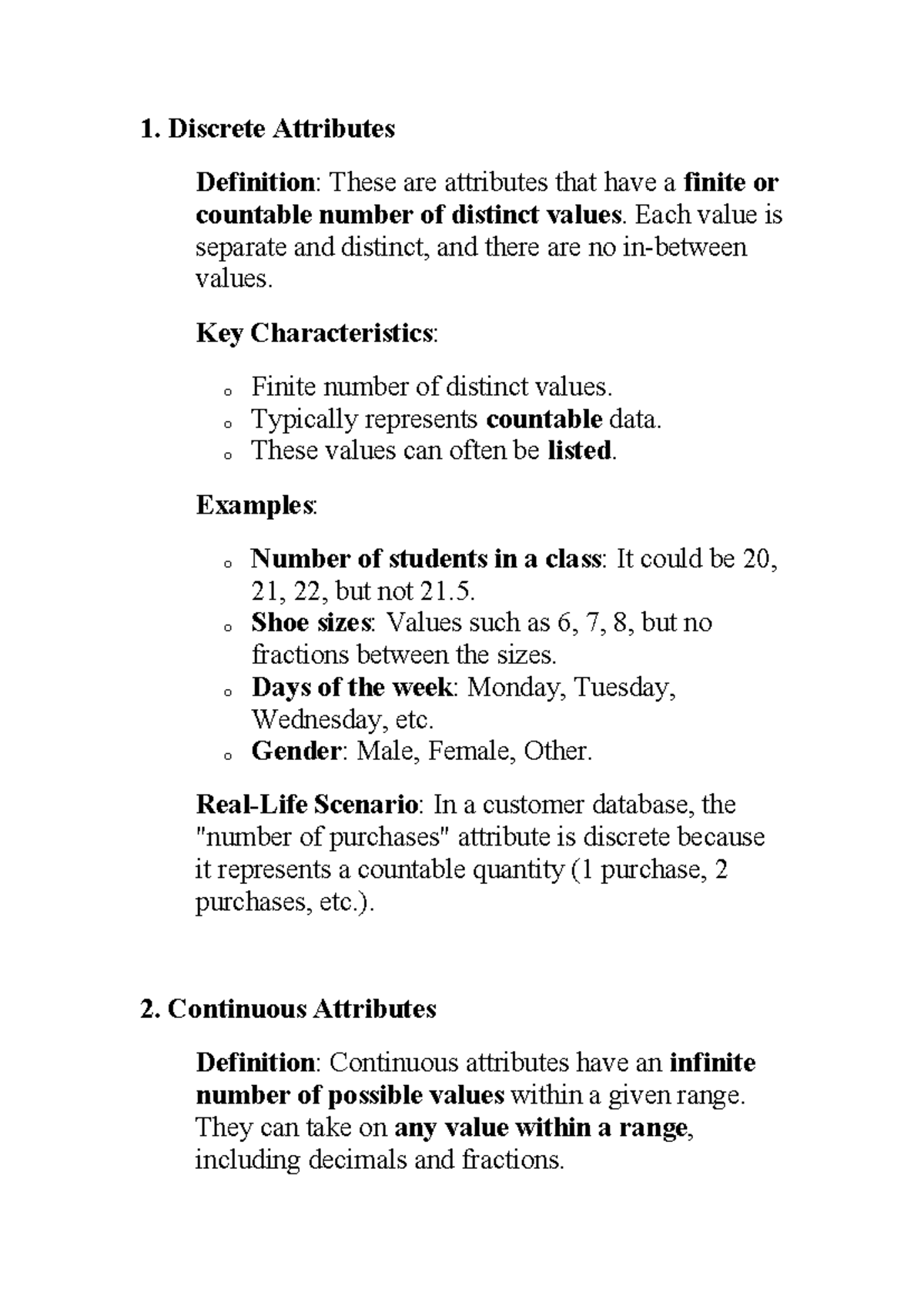
- Attribute Data (Qualitative/Discrete Data): Information gathered by counting discrete outcomes. Attribute data is often binary (Pass/Fail, Accept/Reject, Defective/Non-defective) or categorical (Color: Red, Blue, Green). For instance, inspecting a circuit board and recording whether it is "defective" yields attribute data. Control charts designed for this data type include $p$-charts, $np$-charts, $c$-charts, and $u$-charts.
- Variable Data / Quality Characteristics (Quantitative/Continuous Data): Information obtained by measuring a physical characteristic on a continuous scale. Examples include measuring a steel rod's diameter in millimeters or a liquid's viscosity in centipoise. Because variable data measures continuous characteristics, quality engineers use control charts such as $\bar{X}$ and $R$ charts or $\bar{X}$ and $S$ charts.
Understanding this distinction prevents severe analytical errors; applying a continuous Gaussian statistical model to discrete attribute pass/fail counts invalidates quality control metrics.
Context 3: Linguistics, Psychology, and Biological Taxonomy
Outside technical engineering and system design, humanities and biological sciences apply these terms based on whether a property is intrinsic or external.
Linguistic Syntactic Functions
In English grammar, the term "attribute" has a specialized structural meaning. An attributive adjective sits directly adjacent to the noun it modifies (usually before it), establishing a direct modifier-noun relationship without a linking verb.
- Attributive Usage: "The reliable system processed the batch." (Here, "reliable" acts as an attributive adjective modifying "system.")
- Predicative Usage: "The system is reliable." (Here, "reliable" functions predicatively via the linking verb "is.")
Conversely, grammar never uses "characteristic" as a structural syntactic label; rather, "characteristic" functions purely as a semantic noun describing an underlying trait.
Psychology and Biological Taxonomy
In biological taxonomy and genetics, evolutionary biologists analyze phenotypic characteristics (or traits) to classify species. Organisms inherit traits such as coat density, photosynthetic pathways, or skeletal structures through genetic expression. These inherent traits reflect biological characteristics.
In contrast, social psychologists and behavioral researchers often differentiate between:
- Personal Characteristics: Stable, internal traits such as introversion, cognitive processing speed, or neurodivergence.
- Attributed Traits (Attributes): Social perceptions, titles, reputations, or authority levels assigned to an individual by a peer group or societal institution.
Direct Comparison: Attribute vs. Characteristic
To clarify operational differences, the following matrix summarizes how attributes and characteristics differ across core operational criteria:
| Dimension | Attribute | Characteristic |
|---|---|---|
| Primary Domain Usage | Computer Science, Database Design, Data Engineering, Grammar | Quality Control, Physics, Biology, Psychology, Materials Science |
| Fundamental Nature | Extrinsic, assigned, categorical, or metadata-driven | Intrinsic, inherent, structural, or behavioral |
| Data Representation | Key-value pairs, string labels, relational schema columns, counts | Continuous physical measurements, qualitative traits, performance metrics |
| System Mutability | Highly fluid; easily assigned, updated, or dropped programmatically | Relatively stable; deeply linked to physical or biological structure |
| Statistical Context (SPC) | Discrete count data (Pass/Fail, Defect Counts, Go/No-Go) | Continuous variable data (Length, Mass, Resistance, Temperature) |
| Standardization Framework | ISO/IEC 11179 (Metadata Registries), W3C RDF, UML Standards | ISO 9000 (Quality Management), ASTM Testing Standards |
| Representative Examples | user_role="admin", order_status, syntactic adjective placement |
Tensile strength (500 MPa), eye color, boiling point (100°C) |
Data Architecture Deep Dive: Entity-Attribute-Value (EAV) vs. Domain Characteristics
In enterprise software architecture, confusing business domain characteristics with computational attributes can degrade system scalability and schema clarity.
The Entity-Attribute-Value (EAV) Pattern
When designing systems that manage items with thousands of unpredictable features—such as an e-commerce catalog featuring electronics, clothing, and food—relational database schemas struggle if developers try to create dedicated columns for every single physical characteristic.
To solve this, software architects implement the Entity-Attribute-Value (EAV) schema design pattern. Instead of mapping every physical characteristic to a static table column, the system stores properties dynamically as flexible key-value attributes:
Entity Table
| Entity_ID |
|---|
| 1001 (Product) |
| 1002 (Product) |
Attribute Table
| Attribute_ID |
|---|
| 1 (Color) |
| 2 (Weight) |
Value Table
| Entity_ID | Attribute_ID | Value |
|---|---|---|
| 1001 | 1 | Blue |
| 1001 | 2 | 1.5 kg |
In an EAV design:
- The physical product possesses real-world characteristics (e.g., a laptop's thermal output, screen size, or shell material).
- The database normalizes these properties into generic, queryable attributes (
screen_size_inches,chassis_material).
By converting physical domain characteristics into database attributes, software engineers build flexible systems capable of storing disparate item properties without requiring continuous SQL ALTER TABLE operations.
For detailed technical specifications on metadata registries and standardized attribute structures, developers can consult the ISO/IEC 11179 Metadata Registries Standard.
Common Pitfalls and Misconceptions
Misusing these technical terms can obscure system specifications, introduce statistical bias, or impair technical documentation clarity.
Pitfall 1: Referring to Database Schema Fields as "Characteristics"
- Incorrect: "We need to add three new characteristics to the customer PostgreSQL table."
- Correct: "We need to add three new attributes (or columns) to the customer PostgreSQL schema."
- Why it matters: Database theory explicitly defines tables as entity sets made of attributes. Using non-standard terminology creates ambiguity during technical reviews and code refactoring.
Pitfall 2: Confusing Attribute Inspection with Variable Measurement in Quality Audits
- Incorrect: "We performed attribute testing on the shaft thickness and found an average of 14.02 mm."
- Correct: "We measured the shaft thickness as a continuous quality characteristic, recording an average of 14.02 mm."
- Why it matters: Numeric measurements along a continuous scale represent variable data (measuring a characteristic). Attribute testing yields discrete pass/fail or count data. Confusing the two leads analysts to select wrong control charts, compromising quality assurance.
Pitfall 3: Overlooking Context in Machine Learning Feature Engineering
In Machine Learning (ML), engineers frequently debate the distinction between "features," "attributes," and "characteristics":
- An attribute is a raw input data field extracted from a dataset (e.g., raw sensor data or user record fields).
- A characteristic describes an underlying property of the distribution or physical system generating the data.
- A feature is an engineered, transformed numerical representation of an attribute optimized for model training (e.g., a normalized log-transformed vector).
Treating raw database attributes as engineered features without preprocessing often introduces noise and degrades model accuracy.
Decision Framework: Choosing the Right Term
When selecting between "attribute" and "characteristic" for documentation, schema design, or scientific reporting, follow this step-by-step decision framework:
- Identify Property
- Is it an assigned field, system key, or metadata entry?
- Use: ATTRIBUTE
- Relational Schema Columns
- Key-Value Configurations
- Discrete Pass/Fail Counts
- Syntactic Modifiers
- Use: ATTRIBUTE
- Is it an inherent, physical, or behavioral trait?
- Use: CHARACTERISTIC
- Physical Measurements
- Biological Traits
- Performance Qualities
- Material Properties
- Use: CHARACTERISTIC
- Is it an assigned field, system key, or metadata entry?
- Is the property assigned by an administrative system, data schema, or user choice?
- Yes: Use attribute. (e.g.,
user_access_level,product_sku).
- Yes: Use attribute. (e.g.,
- Is the property an inherent physical, biological, or operational quality of the object itself?
- Yes: Use characteristic. (e.g., chemical volatility, tensile yield point, human temperament).
- Are you conducting statistical quality control based on discrete counts (pass/fail, defect count)?
- Yes: Use attribute data.
- Are you measuring physical dimensions on a continuous numerical scale?
- Yes: Use variable data to quantify a characteristic.
- Are you writing software code, UML diagrams, or database migration scripts?
- Yes: Use attribute (or language-specific primitives such as property, field, or member variable).
Frequently Asked Questions
Is an attribute the same as a feature in machine learning?
No. An attribute is typically a raw data field in a dataset (such as an input column in a CSV or SQL table). A feature is an engineered, processed representation of an attribute designed specifically for algorithm training—such as a scaled numerical value, one-hot encoded categorical vector, or calculated ratio derived from raw attributes.
What is the difference between attribute data and variable data in Six Sigma?
Attribute data consists of discrete counts or categorical classifications (e.g., Pass/Fail, Go/No-Go, or counting the number of surface scratches on a car door). Variable data represents continuous measurements of physical characteristics along a numerical scale (e.g., measuring precise door thickness in millimeters or paint mass in grams).
Can a characteristic become an attribute in software design?
Yes. When a physical or domain characteristic (such as an engine's thermal operating limit) is measured, structured, and saved into a database schema field or JSON payload key, that real-world characteristic is modeled inside the software as an attribute (max_operating_temp_celsius).
What is an attributive noun in English linguistics?
An attributive noun (or noun adjunct) is a noun that stands before another noun to modify it, functioning syntactically like an adjective. Examples include "database schema," "quality control," or "computer system." In these phrases, "database," "quality," and "computer" are nouns functioning attributively.
Are attributes and properties identical in programming?
In most modern programming contexts (such as Python, C#, or JavaScript), "attribute" and "property" are used interchangeably to mean variables bound to a specific class or instance. However, some languages draw subtle distinctions: in Python, all instance variables are attributes, while a "property" specifically refers to an attribute managed via getter and setter decorator methods (@property).
Next Steps and Best Practices
To enforce consistent, professional terminology across your team's technical writing and engineering projects:
- Audit Technical Specifications: Review active database documentation, API schemas, and UML models. Ensure metadata fields, schema columns, and key-value configurations are systematically designated as attributes.
- Standardize Quality Assurance Guidelines: Align your Quality Management System (QMS) terminology with ISO 9000:2015. Clearly separate attribute inspection charts (discrete counts) from continuous characteristic measurements (variable data) in operational procedures.
- Establish Team Style Guides: Add a clear section to your engineering or technical writing style guide defining when to use "attribute," "characteristic," and "feature," reducing ambiguity across technical specifications and architectural documentation.