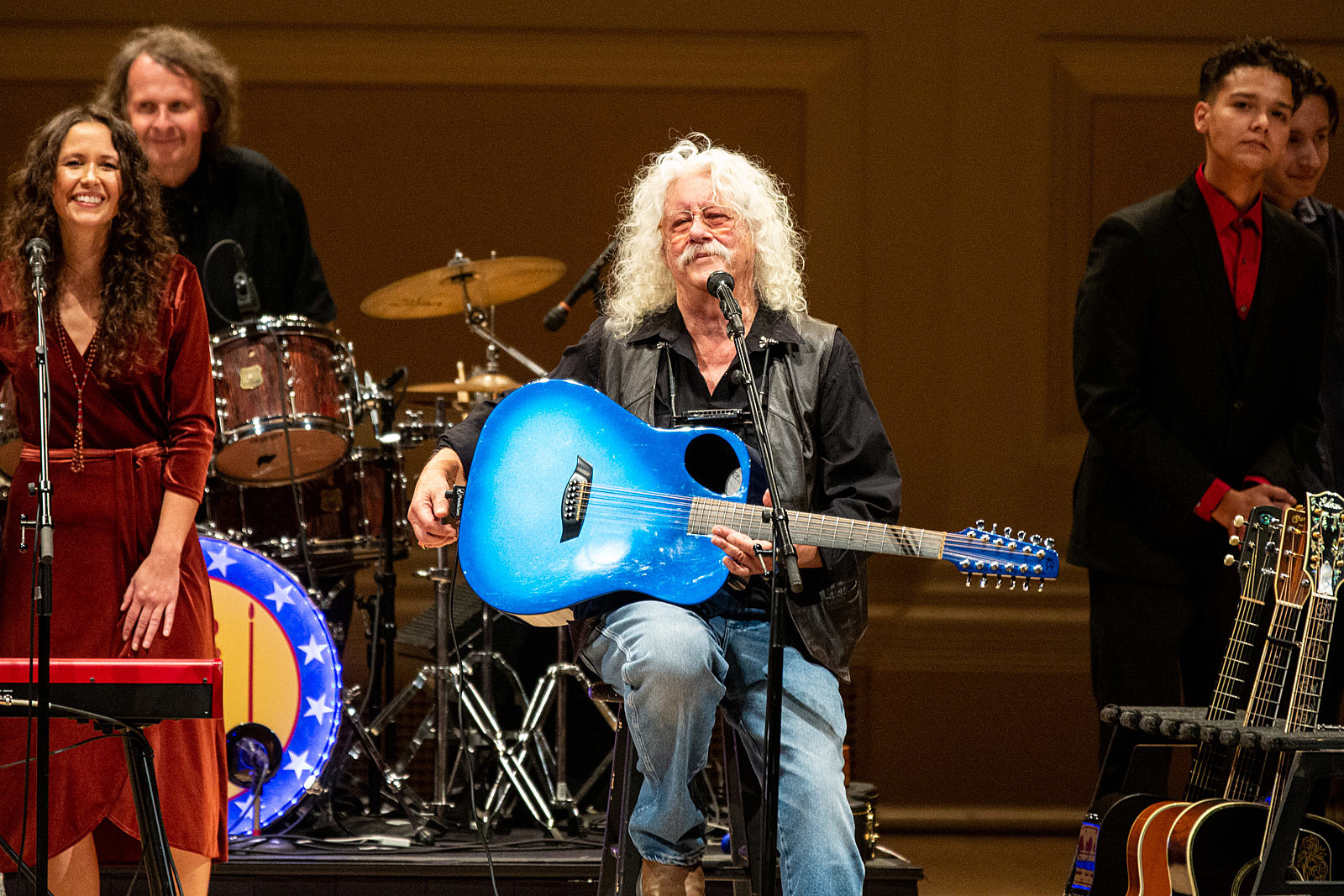
Arlo Guthrie’s politics represent a complex journey from the radical folk activism of the 1960s to a nuanced, fiercely independent libertarianism in his later years. While famous for the anti-war anthem "Alice’s Restaurant Massacree," Guthrie later registered as a Republican and supported Ron Paul, ultimately prioritizing individual liberty and local community action over rigid partisan ideologies or federal bureaucracy.
Arlo Guthrie is an artist whose political identity is often shrouded in the long shadow of his father, the legendary dust-bowl balladeer Woody Guthrie. However, to understand Arlo Guthrie’s politics in 2026, one must look beyond the "Red Diaper Baby" labels of his youth. His political life has been defined not by a static adherence to the New Left, but by a consistent distrust of authority, a commitment to civil liberties, and an evolving belief that real change happens at the dinner table and the local church, rather than in the halls of Congress.
The Roots of Resistance: Growing Up Guthrie
To analyze Arlo’s politics, one must first recognize the environment in which he was raised. As the son of Woody Guthrie, Arlo was immersed in a world where music and social justice were inseparable. Woody’s guitar famously bore the inscription "This Machine Kills Fascists," and the Guthrie household was a revolving door for activists, union organizers, and folk legends like Pete Seeger.
However, Arlo’s early political identity was less about Marxist theory and more about the humanism he observed in his father’s work. While Woody focused on the collective—the "Union" and the "Big We"—Arlo’s sensibilities began to lean toward the "I." Even in his early career, there was a sense of the individual standing against a nonsensical system. This distinction would eventually lead him down a very different political path than many of his folk-singing contemporaries.
The Impact of "Alice's Restaurant"
The 1967 release of "Alice's Restaurant Massacree" remains the definitive document of Arlo’s early political influence. While often categorized as a "protest song," it is specifically a critique of the absurdity of the military-industrial complex and the draft.
The narrative—based on Arlo's actual arrest for littering in Stockbridge, Massachusetts—highlights the bureaucratic madness of the Vietnam War era. By being deemed "morally unfit" for the draft because of a littering conviction, Guthrie exposed the contradictions of a government that would send young men to kill but wouldn't allow them to serve if they had a minor criminal record for "litterin'." This song galvanized the anti-war movement, not through ideological lectures, but through the power of ridicule.
The Great Pivot: From the New Left to Libertarianism
By the late 1980s and early 1990s, Guthrie’s political trajectory began to diverge significantly from the expected trajectory of a 1960s icon. He began to express frustration with the Democratic Party, which he felt had become bloated, overly bureaucratic, and disconnected from the individual liberties it once claimed to champion.
In a move that shocked much of his fanbase, Arlo Guthrie registered as a Republican in the early 2000s. He later clarified that this wasn't an endorsement of the entire GOP platform, but rather a "protest" against the lack of options and a specific alignment with the libertarian wing of the party.
The Ron Paul Endorsement
The most significant evidence of Arlo Guthrie's political shift came during the 2008 and 2012 presidential cycles when he publicly endorsed Ron Paul. Guthrie’s support for Paul was rooted in a shared belief in non-interventionist foreign policy, the protection of the Bill of Rights, and a reduction in the size of the federal government.
Guthrie’s "politics of the individual" resonated with Paul’s libertarian message. He famously stated that he was a "Republican" only because the party of his father (the Democrats) had drifted too far toward government dependency. For Arlo, the true "folk" tradition was about self-reliance and being left alone by the state—a sentiment that aligns more with Jeffersonian democracy than with modern progressive liberalism.
The Guthrie Center and Politics of the Local
Perhaps the most authentic expression of Arlo Guthrie’s politics is the Guthrie Center, located at the Old Trinity Church in Van Deusenville, Massachusetts. This is the same church where the events of "Alice's Restaurant" began.
Founded in 1991, the center is an interfaith sanctuary and a community resource. Guthrie’s political philosophy here is "think globally, act locally." Rather than lobbying for national legislation, the center focuses on:
- Food Security: Providing free lunches and community meals.
- Interfaith Dialogue: Bringing together people of different faiths to find common ground.
- Educational Support: Providing a space for local artists and students.
In 2026, the Guthrie Center stands as a testament to Arlo’s belief that the "politics of kindness" and local charity are more effective than federal social programs. He has often argued that when the government takes over the role of the neighbor, the community loses its soul.
Comparing the Political Eras of Arlo Guthrie
The following table outlines the transition of Arlo Guthrie's political focuses over the decades, highlighting his movement from specific anti-war activism to a broader philosophy of individual liberty.
| Period | Primary Political Alignment | Core Issues | Key Actions/Statements |
|---|---|---|---|
| 1960s - 1970s | New Left / Anti-War | Vietnam Draft, Civil Rights, Environmentalism | Wrote "Alice's Restaurant," performed at Woodstock, supported George McGovern. |
| 1980s - 1990s | Independent / Localist | Community self-reliance, Interfaith cooperation | Founded the Guthrie Center, moved away from national partisan campaigning. |
| 2000s - 2010s | Libertarian / Republican | Small government, Non-interventionism, Second Amendment | Registered as Republican (2004), endorsed Ron Paul for President (2008, 2012). |
| 2020s - 2026 | Independent Elder Statesman | Civil liberties, Individual sovereignty, Digital privacy | Retired from touring; focuses on archival work and social commentary through the Guthrie Center. |
Contemporary Views: Arlo in the 2020s
Following his retirement from touring in 2020 after a series of mini-strokes, Arlo Guthrie has remained a vocal commentator on social media. His politics in the mid-2020s are characterized by a deep skepticism of "cancel culture," government mandates, and the polarization of American life.
He frequently posts reflections that challenge both the left and the right. To Arlo, the modern political landscape is a "circus" where both sides are trying to control the narrative of the individual. He remains a staunch defender of the First Amendment, often reminding his audience that the right to speak is the foundation of all other freedoms.
The Environmental Legacy
Despite his shift toward libertarianism, Guthrie has never abandoned his environmental roots. He continues to support the Hudson River Sloop Clearwater, the organization founded by his friend Pete Seeger. However, his approach to environmentalism is often framed as stewardship rather than top-down regulation. He believes that those who live on the land are its best protectors, not bureaucrats in distant offices.
The Disambiguation of the "Guthrie Name"
A common point of confusion for researchers is the assumption that Arlo’s politics must mirror those of his father, Woody, or his children, who are also active in the music scene. While the Guthrie family shares a core value of social empathy, they are not a political monolith.
Woody Guthrie was a staunch supporter of the labor movement and had deep ties to the Communist Party of the USA (though it is debated if he was ever a formal member). Arlo, conversely, found his political home in the defense of the individual against all large institutions—including unions and corporations if they infringe on personal liberty.
Troubleshooting Common Misconceptions
When researching Arlo Guthrie’s politics, several common errors often appear in contemporary reporting. It is essential to verify these points:
- "Arlo Guthrie is a Conservative": This is an oversimplification. While he registered as a Republican, his views on drug decrimilization, anti-war policy, and gay rights (which he has supported for decades) do not align with the religious right or traditional neoconservatism.
- "He abandoned his father's legacy": Guthrie views his libertarianism as the logical conclusion of the folk tradition. To him, the "common man" is best served when he is free from the dictates of any ruling class, whether they wear suits or overalls.
- "Alice's Restaurant is a hippie song": While it became a hippie anthem, Arlo has always described himself as more of a "traditionalist" who happened to have long hair. His critique was of the system’s logic, not necessarily a call for a counter-culture revolution.
FAQ: Understanding Arlo Guthrie's Political Stance
Is Arlo Guthrie still a registered Republican? As of the mid-2020s, Arlo Guthrie generally identifies as an Independent. While he used the Republican registration in the 2000s to support specific candidates like Ron Paul and to protest the Democratic Party's direction, he has stated that he does not feel at home in either major party.
Did Arlo Guthrie ever run for political office? No, Arlo Guthrie has never sought public office. He has consistently maintained that he can do more good as a "clown" or a "storyteller" than as a politician. He prefers to influence culture and community directly through his foundation and music.
How does Arlo Guthrie view the "This Land is Your Land" legacy? Arlo views the song not just as a patriotic anthem, but as a reminder of the shared responsibility of all people to care for the earth and each other. He often performs the "forgotten" verses of the song (which deal with private property and hunger) to ensure the political weight of his father’s message is not lost to commercialization.
What is Arlo's stance on the Second Amendment? Unlike many of his folk-era peers, Arlo Guthrie has expressed support for the right to bear arms, viewing it as a fundamental component of individual liberty and self-reliance. This is one of several issues where his libertarian leanings deviate from the modern progressive platform.
How has his health affected his political activism? Since his 2020 retirement, his activism has moved from the stage to the digital realm. He uses his platform to encourage "common sense" and "neighborliness," often steering clear of the vitriolic partisan debates that dominate modern social media in favor of historical perspective and humor.
Final Recommendation: Engaging with Guthrie's Legacy
To truly understand Arlo Guthrie’s politics, one should not look for a party platform. Instead, listen to his live recordings where he tells long, rambling stories between songs. It is in these anecdotes that his true philosophy emerges: a belief in the inherent dignity of the individual, a healthy skepticism of anyone in a uniform, and a deep-seated conviction that humor is the best weapon against tyranny.
For those looking to explore this further, visiting the Guthrie Center or reading his ongoing "Arlo’s Note" columns provides the most direct access to his current thinking. In 2026, Arlo Guthrie remains a vital voice, reminding us that being "political" is often as simple as helping your neighbor and questioning the people in charge.