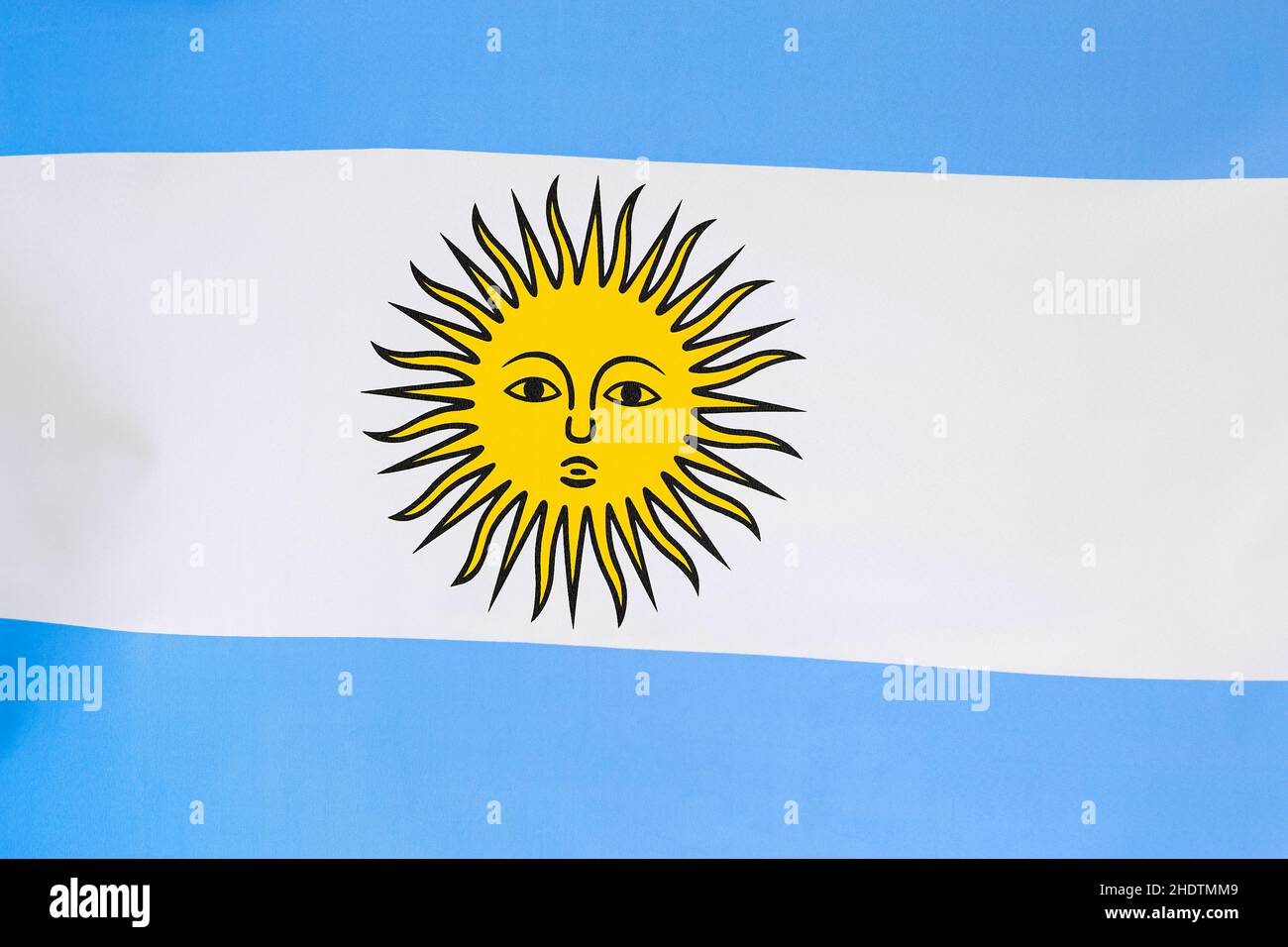
The colors of the Argentine flag, sky blue (celeste) and white, traditionally represent the sky and clouds, though historical evidence suggests they were originally chosen to signify loyalty to the House of Bourbon. The central "Sun of May" (Sol de Mayo) symbolizes the Inca sun god, Inti, and marks the dawn of Argentine independence in 1810.
The Argentine flag, known as the Albiceleste, is one of the most recognizable national symbols in the world. While its aesthetic is simple—three horizontal bands of sky blue and white—the history behind these choices is a complex tapestry of revolutionary politics, religious devotion, and indigenous heritage. As of 2026, the flag remains a potent symbol of national identity, governed by strict ceremonial protocols and historical interpretations that have evolved over two centuries.
The Origins of the Albiceleste: Manuel Belgrano’s Vision
The flag was created by Manuel Belgrano, an economist, lawyer, and military leader, during the Argentine War of Independence. On February 27, 1812, in the city of Rosario, Belgrano raised the sky blue and white flag for the first time by the banks of the Paraná River. At the time, the United Provinces of the Río de la Plata (the precursor to modern Argentina) were in open revolt against Spanish colonial rule.
Belgrano’s decision to create a distinct flag was born out of military necessity. Soldiers were using a variety of colors, often mirroring those of the Spanish forces, which led to confusion on the battlefield. By establishing a unique cockade (escarapela) and subsequently a flag, Belgrano provided his troops with a unified visual identity. However, the First Triumvirate (the governing body in Buenos Aires at the time) initially rejected the flag, fearing it would appear as an outright declaration of independence before they were politically ready to handle the repercussions from Europe.
Interpreting the Colors: Sky, Religion, or Royalty?
There are three primary schools of thought regarding why Manuel Belgrano chose sky blue and white. While the "sky and clouds" explanation is taught to most Argentine schoolchildren, historians often point to more pragmatic and political origins.
1. The Naturalist Interpretation: Sky and Clouds
The most popular and romanticized version is that the colors represent the sky and the clouds. Legend suggests that Belgrano looked up at the sky over the Paraná River and was inspired by the colors of the firmament. This interpretation aligns with the Argentine National Anthem, which references "the sky's colors" in relation to the nation’s birth.
2. The Religious Interpretation: The Virgin Mary
In the early 19th century, Catholicism was deeply intertwined with social and political life. The colors blue and white are traditionally associated with the Virgin Mary, specifically the Immaculate Conception. Belgrano was a devout Catholic, and many historians believe he chose these colors to place the revolutionary movement under the protection of the Virgin. The Order of Charles III, a Spanish order of knighthood, also used these colors in honor of the Virgin, which leads into the third theory.
3. The Political Interpretation: The House of Bourbon
This theory is the most historically supported among academic circles. During the early stages of the revolution, the patriots claimed they were not rebelling against the Spanish King Ferdinand VII, but rather against the French occupation of Spain. They argued they were ruling in the King's name until he was restored to the throne. This was known as the "Mask of Ferdinand VII."
The House of Bourbon, the ruling family of Spain, used sky blue and white as their representative colors (seen in the sash of the Order of Charles III). By adopting these colors, Belgrano and the revolutionary government could signal their "loyalty" to the legitimate Spanish crown while effectively operating as an independent state. This provided a layer of diplomatic protection during a volatile era.
The Sun of May: A Symbol of Independence
The golden sun in the center of the flag, known as the Sol de Mayo, was added in 1818 by the Congress of Tucumán. It is not merely an aesthetic addition; it is a profound symbol of the nation's emergence.
The sun represents the 1810 May Revolution, which marked the beginning of the end for Spanish rule in the region. According to accounts of the time, as the new government was being proclaimed in Buenos Aires on May 25, 1810, the sun suddenly broke through heavy clouds and rain. This was interpreted by the gathered crowds as a divine omen of success.
Vexillological Details of the Sun
The Sun of May is a radiant golden yellow sun with a human face. Its design is modeled after the 1813 Argentine coin, which in turn was inspired by the Inca sun god, Inti.
The technical specifications of the sun are strictly defined:
- Rays: The sun features 32 rays.
- Pattern: 16 rays are straight, and 16 are wavy (flaming), arranged in an alternating pattern.
- Face: The "face" of the sun is depicted with a serene expression, symbolizing peace and the dawn of a new era.
Evolution of the Flag’s Design and Use
For much of the 19th and early 20th centuries, Argentina actually used two different versions of the flag. This distinction is vital for understanding the flag’s ceremonial history.
- Official Ceremonial Flag (Bandera Oficial de Ceremonia): This version features the Sun of May. Historically, it was reserved for the federal government, the military, and provincial governments.
- Ornamental Flag (Bandera de Ornato): This version consisted only of the three stripes without the sun. It was the version intended for use by private citizens and businesses.
This changed in 1985 with the passing of Law 23.208, which decreed that there is only one national flag. Today, all Argentine citizens, institutions, and organizations have the right to use the flag with the Sun of May, provided it is treated with the appropriate respect and honor.
Technical Specifications and Standardization
In 2010, the Argentine government updated the technical standards for the flag to ensure uniformity across all national displays. These standards define the exact shades of blue and the proportions of the sun.
| Feature | Specification |
|---|---|
| Proportions | 9:14 (Height to Width) |
| Color (Celeste) | Pantone 284C / RGB (119, 172, 219) |
| Color (White) | Pure White |
| Color (Gold) | Pantone 1235C / RGB (252, 191, 73) |
| Sun Diameter | 1/3 the height of the white stripe |
| Sun Rays | 32 alternating straight and wavy |
Cultural Significance and Ceremonies
The flag is more than a piece of fabric; it is a central figure in Argentine civic life. Every June 20th, Argentina celebrates National Flag Day, commemorating the anniversary of Manuel Belgrano's death in 1820.
The Pledge of Allegiance
One of the most significant moments for Argentine youth is the "Promise to the Flag" (Promesa a la Bandera). In the fourth grade of primary school, students across the country participate in a formal ceremony where they pledge their loyalty and respect to the national symbol. This ritual reinforces the flag as a representation of the "motherland's heart" and the shared values of freedom and justice.
The National Flag Memorial
In Rosario, the site where the flag was first raised, stands the Monumento Nacional a la Bandera (National Flag Memorial). It is a massive stone complex that houses the ashes of Manuel Belgrano and serves as the epicenter of Flag Day celebrations. The memorial is a pilgrimage site for many Argentines, representing the birth of the nation’s visual identity.
Common Misconceptions About the Argentine Flag
Despite its clear history, several myths persist regarding the Albiceleste. Clarifying these is essential for a complete understanding of its meaning.
- The "Blue" vs. "Sky Blue" Debate: There has been historical debate over whether the blue should be a darker "Azul" or a lighter "Celeste." While some 19th-century variations were darker, modern laws firmly establish the "Celeste" (Sky Blue) shade as the official color.
- The Sun is NOT the Spanish Sun: While the sun was a common motif in European heraldry, the Argentine Sun of May specifically draws its lineage from the Inca deity Inti, signifying a deliberate link between the new republic and the pre-colonial history of the Americas.
- Usage Restrictions: Many believe it is illegal for a common citizen to fly the flag with the sun. As mentioned, this was true prior to 1985, but current law encourages all citizens to use the full version with the Sun of May.
Comparison: The Flags of the Río de la Plata
The influence of the Argentine flag is evident in the flags of neighboring countries, particularly Uruguay. Both nations share a history of resistance against Spanish and Brazilian rule, and their flags reflect this common origin.
| Feature | Argentina | Uruguay |
|---|---|---|
| Primary Colors | Sky Blue and White | Blue and White |
| Pattern | 3 Horizontal Bands | 9 Horizontal Stripes |
| Sun Symbol | Sol de Mayo (32 rays) | Sol de Mayo (16 rays) |
| Creator/Inspiration | Manuel Belgrano | Based on Argentine/US designs |
| Meaning of Sun | Independence/Inca Inti | Independence/May Revolution |
FAQ
Who designed the Argentine flag?
The Argentine flag was designed by Manuel Belgrano in 1812. He was a prominent military leader and lawyer who sought to distinguish his revolutionary troops from the Spanish forces.
Why does the Argentine flag have a sun?
The sun, known as the Sun of May, was added in 1818 to represent the 1810 May Revolution. It symbolizes the birth of the nation and independence, and its design is inspired by the Inca sun god, Inti.
What do the colors sky blue and white mean?
While they are often said to represent the sky and clouds, historians believe the colors were originally chosen to show loyalty to the House of Bourbon (the Spanish royalty) while the King was imprisoned by Napoleon, or to represent the Virgin Mary's Immaculate Conception.
Is the Sun of May always required on the flag?
According to the law established in 1985, the official national flag of Argentina must include the Sun of May. While simplified versions without the sun are sometimes seen in casual settings, the official version used by all citizens and the state includes the sun.
How many rays are on the sun in the Argentine flag?
The Sun of May on the Argentine flag has 32 rays: 16 straight rays and 16 wavy (flaming) rays, which alternate around the sun's face.
Conclusion and Recommendations
The colors and symbols of the Argentine flag serve as a bridge between the country’s colonial past, its revolutionary struggle, and its modern identity. Whether viewed as a tribute to the Virgin Mary, a political maneuver involving the House of Bourbon, or a literal representation of the South American sky, the Albiceleste remains the ultimate symbol of Argentine sovereignty.
For those interested in the historical preservation of these symbols, a visit to the National Flag Memorial in Rosario is highly recommended. Additionally, researchers should consult the National Academy of History of the Argentine Republic for access to primary documents regarding the 1812 and 1818 decrees. Understanding the flag requires looking beyond the fabric to the ideals of Manuel Belgrano—a man who sought to create a symbol that would unite a diverse and burgeoning nation.