A DBMS architecture is the structural framework that defines how data is stored, managed, and accessed by users and applications. It establishes the relationship between hardware, software, and data layers, typically categorized into tiered models (1-tier, 2-tier, 3-tier) or functional levels (external, conceptual, and internal) to ensure scalability, security, and data independence.
Understanding the Fundamental Concept of DBMS Architecture
Architecture in a Database Management System (DBMS) acts as a blueprint that dictates how a system is built, how users interact with the data, and how the underlying hardware processes requests. In 2026, as data volumes reach exabyte scales and real-time processing becomes the standard, understanding these architectural nuances is critical for software engineers, database administrators (DBAs), and system architects.
The primary goal of a well-designed DBMS architecture is to separate the user's view of the data from the physical reality of how that data is stored on a disk or in a cloud cluster. This separation is known as data independence. By creating layers of abstraction, developers can modify the storage hardware or the database schema without forcing every end-user application to be rewritten.
Modern DBMS designs are usually categorized in two ways: by the number of tiers (the physical distribution of components) and by the internal schema levels (the logical abstraction of data). Both are essential for creating a system that is performant, secure, and easy to maintain over time.
The Physical Tiered Architectures
Physical architecture refers to how the various components of the DBMS are distributed across different machines or processes. Choosing the right tier model depends on the organization's needs for security, budget, and scalability.
1-Tier Architecture
The 1-tier architecture is the simplest form of database design. In this model, the user, the application logic, and the database itself reside on the same machine. There is no network communication involved in the data retrieval process.
In 2026, 1-tier systems are rarely used for enterprise-level production environments but remain vital for specific use cases. Developers utilize 1-tier setups for local testing, prototyping, and small-scale standalone applications where performance is less of a concern than simplicity. Because the user has direct access to the database files, security is minimal, making it unsuitable for multi-user environments.
2-Tier Architecture
The 2-tier architecture, also known as the client-server architecture, introduces a network layer. The application runs on a client machine (like a PC or a mobile device) and communicates directly with the database server.
Key characteristics include:
- Direct Communication: The client uses an Application Programming Interface (API) such as ODBC (Open Database Connectivity) or JDBC (Java Database Connectivity) to send SQL queries to the server.
- Performance: Because there is only one hop between the user and the data, performance for small numbers of users is often excellent.
- Security Challenges: The database server must manage the security credentials of every individual client, which can become a bottleneck as the user base grows.
While less common for public-facing web applications, 2-tier systems are still prevalent in internal corporate environments (Intranets) where a limited number of trusted employees access a central data repository.
3-Tier Architecture
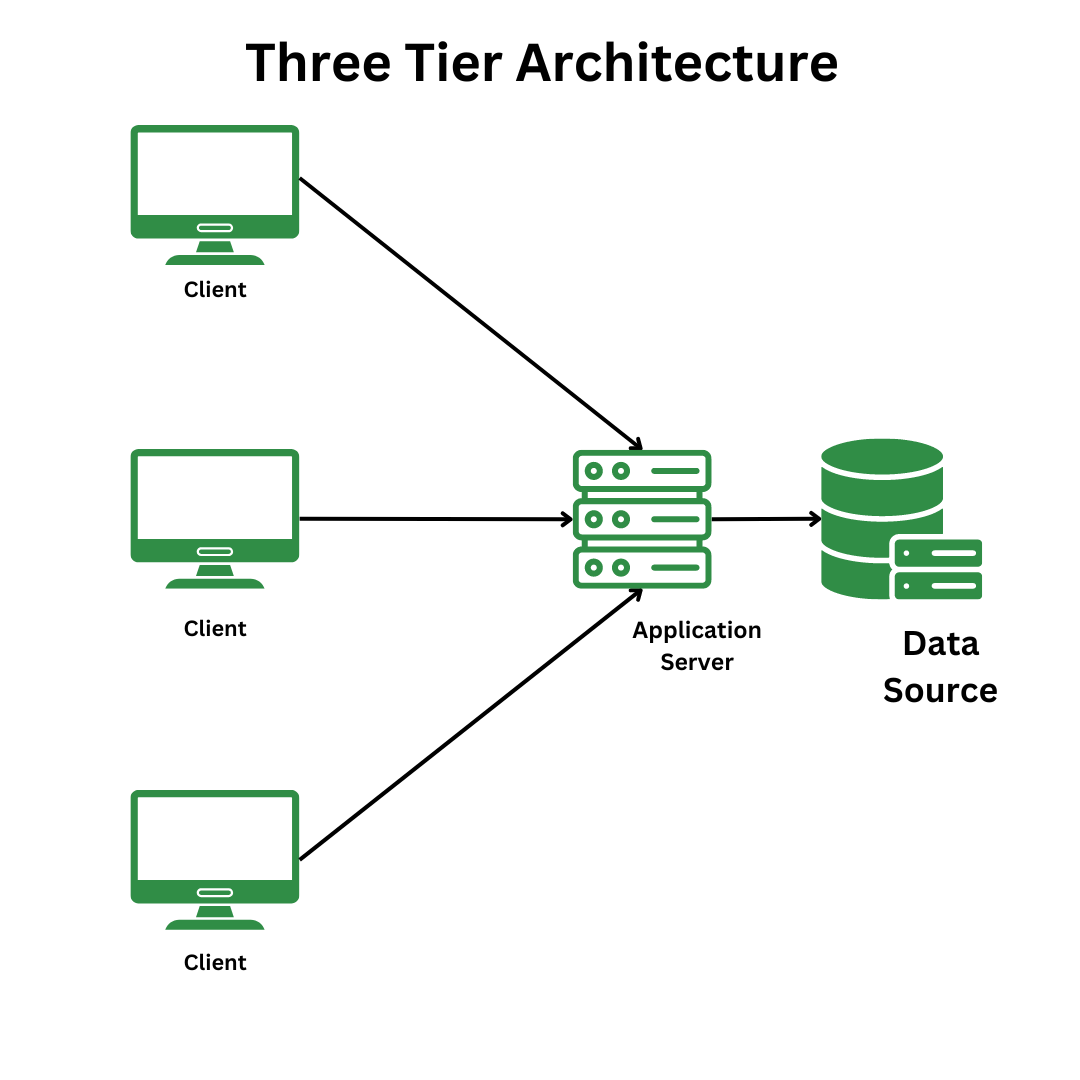
The 3-tier architecture is the industry standard for modern web and mobile applications. It adds an intermediate layer—the Application Server (or Middleware)—between the client and the database.
- Presentation Tier: This is the user interface (web browser or mobile app). It does not know how the database is structured; it only knows how to display data.
- Application Tier (Logic Tier): This layer handles the business logic, calculations, and data validation. It acts as a gateway, receiving requests from the client and translating them into queries for the database.
- Data Tier: This is the DBMS itself, which stores and retrieves the data requested by the application tier.
The 3-tier model provides superior scalability because the application logic is decoupled from the data storage. If the user base triples, you can scale the application servers horizontally without necessarily changing the database configuration. Furthermore, it enhances security by ensuring the database is never directly exposed to the public internet; it only communicates with the trusted application server.
The 3-Schema (ANSI-SPARC) Architecture
While the tiers describe physical locations, the 3-schema architecture (also known as the ANSI-SPARC architecture) describes the logical levels of data abstraction. This framework is what allows a DBMS to provide data independence.
1. External Level (View Level)
The external level is the highest level of abstraction. It defines how individual users or groups of users perceive the data. A database might contain thousands of tables, but a specific user (e.g., an HR manager) only needs to see employee names and salaries.
At this level, "views" are created to simplify the complexity of the underlying database. Multiple views can exist for the same database, each tailored to different business requirements. This ensures that users are not overwhelmed by irrelevant data and adds a layer of security by hiding sensitive fields from unauthorized personnel.
2. Conceptual Level (Logical Level)
The conceptual level describes the entire structure of the database for the whole organization. It defines what data is stored, the relationships between data entities, and the constraints that govern the data (such as "age must be a positive integer").
The conceptual schema is the bridge between the user's view and the physical storage. It uses logical models—like the Relational Model or Entity-Relationship (ER) Model—to organize data into tables, rows, and columns. When a DBA changes the database's logical structure, they are working at the conceptual level.
3. Internal Level (Physical Level)
The internal level is the lowest level of abstraction. It describes exactly how the data is stored on the physical storage media (HDDs, SSDs, or cloud storage blocks). This level covers:
- Data compression and encryption techniques.
- The use of specific data structures like B+ Trees, LSM Trees, or Hashing to index data.
- The allocation of storage space and the record formats used for physical files.
Users and application developers never interact with the internal level directly. The DBMS software handles the complex translation between the conceptual tables and the binary bits stored on a disk.
Data Independence: The Core Benefit
The primary purpose of the 3-schema architecture is to achieve Data Independence. This is categorized into two types:
Logical Data Independence
This is the ability to modify the conceptual schema without requiring changes to the external schemas (user views) or application programs. For example, if you decide to split one large table into two smaller tables to improve normalization, you can update the mapping to ensure the user view remains identical. The user doesn't even realize the underlying logical structure has changed.
Physical Data Independence
This is the ability to change the internal schema without changing the conceptual schema. This is much more common. For instance, if you move your database from a legacy on-premise server to a high-speed NVMe-based cloud storage system, or if you change the indexing method from a B-tree to a Hash index to speed up searches, you do not need to change your SQL queries or your table structures.
Internal Components of a DBMS
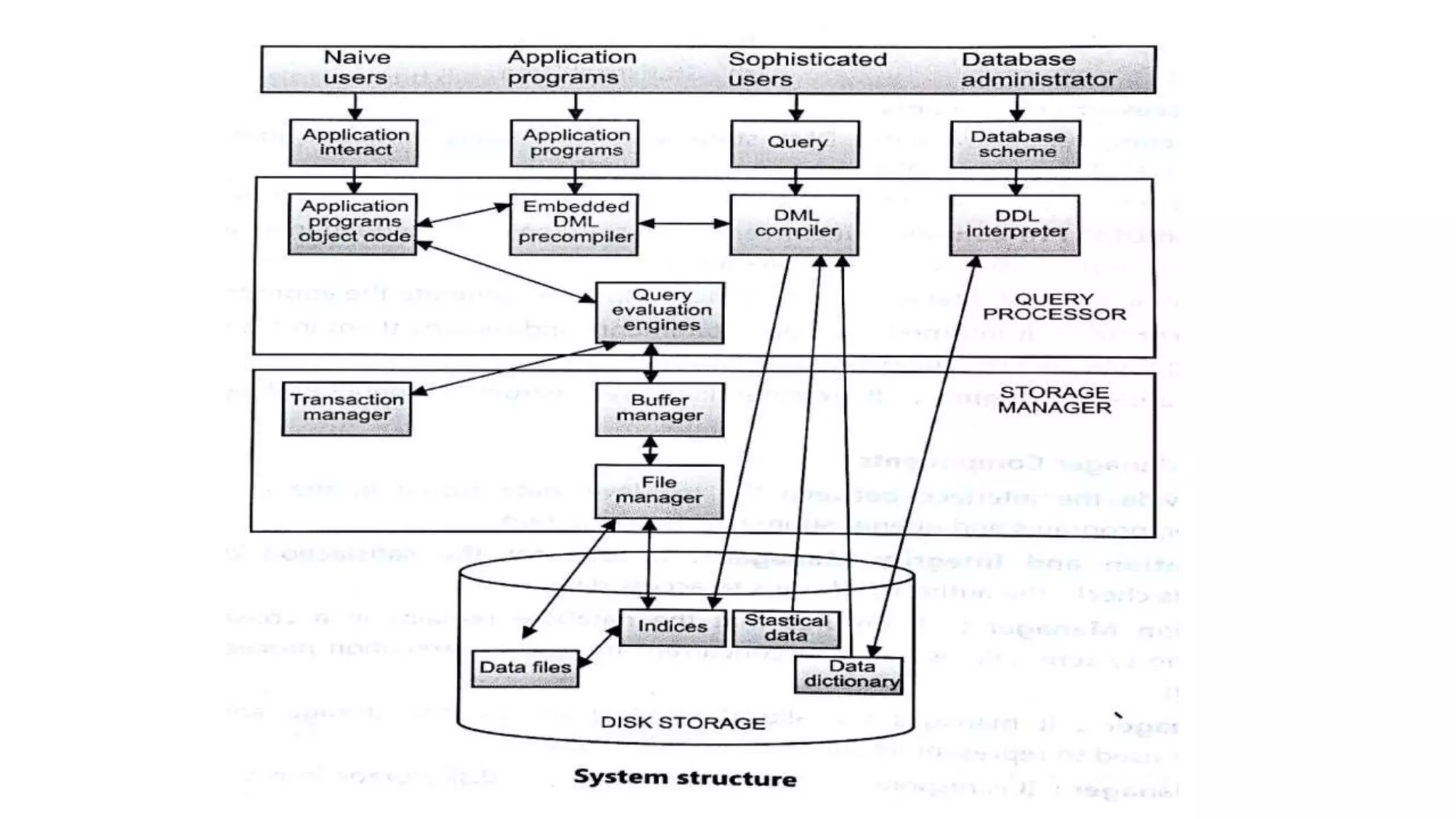
To understand the architecture fully, one must look at the internal software components that make a DBMS functional. These components work together to process queries and ensure data integrity.
The Query Processor
When a user submits an SQL statement, the Query Processor is the first point of contact. It parses the SQL to check for syntax errors, validates the names of tables and columns against the conceptual schema, and then passes the request to the Query Optimizer. The optimizer analyzes different "execution plans" to determine the most efficient way to retrieve the data (e.g., using an index versus a full table scan).
The Storage Manager
The Storage Manager acts as the interface between the low-level data stored on the disk and the high-level queries submitted to the system. It handles:
- Buffer Manager: Manages the cache (RAM) to ensure frequently accessed data is available without hitting the disk.
- File Manager: Manages the allocation of space on the disk.
- Authorization Manager: Verifies that the user has the permissions required to access the requested data.
The Transaction Manager
In a multi-user environment, the Transaction Manager ensures that the database remains in a consistent state even if multiple users are trying to update the same record simultaneously. It enforces the ACID properties (Atomicity, Consistency, Isolation, Durability), preventing data corruption during system crashes or power failures.
Comparison of DBMS Architectures
The following table summarizes the differences between the primary physical architectures used in 2026.
| Feature | 1-Tier Architecture | 2-Tier Architecture | 3-Tier Architecture |
|---|---|---|---|
| User Interface | Same machine as DB | Client machine | Client machine (Web/App) |
| Business Logic | Embedded in DB/User machine | On the Client machine | On a dedicated App Server |
| Scalability | Non-existent | Low to Moderate | Extremely High |
| Security | Low (Direct File Access) | Moderate (Server-side) | High (Database is hidden) |
| Common Use Case | Local development, SQLite | Small office apps, Intranets | Modern Web Apps, E-commerce |
| Maintenance | Difficult for multiple users | Requires client updates | Centralized updates on App Server |
Modern Trends: Distributed and Cloud-Native Architectures
As of 2026, the traditional 3-tier model has evolved into more complex Distributed Architectures. With the rise of global applications, a single database server is often insufficient.
- Shared-Nothing Architecture: In this model, each node in a cluster has its own private memory and disk. No two nodes share the same resources. This is the foundation of modern "NewSQL" and NoSQL databases like CockroachDB and Apache Cassandra. It allows for nearly infinite horizontal scaling.
- Microservices and Database-per-Service: Modern software design often breaks a monolithic application into dozens of tiny services. Each service has its own dedicated database (and sometimes even its own DBMS architecture). This prevents a failure in one part of the system (e.g., the billing database) from crashing the entire application (e.g., the product catalog).
- Serverless Databases: Cloud providers now offer architectures where the database scales up and down automatically based on demand. In this scenario, the "architecture" is managed entirely by the provider, allowing developers to focus solely on the conceptual schema.
Frequently Asked Questions
What is the most common DBMS architecture used today?
The 3-tier architecture is currently the most dominant, especially for web and cloud-based applications. It provides the best balance of security, scalability, and ease of maintenance by separating the presentation, application logic, and data storage.
Why is the 3-schema architecture important?
It is vital because it provides data independence. By separating the physical storage (internal level) from the logical design (conceptual level) and the user's view (external level), it allows organizations to make technical changes to their systems without disrupting users or rewriting application code.
Can a DBMS have both 2-tier and 3-tier components?
Yes, this is often seen in hybrid enterprise environments. A company might use a 3-tier architecture for its customer-facing mobile app while maintaining a 2-tier architecture for its internal administrative tools that connect directly to the database server over a secure private network.
What is the role of mapping in DBMS architecture?
Mapping is the process of transforming requests and results between different levels of the 3-schema architecture. For example, "Conceptual-to-Internal Mapping" defines how logical tables are linked to physical files. If the physical storage changes, only this mapping needs to be updated.
How does architecture affect database performance?
The architecture determines the number of network "hops" data must take and how efficiently the system can use hardware resources. While a 1-tier system is fastest for a single user, a 3-tier system is much faster for thousands of users because it can distribute the processing load across multiple application servers.
Practical Recommendations
When selecting or designing a DBMS architecture in 2026, consider the following steps:
- Assess Your Scale: For internal tools with fewer than 50 users, a 2-tier architecture may be sufficient and more cost-effective. For any public-facing application, start with a 3-tier model to ensure future scalability.
- Prioritize Data Independence: Always design your conceptual schema carefully before worrying about physical storage. Use tools like ER diagrams to ensure the logical relationships are sound, as this makes future physical migrations much easier.
- Security First: Never allow a client application to communicate directly with a database server over the public internet. Always use an intermediate application layer or an API gateway to sanitize inputs and manage authentication.
- Consider Cloud-Native Options: If your data load is unpredictable, look into serverless or distributed database architectures that can handle automatic scaling, reducing the need for manual architectural adjustments as your business grows.