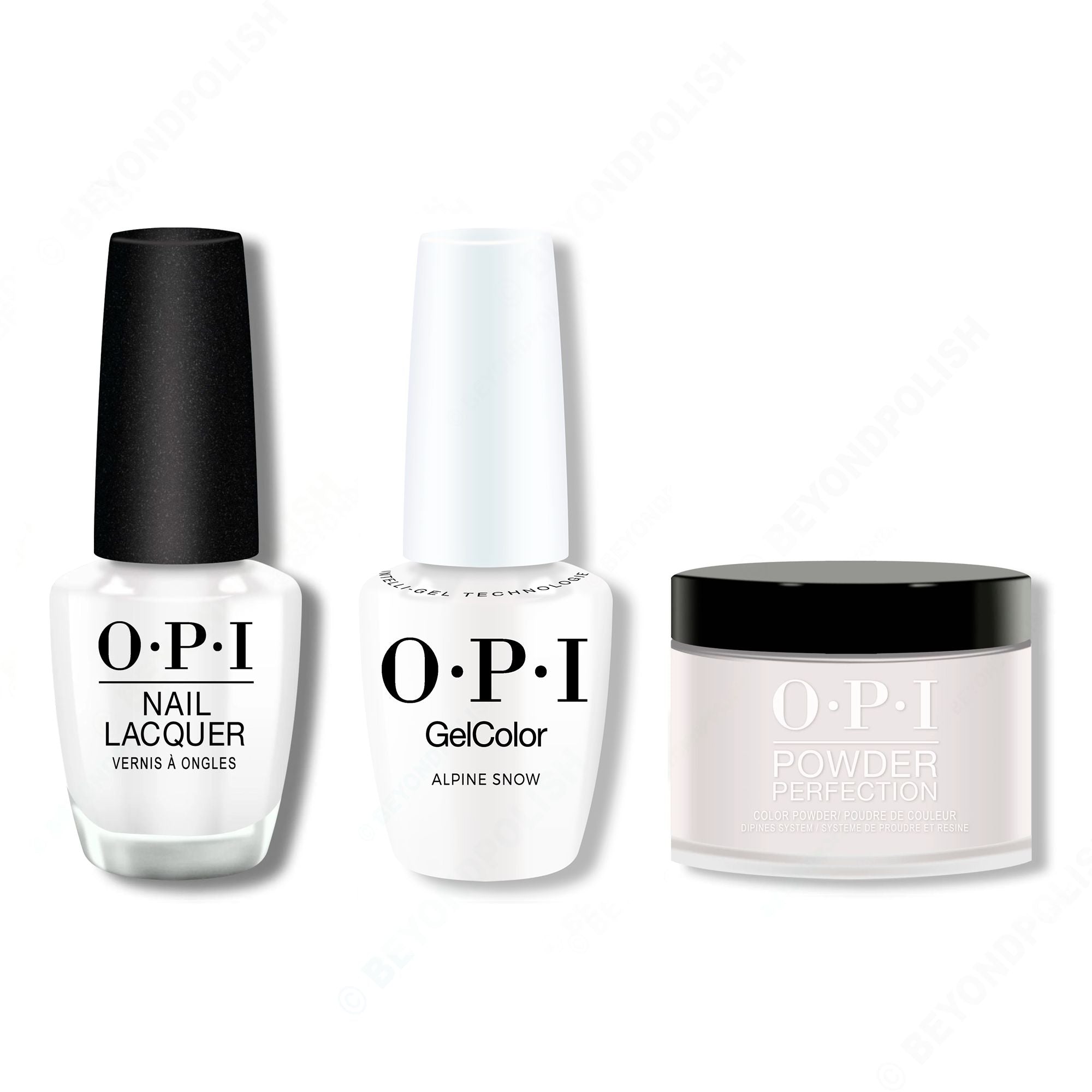
Alpine Snow is the definitive crisp, opaque white that serves as the cornerstone of the OPI white palette, offering a "true white" finish without undertones. It remains the industry standard for French manicures and solid white sets due to its high pigment density and reliable performance across lacquer, gel, and professional powder systems.
For decades, the search for the perfect white nail polish has led both professional technicians and DIY enthusiasts to a single, consistent answer: OPI Alpine Snow. While the brand has introduced dozens of variations of white—ranging from the sheer and milky to the pearlescent and cream-toned—Alpine Snow continues to dominate the market in 2026. This dominance is not merely a result of brand recognition, but a consequence of a specific chemical formulation that balances opacity with a workable viscosity, a feat that is notoriously difficult to achieve with white pigments.
The Chemistry of Dominance: What Makes Alpine Snow Unique
To understand why Alpine Snow dominates the OPI white palette, one must look at the technical composition of white nail polish. Most white polishes rely heavily on titanium dioxide, a dense white pigment that provides opacity. However, high concentrations of titanium dioxide often lead to "chalkiness," streaking, and a thick, unmanageable consistency.
OPI’s Alpine Snow manages to suspend a high load of this pigment in a formula that maintains a smooth flow. Unlike "Funny Bunny," which is a soft, buildable sheer, or "Kyoto Pearl," which utilizes mica for a shimmery finish, Alpine Snow is a crème finish. This means it contains no shimmer or sparkle, relying entirely on its pigment-to-solvent ratio to create a flat, reflective surface. In the 2026 professional landscape, where "clean girl" aesthetics have evolved into "high-definition minimalism," the starkness of Alpine Snow provides the necessary contrast that softer whites cannot replicate.
Comparing the OPI White Spectrum
OPI does not offer just one white; they offer a spectrum. However, Alpine Snow sits at the absolute center as the "neutral" point. To understand its dominance, we must compare it to the other pillars of the OPI white collection.
| Shade Name | Opacity Level | Finish Type | Primary Recommended Use |
|---|---|---|---|
| Alpine Snow | High (Opaque) | Crisp Crème | French Tips, Solid White, Nail Art Base |
| Funny Bunny | Low (Sheer) | Soft Jelly/Milky | Natural Looks, "Glazed Donut" Layering |
| Kyoto Pearl | High (Opaque) | Frost/Shimmer | Elegant Events, Metallic Accents |
| Suzi Chases Portu-geese | High (Opaque) | Cool Crème | Modern Minimalist (Slightly Off-White) |
| Tiramisu for Two | High (Opaque) | Warm Cream | Nude-Adjacent White, Soft Contrast |
As the table illustrates, Alpine Snow is the only shade that offers a completely neutral, high-opacity crème finish. This makes it the most versatile tool in a technician's kit. Whether used for the "smile line" of a French manicure or as a bright canvas for neon nail art, it provides a "blank slate" that does not lean too yellow or too blue.
Technical Application: Achieving a Streak-Free Finish
Despite its dominance, white polish is often cited as the most difficult color to apply. Because of its high pigment load, Alpine Snow can show every brushstroke if not handled correctly. Professionals in 2026 emphasize a specific three-stroke technique to maximize the performance of this specific shade.
The Preparation Phase
Before Alpine Snow touches the nail, the surface must be perfectly smooth. White pigments highlight ridges and imperfections more than any other color. Using a high-quality ridge-filling base coat, such as the OPI Natural Nail Base Coat, is essential. This creates a "grip" for the heavy pigments in Alpine Snow to adhere to without pooling in the cuticles.
The Three-Stroke Method
To prevent the "dragging" effect common with opaque whites:
- The Center Drop: Place a bead of polish in the center of the nail near the cuticle, then push it slightly toward the cuticle before pulling it down to the free edge.
- The Side Swipes: In two quick, light strokes, cover the left and right sides of the nail.
- The "Float" Technique: The second coat of Alpine Snow should be "floated" over the first. This means applying very little pressure to the brush, allowing the polish to self-level over the initial layer without digging into it.
Formats: Nail Lacquer vs. Infinite Shine vs. GelColor
As of 2026, Alpine Snow is available in three primary systems, each with different performance metrics:
- Nail Lacquer: The classic solvent-based formula. It dries via evaporation and offers about 7 days of wear. It is the most common choice for DIY users.
- Infinite Shine: A three-step "hybrid" system that provides gel-like shine and up to 11 days of wear without the need for a UV lamp. Alpine Snow in Infinite Shine has a slightly higher gloss retention.
- GelColor: A professional-only, soak-off gel system cured under LED lamps. This is the preferred version for French manicures because the "smile line" can be perfected with a clean brush before curing, something impossible with air-dry lacquer.
The Role of Alpine Snow in Modern Nail Art
While a full set of Alpine Snow is a bold statement, its true dominance is found in its role as a "utility" shade. In the current 2026 trend cycle, nail art has moved toward intricate, layered designs where Alpine Snow acts as the foundational layer.
The Chrome Canvas
The massive popularity of "chrome" finishes requires a base color that can influence the final result. While black is often used for a "dark" chrome, Alpine Snow is used for "aurora" or "pearl" chromes. By applying a layer of Alpine Snow and then rubbing a pearlescent powder over it, technicians achieve a high-impact, ethereal glow that sheer whites cannot support.
Precision Nail Art
Because it is so pigmented, Alpine Snow is the go-to for detail work. When creating fine lines, marble effects, or geometric shapes, the "one-coat" opacity of Alpine Snow ensures that the design remains crisp and visible even over darker base colors.
Troubleshooting Common Issues with OPI Alpine Snow
Even the most dominant products have limitations. Users often encounter three specific issues when working with high-opacity whites.
1. Yellowing Over Time
Because Alpine Snow is a pure white, it is susceptible to environmental staining. Exposure to UV rays, cleaning chemicals, or even certain hair dyes can cause the white to turn yellow. To prevent this, a high-quality, non-yellowing top coat with UV inhibitors is required. Professionals often recommend the OPI Stay Shiny Top Coat for gel users to maintain that "refrigerator white" look for the full three weeks of wear.
2. Thickening in the Bottle
Due to the high concentration of solids (pigments), Alpine Snow can thicken faster than sheerer shades like "Bubble Bath." If the polish becomes "goopy," it is tempting to use nail polish remover to thin it out. This is a mistake, as the acetone will break down the formula. Instead, a dedicated professional lacquer thinner should be used, adding only one or two drops at a time.
3. Curing Issues in Gel
In its GelColor format, Alpine Snow’s high opacity can actually work against it. The pigment can block UV light from reaching the bottom of the polish layer. If applied too thickly, the top will "skin" and cure, while the bottom remains wet, leading to peeling or "shriveling." The solution is to apply extremely thin, even layers—thinner than one would for a translucent or dark color.
Why Alpine Snow is the 2026 "Must-Have"
As we navigate 2026, the beauty industry has seen a return to "intentional" grooming. The "white-out" look of Alpine Snow is no longer viewed as a 90s relic but as a sophisticated, high-contrast choice for the modern professional. It provides a level of "brightness" that makes the hands appear tan and the nails appear clean and elongated.
Furthermore, its consistency across different markets—from luxury salons in New York to retail shelves in London—ensures that it remains a reliable constant in an ever-changing beauty landscape. When a client asks for "white," they are almost certainly envisioning the specific opacity and brightness that Alpine Snow provides.
Frequently Asked Questions
Is Alpine Snow the same as Funny Bunny?
No, they are fundamentally different. Alpine Snow is a high-opacity, "bright white" crème that is completely solid in two coats. Funny Bunny is a sheer, "milky white" that remains translucent even after multiple layers. Alpine Snow is used for a stark, bold look or French tips, while Funny Bunny is used for a soft, natural aesthetic.
Why does my Alpine Snow look streaky?
Streaking is usually caused by applying too much pressure to the brush or by the polish being too thick. Ensure you are using a ridge-filling base coat, and try "floating" the second coat over the first with very light pressure. If the polish is old, a few drops of professional lacquer thinner can restore the correct viscosity.
Can I use Alpine Snow for stamping?
Yes, Alpine Snow is one of the few standard nail polishes that is pigmented enough to work for nail stamping. While dedicated stamping polishes are thicker, Alpine Snow’s high titanium dioxide content allows it to pick up well on stampers and show up clearly over darker base colors.
How do I prevent Alpine Snow from turning yellow?
Yellowing is caused by UV exposure or chemicals. To maintain the crisp white color, use a top coat specifically labeled as "non-yellowing" or one that contains UV protection. For gel manicures, ensure the gel is fully cured and that you are using a high-quality, professional-grade top coat.
Is Alpine Snow "9-Free"?
As of 2026, OPI has continued its commitment to safer formulations. Alpine Snow, like the rest of the OPI Nail Lacquer line, is formulated to be "9-Free," meaning it does not contain Formaldehyde, Formaldehyde Resin, Toluene, Xylene, Dibutyl phthalate (DBP), Camphor, Parabens, Ethyl Tosylamide, or Triphenyl Phosphate (TPHP).
Final Recommendation
For those seeking the ultimate white polish that offers versatility, high opacity, and a professional finish, Alpine Snow remains the superior choice within the OPI white palette. It is best suited for users who want a high-contrast, "true white" look or those who require a dependable base for nail art and French manicures. To achieve the best results, always pair it with a ridge-filling base coat and a UV-protective top coat to ensure the color remains as bright on day seven as it was on day one.