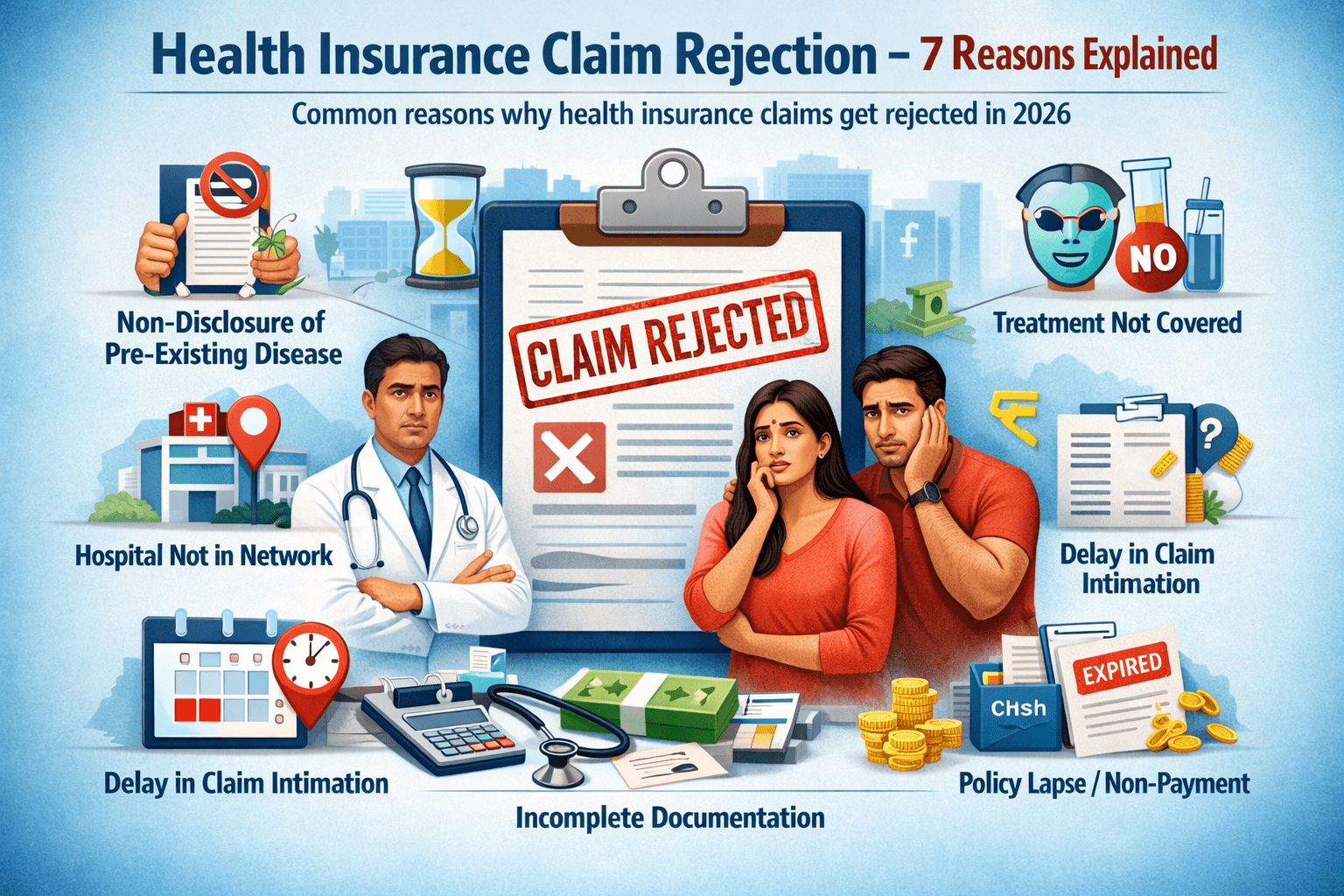
Life insurance policy denials generally fall into two distinct categories: application rejections during underwriting and claim denials after the policyholder passes away. The most common reasons include material misrepresentation on the application, unpaid premiums causing policy lapse, death during the two-year contestability period, specific policy exclusions, and policy expiration. Understanding these triggers helps policyholders and beneficiaries protect their financial coverage.
Understanding Life Insurance Denials: Application vs. Claim Denial
When discussing a life insurance policy denial, it is essential to distinguish between application denial (underwriting rejection) and claim denial (payout rejection for beneficiaries). An application denial occurs before a policy is issued, when an insurer determines that an applicant carries an unacceptable level of risk based on medical history, dangerous occupations, lifestyle factors, or criminal background. While frustrating, an application denial does not result in lost death benefits for surviving family members; it simply means the applicant must seek alternative coverage options.
Conversely, a claim denial occurs after the insured individual has passed away and the designated beneficiaries submit a claim for the death benefit. In this scenario, the insurer refuses to disburse the face value of the policy. Claim denials can create immediate financial hardship for surviving families who rely on those funds for funeral costs, mortgage payments, income replacement, and estate settlement.
Life Insurance Denial Types:
- APPLICATION DENIAL (Underwriting Stage)
- Happens before policy issuance.
- Triggered by medical risks, high-risk jobs, or lifestyle.
- Outcome: Policy is not issued; no premiums lost.
- CLAIM DENIAL (Post-Mortem Stage)
- Happens after the insured passes away.
- Triggered by lapse, misrepresentation, exclusions, etc.
- Outcome: Beneficiary receives no death benefit payout.
Understanding how life insurance contracts operate—specifically regarding legal terms like the contestability period, grace periods, policy riders, and proof-of-loss requirements—is crucial for avoiding coverage gaps and ensuring that intended death benefits are successfully paid out.
Disclaimer: This guide is provided for educational and informational purposes only and does not constitute legal, financial, or tax advice. Insurance regulations vary by state and jurisdiction. Consult a licensed insurance professional or an attorney specializing in insurance law regarding specific policy disputes.
7 Most Common Reasons for Life Insurance Policy Denial
1. Material Misrepresentation or Concealment on the Application
Material misrepresentation is one of the most frequent reasons life insurance claims and applications are denied. A material misrepresentation occurs when an applicant provides false, incomplete, or misleading information during the application process that would have altered the insurance company’s underwriting decision—either by increasing the premium rate or declining coverage altogether.
Common Application Omissions Leading to Claim Denial:
- Undisclosed Pre-Existing Medical Conditions (e.g., heart disease, diabetes)
- False Tobacco or Nicotine Usage Status (including vaping or cigars)
- Omission of Mental Health History or Prescription Medications
- Failure to Report High-Risk Hobbies (e.g., pilot certification, skydiving)
- Concealment of Criminal Records or Driving Violations (e.g., DUIs)
Insurers do not rely solely on self-reported data. During underwriting and claim investigations, insurance carriers routinely cross-reference statements against database records maintained by the MIB Group (formerly the Medical Information Bureau), pharmacy benefit managers, state motor vehicle departments, and official medical records.
An honest mistake, such as miscalculating your height by an inch or forgetting a minor routine doctor visit for a common cold years ago, rarely constitutes material misrepresentation. However, intentionally omitting a diagnosis of hypertension, failing to disclose daily nicotine use, or underreporting alcohol consumption gives the insurer legal grounds to rescind the policy or deny the death benefit claim entirely.
2. Death Occurring During the Two-Year Contestability Period
Under state insurance laws across the United States, virtually every individual life insurance policy contains a contestability clause. This clause grants the insurance company a statutory window—typically two years from the date the policy goes into effect—to investigate the accuracy of the statements made on the original application.
If the policyholder dies within this two-year contestability window, the insurer will automatically initiate a routine claim investigation before issuing the death benefit payout. The carrier requests full medical records from the deceased's healthcare providers, toxicology reports, and official coroner findings to verify whether all pre-existing conditions and lifestyle factors were disclosed during underwriting.
If the investigation reveals that the applicant lied about or omitted a material health condition on the application, the insurer can rescind the contract and deny the claim, even if the cause of death was entirely unrelated to the undisclosed condition. For example, if an insured individual failed to disclose a history of severe asthma and subsequently died in an automobile accident during the contestability period, some state statutes allow the insurer to deny the claim based on the initial material misrepresentation that invalidated the contract formation. Once the two-year contestability period passes, the insurer loses the right to contest claims based on misstatements, except in cases of deliberate, fraudulent impersonation or criminal fraud.
3. Non-Payment of Premiums and Policy Lapse
Life insurance policies are conditional contracts that require regular, timely premium payments to remain in force. If a policyholder stops paying premiums, the policy will eventually lapse, terminating the insurance company’s obligation to pay a death benefit upon the insured’s death.
Timeline of a Life Insurance Policy Lapse:
- Due Date
- 30/31-Day Grace Period
- Lapse Notice Issued
- Policy Terminated
To protect consumers, state laws mandate a grace period—usually 30 or 31 days—following a missed payment deadline. During this grace period, the coverage remains active. If the insured passes away during the grace period, the insurer must pay the death benefit, though it will deduct the overdue premium amount from the total payout.
However, if the grace period expires without the outstanding premium being paid:
- Term Life Insurance: The policy lapses immediately, coverage terminates, and no death benefit is payable.
- Permanent Life Insurance (Whole or Universal Life): Accumulated cash value may automatically fund a premium loan or convert the policy to paid-up status depending on policy provisions, but once available cash values are exhausted, the policy lapses.
A frequent cause of unexpected lapse occurs when group life insurance through an employer terminates after an employee changes jobs, retires, or goes on extended leave, and the individual fails to convert the group policy into a portable personal policy within the employer's designated window (typically 31 days).
4. Specific Policy Exclusions (Suicide, Dangerous Activities, and Illegal Acts)
Life insurance policies contain contractual exclusions that define specific circumstances under which a death benefit will not be paid, regardless of whether premiums are fully paid up.
The Suicide Clause
Standard policies feature a two-year suicide exclusion clause (in some states, one year). If the policyholder dies by suicide within the first two years of policy issuance, the insurer will deny the death benefit payout and refund the paid premiums to the beneficiary. Once the two-year period has elapsed, deaths by suicide are generally covered under standard individual policies.
High-Risk Hobbies and Occupations
Insurers assess risk based on daily activities. If an applicant engages in hazardous activities—such as private aviation, scuba diving beyond recreational depths, rock climbing, or auto racing—the insurer may apply an exclusion rider. If the insured dies while participating in the excluded activity, the claim will be denied unless the policyholder paid an additional premium rating specifically covering that high-risk hazard.
Illegal Acts and Substance Exclusions
Many life insurance contracts exclude coverage if the insured's death occurs during, or as a direct result of, participation in a felony or illegal activity. Furthermore, policies may contain specific drug and alcohol exclusions, denying claims if toxicology reports demonstrate that the death was caused by an overdose of non-prescribed controlled substances or illegal narcotics.
5. Expiration of Term Life Policy Terms
Term life insurance provides financial protection for a specified duration, such as 10, 15, 20, or 30 years. A common misconception among beneficiaries leads to claim denial when the insured passes away after the term period has officially expired.
When a term life policy reaches the end of its stated term, coverage ends unless the policyholder takes proactive action:
- Executing a Convertible Option: Converting the term policy into a permanent whole or universal life policy without undergoing a medical exam prior to the conversion deadline.
- Renewing Under an Annual Renewable Term (ART) Rider: Extending coverage on a year-to-year basis, typically at significantly higher, age-adjusted premium rates.
If a policyholder lets a 20-year term policy expire at midnight on its end date and passes away a month later without having renewed or converted the coverage, the policy is no longer active. The insurer is under no legal obligation to pay a claim on an expired contract.
6. Failure to Provide Adequate Documentation or Proof of Loss
Beneficiaries must formally file a claim and supply required documentation to receive a payout. Insurance companies will deny or indefinitely withhold claims if the beneficiary fails to submit acceptable proof of loss.
Standard required documentation includes:
- The original or certified official death certificate stating the cause and manner of death.
- Completed claimant statement forms signed by each designated beneficiary.
- The original physical policy document (if required by the carrier).
- Verification of identity and tax documentation (such as Form W-9 in the U.S.).
Standard Claim Documentation Workflow:
- Submit Claim Form
- Provide Death Certificate
- Submit ID / W-9
- Claim Review & Approval
Delays or denials frequently occur when the cause of death listed on the death certificate is marked as "Pending Investigation," "Deferred," or "Undetermined"—common scenarios in unexpected deaths requiring autopsy or toxicology analysis. Insurers will freeze claim processing until the final official coroner's report is issued. Additionally, if beneficiaries miss contractually specified deadlines for filing proof of loss (often within one year of death, subject to state law exceptions), the insurer may legally disclaim liability.
7. Changes in Medical Status Prior to Policy Delivery
A lesser-known reason for policy denial involves changes in health status between the time an application is completed and the time the policy is formally delivered and bound.
When applying for life insurance, applicants sign a agreement stipulating that the policy will not take effect until:
- The policy is delivered to the owner,
- The initial premium payment is collected, and
- The health status of the applicant remains unchanged from what was stated on the application.
If an applicant develops a new health condition, undergoes a medical procedure, receives an adverse lab result, or is hospitalized after submitting the application but before paying the first premium and receiving the final policy documents, they are legally required to report this change to the insurer. Failing to disclose a material decline in health during this interim period violates the Statement of Good Health condition. If the insured passes away shortly thereafter, the insurer can invalidate the policy on the grounds that the insurance contract never legally attached.
Summary Matrix: Life Insurance Denial Reasons, Impacts, and Remedial Actions
The following table summarizes the key characteristics, timing, and preventative steps associated with primary life insurance denial triggers:
| Denial Reason | Affected Stage | Primary Underlying Cause | Key Prevention Strategy | Potential Remedial Action / Appeal |
|---|---|---|---|---|
| Material Misrepresentation | Application & Claim | Omitted or falsified medical/lifestyle details | Complete applications with 100% full disclosure | Provide medical records proving omission was non-material |
| Contestability Window | Claim (First 2 Years) | Death occurs within 24 months of policy start | Maintain accuracy; keep medical records organized | Demonstrate cause of death was unrelated to medical history |
| Policy Lapse (Unpaid Premiums) | Claim | Missed payments past 30-day grace period | Set up automatic bank draft (ACH); assign contingent owner | Verify if grace period notice complied with state notification laws |
| Policy Exclusions | Claim | Death due to suicide, crime, or high-risk activity | Add specific coverage riders for high-risk hobbies | Prove death was accidental or outside excluded activity definitions |
| Term Policy Expiration | Claim | Death occurs after term end date | Track expiration dates; convert term to permanent | Check if annual renewal or conversion grace periods apply |
| Missing Proof of Loss | Claim | Missing death certificates or toxicology data | Obtain multiple certified death certificates early | Work with medical examiners to finalize pending certificates |
| Health Change Before Delivery | Application / Claim | Unreported illness between application & delivery | Notify broker immediately of new diagnoses before binding | Prove diagnosis occurred after initial premium payment/delivery |
What to Do If Your Life Insurance Claim Is Denied: Step-by-Step Appeal Process
Receiving a claim denial letter from an insurance company does not necessarily mean the decision is final. Insurers make administrative errors, misinterpret medical charts, or apply policy exclusions incorrectly. Beneficiaries have legal rights to challenge denials through a structured appeal process.
Claim Denial Appeal Steps:
- Request & Review the Formal Denial Letter
- Collect Medical Records & External Evidence
- File Administrative Appeal with the Insurer
- Submit Complaint to State Department of Insurance
- Consult an Insurance Bad Faith Attorney
Step 1: Request and Review the Written Explanation of Denial
By law, insurers must provide a detailed written explanation specifying the exact contractual language, policy provisions, or missing documentation that prompted the denial. Carefully review this letter against the original policy documents to identify the precise basis for rejection.
Step 2: Gather Supporting Records and Evidence
Gather evidence that directly rebuts the insurer's rationale:
- If the denial is based on alleged misrepresentation, obtain statements from attending physicians confirming that the condition was not diagnosed prior to policy issuance, or that the omission was immaterial.
- If the denial is based on policy lapse, pull bank statements, canceled checks, or payroll deduction receipts proving premiums were paid, or show that the insurer failed to send legally required lapse notices to the policyholder's last known address.
- If the denial is based on an exclusion, gather police reports, official coroner findings, or eyewitness accounts proving the death was accidental or unrelated to an excluded activity.
Step 3: Submit a Formal Administrative Appeal to the Insurer
Draft a comprehensive appeal letter to the insurance company’s claims review committee. Attach all collected medical evidence, doctor attestations, and financial records. Send the appeal via certified mail with return receipt requested to establish a clear paper trail of compliance with appeal deadlines.
Step 4: File a Complaint with the State Insurance Commissioner
If the internal appeal is rejected, file a formal complaint with your state's insurance regulator (such as the department of insurance). State regulators oversee insurance carrier compliance and can investigate unfair claim settlement practices under state laws modeled after the National Association of Insurance Commissioners (NAIC) guidelines. Regulatory intervention often compels insurers to re-examine disputed claims.
Step 5: Consult an Insurance Attorney
When large sums are at stake or an insurer acts in bad faith—such as unreasonably delaying investigations, misrepresenting policy terms, or ignoring clear evidence—consult an attorney specializing in life insurance litigation. Many insurance attorneys operate on a contingency fee basis, meaning they only receive payment if they successfully recover funds for the beneficiary.
Frequently Asked Questions (FAQs)
Can an insurance company deny a claim after the 2-year contestability period?
Yes, an insurance company can still deny a claim after the two-year contestability period has passed under specific circumstances. The primary grounds for post-two-year denial include non-payment of premiums (policy lapse), death caused by an explicit exclusion rider (such as a felony exclusion), or acts of deliberate fraud (such as someone else taking the medical exam on behalf of the applicant). However, standard misstatements or omissions on the application can no longer be used as grounds for denial after the contestability window expires.
What is the difference between a life insurance denial and a policy contestation?
A policy contestation is an investigative process where the insurer delays paying a claim to review medical records and application statements, usually because the death occurred during the two-year contestability window. A policy denial is the formal final decision made by the insurer to withhold payment after completing its investigation. A contestation may ultimately end in full claim approval once all facts are verified.
Will life insurance pay out if the insured died from a pre-existing condition?
Yes, life insurance will pay out for deaths caused by pre-existing conditions, provided those conditions were fully and accurately disclosed on the original application during underwriting. Underwriting accounts for pre-existing conditions by adjusting the premium rate accordingly. The claim will only be denied if the policyholder intentionally concealed or lied about the pre-existing condition on their application.
What happens to paid premiums if a life insurance claim is denied for misrepresentation?
If an insurer denies a claim and rescinds the policy during the contestability period due to material misrepresentation, the contract is treated as if it never existed. In most jurisdictions, the insurance company is legally required to refund all accumulated premium payments made over the life of the policy to the beneficiary or the deceased’s estate, minus any administrative fees allowed by law.
How long do beneficiaries have to appeal a life insurance denial?
The timeframe to appeal a life insurance denial depends on policy provisions and state statutes of limitations for breach of contract claims, which typically range from two to six years from the date of denial. However, policy internal appeals usually have much shorter administrative deadlines—often 60 to 90 days from receipt of the denial letter. Beneficiaries should review the denial letter immediately to preserve their rights.
Practical Action Plan for Policyholders and Beneficiaries
To safeguard your policy and protect your family's financial security, follow these essential steps:
- For Current Applicants: Exercise complete transparency during underwriting. Disclose all medical conditions, prescription history, tobacco use, driving records, and high-risk hobbies. Full disclosure eliminates future material misrepresentation claims.
- For Active Policyholders: Establish automatic bank payments (ACH) for premiums to prevent accidental policy lapse. Update beneficiary designations after major life events (marriage, divorce, birth of a child), and inform your beneficiaries where policy documents are stored.
- For Beneficiaries Facing Denial: Request a complete copy of the claim file and original policy contract immediately. Do not accept a verbal denial; require a formal written explanation. Gather independent medical and financial evidence, monitor contractual appeal deadlines, and consult a qualified insurance attorney before accepting a premium refund check, as cashing a refund check may extinguish your right to appeal.