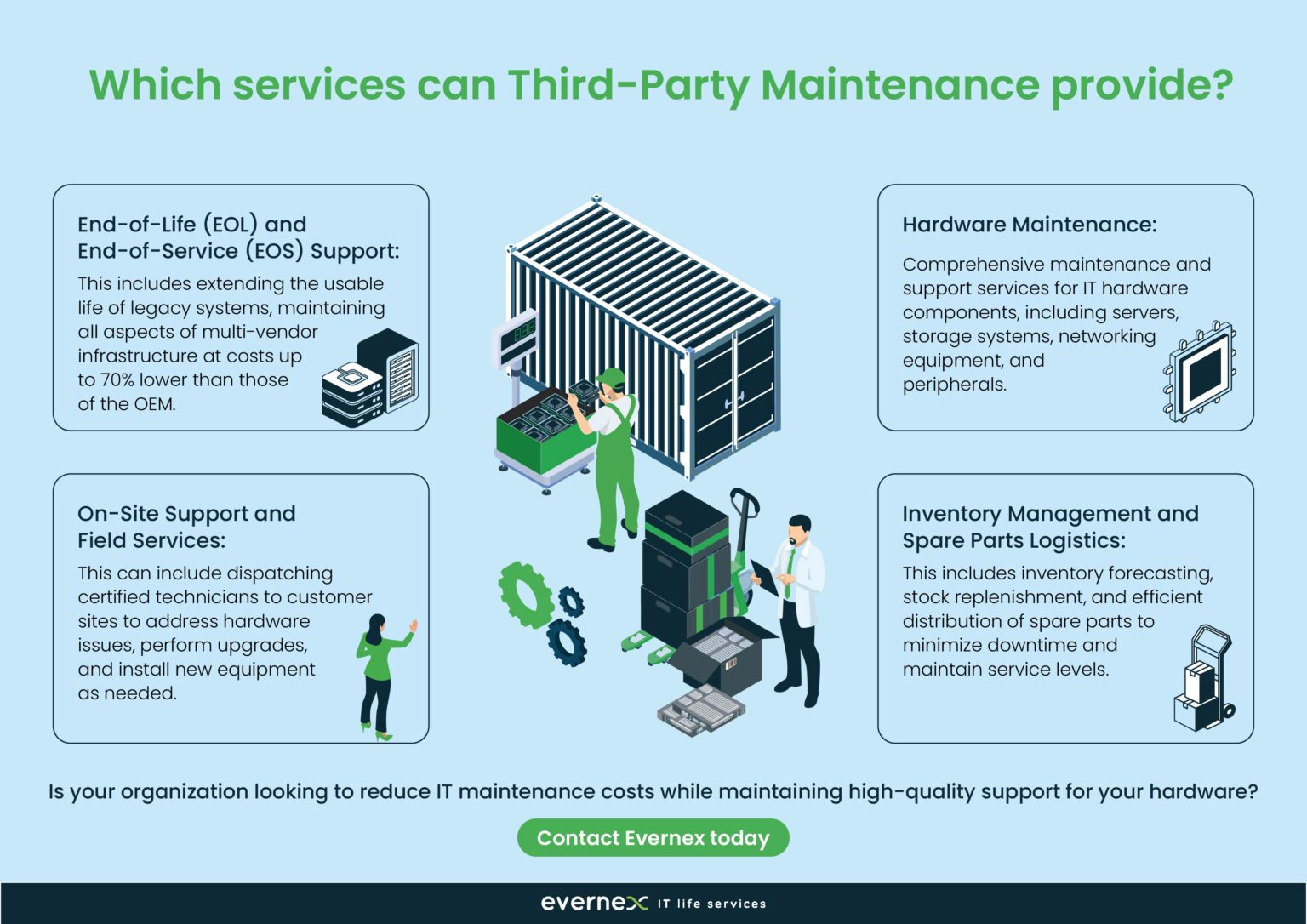
Switching to a Third-Party Maintenance (TPM) provider typically reduces IT support costs by 50% to 70% compared to Original Equipment Manufacturer (OEM) contracts. In 2026, organizations achieve these savings by decoupling hardware support from software licensing, extending the lifespan of post-warranty assets, and utilizing flexible, multi-vendor Service Level Agreements.
The Financial Mechanics of 60% Savings
The primary driver behind the significant cost reduction offered by Third-Party Maintenance (TPM) is the fundamental difference in business models between OEMs and independent support providers. For an Original Equipment Manufacturer, maintenance is often used as a tool to incentivize hardware refreshes. By increasing support premiums as equipment ages, OEMs make the cost of maintaining "legacy" gear nearly as expensive as purchasing new systems.
TPM providers, conversely, operate on a service-centric model. They do not sell hardware; their revenue depends entirely on the efficiency and quality of their support. By 2026, the maturity of the secondary market for enterprise components and the refinement of global logistics chains have allowed TPMs to offer high-quality engineering support at a fraction of the OEM’s list price.
The "60% savings" figure is an industry average grounded in several key areas:
- Reduced Overhead: TPMs do not carry the massive R&D or marketing budgets associated with manufacturing new hardware. These savings are passed directly to the customer.
- End of Price Escalation: OEMs often implement annual price hikes of 15% to 25% once a product reaches its fourth or fifth year of service. TPM providers typically keep pricing stable for the duration of the hardware's useful life.
- Avoidance of Forced Upgrades: By maintaining equipment past the OEM’s designated End of Service Life (EOSL), organizations can defer capital expenditures (CAPEX) for several years, significantly improving the Return on Investment (ROI) for existing infrastructure.
Breaking the Refresh Cycle: The EOSL Advantage
In 2026, the concept of "End of Service Life" (EOSL) is no longer viewed as a technical expiration date, but rather a financial milestone. When a manufacturer declares a server, storage array, or network switch EOSL, they are essentially stating they will no longer provide official support or parts. This is rarely because the hardware is obsolete; rather, it is because the manufacturer wants to move the customer toward a newer product line.
Third-party maintenance providers specialize in this post-warranty and EOSL space. By providing guaranteed access to tested, certified parts and experienced engineers, TPMs allow data center managers to keep stable, functional hardware in production for 10 years or longer. This shift from a three-year refresh cycle to a seven- or ten-year cycle provides a compounding financial benefit that far exceeds the initial 60% reduction in annual support premiums.
According to research from Gartner, the ability to extend hardware life is one of the most effective ways for CIOs to optimize their IT operations budget (OPEX). In an era where sustainability and ESG (Environmental, Social, and Governance) goals are paramount, keeping hardware in the "circular economy" rather than the landfill is both a financial and ethical imperative.
Technical Capabilities and SLA Flexibility
A common misconception is that lower cost equates to lower quality. However, in 2026, top-tier TPM providers often outperform OEMs in specific technical metrics. Because TPMs are not tied to a single brand, they hire engineers with cross-platform expertise, allowing them to troubleshoot complex, multi-vendor environments more effectively than a technician trained only on a single manufacturer’s stack.
Service Level Agreement (SLA) Customization
OEM contracts are notoriously rigid. Customers are often forced to choose between "Gold" or "Silver" packages that may not align with the actual criticality of the hardware. TPM providers offer "Selectable SLAs," allowing organizations to mix and match coverage levels across their entire inventory.
- Mission-Critical Assets: 4-hour onsite response with 24/7 coverage.
- Development Environments: Next-business-day (NBD) parts replacement.
- Redundant Infrastructure: "Parts only" contracts where the organization handles the labor, further driving down costs.
Parts Sparing and Logistics
In 2026, leading TPMs utilize AI-driven predictive analytics to manage their global parts inventory. By analyzing failure rates and regional hardware density, they ensure that critical components are housed in local depots close to the customer site. These parts are often "better than new," having undergone rigorous stress testing that exceeds original factory standards.
Risk Management: Addressing Firmware and Software
The most significant hurdle in moving to third-party maintenance is the management of firmware and software updates. It is essential to distinguish between microcode (firmware) and operating system (OS) software.
For many storage arrays and servers, firmware updates become infrequent once a product has been on the market for three or more years. By the time an asset moves to TPM, the firmware is usually stable. If a critical security patch is required, it is often made available by the OEM to the public, or the organization can maintain a limited "software-only" contract with the manufacturer while using a TPM for hardware replacement and labor.
When evaluating a provider in 2026, it is vital to verify their "Firmware Access Strategy." Reputable providers will conduct a "Gap Analysis" during the quoting process to identify which devices in your environment require ongoing OEM software support and which can safely transition to 100% TPM coverage.
Navigating the Transition: A Strategic Guide
Transitioning from OEM to TPM is not an "all or nothing" decision. Most modern enterprises adopt a Hybrid Maintenance Strategy. This involves keeping the newest, most software-dependent assets under OEM warranty while moving older, stable, or secondary infrastructure to a TPM.
Step 1: Comprehensive Asset Audit
The foundation of a 60% savings plan is an accurate inventory. Many organizations pay for OEM support on "ghost assets"—equipment that has been decommissioned but never removed from the support contract. A TPM transition begins with a physical and logical audit to ensure you are only paying for what you use.
Step 2: Categorization by Criticality
Group your assets into tiers based on their impact on business continuity.
- Tier 1: High-performance, brand-new, or heavily software-reliant gear (OEM).
- Tier 2: Stable, production-grade hardware past its initial 3-year warranty (TPM).
- Tier 3: Non-critical, lab, or disaster recovery (DR) equipment (TPM/Parts-only).
Step 3: Provider Verification
In 2026, the TPM market is diverse. Verify that your chosen provider holds relevant certifications such as ISO 9001 (Quality Management) and ISO 27001 (Information Security). Furthermore, ensure they have a verified engineering presence in your specific geographic regions to meet onsite SLA commitments.
Comparison Table: OEM vs. Third-Party Maintenance (2026)
| Feature | OEM Maintenance | Third-Party Maintenance (TPM) |
|---|---|---|
| Typical Annual Cost | 100% (Baseline) | 30% – 50% (60% Average Savings) |
| Contract Flexibility | Low (Standardized packages) | High (Customizable per asset) |
| Lifecycle Support | Short (Push toward refresh) | Long (Support through EOSL and beyond) |
| Engineering Focus | Single-vendor specialists | Multi-vendor, cross-platform experts |
| Response Times | Tiered (Standard) | Guaranteed (Often local/regional depots) |
| Software Updates | Included (Usually) | Restricted (Depends on manufacturer policy) |
| Sustainability Impact | Low (Encourages disposal) | High (Supports circular economy/reuse) |
The Role of TPM in Modern Data Center Sustainability
As of 2026, environmental regulations in many jurisdictions require corporations to report on their "Scope 3" emissions, which include the carbon footprint of their supply chain and hardware lifecycle. Manufacturing a single server produces significant CO2 emissions and requires the extraction of rare-earth minerals.
By choosing TPM, organizations directly contribute to their sustainability goals by extending the "first life" of their hardware. This reduces the frequency of manufacturing cycles and minimizes electronic waste (e-waste). For many modern enterprises, the environmental benefits of TPM are becoming as influential as the 60% financial savings.
Frequently Asked Questions
Will using a TPM provider void my hardware warranty?
No. In most jurisdictions, including the United States under the Magnuson-Moss Warranty Act, the use of a third-party service provider does not void the original manufacturer's warranty. However, since TPM is usually engaged after the initial OEM warranty has expired, this is rarely a practical concern.
How do TPM providers handle proprietary parts?
TPM providers source parts through a variety of legitimate channels, including the secondary market, decommissioned systems, and overstock from authorized distributors. These parts are rigorously tested. In 2026, many high-end TPMs also have partnerships that allow them to source new-in-box components when required.
Can a TPM provider support my entire data center?
Yes, most top-tier providers offer "Single Point of Contact" support. Even if you have a mix of Cisco networking, NetApp storage, and Dell servers, a single TPM contract can cover the entire environment, simplifying management and reducing administrative overhead.
What happens if the TPM engineer cannot fix the problem?
Reputable TPM providers have "Escalation Paths" that include Level 3 engineering teams. In the rare event of a catastrophic software or architectural failure that requires OEM intervention, many TPMs offer "best effort" coordination with the manufacturer or advise the client on how to purchase a one-time support incident from the OEM.
Are the savings really 60% every year?
The 60% savings are most visible when comparing the "Post-Warranty" price hike from an OEM to the flat-rate pricing of a TPM. While the first year of TPM might show a 50% saving, by year three or four of the contract—when the OEM would have doubled or tripled their rates—the effective savings often exceed 70% or 80%.
Practical Recommendation for 2026
To capture the maximum benefit of third-party maintenance, perform a Maintenance Strategy Review immediately. Identify all hardware that is currently in its third year of service or older. Request a "side-by-side" quote from a reputable TPM provider for these specific assets. By moving just 40% of your stable infrastructure to a TPM model, you can often save enough in OPEX to fund new innovation projects or offset the rising costs of energy and cloud egress fees.