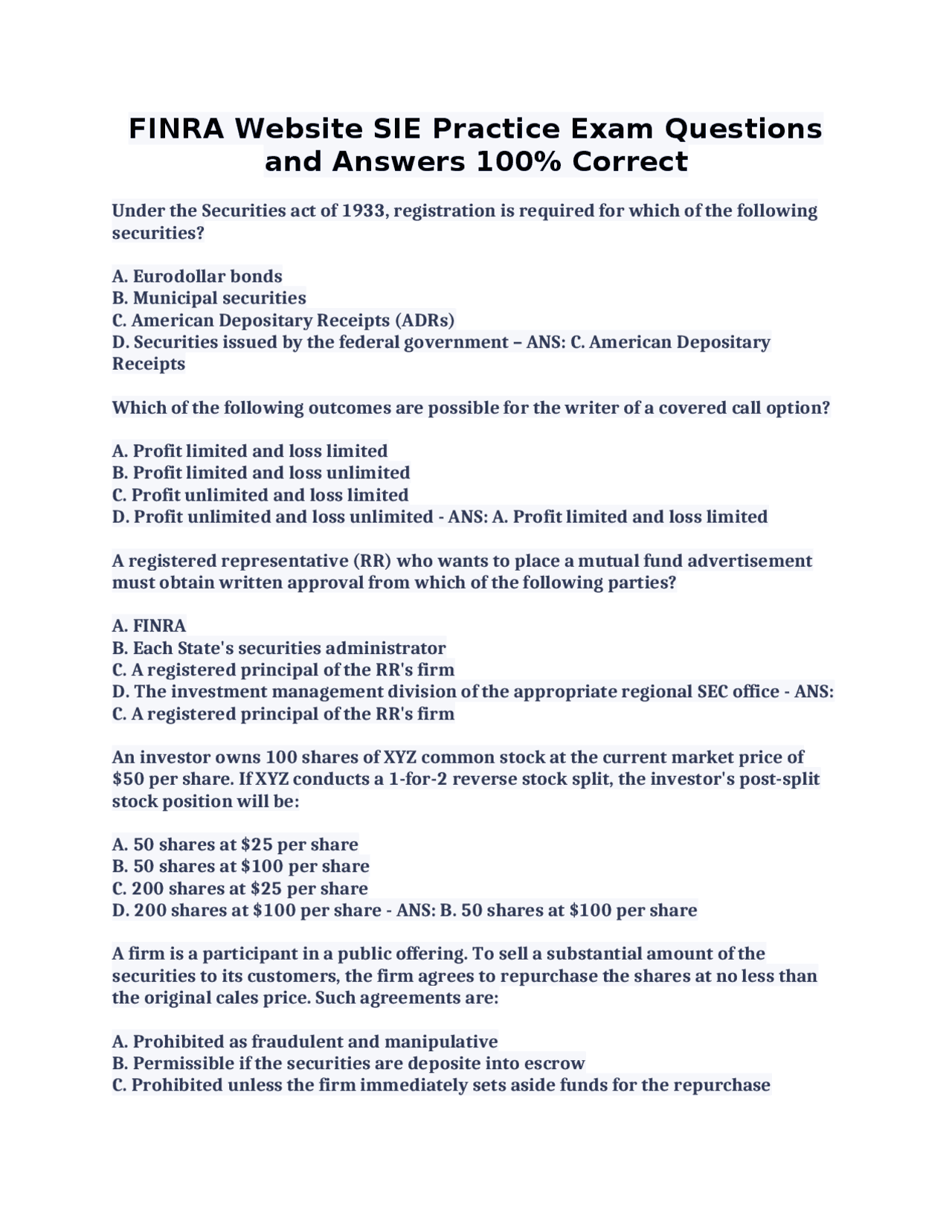
Preparing for the General Securities Representative Examination—commonly known as the Series 7 Top-Off exam—administered by the Financial Industry Regulatory Authority (FINRA), requires a structured study plan centered around realistic practice tests. Utilizing a high-quality "1 overview of series 7 top off practice exam finra" strategy helps candidates identify knowledge gaps across complex topics like municipal securities, options strategies, margin accounts, and retirement plans, ultimately ensuring they understand the rigorous format, time constraints, and question style of the actual licensing test.
Understanding the Series 7 Top-Off Exam Structure and Prerequisites
The Series 7 Top-Off exam is the primary licensing examination for individuals seeking to qualify as General Securities Representatives in the United States. Before a candidate can sit for the Series 7 Top-Off, they must successfully pass the Securities Industry Essentials (SIE) exam and become associated with a FINRA member firm or another applicable self-regulatory organization (SRO). The SIE exam acts as a foundational prerequisite, covering basic industry knowledge, while the Series 7 Top-Off dives deep into the specific functions, products, and regulatory rules required of a practicing registered representative.
Administered via computerized testing centers, the Series 7 Top-Off consists of 125 multiple-choice questions plus 10 unscored pre-test questions, giving candidates 3 hours and 45 minutes to complete the assessment. A passing score of 72% is required. Because the exam tests a vast expanse of regulatory guidelines and sophisticated financial products, candidates cannot rely solely on reading textbooks. They must integrate comprehensive practice exams into their preparation routine to build mental stamina and master the application of theoretical rules to practical scenarios.
Core Content Categories on the Exam
FINRA outlines four primary job functions for the Series 7 Top-Off exam. Each function represents a distinct percentage of the overall test bank, dictating how candidates should allocate their study and practice exam time:
- Seeking Business for Customers through Customers and Potential Customers (Function 1): Focuses on opening accounts, understanding customer profiles, and identifying investment opportunities suitable for specific financial goals.
- Opening Accounts After Evaluating Customers' Profiles (Function 2): Covers the mechanics of account types—such as cash, margin, discretionary, and custodial accounts—along with compliance requirements and anti-money laundering (AML) protocols.
- Providing Customers Information About Investments, Making Recommendations, and Transferring Assets (Function 3): Addresses specific product knowledge, including equities, debt instruments, packaged securities, options, direct participation programs (DPPs), and municipal bonds.
- Obtaining Purchase and Sale Orders and Customers' Transactions (Function 4): Evaluates trade execution, settlement cycles, confirmations, account statements, and margin mechanics.
The Strategic Value of Taking Series 7 Practice Exams
Integrating a structured practice exam routine into a study schedule transforms passive reading into active learning. When candidates take practice tests under simulated exam conditions, they experience the pressure of the 225-minute time limit and learn how to pace themselves across 125 complex questions. Furthermore, review sessions following each practice exam provide critical diagnostic feedback, highlighting specific weak spots—such as complex options spreads, municipal tax-equivalent yields, or margin calculations—that require further review.
Effective preparation involves transitioning from untallied, chapter-by-chapter quizzes to full-length, timed simulation exams. Initial diagnostic tests establish a baseline score, helping candidates measure their progress over weeks of preparation. Subsequent practice exams reveal whether study efforts are effectively closing knowledge gaps. Candidates should analyze both incorrect answers and questions guessed correctly to ensure they understand the underlying regulatory and financial principles rather than simply memorizing answers.
| Exam Metric | Series 7 Top-Off Specification | Practice Exam Recommendation |
|---|---|---|
| Total Questions | 125 scored questions (+ 10 unscored) | 125–135 questions per full simulation |
| Time Allowed | 3 hours and 45 minutes (225 minutes) | Strict 225-minute timer |
| Passing Score | 72% | Target 75% to 80%+ consistently |
| Prerequisite | Passing the SIE Exam | Complete after mastering SIE content |
| Primary Focus | Product suitability and trading rules | Mixed-domain question banks |
Key Product Areas Tested on FINRA Practice Exams
Practice exams mirror the multi-product complexity of the actual FINRA test. Candidates encounter intricate questions regarding equity securities, debt instruments, and derivative products. Understanding how these products behave individually and within a diversified portfolio is essential for scoring well on both practice exams and the official test.
Equities and Debt Instruments
Equity questions often focus on corporate actions, rights offerings, warrants, dividend distributions, and the taxation of stock dividends and capital gains. Candidates must understand the difference between common and preferred stock, as well as American Depositary Receipts (ADRs).
Debt instruments form a substantial portion of the exam. Candidates must master corporate bonds, U.S. Treasury securities, government agency issues, and municipal securities. Practice exams frequently test the nuances of municipal bonds, including general obligation (GO) bonds versus revenue bonds, tax-exempt interest calculations, and underwriting syndicates. Understanding yield calculations—such as current yield, yield to maturity (YTM), and yield to call (YTC)—is also critical.
Options and Derivative Strategies
Options trading represents one of the most challenging content areas on the Series 7 Top-Off. Practice exams test a candidate's ability to calculate breakeven points, maximum gains, and maximum losses for calls and puts, both naked and covered. More advanced questions require an understanding of spreads (e.g., bull and bear spreads), straddles, and combinations. Candidates must be comfortable using options matrixes or mental visualization to determine whether a particular strategy generates income, hedges a portfolio, or speculates on directional market movements.
Direct Participation Programs and Investment Companies
Investment companies—including mutual funds, exchange-traded funds (ETFs), unit investment trusts (UITs), and closed-end funds—frequently appear on practice exams. Candidates must distinguish between open-end and closed-end management companies, calculate net asset value (NAV) and public offering price (POP), and understand sales charges like front-end loads, back-end loads (contingent deferred sales charges), and 12b-1 fees. Direct Participation Programs (DPPs) and real estate investment trusts (REITs) require knowledge of passive loss rules, syndication, and liquidity limitations.
Margin Accounts and Regulatory Rules
Margin trading and broker-dealer regulations test a candidate's operational and regulatory knowledge. Practice exams evaluate a candidate's ability to perform margin math, including calculating initial margin requirements under Regulation T, maintenance margin calls, SMA (Special Memorandum Account) balances, and combined equity in short and long margin accounts.
On the regulatory front, candidates must know the rules governing customer communications, the handling of customer complaints, insider trading prohibitions, and the Code of Procedure and Code of Arbitration. Understanding the responsibilities of a registered representative regarding customer privacy (Regulation S-P), anti-money laundering (FinCEN and the USA PATRIOT Act), and business continuity plans ensures that candidates can navigate both product-specific and compliance-oriented exam questions.
Common Mistakes to Avoid During Practice Exam Preparation
Many candidates struggle during their preparation due to preventable strategic errors. Recognizing these pitfalls helps optimize study time and improves performance on test day.
- Memorizing Questions Instead of Concepts: Simply memorizing the answers to practice questions provides a false sense of security. FINRA updates question phrasing to test underlying concepts rather than rote memory.
- Ignoring Incorrect Answers: Reviewing only the questions answered correctly wastes valuable diagnostic data. Detailed analysis of rationale for incorrect choices prevents repeat mistakes.
- Neglecting Time Management: Practicing without a timer can lead to poor pacing on test day, causing candidates to rush through complex calculations or run out of time entirely.
- Skipping Difficult Domains: Avoiding weak areas—such as options math or margin calculations—guarantees those topics will lower the final exam score. Candidates should lean into difficult subjects during practice sessions.
Best Practices for Maximizing Practice Exam Utility
To extract maximum value from practice exams, candidates should establish a disciplined testing routine. Begin by studying one chapter or module at a time, followed by targeted quizzes to reinforce immediate comprehension. Once all material has been reviewed at least once, transition to full-length, comprehensive practice exams under strict testing conditions—no notes, no phone, and a locked 225-minute timer.
After completing each simulation, dedicate equal or greater time to reviewing the detailed explanations for every question. Maintain a log of missed questions categorized by topic to identify persistent weaknesses. Finally, schedule practice exams consistently in the weeks leading up to the test date to build endurance and reduce test-day anxiety. Candidates seeking further official guidelines and enrollment details can review resources provided directly by FINRA.
Conclusion
Passing the Series 7 Top-Off exam is a critical milestone for anyone pursuing a career as a general securities representative. By leveraging realistic practice exams, candidates bridge the gap between theoretical knowledge and practical application. Focus on mastering the four core job functions, analyzing complex product rules like options and municipal bonds, and reviewing every missed practice question to build the confidence and competence required to pass on the first attempt.