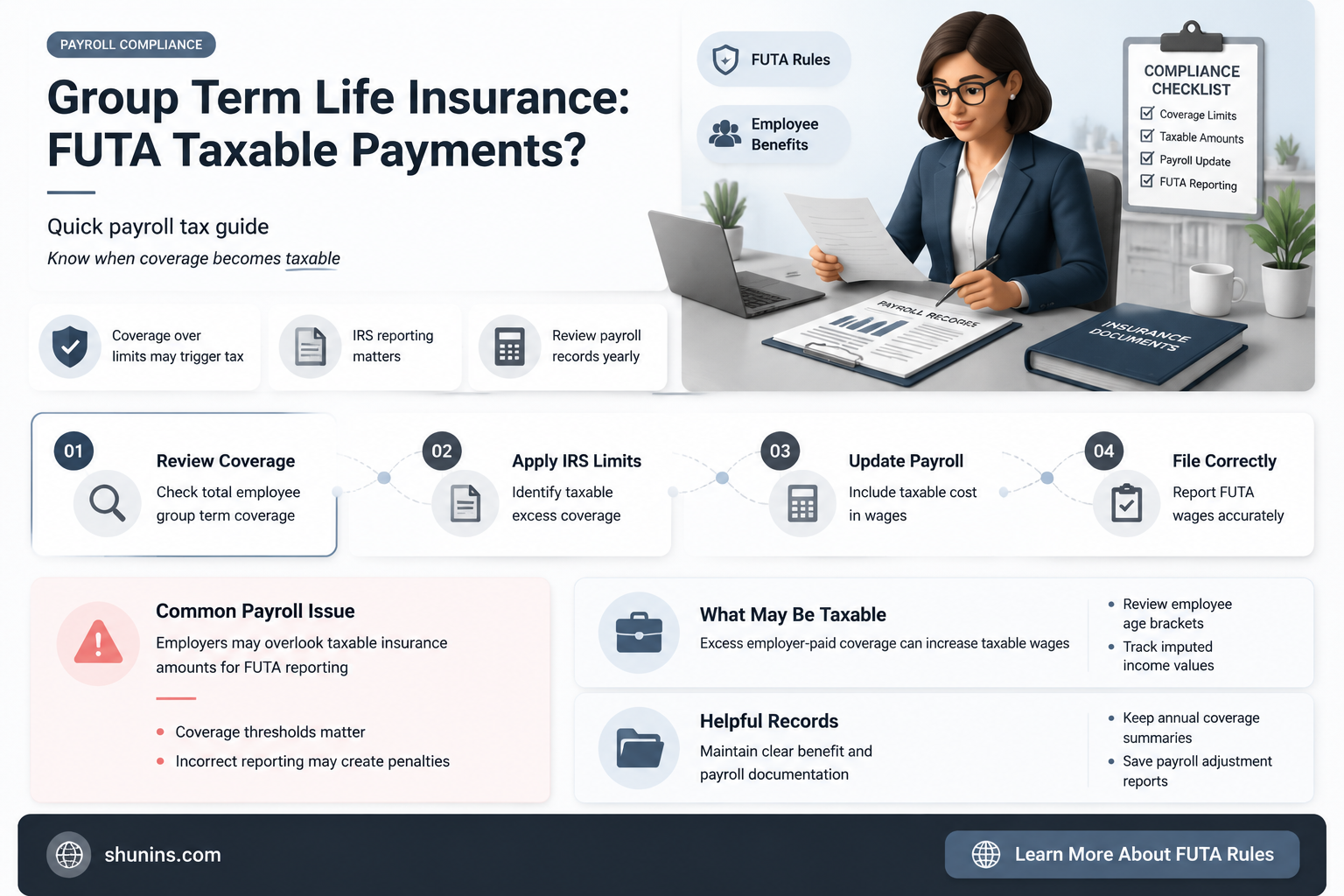
When an employer provides group-term life insurance as part of a benefits package, the premiums paid by the employer for coverage exceeding $50,000 are considered taxable income to the employee. To calculate this "imputed income," you must determine the value of the excess coverage based on the IRS Uniform Premium Table, adjust for your age, and subtract any contributions you make toward the policy's cost using after-tax dollars.
Understanding Taxable Group-Term Life Insurance
Group-term life insurance is a common employer-provided benefit. Under Internal Revenue Code Section 79, the cost of the first $50,000 of group-term life insurance coverage provided by an employer is excluded from an employee's gross income. This exclusion applies regardless of whether the employer pays the entire premium or a portion of it. However, the IRS maintains that coverage exceeding this threshold represents a form of economic benefit that should be treated as wages.
The amount that must be included in your income is not the actual premium paid by your employer. Instead, it is the value calculated using the IRS’s Table I, titled "Uniform Premiums for $1,000 of Group-Term Life Insurance Protection." This table establishes a monthly cost per $1,000 of coverage based on five-year age brackets.
Prerequisites: Information You Need
Before performing the calculation, you must gather specific information regarding your policy and personal circumstances as of the end of the tax year:
- Total Coverage Amount: Identify the total death benefit provided by your employer-sponsored group-term life insurance policy.
- Employer-Paid Coverage: Ensure you have the exact dollar amount of coverage provided to you.
- Your Age: Determine your age as of December 31 of the tax year. The IRS uses your age at the end of the year to determine the bracket for the entire year's calculation.
- Employee Contributions: Identify any amount you personally paid toward the insurance premiums during the year using after-tax dollars. Pre-tax contributions are generally excluded from the calculation, but after-tax contributions serve as an offset.
Step-by-Step Calculation Process
The process of calculating the taxable amount involves four distinct mathematical steps. By following this sequence, you can determine exactly what should appear on your Form W-2.
1. Determine the Excess Coverage
Subtract $50,000 from your total group-term life insurance coverage. If your policy is for $150,000, your excess coverage is $100,000. If your coverage is $50,000 or less, you have no imputed income to report.
2. Apply the Table I Rates
The IRS Table I provides a monthly cost per $1,000 of coverage. For example, if you are 45 years old, the current cost is $0.15 per month per $1,000 of coverage. Divide your excess coverage by 1,000 and multiply that figure by the rate corresponding to your age bracket in Table I.
3. Calculate Annualized Cost
Multiply the monthly cost obtained in the previous step by 12 to find the total annual value of the coverage provided by your employer.
4. Subtract After-Tax Contributions
If you paid any portion of the premiums for your group-term life insurance with after-tax dollars, subtract that total annual amount from the value calculated in Step 3. The remaining balance is the amount that must be included in your gross income.
Comparison Table: IRS Table I (Monthly Cost per $1,000)
The following table reflects the standard IRS rates used to calculate the economic benefit of group-term life insurance. These rates are subject to updates; ensure you are utilizing the current version provided by the IRS for the 2026 tax year.
| Age Bracket | Cost per $1,000 of Coverage (Monthly) |
|---|---|
| Under 25 | $0.05 |
| 25 to 29 | $0.06 |
| 30 to 34 | $0.08 |
| 35 to 39 | $0.09 |
| 40 to 44 | $0.10 |
| 45 to 49 | $0.15 |
| 50 to 54 | $0.23 |
| 55 to 59 | $0.43 |
| 60 to 64 | $0.66 |
| 65 to 69 | $1.27 |
| 70 and older | $2.06 |
Handling Variations in Coverage
Not all group-term policies are straightforward. If your coverage amount changes during the year—for example, due to a salary adjustment or a change in your benefit level—you must perform the calculation on a pro-rata basis. Calculate the imputed income for each period of coverage separately based on the amount in force and your age at the end of the year, then sum the results.
Furthermore, if your employer provides different levels of coverage for different classes of employees, ensure you are using the specific death benefit amount associated with your enrollment. Voluntary supplemental life insurance that you pay for entirely with after-tax dollars is usually not included in the $50,000 calculation, as you are bearing the full cost of that specific coverage, though this depends on how the plan is structured by your employer.
Common Mistakes to Avoid
One of the most frequent errors is failing to account for after-tax contributions. Many employees assume that because they see a deduction on their paystub for life insurance, the entire amount is taxable. If those deductions are taken on an after-tax basis, they reduce your taxable imputed income dollar-for-dollar.
Another error involves the age bracket. Remember that the calculation uses your age at the end of the tax year. If you turn 40 in November, you are considered 40 for the entire tax year for the purpose of this calculation. Failing to update your age bracket when moving from one tier to the next can result in under-reporting or over-reporting your taxable income.
Reporting on Form W-2
Your employer is responsible for calculating this amount and including it on your Form W-2. Specifically, the imputed income will be included in the amounts reported in Boxes 1 (Wages, tips, other compensation), 3 (Social Security wages), and 5 (Medicare wages and tips). Additionally, the amount will be reported in Box 12 with Code C to signify that it represents taxable cost of group-term life insurance over $50,000.
You should verify that your employer’s year-end statement matches your own manual calculation. If you notice a discrepancy, consult your human resources or payroll department to clarify whether they used a different calculation method or if an error occurred in the reporting process.
Legal and Financial Considerations
The taxation of group-term life insurance is a federal requirement under the IRS. However, state laws regarding the taxation of these benefits can vary. While most states conform to federal tax treatment for income tax purposes, it is essential to check if your specific jurisdiction has unique reporting requirements for group-term life insurance premiums.
Additionally, this article provides general guidance for informational purposes and does not constitute professional tax, legal, or financial advice. Tax laws can be complex and subject to change; individuals should consult with a qualified tax professional or a certified public accountant (CPA) regarding their specific tax obligations, especially if they have unique policy features, international assignments, or complex compensation structures.
Frequently Asked Questions
What happens if I have two different employers providing group-term life insurance? If you are employed by two or more unrelated employers, the $50,000 exclusion applies to the total amount of coverage you receive. You may need to coordinate this between your employers or account for the total in your personal tax filing to avoid underpayment of taxes on the excess coverage.
Are my spouse's or children’s life insurance benefits subject to this tax? Generally, if the employer provides "dependent" coverage and the cost is more than $2,000, that benefit is considered taxable income. This is separate from the $50,000 exclusion for your personal group-term policy and is usually calculated differently.
Does this tax apply to whole life or universal life insurance policies? No. The IRS Table I calculation specifically applies to group-term life insurance. Permanent life insurance policies (such as whole or universal life) provided by an employer have different tax implications, as they carry a cash value component.
What is the penalty for not reporting this income? Failure to include taxable income in your gross earnings can lead to interest and penalties on underpaid taxes. Since this amount is typically reported by the employer on your W-2, the IRS is usually aware of these amounts, making it critical that your tax return aligns with the figures provided by your employer.
Can I opt out of the coverage to avoid the tax? While you may be able to reduce your coverage to $50,000 to avoid the tax, you must review your employer’s benefit plan document. Many group-term life insurance policies are mandatory "base" benefits that cannot be declined.
Next Actions for Employees
To ensure your records are accurate:
- Locate your most recent paystub to determine if your life insurance deduction is labeled as "pre-tax" or "after-tax."
- Review your benefits handbook to confirm your total group-term life insurance coverage amount.
- Check your final paystub of 2026 to see the year-to-date deductions for life insurance.
- Once you receive your Form W-2 in early 2027, verify that the amount in Box 12 (Code C) aligns with your calculated figures. If the numbers seem incorrect, contact your payroll administrator immediately to resolve any discrepancies before you file your tax return.