A list of industry types is a structured categorization framework used by governments, financial institutions, and analysts to group businesses based on their primary economic activities. These systems, such as the North American Industry Classification System (NAICS) and the International Standard Industrial Classification (ISIC), provide the necessary standardization for economic data collection, tax reporting, and market research.
The Purpose of Industry Classification
Industry classification systems serve as the backbone for macroeconomic analysis. By assigning a specific code to a business, regulatory bodies and statisticians can track the health of specific sectors, measure employment trends, and assess the impact of legislation. Without these standardized lists, it would be impossible to compare a retail shop in one region to a similar business in another, as definitions of "retail" or "manufacturing" could vary wildly between jurisdictions.
For business owners and managers, understanding these classifications is often a matter of compliance. When applying for loans, insurance, or government contracts, you will frequently be asked to identify your business according to an official industry list. Misclassification can result in incorrect tax assessments, loss of eligibility for government subsidies, or inaccurate insurance risk profiles.
Primary Economic Sectors: The Foundation
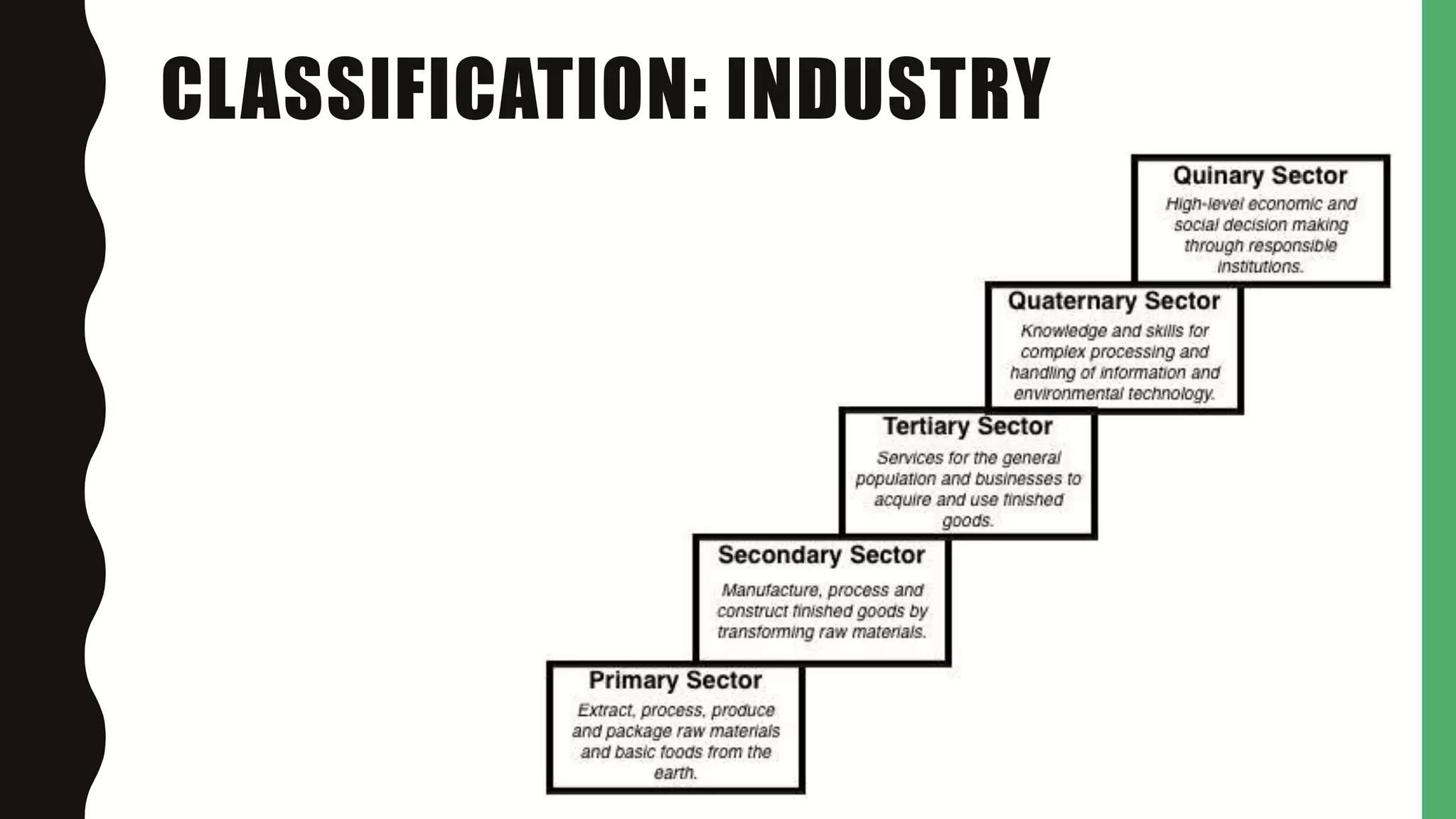
Most industry classification systems begin by segmenting the entire economy into three or four fundamental sectors. This high-level view helps in understanding the lifecycle of a product or service.
- Primary Sector: This encompasses the extraction and harvesting of natural resources. Examples include agriculture, fishing, forestry, and mining.
- Secondary Sector: This sector involves the processing of raw materials from the primary sector into finished goods. It is characterized by manufacturing, construction, and power generation.
- Tertiary Sector: Also known as the service sector, this area focuses on providing services rather than tangible goods. This includes retail, hospitality, finance, healthcare, and education.
- Quaternary Sector: This represents an evolution of the tertiary sector, focusing on knowledge-based activities such as research and development, information technology, and consultancy.
Understanding Standardized Industry Codes
In the United States, the primary system is the North American Industry Classification System (NAICS). Revised periodically—with the most recent major updates relevant to the current 2026 reporting period—the NAICS is designed to reflect the modern economy.
- Structure: NAICS uses a hierarchical structure. A two-digit code represents a major sector (e.g., 44-45 for Retail Trade), three digits identify a sub-sector, four digits a group, five digits an industry, and six digits a specific national industry.
- Application: If your business is involved in "Clothing Stores," you would look for the 448 series. Drilling down further to "Women's Clothing Stores" provides a more specific code. This level of granularity ensures that data analysts can differentiate between a boutique and a large national chain.
Comparison of Global and Regional Classification Systems
| System | Scope | Primary Use |
|---|---|---|
| NAICS | North America | Economic reporting, tax, and government procurement. |
| ISIC | Global | International standard for national statistics (UN). |
| NACE | European Union | Statistical classification of economic activities in the EU. |
| ANZSIC | Australia/NZ | Standard classification for regional economic analysis. |
| SIC | Historical/US | Legacy system (replaced by NAICS, but still used in some older databases). |
How to Correctly Categorize Your Business
Identifying the correct industry type requires an objective assessment of where your revenue originates. A common mistake is to classify a business based on what it aspires to be rather than what it currently does.
- Determine Primary Activity: Identify the activity that generates the largest portion of your annual revenue. If you are a manufacturing company that also sells its products directly to consumers through an on-site store, your primary activity is likely manufacturing, not retail.
- Review the Manual: Use the official NAICS manual or the relevant government portal for your jurisdiction. Do not rely on third-party lists that may be outdated or simplified.
- Consult Professional Guidance: If your business model is hybrid—for example, a software-as-a-service (SaaS) company that also provides high-touch hardware installation—you may need to consult with a tax professional or an accountant to determine which industry code best represents your tax status and legal exposure.
- Verify with Stakeholders: If you are categorizing for insurance purposes, contact your provider. Insurance industries often use their own internal classification systems, which may differ slightly from government-mandated NAICS codes.
Industry Classifications in Finance and Investment
Investors and financial analysts use industry classifications to build "comparable groups." When evaluating a company for a potential investment, it is critical to compare its performance metrics—such as Price-to-Earnings (P/E) ratios or EBITDA margins—against peers within the same industry group.
For instance, comparing the profit margins of a utility company (which is capital-intensive and highly regulated) with those of a software company (which has low overhead but high research costs) would yield misleading results. Industry classification lists allow analysts to filter out these "apples-to-oranges" comparisons and focus on sector-specific benchmarks.
Common Mistakes in Industry Classification
- Confusing Secondary and Primary Activities: Many businesses fail to distinguish between their core revenue stream and ancillary support activities. If your company prints its own brochures, you are not in the printing industry; you are in the industry associated with the product you are marketing.
- Ignoring System Updates: Classification systems are updated periodically to account for new technologies. A code that was accurate in 2017 may have been split or reorganized in the most recent version used by government agencies. Always verify that you are referencing the most current version.
- Over-Segmentation: Businesses sometimes choose an overly specific code to make their operations sound more niche or prestigious. This can backfire when dealing with regulatory filings, where broader categories often carry specific legal requirements or tax benefits.
Navigating Industry-Specific Regulations
Once you identify your industry type, you become subject to the regulatory environment governing that sector. For example, industries in the financial services sector are subject to strict oversight by bodies like the SEC or the Federal Reserve, whereas the construction industry must adhere to building codes and labor safety standards.
Understanding your classification is the first step in identifying your compliance burden. You should regularly review industry-specific trade journals and government bulletins to stay informed about changes in safety protocols, environmental regulations, or tax incentives that apply specifically to your identified industry group.
Frequently Asked Questions
What is the difference between an industry and a sector? In casual conversation, these terms are often used interchangeably. Technically, a sector is a broader category (e.g., the technology sector), while an industry is a more specific subset (e.g., the semiconductor industry).
Can a business have more than one industry code? Yes. Large, diversified corporations often have multiple lines of business and may be categorized under several different industry codes for different subsidiaries or divisions. However, for tax reporting, the entity will generally be assigned a primary code.
Where can I find the official NAICS code for my business? The official U.S. Census Bureau website maintains a searchable database of NAICS codes. You can search by keyword or browse by the hierarchical structure to find the code that most accurately describes your primary business activity.
How often are industry classification systems updated? NAICS, for example, undergoes a review process every five years to ensure it remains relevant to the evolving economy. These updates reflect emerging technologies, new service models, and shifts in global economic activity.
Does my industry type affect my business insurance premiums? Yes. Insurance companies assess risk based on industry classification. High-risk industries, such as heavy manufacturing or hazardous waste management, typically face higher premiums than low-risk industries, such as software development or professional services.
Next Steps for Business Owners
If you have not verified your industry classification recently, take the following steps to ensure accuracy:
- Review your most recent tax filings to see which industry code was reported.
- Compare this code against the current version of the NAICS or your region's equivalent standard.
- If you have pivoted your business model significantly in the past few years, re-evaluate if your current code still reflects your primary revenue-generating activity.
- Update your registration and insurance profiles if you find that your current classification is no longer accurate.
Maintaining accurate industry classification is not merely an administrative chore; it is an essential component of business transparency, regulatory compliance, and strategic financial planning.